
AI in 2026: Jobs at Risk and Roles That Are Safe
Last week, a customer service AI answered 500 calls in the time it would take a single human rep to handle 20. That’s not a glimpse of the future, it’s happening right now.
AI is transforming how we work, but it’s not wiping out every job. The impact depends on what you do, how much of your work can be automated, and whether you adapt before the shift hits.
Here’s what’s changing, what’s staying safe (for now), and exactly how you can prepare.
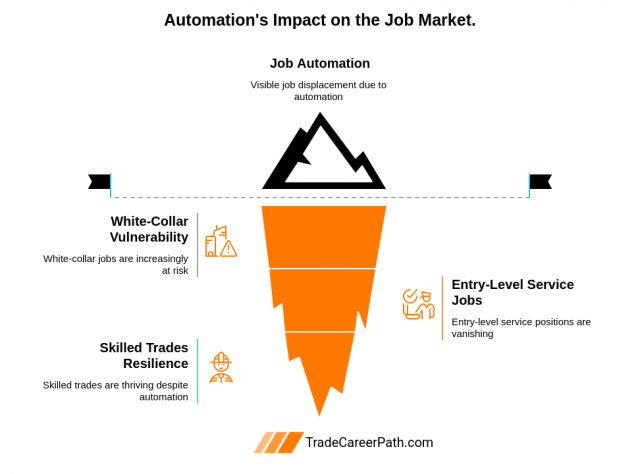
11 Jobs Most at Risk from AI in 2025
These are the roles where automation is already making cuts or changing job descriptions.
1. Data Entry Specialists
AI tools can scan, extract, and upload information faster and more accurately than people.
Next step: Learn basic database management or data analysis to move into higher-value work.
2. Customer Service Representatives
Chatbots and virtual agents now handle routine questions, returns, and account issues 24/7.
Next step: Upskill in sales, account management, or customer success roles that require human relationships.
3. Bookkeepers & Accounting Clerks
Automated accounting systems can reconcile accounts and prepare reports in seconds.
Next step: Train in financial analysis or advisory services that require interpretation, not just data entry.
4. Manufacturing Workers
Robotics and AI scheduling systems reduce the need for manual labor on production lines.
Next step: Learn equipment maintenance or programming to work alongside automation.
5. Translators & Proofreaders
Machine translation and grammar tools handle straightforward content instantly.
Next step: Specialize in creative translation, localization, or legal/medical language where accuracy and nuance matter.
6. Market Research Analysts & Insurance Underwriters
AI can scan millions of data points and build risk models without human intervention.
Next step: Focus on strategic analysis and human insight, things AI can’t generate without context.
7. Bank Tellers
Mobile banking and AI-powered kiosks are reducing in-branch visits.
Next step: Transition into financial advising or customer relationship roles.
8. Medical Image Analysts & Legal Document Reviewers
AI identifies irregularities in scans and flags key legal clauses faster than humans.
Next step: Shift toward oversight, consulting, or specialized case review that requires expertise.
9. Clerks, Telemarketers, Receptionists, and Cashiers
Customer self-service systems and automated calling have cut these roles sharply.
Next step: Learn POS technology, CRM systems, or in-person sales skills.
10. Office & Administrative Support Workers
Routine scheduling, filing, and data prep are now AI-friendly tasks.
Next step: Move toward project coordination or operations management.
11. Entry-Level White-Collar Roles
AI can now draft reports, process claims, and create presentations, jobs once given to interns and assistants.
Next step: Build skills in strategy, creative problem-solving, or industry-specific expertise.
15+ Careers Safer From AI in 2025
Jobs that rely on hands-on skill, emotional intelligence, creativity, and trust remain more resistant to automation.
Healthcare and Personal Care
- Nurse Practitioners
- Nursing Assistants
- Phlebotomists
- Therapists and Counselors
Why safe? These jobs require empathy, physical presence, and complex judgment in real-time.
Skilled Trades and Hands-On Work
- Electricians
- Plumbers
- Carpenters
- Hazardous Materials Removal Workers
- Hospitality Staff
Why safe? They demand physical skill, problem-solving on the spot, and adaptability.
Creative and Education Roles
- Teachers and School Administrators
- Musicians, Artists, and Writers
- Journalists
- Coaches and Personal Trainers
Why safe? Original ideas, cultural understanding, and personal mentorship can’t be replicated by AI.
How to Spot a Safe Job
✅ Requires physical presence or manual skill
✅ Needs high emotional intelligence
✅ Involves creative problem-solving
✅ Relies on trust, relationships, or cultural understanding
✅ Work environment changes often, not fully predictable
✅ Combines tech tools with human oversight
At-Risk vs. Safe Jobs (With Next Steps)
| At-Risk Roles | Safer Roles | Next Step for Transition |
|---|---|---|
| Data entry, bookkeeping, customer service | Nurses, therapists, healthcare staff | Learn database, CRM, or patient support tech |
| Manufacturing, clerical work | Electricians, plumbers, carpenters | Train in automation maintenance or control systems |
| Translators, proofreaders, underwriters | Teachers, artists, coaches | Specialize in creative or regulated fields |
| Bank tellers, telemarketers | Hospitality and skilled trades | Upskill in sales or guest experience |
| Entry-level office roles | Jobs requiring empathy & creativity | Build industry expertise and leadership skills |
How to Future-Proof Your Career
1. Learn Skills AI Can’t Easily Copy
Focus on leadership, creative thinking, and problem-solving.
2. Use AI as a Tool
Integrate AI into your work to speed up repetitive tasks and free yourself for higher-value work.
3. Keep Learning
Enroll in short courses, apprenticeships, or certifications that boost your adaptability.
4. Blend Tech and Human Skills
Hybrid roles, like healthcare tech specialists or AI-assisted trades, will be in demand.
FAQs About AI and Jobs
Will AI take all jobs?
No. It will replace some tasks entirely, change others, and create new opportunities, just like past technology shifts.
Which jobs are impossible for AI to replace?
Jobs relying on empathy, physical dexterity, human judgment, or deep cultural understanding remain the hardest for AI to do well.
How can I use AI to help my career?
Learn how AI tools work in your industry. Use them to handle repetitive work so you can focus on strategy, creativity, and relationship-building.
Bottom Line
AI is a powerful tool, not an unstoppable job destroyer. The workers who adapt early, build human-centered skills, and learn to collaborate with AI will be in the best position to succeed in the years ahead.
About this guide: Researched and written by the TradeCareerPath Editorial Team. Our editorial team researches and sources every trade school and career guide using federal labor and education data, including BLS OEWS and Employment Projections, DOL apprenticeship records, IPEDS, College Scorecard, and state licensing boards. We follow the editorial standards documented at /editorial-policy/.