
Highest Paying Trades 2026: 13 Skilled Careers Without a Degree
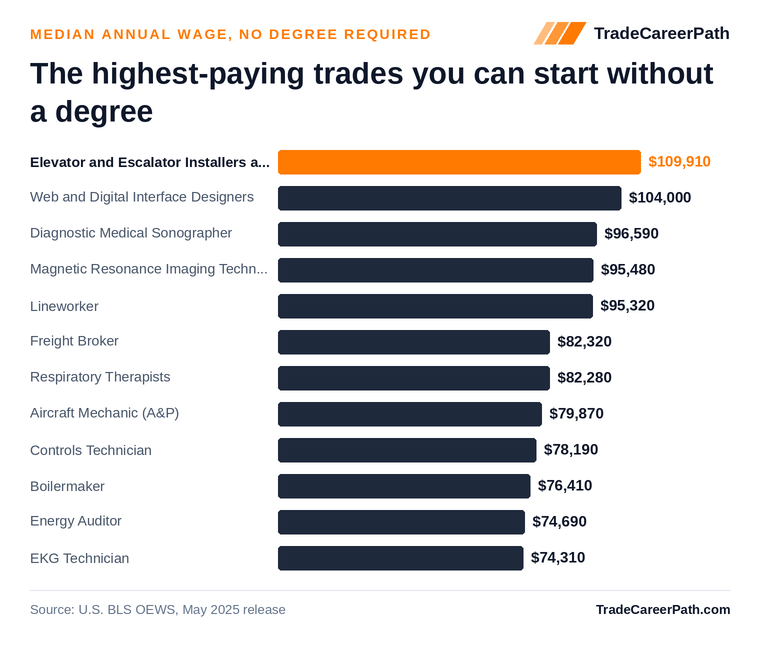
Quick answer: The highest paying skilled trade without a four year degree is elevator and escalator installer and repairer, with a median wage of $109,910 (BLS, May 2025). Diagnostic medical sonographers come next at $96,590, followed by electrical power-line installers (lineworkers) at $95,320. All three pay well above the typical trade and need no bachelor’s degree.
For the copy-ready national figures, including wage premiums vs all occupations, see skilled trade salary statistics 2026. Occupation cuts: electrician salary statistics 2026 and HVAC technician salary statistics 2026.
The data below ranks 13 of the highest paying skilled trades that, in most cases, do not require a four year bachelor’s degree. Wage and outlook figures come from the Bureau of Labor Statistics Occupational Employment and Wage Statistics (May 2025) and the Employment Projections program (2024 to 2034).
How we ranked the trades
Trades on this list were selected from BLS detailed occupations in three families: construction and extraction (47-XXXX), installation, maintenance, and repair (49-XXXX), and healthcare technologists (29-2XXX). To qualify, an occupation needed:
- A May 2025 median annual wage of at least $50,000 (BLS OEWS).
- A typical entry path that does not require a bachelor’s degree (per BLS Occupational Outlook Handbook).
- A real career pathway through trade school, apprenticeship, or technical training in the U.S.
Pay can vary widely by state, metro area, employer, and experience. The figures below are national medians.
Ranked: 13 highest paying skilled trades for 2026
1. Elevator and Escalator Installers and Repairers
- Median annual wage: $109,910 (BLS, May 2025)
- 90th percentile: $158,890 (BLS, May 2025)
- Projected growth 2024 to 2034: 5.0% (BLS)
- Annual openings: about 2,000 per year (BLS)
- Training: typically a 4 year apprenticeship sponsored by the National Elevator Industry Educational Program (NEIEP) or Elevator Industry Work Preservation Fund.
Elevator mechanics earn the highest median wage of any major skilled trade tracked by BLS. The work combines mechanical, electrical, and electronic systems, and most states require a license.
2. Diagnostic Medical Sonographers
- Median annual wage: $96,590 (BLS, May 2025)
- 90th percentile: $129,370 (BLS, May 2025)
- Projected growth 2024 to 2034: 13.0% (BLS), much faster than average
- Annual openings: about 5,800 per year (BLS)
- Training: typically a 2 year associate degree from a CAAHEP accredited program, plus ARDMS or ARRT certification.
- Learn more: /trades/sonography-ultrasound/
Sonographers use ultrasound imaging to help diagnose medical conditions. The role pairs strong pay with one of the fastest growth rates in healthcare.
3. Electrical Power-Line Installers and Repairers (Lineworkers)
- Median annual wage: $95,320 (BLS, May 2025)
- 90th percentile: $128,690 (BLS, May 2025)
- Projected growth 2024 to 2034: 6.6% (BLS)
- Annual openings: about 10,700 per year (BLS)
- Training: typically a 3 to 4 year apprenticeship through a utility, IBEW, or NRECA-affiliated program after a short line school.
- Learn more: /trades/lineworker/
Lineworkers (also called linemen) install and repair the high voltage transmission and distribution lines that power the grid. Storm work and overtime can push earnings well above the median.
4. Radiologic Technologists and Technicians
- Median annual wage: $80,110 (BLS, May 2025)
- 90th percentile: $118,660 (BLS, May 2025)
- Projected growth 2024 to 2034: 4.3% (BLS)
- Annual openings: about 12,900 per year (BLS)
- Training: typically a 2 year associate degree from a JRCERT accredited program plus ARRT certification and state licensure.
- Learn more: /trades/radiology-technician/
Often called “rad techs” or X-ray technologists, these specialists perform imaging studies that physicians use to diagnose injury and disease.
5. Aircraft Mechanics and Service Technicians
- Median annual wage: $79,870 (BLS, May 2025)
- 90th percentile: $128,890 (BLS, May 2025)
- Projected growth 2024 to 2034: 4.0% (BLS)
- Annual openings: about 11,300 per year (BLS)
- Training: typically an 18 to 24 month FAA approved Part 147 program leading to the Airframe and Powerplant (A&P) certificate.
Aircraft mechanics inspect and repair commercial, cargo, and general aviation aircraft. The FAA A&P certificate is the standard credential.
6. Surgical Technologists
- Median annual wage: $64,650 (BLS, May 2025)
- 90th percentile: $96,940 (BLS, May 2025)
- Projected growth 2024 to 2034: 4.5% (BLS)
- Annual openings: about 7,000 per year (BLS)
- Training: typically a 1 to 2 year diploma or associate degree, plus the CST credential from NBSTSA.
- Learn more: /trades/surgical-tech/
Surgical technologists prepare operating rooms, sterilize instruments, and assist surgeons during procedures. CAAHEP accreditation matters for CST eligibility.
7. Plumbers, Pipefitters, and Steamfitters
- Median annual wage: $63,800 (BLS, May 2025)
- 90th percentile: $108,420 (BLS, May 2025)
- Projected growth 2024 to 2034: 4.5% (BLS)
- Annual openings: about 44,000 per year (BLS)
- Training: typically a 4 to 5 year apprenticeship registered with the U.S. Department of Labor or a UA local.
- Learn more: /trades/plumber/
Plumbing licensure is regulated state by state. Pipefitters and steamfitters often work in industrial and power plant settings at the upper end of the wage range.
8. Electricians
- Median annual wage: $63,190 (BLS, May 2025)
- 90th percentile: $108,510 (BLS, May 2025)
- Projected growth 2024 to 2034: 9.5% (BLS), faster than average
- Annual openings: about 81,000 per year (BLS)
- Training: typically a 4 to 5 year registered apprenticeship through IBEW/NECA or an independent (IEC, ABC) program.
- Learn more: /trades/electrician/
Electricians have one of the strongest growth outlooks among the major construction trades, fueled by data center and clean energy demand.
9. Heating, Air Conditioning, and Refrigeration Mechanics and Installers (HVAC)
- Median annual wage: $61,010 (BLS, May 2025)
- 90th percentile: $95,210 (BLS, May 2025)
- Projected growth 2024 to 2034: 8.1% (BLS), faster than average
- Annual openings: about 40,100 per year (BLS)
- Training: typically a 6 to 24 month trade school program or a 3 to 5 year apprenticeship, plus EPA Section 608 certification.
- Learn more: /trades/hvac/
HVAC technicians install and service heating and cooling systems. EPA 608 is required to handle refrigerants.
10. Carpenters
- Median annual wage: $60,580 (BLS, May 2025)
- 90th percentile: $99,910 (BLS, May 2025)
- Projected growth 2024 to 2034: 4.5% (BLS)
- Annual openings: about 74,100 per year (BLS)
- Training: typically a 3 to 4 year apprenticeship or a 6 to 12 month trade school program plus on the job experience.
- Learn more: /trades/carpenter/
Carpenters frame, finish, and remodel structures. Specializing in commercial framing, finish carpentry, or millwork can lift pay above the median.
11. Operating Engineers and Other Construction Equipment Operators
- Median annual wage: $59,850 (BLS, May 2025)
- 90th percentile: $101,090 (BLS, May 2025)
- Projected growth 2024 to 2034: 3.6% (BLS)
- Annual openings: about 41,900 per year (BLS)
- Training: typically a 3 to 4 year operating engineers apprenticeship (IUOE) or a 3 to 12 month heavy equipment school, plus NCCCO crane certifications when applicable.
- Learn more: /trades/heavy-equipment-operator/
Heavy equipment operators run excavators, dozers, loaders, graders, and cranes on infrastructure and commercial sites.
12. Heavy and Tractor-Trailer Truck Drivers
- Median annual wage: $58,640 (BLS, May 2025)
- 90th percentile: $79,380 (BLS, May 2025)
- Projected growth 2024 to 2034: 4.0% (BLS)
- Annual openings: about 237,600 per year (BLS)
- Training: typically 3 to 7 weeks of FMCSA registered Entry Level Driver Training, plus a Class A CDL.
- Learn more: /trades/truck-driver/
Class A CDL drivers move freight cross country. Specialty endorsements (HazMat, tanker, doubles/triples) and OTR routes raise earning potential.
13. Welders, Cutters, Solderers, and Brazers
- Median annual wage: $53,750 (BLS, May 2025)
- 90th percentile: $77,530 (BLS, May 2025)
- Projected growth 2024 to 2034: 2.2% (BLS)
- Annual openings: about 45,600 per year (BLS)
- Training: typically a 6 to 18 month trade school program, plus AWS certifications such as Certified Welder.
Pipe welders, underwater welders, and rig welders earn well above the median; structural and production welding sit at or near the median.
How to choose between high paying trades
When comparing the trades above, weigh these data points together rather than picking on wage alone:
- Median wage versus 90th percentile. A higher 90th percentile (carpenter $99,910, plumber $108,420, electrician $108,510) tells you how far experienced workers can climb.
- Projected growth. Trades growing faster than 5% (sonographer 13.0%, electrician 9.5%, HVAC 8.1%, lineworker 6.6%) tend to have stronger long term demand.
- Annual openings. Even slower growing trades like truck driving (about 237,600 per year) and welding (about 45,600 per year) can offer many entry points.
- Training time and credential. Apprenticeships pay while you learn. Healthcare tech roles usually require a degree from an accredited (CAAHEP, JRCERT) program plus a national certification.
- Licensing. Electricians, plumbers, HVAC technicians, and elevator mechanics face state licensure rules. Healthcare tech roles depend on national certification through bodies like ARRT or ARDMS.
Sources
- U.S. Bureau of Labor Statistics, Occupational Employment and Wage Statistics, May 2025 (bls.gov/oes).
- U.S. Bureau of Labor Statistics, Employment Projections program, 2024 to 2034 (bls.gov/emp).
- U.S. Bureau of Labor Statistics, Occupational Outlook Handbook, accessed 2026 (bls.gov/ooh).
About this guide: Researched and written by the TradeCareerPath Editorial Team. Our editorial team researches and sources every trade school and career guide using federal labor and education data, including BLS OEWS and Employment Projections, DOL apprenticeship records, IPEDS, College Scorecard, and state licensing boards. We follow the editorial standards documented at /editorial-policy/.