
The Most At-Risk Jobs - And Why Skilled Trades Are Cementing Their Future
Quick answer: Routine office and entry-level service jobs face the highest risk from AI and automation, while hands-on skilled trades stay in demand because they cannot be done from a keyboard. If you want work that cannot be done from a keyboard, plumbers and pipefitters earn a median of $63,800 a year, electricians $63,190, and HVAC technicians $61,010 (BLS, May 2025), all with tens of thousands of yearly openings.
McKinsey estimates that by 2030, up to 30% of U.S. work hours could be automated, accelerating a shift we are already witnessing1.
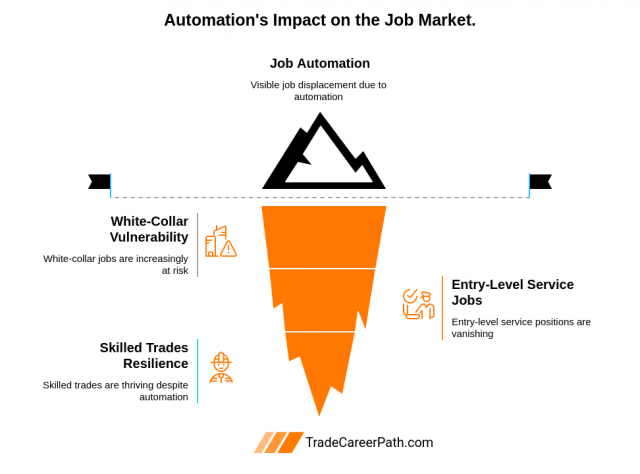
White-collar roles? Vulnerable. Entry-level service jobs? Disappearing.
But skilled trades? They are not just surviving, they are thriving.
The Fast-Food Example: Automation in Action
Imagine this:
- You order via a tablet or app (no cashier).
- Robotic arms cook your meal (Cali Group’s “Flippy” already flips burgers at White Castle2).
- A Tesla Optimus robot packs your order.
- A Tesla robotaxi delivers it to your doorstep.
Result? One $15/hour fast-food job vanishes every 30 minutes robots operate3.
McDonald’s now deploys kiosks in 100% of new U.S. stores4.
White-Collar Workers: The AI Squeeze is Real
If your job involves routine data analysis, writing, or process-driven tasks, AI is coming for it.
- AI-generated reports can slash a 4-hour task to 4 minutes (ChatGPT processes ~10M queries daily5).
- Marketing teams are now 60% smaller but 200% more productive with AI tools6.
- IBM paused hiring for 7,800 roles in 2023, openly citing AI replacement7.
The World Economic Forum warns 85 million jobs globally may be displaced by machines by 20258.
The Blue-Collar Lifeline: Why Trades Are Automation-Proof
Trades face a labor shortage - not a robot takeover:
- Job sites are unpredictable. Will an HVAC unit fit? Is that pipe corroded? Bots can’t improvise like humans.
- The U.S. needs 1 million new electricians by 2030 to meet EV and green-energy projects9.
- Trade wages are rising. Median pay for plumbers and pipefitters is $63,800 a year (BLS, May 2025), and electricians earn a median of $63,190 (BLS, May 2025)10.
Job Risk vs. Job Security
| Job Type | Automation Risk (2030) | Demand Trend | Example Roles |
|---|---|---|---|
| Data Entry Clerk | Very High (80%+) | Declining | Billing clerk, admin assistant |
| Marketing Coordinator | High (60%+) | Declining | Junior marketer, content coord |
| Electrician | Low (10-15%) | Increasing | Residential, commercial, plant |
| HVAC Technician | Low (15%) | Increasing | Install, repair, energy retro |
The 2-5 Year Outlook
By 2027:
- Entry-level office roles shrink ~40%11
- AI prompt engineers earn $175K-$300K/year12
- Skilled trade shortages worsen - construction alone needs ~546,000 workers now13
By 2030:
- Automation covers ~50% of current tasks14
- “AI-enhanced tradespeople” dominate - think electricians using AR glasses for diagnostics
- Trade school enrollment triples15
Hybrid Trades: Where Tech Meets Tools
Some of the fastest-growing roles will combine physical skills with advanced tech:
- Electricians using AR for complex wiring
- HVAC techs with AI-driven predictive maintenance
- Plumbers using IoT leak-detection tools
These jobs will be even harder to automate - and often pay more.
Real-World Career Pivot
In 2024, Sarah was a marketing assistant. AI cut her team from six to two. She enrolled in an HVAC certification program and landed a job before graduating - doubling her old salary and gaining long-term security.
Trade Career ROI: College vs. Trades
| Path | Time to Job | Avg Cost (Public) | Private Trade School Cost (2025 est.) | Median Salary (BLS, May 2025) |
|---|---|---|---|---|
| Electrician Trade School | 6-12 months | $7K-$15K (Midwest Technical Institute) | $13K-$17K+ (Indeed, SoFi) | $63,190 |
| Bachelor’s Degree | 4 years | $85K+ (Federal Reserve) | - | Varies by field |
Notes:
- Public/community trade programs: $7K-$15K total tuition and fees.
- Private trade schools: $13K-$17K+ for many programs, with some reaching $20K+ per year depending on the field and institution (SoFi, Indeed, College Raptor).
Your Move: Pivot Before the Cliff Edge
If your job feels automatable - spreadsheets, customer service scripts, templated designs - start skilling up.
Why trades?
- $0 college debt vs. $85K average student loans16
- Earn while you learn through apprenticeships
- ~750,000 construction openings stay unfilled each month17
Not sure where to start? Trade schools can get you started with hands-on training that prepares you for in-demand careers; outcomes vary by location and job market.
Don’t race against machines - build them, fix them, or outsmart them.
References
About this guide: Researched and written by the TradeCareerPath Editorial Team. Our editorial team researches and sources every trade school and career guide using federal labor and education data, including BLS OEWS and Employment Projections, DOL apprenticeship records, IPEDS, College Scorecard, and state licensing boards. We follow the editorial standards documented at /editorial-policy/.
References
McKinsey - Generative AI and the future of work in America (2023) ↩︎
Restaurant Dive - White Castle brings cooking robot to 100 more restaurants (2023) ↩︎
OpenAI Community Forum - ChatGPT usage stats (~100M users/month) ↩︎
Reuters - IBM to pause hiring to replace 7,800 jobs with AI (2023) ↩︎
Forrester - Predictions 2025: GenAI, Citizen Developers, And Caution Influence Automation (Oct 23, 2024) ↩︎
TechCrunch - AI may already be shrinking entry-level jobs in tech (May 2025) ↩︎
McKinsey - Modeling automation adoption through 2030 (2024) ↩︎
NSC Research Center - Current Enrollment Estimates, Spring 2025 ↩︎
Federal Reserve - Report on the Economic Well-Being of U.S. Households in 2024 (Student Loans) ↩︎
U.S. Chamber - States suffering most from labor shortage (2025) ↩︎