
Should You Choose Trade School or Apprenticeship?
Quick answer: If you can cover tuition and want to start working in 1 to 2 years, trade school is the faster path. If you would rather earn a wage from day one and do not mind a 3 to 5 year commitment, an apprenticeship is the stronger choice. Either way, pay ends up tied to your trade and location, not which route you took.
If you’re serious about joining the skilled trades, whether it’s electrical, HVAC, plumbing, or welding, you’ll eventually face a big decision:
Should you go to trade school or start an apprenticeship?
Both are proven paths to high-paying, in-demand careers. But the right choice depends on your learning style, budget, timeline, and career goals. This guide breaks it down side by side so you can move forward with confidence.
Quick Comparison: Trade School vs. Apprenticeship
| Factor | Trade School | Apprenticeship |
|---|---|---|
| Duration | 6 to 24 months | 3 to 5 years (on the job) |
| Cost | $5,000 to $30,000+ tuition | Free or paid (earn while you learn) |
| Paid During Training | No (you pay tuition) | Yes (hourly wage) |
| Class Format | Structured classroom and lab | Real-world work plus supplemental classes |
| Credential Earned | Certificate, diploma, license | Journeyman card, license |
| Best For | Fast learners, schedule flexibility | Hands-on learners, long-term earners |
“Both apprenticeships and technical schools are valuable tools in meeting the country’s demand for skilled labor. The best choice depends on the individual.”
- U.S. Department of Labor
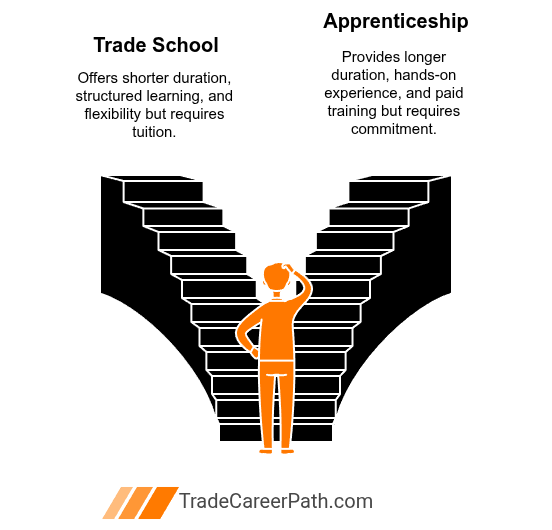
Trade School: Accelerated Your Way Into the Trades
Trade schools, also called vocational or technical colleges, offer formal programs that usually last 6 to 24 months. You get structured classroom learning, hands-on lab training, and an industry-aligned curriculum focused on job readiness.
Pros
- Faster completion. Enter the workforce in 1 to 2 years.
- Predictable schedule. Ideal if you’re juggling work or family.
- Support built in. Access to instructors and career placement help.
Cons
- You pay tuition, which varies widely by school, program and format.
- No income while in school.
- Not always enough for licensing. Some states still require work hours.
“Trade schools are ideal for those who want structured learning and fast entry into the workforce.” - U.S. Department of Education
Apprenticeships: Earn While You Learn
Apprenticeships combine paid, on-the-job training with related classroom instruction, usually through a union, employer, or state-registered program. You work under a licensed professional while learning the trade from the ground up.
Pros
- You get paid from day one, starting around $15 to $25 per hour.
- Hands-on, real-world experience.
- Low or no tuition costs.
- Path to journeyman status and long-term career placement.
Cons
- Takes 3 to 5 years to complete.
- Schedules can be rigid and physically demanding.
- Competitive entry in some regions and trades.
“Registered apprenticeships are one of the most reliable pathways to stable, high-wage careers in the trades.” - U.S. DOL Apprenticeship Office
How to Decide: Trade School or Apprenticeship?
Here’s how to choose the right path for you:
| Consideration | Trade School | Apprenticeship |
|---|---|---|
| Need to work while training? | No | Yes (earn while you train) |
| Want to graduate quickly? | Yes (6 to 24 months) | No (3 to 5 years) |
| Prefer hands-on over classroom? | More classroom-based | Yes (mostly hands-on) |
| Can afford tuition or get aid? | Yes (eligible for financial aid) | Yes (often free or paid) |
| Want direct entry into a union? | May require a job hunt | Often includes union placement |
What Real People Are Saying
“Trade school got me licensed and on the job in 14 months. I’m now an HVAC tech making good money, and it was worth the tuition.”
- Marcus D., HVAC Technician (Florida)
“I went the apprenticeship route. Started at $18 an hour, finished in four years, and now I’m a journeyman with full benefits.”
- Natalie P., Electrician (Texas)
For context, HVAC technicians earn a median of $61,010 per year and electricians earn a median of $63,190 per year (BLS, May 2025). Top earners can reach roughly $95,000 in HVAC and over $108,000 in electrical work.
Still Not Sure?
You don’t have to choose right now, but you do need to get moving. If you’re still unsure, consider:
- Reaching out to a union rep or workforce board in your state.
- Reading our state-specific guides to understand licensing timelines and costs.
Bottom Line
There’s no wrong path, only the one that fits your life.
If you want to start sooner, trade school is the shorter route in. If you’d rather earn while you learn, an apprenticeship offers long-term stability with real pay from day one.
Both paths can lead to strong, long-term careers with steady demand. Outcomes vary by trade and location.
Next Steps:
About this guide: Researched and written by the TradeCareerPath Editorial Team. Our editorial team researches and sources every trade school and career guide using federal labor and education data, including BLS OEWS and Employment Projections, DOL apprenticeship records, IPEDS, College Scorecard, and state licensing boards. We follow the editorial standards documented at /editorial-policy/.