
Trade Careers in Idaho
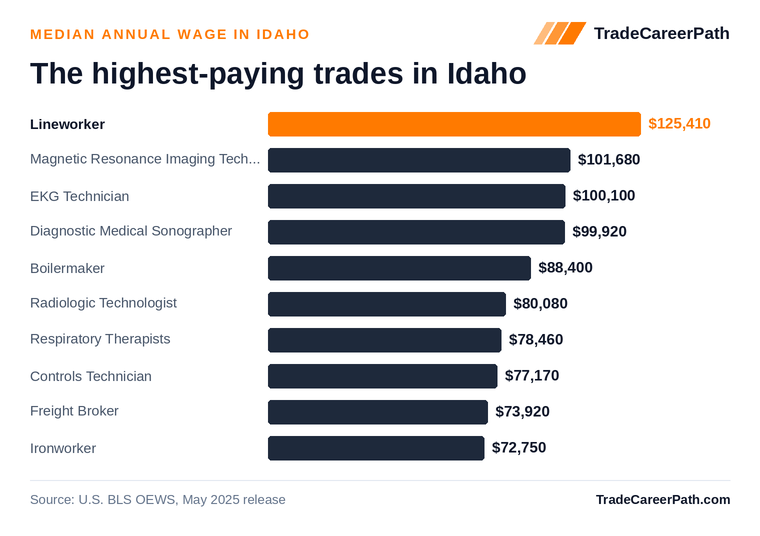
Quick answer: In Idaho, power line workers earn a median of $125,410 and electricians $63,000 (BLS, May 2025), making them among the highest-paying trades in the state. Most trades are entered through an apprenticeship or a trade-school program, with no four-year degree required. Licensing is handled by the state agencies listed below, such as the Idaho Division of Building Safety.
Idaho’s skilled trades support critical sectors like agriculture, energy, construction, and manufacturing. From Boise and Coeur d’Alene to Idaho Falls and Twin Falls, trade workers are in high demand to help fuel the state’s rapid growth.
Whether you’re entering the workforce for the first time or starting over, Idaho offers strong opportunities to build a career in the trades.
Why Trade Careers Are Growing in Idaho
| Benefit | Details |
|---|---|
| Construction Boom | Population growth is driving residential and commercial development |
| Energy & Agriculture | Power systems and irrigation projects create skilled labor demand |
| Low Cost of Training | State-supported colleges and training centers keep costs accessible |
| Strong Rural Need | Shortage of tradespeople in non-urban regions across the state |
“Skilled trades are essential to Idaho’s infrastructure and economic resilience.” - Idaho Department of Labor1
Compare Skilled Trades in Idaho
| Trade | Median Salary | Training Time | License Required? |
|---|---|---|---|
| Carpenter | $52,000 | 6 months - 4 years (trade school or apprenticeship) | Optional (apprenticeship recommended) |
| Construction Worker | $46,940 | 3-12 months (apprenticeship or on-the-job) | Varies (OSHA 10/30; state contractor license for supervisors) |
| Flooring Installer | N/A | 6-12 months (on-the-job + coursework) | Optional (apprenticeship recommended) |
| Plumber | $52,380 | 4-5 years (apprenticeship) | Yes (state licensing) |
| Welder | $50,530 | 6-18 months (trade school or apprenticeship) | Optional (AWS certification preferred) |
| Construction Manager | $104,600 | 2-4 years (degree or field experience) | Varies (contractor license in many states) |
| Home Inspector | $63,570 | 2-6 months (state-approved course) | Yes in many states (state license) |
| Mold Inspector | N/A | 3-12 months (coursework + field hours) | Varies (state license or industry certification) |
| Electrician | $63,000 | 4-5 years (apprenticeship) | Yes (state licensing) |
| HVAC Technician | $56,240 | 6 months - 2 years (certificate or associate) | Yes (EPA 608 and state licensing) |
| Lineworker | $125,410 | 3-4 years (joint apprenticeship) | Yes (apprenticeship + utility certifications) |
| Solar Installer | N/A | 3-12 months (bootcamp or apprenticeship) | Optional (NABCEP certification beneficial) |
| Tower Technician | $107,250 | 3-9 months (tower climbing school + field training) | Yes (OSHA/NRF safety + CPR certifications) |
| Wind Turbine Technician | $60,810 | 1-2 years (associate or technical diploma) | Yes (industry safety certifications) |
| Aircraft Mechanic (A&P) | $61,250 | 18-30 months (Part 147 school or apprenticeship) | Yes (FAA A&P license) |
| Auto Mechanic | $48,420 | 6-12 months (trade school or apprenticeship) | Optional (ASE certifications preferred) |
| Automotive Technician | $48,420 | 9-18 months (advanced diploma or apprenticeship) | Optional (ASE certifications preferred) |
| CNC Machinist | $58,810 | 9-24 months (certificate or apprenticeship) | Optional (NIMS certification beneficial) |
| Diesel Technician | $59,230 | 1-2 years (associate or apprenticeship) | Optional (ASE or OEM certifications) |
| Gunsmith | N/A | 6-18 months (certificate or apprenticeship) | Optional (NRA/NSTC credentials beneficial) |
| Heavy Equipment Operator | $61,680 | 6-12 months (trade school or union program) | Optional (CDL required for many roles) |
| Maintenance Technician | $48,190 | 6-12 months (trade school or on-the-job) | Optional (CMRT or OEM certifications) |
| Truck Driver (CDL) | $58,770 | 3-6 months (CDL program) | Yes (CDL Class A or B) |
| Certified Nursing Assistant (CNA) | $38,650 | 4-12 weeks (state-approved program) | Yes (state CNA exam) |
| Patient Care Technician | $38,650 | 4-12 months (certificate + clinical hours) | Yes (CNA license + PCT certification in many hospitals) |
| Hemodialysis Technician | $47,220 | 4-12 months (certificate + clinical hours) | Yes (state certification or BONENT/CCHT credential) |
| Home Health Aide | $34,790 | 3-6 months (training + competency exam) | Yes in many states (state-approved HHA program) |
| Medical Assistant | $44,700 | 9-12 months (certificate or diploma) | Optional (CMA, RMA, or CCMA) |
| Mental Health Technician | $41,490 | 6-12 months (certificate + clinical experience) | Varies (state registration + employer training) |
| Licensed Practical Nurse (LPN) | $63,800 | 12-18 months (state-approved program) | Yes (state license via NCLEX-PN) |
| Licensed Vocational Nurse (LVN) | $63,800 | 12-18 months (state-approved program) | Yes (state license via NCLEX-PN) |
| Dental Assistant | $45,880 | 9-18 months (diploma or associate program) | Varies (CDA, RDA, or state license) |
| EKG Technician | $100,100 | 3-9 months (certificate program) | Optional (CET, CCT, or AMCA) |
| Pharmacy Technician | $46,420 | 6-12 months (certificate or on-the-job) | Varies (state license or PTCB/ExCPT) |
| Phlebotomy Technician | $43,400 | 4-6 months (certificate + clinical practice) | Yes in many states (national certification preferred) |
| Radiologic Technologist | $80,080 | 2 years (associate degree) | Yes (ARRT registration + state license) |
| Diagnostic Medical Sonographer | $99,920 | 18-24 months (accredited associate or certificate) | Yes (ARDMS/CCI credential; state license in some areas) |
| Sterile Processing Technician | $46,450 | 6-12 months (certificate + clinical hours) | Yes in many states (CRCST or CBSPD certification) |
| Surgical Technologist | $72,550 | 12-24 months (accredited surgical tech program) | Yes in many states (NBSTSA or NCCT certification) |
| Optician | $43,950 | 9-24 months (apprenticeship or associate) | Yes in many states (state license or ABO-NCLE) |
| Medical Billing & Coding Specialist | $53,460 | 9-24 months (certificate or associate) | Optional (CPC, CCA, or CBCS) |
| Medical Office Administrator | $44,920 | 9-18 months (certificate or associate) | Optional (CMAA or CEHRS certification) |
| Occupational Therapy Assistant | $65,330 | 2 years (accredited associate degree) | Yes (state license via NBCOT exam) |
| Physical Therapy Aide | $28,660 | 3-12 months (certificate or employer training) | Optional (on-the-job + certificate programs) |
| Massage Therapist | $60,420 | 9-18 months (state-approved school) | Yes (state license) |
| Personal Trainer | $49,780 | 3-6 months (exam prep + practicum) | Yes (national certification required by many employers) |
| Dog Trainer | $40,770 | 6-12 months (mentorship or certificate) | Optional (industry certifications preferred) |
| Veterinary Assistant | $37,530 | 6-12 months (certificate + hands-on experience) | Optional (AVMA-approved assistant credential) |
| Veterinary Technician | $42,120 | 2 years (associate degree) | Yes (VTNE and state license) |
| Beauty Professional | $35,480 | 9-15 months (state-approved school) | Yes (state cosmetology license) |
| Cosmetologist | $35,480 | 9-18 months (state-approved school) | Yes (state cosmetology license) |
| Esthetician | $34,130 | 4-9 months (state-approved program) | Yes (state esthetics license) |
| Culinary Chef | $36,738 | 1-2 years (culinary school or apprenticeship) | Optional (ServSafe + local food handler permit) |
| Pastry Chef | $36,738 | 9-18 months (baking & pastry diploma or apprenticeship) | Optional (ServSafe; ACF certification boosts prospects) |
| Bookkeeper | $48,310 | 6-12 months (certificate or on-the-job) | Optional (CB or CPB certification beneficial) |
| Digital Court Reporter | $69,330 | 6-12 months (certificate program) | Optional (AAERT certification preferred) |
| Paralegal | $49,690 | 12-24 months (certificate or associate) | Optional (ABA-approved certificate beneficial) |
Source: BLS OEWS, May 2025. State data (Idaho).
Idaho Apprenticeships and Schools
Idaho offers trade-focused education through regional technical colleges, public workforce programs, and union apprenticeships.
| Training Type | Duration | Notes |
|---|---|---|
| Apprenticeship | 3-5 years | Earn while you learn via programs registered with IdahoWorks |
| Technical Colleges | 6-24 months | Programs offered through Idaho’s four technical colleges |
| Community Colleges | 12-24 months | Associate degrees and certifications in skilled trades |
“Apprenticeship is a proven model for training Idaho’s future workforce.” - Idaho Career & Technical Education2
Trade Schools in Idaho
Idaho’s public colleges and private trade schools make hands-on training affordable and accessible in both metro and rural areas.
Why Attend Trade School in Idaho?
| Advantage | What It Means for You |
|---|---|
| Affordable Tuition | Certificate programs at Idaho’s technical colleges run a fraction of 4-year degree cost |
| Rural Workforce Demand | High need in farming, mining, and infrastructure sectors |
| Strong Job Outcomes | Programs are designed with local employer input; results vary by location and job market |
| Multiple Pathways | Apprenticeship, school, and work-based learning options |
| Funding Options | Ask schools about available payment options |
Explore Accredited Schools
Degree Programs in Idaho
Trade school is not the only route. These are the four-year and graduate degrees on this site, with Idaho pay, employment and school listings for each. They sit above the trades on this page rather than alongside them.
Construction and the built environment
- Construction Supervision Degree in Idaho
- Online Construction Management Degrees in Idaho
- Online Civil Engineering Degree in Idaho
- Online Architecture Degree in Idaho
Manufacturing, maintenance and energy
- Production Supervision Degree in Idaho
- Maintenance Supervision Degree in Idaho
- Online Mechanical Engineering Degree in Idaho
- Online Electrical Engineering Degree in Idaho
- Online Industrial Engineering Degree in Idaho
Health care
- Online Nursing Degrees in Idaho
- Physician Assistant Programs in Idaho
- Online Radiologic Technology Degree in Idaho
- Online Health Sciences Degree in Idaho
- Online Healthcare Administration Degrees in Idaho
Business, technology and public service
All degree programs - the full index
Idaho Licensing Agencies
| Trade | Licensing Agency |
|---|---|
| Electrician | Idaho Division of Building Safety - Electrical Bureau |
| Plumber | Idaho Division of Building Safety - Plumbing Bureau |
| HVAC Technician | HVAC contractors must register with the state; licenses required for gas piping |
| Solar Installer | Electrical license required for system integration |
| Mold Inspector | No state license; ACAC or NORMI certification recommended |
Idaho Trade Career Outlook
Building & Construction Trades
| Trade | Job Growth (2024-2034, US) |
|---|---|
| Flooring Installer | 9.5% |
| Plumber | 4.5% |
| Carpenter | 4.5% |
| Welder | 2.2% |
| Construction Worker | 7.3% |
Construction Management & Inspection
| Trade | Job Growth (2024-2034, US) |
|---|---|
| Construction Manager | 8.7% |
| Home Inspector | -0.8% |
Electrical & Energy Systems
| Trade | Job Growth (2024-2034, US) |
|---|---|
| Lineworker | 6.6% |
| Tower Technician | 8.6% |
| Electrician | 9.5% |
| Wind Turbine Technician | 49.9% |
| HVAC Technician | 8.1% |
| Solar Installer | 42.1% |
Mechanical, Automotive & Transportation
| Trade | Job Growth (2024-2034, US) |
|---|---|
| Gunsmith | 2.0% |
| Heavy Equipment Operator | 3.6% |
| Aircraft Mechanic (A&P) | 4.0% |
| Diesel Technician | 2.4% |
| CNC Machinist | 0.0% |
| Truck Driver (CDL) | 4.0% |
| Auto Mechanic | 4.2% |
| Automotive Technician | 4.2% |
| Maintenance Technician | 3.8% |
Healthcare: Nursing & Patient Care
| Trade | Job Growth (2024-2034, US) |
|---|---|
| Licensed Practical Nurse (LPN) | 2.6% |
| Licensed Vocational Nurse (LVN) | 2.6% |
| Hemodialysis Technician | 5.2% |
| Medical Assistant | 12.5% |
| Mental Health Technician | 20.0% |
| Certified Nursing Assistant (CNA) | 2.3% |
| Patient Care Technician | 2.3% |
| Home Health Aide | 17.0% |
Healthcare: Allied Health & Diagnostics
| Trade | Job Growth (2024-2034, US) |
|---|---|
| EKG Technician | 3.0% |
| Diagnostic Medical Sonographer | 13.0% |
| Radiologic Technologist | 4.3% |
| Surgical Technologist | 4.5% |
| Sterile Processing Technician | 10.0% |
| Pharmacy Technician | 6.4% |
| Dental Assistant | 6.4% |
| Optician | 2.9% |
| Phlebotomy Technician | 5.6% |
Healthcare: Administration & Office Support
| Trade | Job Growth (2024-2034, US) |
|---|---|
| Medical Billing & Coding Specialist | 7.1% |
| Medical Office Administrator | 4.2% |
Therapy, Rehab & Fitness
| Trade | Job Growth (2024-2034, US) |
|---|---|
| Occupational Therapy Assistant | 19.2% |
| Massage Therapist | 15.4% |
| Personal Trainer | 11.9% |
| Physical Therapy Aide | 2.8% |
Animal Care & Training
| Trade | Job Growth (2024-2034, US) |
|---|---|
| Veterinary Technician | 9.1% |
| Dog Trainer | 5.1% |
| Veterinary Assistant | 8.7% |
Beauty & Personal Care
| Trade | Job Growth (2024-2034, US) |
|---|---|
| Beauty Professional | 5.6% |
| Cosmetologist | 5.6% |
| Esthetician | 6.7% |
Culinary & Hospitality Careers
| Trade | Job Growth (2024-2034, US) |
|---|---|
| Culinary Chef | 7.1% |
| Pastry Chef | 7.1% |
Business & Legal Support
| Trade | Job Growth (2024-2034, US) |
|---|---|
| Digital Court Reporter | -0.3% |
| Paralegal | 0.2% |
| Bookkeeper | -5.8% |
Job growth uses state projections when available and national projections (BLS Employment Projections, 2024-2034) when state data is unavailable. Median pay for each trade is shown in the comparison table above.
Source: U.S. Bureau of Labor Statistics Employment Projections (2024-2034). Projected U.S. change shown for each trade.
Ready to Start a Trade Career in Idaho?
With low-cost training, job-ready programs, and strong rural demand, Idaho is a smart place to start a career in the trades. Whether you’re looking to work with your hands, power new energy systems, or build the state’s future infrastructure, Idaho needs you.
Citations
About this guide: Researched and written by the TradeCareerPath Editorial Team. Our editorial team researches and sources every trade school and career guide using federal labor and education data, including BLS OEWS and Employment Projections, DOL apprenticeship records, IPEDS, College Scorecard, and state licensing boards. We follow the editorial standards documented at /editorial-policy/.
References
Idaho Department of Labor - https://www.labor.idaho.gov ↩︎
Idaho Division of Career & Technical Education - https://cte.idaho.gov/ ↩︎