
Best Plumbing Schools in Alaska (2026)
Compare accredited Plumber schools across Alaska below, then review pay, licensing steps, and training paths for the trade.
Sponsored - request program info.
Best Plumber Schools in Alaska
No schools in our database. If this is a mistake, contact us.
Plumber Pay and Job Outlook
Alaska Quick Facts
| Metric | Value | Source |
|---|---|---|
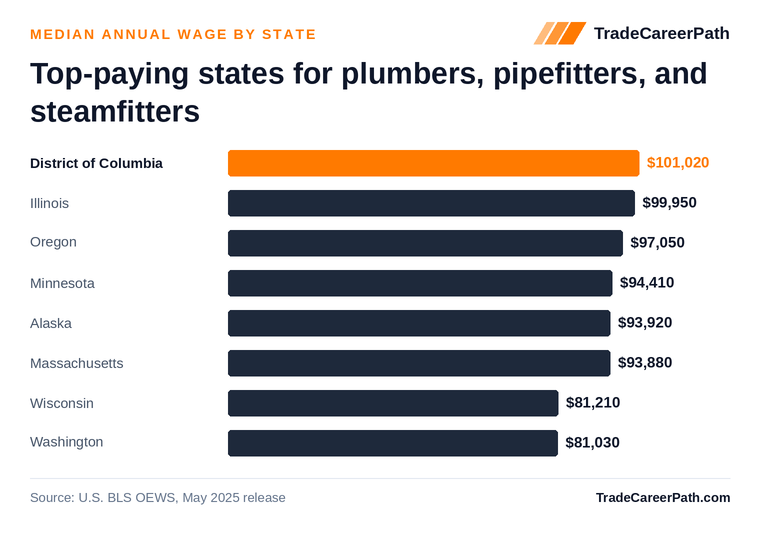
| State median annual wage | $93,920 | BLS OEWS, May 2025 |
| State employment | 1,200 workers | BLS OEWS, May 2025 |
| State location quotient | 1.23 | BLS OEWS, May 2025 |
| State unemployment rate | 6.8% | BLS LAUS (2024) |
| Federal Davis-Bacon prevailing wage | $69.12/hr ($41.5 base + $27.62 fringe) | DOL Wage and Hour Division, 2026 |
Steps to Become a Plumber in Alaska
- Choose an accredited training path. Options include trade schools, community colleges, and registered apprenticeships.
- Complete classroom instruction in code, safety, and trade theory.
- Log on-the-job training hours under a licensed or experienced professional.
- Pass any required state or local exam. In Alaska, the relevant credential is the Plumber (CareerOneStop, 2025).
- Apply for licensure or certification, then maintain it through continuing education as required by the state.
Plumbing Licensing in Alaska
The licenses below are reported by CareerOneStop (U.S. Department of Labor) for plumbing-related work in Alaska:
- Plumber
- Underground Storage Tank Worker and Contractor
- Contractor, Gas Piping, Plumbing & Sheetmetal in Municipality of Anchorage
- Septic System Pumper in Municipality of Anchorage
- Gas Piping and Plumbing, Journeyman & Trainee in Municipality of Anchorage
License names and requirements are sourced from the CareerOneStop License Finder. Verify current rules with the issuing agency before applying.
Apprenticeship Programs in Alaska
In Alaska, registered apprenticeships are coordinated through the Alaska Department of Labor and Workforce Development - Registered Apprenticeship (CareerOneStop, U.S. Department of Labor). Apprenticeships combine paid on-the-job training with related classroom instruction, typically over 3 to 5 years.
About Plumbing Careers in Alaska
Plumbers install and repair piping systems for water supply, drainage, and gas distribution in residential, commercial, and industrial settings.
In Alaska, the BLS reports a median annual wage of $93,920, about 1,200 workers in the occupation, a location quotient of 1.23 (BLS OEWS, May 2025).
Career outlook varies by region and specialization. Refer to the U.S. Bureau of Labor Statistics Occupational Outlook Handbook for national projections and Occupational Employment and Wage Statistics for the latest state and metropolitan area data.
Plumber Wages and Workforce in Alaska
In Alaska, Plumber programs train for an occupation with a median wage of about $93,920 per year, and most earn between $53,730 and $122,660 (BLS OEWS, May 2025). Alaska employs roughly 1,200 workers in this occupation, a workforce concentration of about 1.23 times the national average (BLS OEWS, May 2025).
Plumber Training and Licensing in Alaska
Licensing for Plumber varies by state and locality. Confirm current training, exam, and credential requirements with the appropriate Alaska licensing board before you enroll; many employers also look for recognized industry certifications.
Training paths typically range from certificate programs (6 to 12 months) and associate degrees (about 2 years) to registered apprenticeships (3 to 5 years) that combine paid on-the-job training with classroom instruction (TradeCareerPath program data).
Frequently Asked Questions
What does plumber training in Alaska involve?
Plumber training in Alaska is offered through trade school certificate programs (typically 6 to 12 months), community college associate degree programs (about 2 years), and registered apprenticeships that combine paid on-the-job training with related classroom instruction over 3 to 5 years. Coursework generally covers safety, applicable codes and standards, hands-on lab work, and exam preparation for any required credential.
How much do plumbers earn in Alaska?
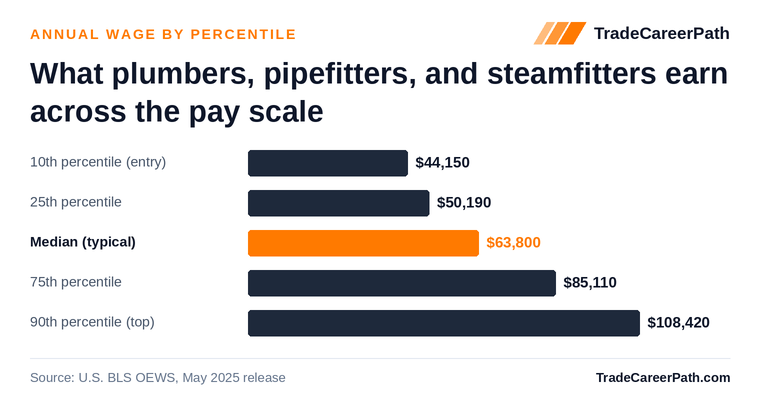
According to BLS Occupational Employment and Wage Statistics (May 2025), plumbers in Alaska earned a median annual wage of approximately $93,920. Pay varies with experience, certification, and employer; the 10th to 90th percentile range was approximately $53,730 to $122,660 (BLS OEWS, May 2025).
What is the Alaska license or certification process for plumbers?
Licensing for plumber work is handled at the state level in Alaska. Consult Alaska's licensing board for current training, examination, and renewal requirements before enrolling in a program.
About this guide: Researched and written by the TradeCareerPath Editorial Team. Our editorial team researches and sources every trade school and career guide using federal labor and education data, including BLS OEWS and Employment Projections, DOL apprenticeship records, IPEDS, College Scorecard, and state licensing boards. We follow the editorial standards documented at /editorial-policy/.
Data sources
Figures on this page are sourced from the federal and state datasets below. Methodology: how we rank and source data.
| Data | Provider | Vintage |
|---|---|---|
| Occupational Employment and Wage Statistics (OEWS) | U.S. Bureau of Labor Statistics | May 2025 |
| Employment Projections | U.S. Bureau of Labor Statistics | 2024-2034 |
| Integrated Postsecondary Education Data System | National Center for Education Statistics (IPEDS) | 2024 |
| College Scorecard (school-level outcomes) | U.S. Department of Education | latest release |
| College Scorecard (field-of-study earnings) | U.S. Department of Education | latest release (updated 2026-06-12) |
| Occupational licensing requirements | CareerOneStop (U.S. Department of Labor) | latest release (updated 2026-02-22) |
| Registered apprenticeship programs | CareerOneStop / Apprenticeship.gov (U.S. Department of Labor) | latest release (updated 2025-10-25) |