Compare accredited Electrician schools across Illinois below, then review pay, licensing steps, and training paths for the trade.
Sponsored - request program info.
Best Electrician Schools in Illinois
How we rank schools – graduation rate, graduate earnings, cost and retention.
Advertising plays no part.
This page lists 10 schools
within 17 miles,
ordered by BOC Score with the highest at the top.
10 of them carry a score.
LOCAL RANK
Location / proximity to this page
Defines the local group
Graduation rate how often students finish
30%
Median earnings, 10 years after entry whether it paid off
25%
Average net price what students actually pay after aid; lower ranks higher
20%
Retention rate how many come back for year two
15%
Fully online availability whether you can study while working
10%
Scores come from IPEDS (2024) and the U.S. Department of Education College Scorecard.
Earnings are for all graduates of a school, not one program, so treat them as a signal
about the institution rather than about this subject.
Sponsored listings are paid placements and are labelled as such; they are separate from
this ranking and never change it. Read the full methodology.
BOC Score, tuition, graduation rate, and median graduate earnings from
federal IPEDS and U.S. Dept. of Education College Scorecard data. Tuition is
the published annual figure for the latest reported year and excludes room,
board, books and fees. Earnings are reported across all programs at the
school (all majors), not a single trade. Distance is measured from
the main population center in Illinois.
Schools closest to the main population center in Illinois are gathered first, then ranked by BOC Score; distance from the main population center in Illinois is shown for reference.
The BOC Score is an independent measure of school outcomes (graduation,
earnings, net price, retention) expressed as a 0–100 percentile within
each school's peer group; higher is better and advertising never affects it.
*Online availability refers to coursework; hands-on trade training is
completed in person. Read the full methodology.
Median Graduate Earnings at Electrician Schools in IllinoisSource: U.S. Dept. of Education College Scorecard - median earnings of all graduates at each school (not a single program).
Median graduate earnings by school for schools serving Best Electrician Schools in Illinois
School
Median graduate earnings
City Colleges of Chicago-Richard J Daley College
$56,827
Triton College
$52,701
Moraine Valley Community College
$51,357
HVAC Technical Institute
$49,913
Lincoln College of Technology-Melrose Park
$47,136
City Colleges of Chicago-Kennedy-King College
$43,247
Electrician Pay and Job Outlook
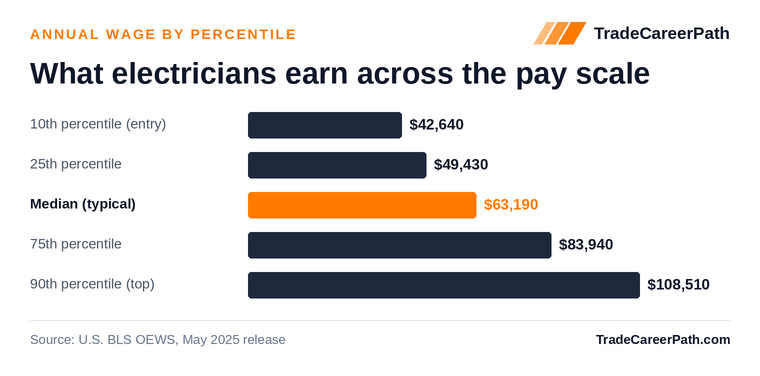
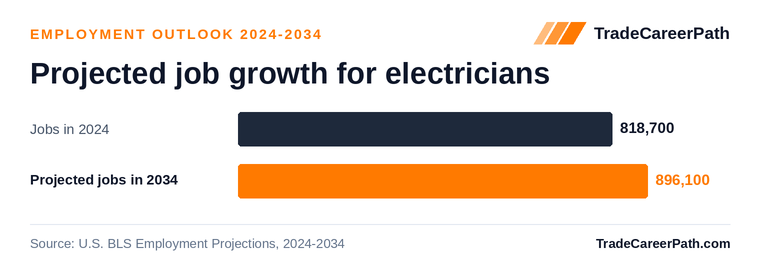
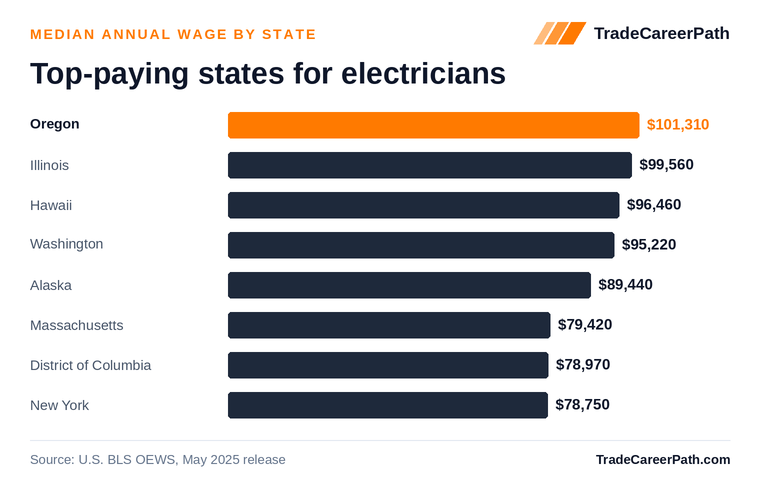
What electricians earn across the pay scaleProjected job growth for electriciansTop-paying states for electricians
Illinois Quick Facts
Metric
Value
Source
State median annual wage
$99,560
BLS OEWS, May 2025
State employment
23,120 workers
BLS OEWS, May 2025
State location quotient
0.78
BLS OEWS, May 2025
State unemployment rate
4.7%
BLS LAUS (2024)
Federal Davis-Bacon prevailing wage
$55.67/hr ($35.0 base + $20.67 fringe)
DOL Wage and Hour Division, 2026
Top Cities for Electrician Training in Illinois
The cities below have the highest concentration of electrician training programs and population centers within Illinois. Click through for school listings near each:
If you want to work as an electrician in Illinois, the first step is finding the right school or apprenticeship program. This choice will shape your skills, confidence, and future job prospects. The good news is Illinois has strong training options. from trade schools to union apprenticeships.
In this guide, we’ll look at the best electrician schools in Illinois and outline the steps you need to get licensed.
How to Become an Electrician in Illinois
Illinois does not have a single statewide electrician license. Instead, most licenses are issued at the local or municipal level. That means the city where you plan to work will set the licensing rules.
However, the basic process is similar almost everywhere:
Complete an approved training program or apprenticeship Most employers prefer candidates who have hands-on training plus classroom instruction.
Work as an electrical apprentice You’ll log a certain number of supervised work hours, often 8,000+ hours across several years 1.
Pass a local or national licensing exam Your city may use tests from the International Code Council (ICC) or a similar organization.
Maintain your license You may need ongoing education to stay compliant with code changes.
Note: Always contact your local building department to confirm licensing requirements before enrolling in a program.
Types of Electrician Training Programs
In Illinois, you can train through:
Union Apprenticeships. Often run by the International Brotherhood of Electrical Workers (IBEW) and local Joint Apprenticeship Training Committees (JATCs).
Non-Union Apprenticeships. Offered by trade associations like the Independent Electrical Contractors (IEC).
Technical Colleges & Trade Schools. Offer shorter diploma and degree programs with classroom and lab training.
Community Colleges. Often combine theory with hands-on practice and can feed into apprenticeship programs.
Comparing Training Lengths
Program Type
Typical Duration
Paid?
Union Apprenticeship
4-5 years
Yes
Non-Union Apprenticeship
4-5 years
Yes
Trade School Diploma
9-15 months
No
Associate Degree
2 years
No (unless employed)
Choosing the Right Program
When comparing Illinois electrician schools, consider:
Location. Some programs require you to live within a certain distance.
outcomes data. Ask how many graduates get jobs or apprenticeships.
Licensing Preparation. The curriculum should cover material for local licensing exams.
Schedule. Balance class time with any work or family obligations.
Hands-On Hours. Employers want grads who have worked with real equipment.
Tip: If your goal is to join a union, applying directly to an IBEW apprenticeship early may be your best move. Many applicants get on a waiting list.
Illinois Licensing Reminders
Because there is no single statewide license, each municipality may require different documentation before allowing you to work independently.
Common requirements include:
Proof of completed training or apprenticeship
Proof of work experience under a licensed electrician
Passing a written exam
Proof of liability insurance
Always check your city or county building department website for exact details. For Chicago’s licensing info, visit https://www.chicago.gov/.
Safety and Code Compliance
Electricians must follow National Electrical Code (NEC) guidelines, along with Illinois amendments that may apply locally.
Safety rule from OSHA: Always verify the circuit is de-energized before starting work to avoid electrical shock hazards 2.
Staying current with NEC updates is a key part of your professional development.
Final Steps
If you’re serious about training as an electrician in Illinois, here’s what to do next:
Pick your target city or county and learn its licensing rules.
Compare at least three training programs or apprenticeships nearby.
Apply early. some programs only open applications once a year.
Start gathering documents like transcripts and proof of age.
Prepare for any entrance tests.
Bottom line: The best electrician school for you will match your career goals, preparation needs, and location. Take the time to research, visit campuses, and talk with current students. Choosing the right training path now will make it easier to succeed when you step onto a job site.
Electrician Wages and Workforce in Illinois
In Illinois, Electrician programs train for an occupation with a median wage of about $99,560 per year, and most earn between $49,240 and $123,660 (BLS OEWS, May 2025). Illinois employs roughly 23,120 workers in this occupation, a workforce concentration of about 0.78 times the national average (BLS OEWS, May 2025).
Trade-relevant schools serving Illinois include Kishwaukee College, John Wood Community College, and Moraine Valley Community College. Compare tuition, program length, and graduation outcomes in the table above (IPEDS and College Scorecard).
Electrician Training and Licensing in Illinois
Licensing for Electrician varies by state and locality. Confirm current training, exam, and credential requirements with the appropriate Illinois licensing board before you enroll; many employers also look for recognized industry certifications.
Training paths typically range from certificate programs (6 to 12 months) and associate degrees (about 2 years) to registered apprenticeships (3 to 5 years) that combine paid on-the-job training with classroom instruction (TradeCareerPath program data).
Frequently Asked Questions
What does electrician training in Illinois involve?
Electrician training in Illinois is offered through trade school certificate programs (typically 6 to 12 months), community college associate degree programs (about 2 years), and registered apprenticeships that combine paid on-the-job training with related classroom instruction over 3 to 5 years. Coursework generally covers safety, applicable codes and standards, hands-on lab work, and exam preparation for any required credential.
How much do electricians earn in Illinois?
According to BLS Occupational Employment and Wage Statistics (May 2025), electricians in Illinois earned a median annual wage of approximately $99,560. Pay varies with experience, certification, and employer; the 10th to 90th percentile range was approximately $49,240 to $123,660 (BLS OEWS, May 2025).
What is the Illinois license or certification process for electricians?
Licensing for electricians in Illinois is administered by Illinois Department of Natural Resources Office of Mines and Minerals, Division of Mine Safety and Training. Most candidates complete an approved training program or registered apprenticeship, log the required on-the-job hours, and pass a state exam. Confirm current hour totals, fees, and renewal terms directly with the licensing agency before enrolling. (Source: U.S. Department of Labor CareerOneStop license database.)
About this guide: Researched and written by the TradeCareerPath Editorial Team. Our editorial team researches and sources every trade school and career guide using federal labor and education data, including BLS OEWS and Employment Projections, DOL apprenticeship records, IPEDS, College Scorecard, and state licensing boards. We follow the editorial standards documented at /editorial-policy/.