Compare accredited Carpenter schools across Virginia below, then review pay, licensing steps, and training paths for the trade.
Sponsored - request program info.
Best Carpenter Schools in Virginia
How we rank schools – graduation rate, graduate earnings, cost and retention.
Advertising plays no part.
This page lists 10 schools
within 221 miles,
ordered by BOC Score with the highest at the top.
10 of them carry a score.
LOCAL RANK
Location / proximity to this page
Defines the local group
Graduation rate how often students finish
30%
Median earnings, 10 years after entry whether it paid off
25%
Average net price what students actually pay after aid; lower ranks higher
20%
Retention rate how many come back for year two
15%
Fully online availability whether you can study while working
10%
Scores come from IPEDS (2024) and the U.S. Department of Education College Scorecard.
Earnings are for all graduates of a school, not one program, so treat them as a signal
about the institution rather than about this subject.
Sponsored listings are paid placements and are labelled as such; they are separate from
this ranking and never change it. Read the full methodology.
#1
Williamson College of the Trades
📍
Media, PA
•213.1 miles away•BOC Score
81.5
Tuition$31,611
Contact
106 South New Middletown Road Media, PA 19063-5299
BOC Score, tuition, graduation rate, and median graduate earnings from
federal IPEDS and U.S. Dept. of Education College Scorecard data. Tuition is
the published annual figure for the latest reported year and excludes room,
board, books and fees. Earnings are reported across all programs at the
school (all majors), not a single trade. Distance is measured from
the main population center in Virginia.
Schools closest to the main population center in Virginia are gathered first, then ranked by BOC Score; distance from the main population center in Virginia is shown for reference.
The BOC Score is an independent measure of school outcomes (graduation,
earnings, net price, retention) expressed as a 0–100 percentile within
each school's peer group; higher is better and advertising never affects it.
*Online availability refers to coursework; hands-on trade training is
completed in person. Read the full methodology.
Median Graduate Earnings at Carpenter Schools in VirginiaSource: U.S. Dept. of Education College Scorecard - median earnings of all graduates at each school (not a single program).
Median graduate earnings by school for schools serving Best Carpenter Schools in Virginia (2026)
School
Median graduate earnings
Williamson College of the Trades
$79,194
Thaddeus Stevens College of Technology
$57,788
Delaware County Community College
$56,647
Cape Fear Community College
$48,346
Fayetteville Technical Community College
$48,138
Vance-Granville Community College
$47,633
Carpenter Pay and Job Outlook
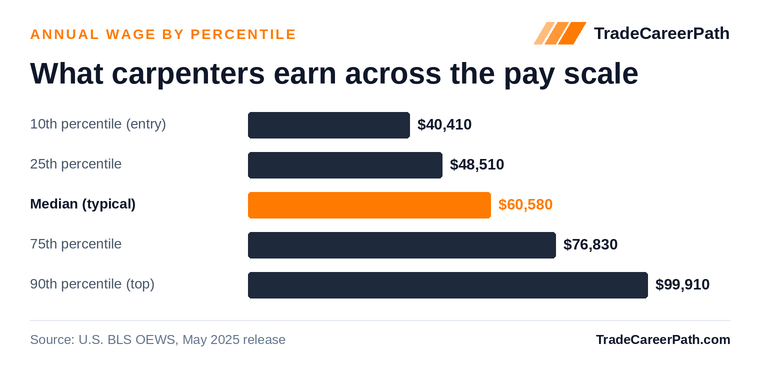
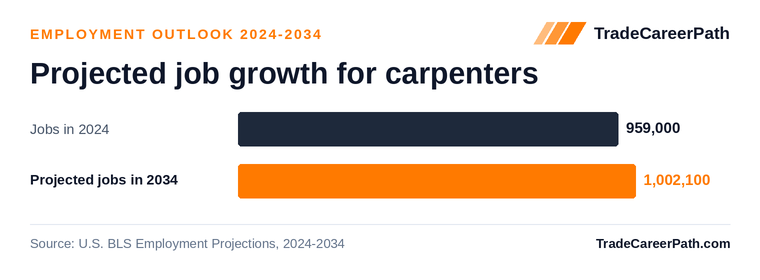
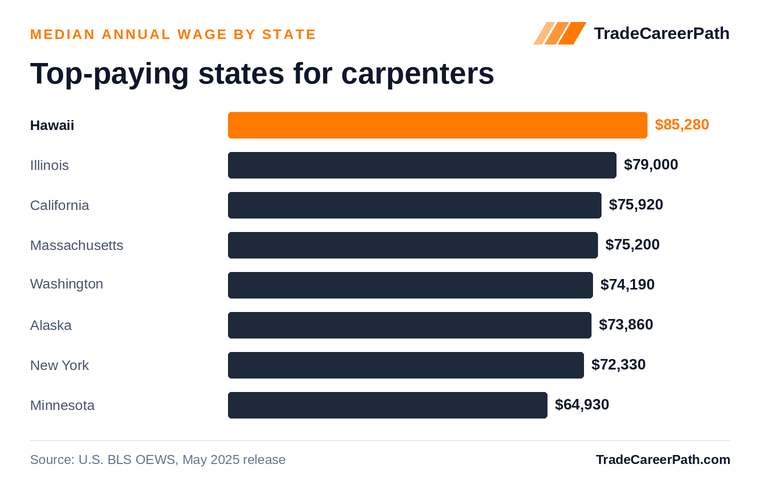
What carpenters earn across the pay scaleProjected job growth for carpentersTop-paying states for carpenters
Virginia Quick Facts
Metric
Value
Source
State median annual wage
$55,690
BLS OEWS, May 2025
State employment
20,460 workers
BLS OEWS, May 2025
State location quotient
1.16
BLS OEWS, May 2025
State unemployment rate
3.2%
BLS LAUS (2024)
Federal Davis-Bacon prevailing wage
$15.6/hr ($15.6 base + $0.0 fringe)
DOL Wage and Hour Division, 2026
Top Cities for Carpenter Training in Virginia
The cities below have the highest concentration of carpenter training programs and population centers within Virginia. Click through for school listings near each:
Choose an accredited training path. Options include trade schools, community colleges, and registered apprenticeships.
Complete classroom instruction in code, safety, and trade theory.
Log on-the-job training hours under a licensed or experienced professional.
Pass any required state or local exam.
Apply for licensure or certification, then maintain it through continuing education as required by the state.
Apprenticeship Programs in Virginia
In Virginia, registered apprenticeships are coordinated through the Virginia Department of Labor and Industry - Registered Apprenticeship (CareerOneStop, U.S. Department of Labor). Apprenticeships combine paid on-the-job training with related classroom instruction, typically over 3 to 5 years.
About Carpenter Careers in Virginia
Carpenters construct, install, and repair building frameworks and structures made from wood and other materials.
In Virginia, the BLS reports a median annual wage of $55,690, about 20,460 workers in the occupation, a location quotient of 1.16 (BLS OEWS, May 2025).
Career outlook varies by region and specialization. Refer to the U.S. Bureau of Labor Statistics Occupational Outlook Handbook for national projections and Occupational Employment and Wage Statistics for the latest state and metropolitan area data.
Carpenter Wages and Workforce in Virginia
In Virginia, Carpenter programs train for an occupation with a median wage of about $55,690 per year, and most earn between $38,230 and $74,250 (BLS OEWS, May 2025). Virginia employs roughly 20,460 workers in this occupation, a workforce concentration of about 1.16 times the national average (BLS OEWS, May 2025).
Trade-relevant schools serving Virginia include Centura College-Norfolk. Compare tuition, program length, and graduation outcomes in the table above (IPEDS and College Scorecard).
Carpenter Training and Licensing in Virginia
Licensing for Carpenter varies by state and locality. Confirm current training, exam, and credential requirements with the appropriate Virginia licensing board before you enroll; many employers also look for recognized industry certifications.
Training paths typically range from certificate programs (6 to 12 months) and associate degrees (about 2 years) to registered apprenticeships (3 to 5 years) that combine paid on-the-job training with classroom instruction (TradeCareerPath program data).
Frequently Asked Questions
What does carpenter training in Virginia involve?
Carpenter training in Virginia is offered through trade school certificate programs (typically 6 to 12 months), community college associate degree programs (about 2 years), and registered apprenticeships that combine paid on-the-job training with related classroom instruction over 3 to 5 years. Coursework generally covers safety, applicable codes and standards, hands-on lab work, and exam preparation for any required credential.
How much do carpenters earn in Virginia?
According to BLS Occupational Employment and Wage Statistics (May 2025), carpenters in Virginia earned a median annual wage of approximately $55,690. Pay varies with experience, certification, and employer; the 10th to 90th percentile range was approximately $38,230 to $74,250 (BLS OEWS, May 2025).
What is the Virginia license or certification process for carpenters?
Licensing for carpenter work is handled at the state level in Virginia. Consult Virginia's licensing board for current training, examination, and renewal requirements before enrolling in a program.
About this guide: Researched and written by the TradeCareerPath Editorial Team. Our editorial team researches and sources every trade school and career guide using federal labor and education data, including BLS OEWS and Employment Projections, DOL apprenticeship records, IPEDS, College Scorecard, and state licensing boards. We follow the editorial standards documented at /editorial-policy/.
Data sources
Figures on this page are sourced from the federal and state datasets below. Methodology: how we rank and source data.
Data
Provider
Vintage
Occupational Employment and Wage Statistics (OEWS)