
How to Become an Aerospace Engineer in 2026
Is Aerospace Engineer Right for You?
The U.S. Department of Labor's O*NET profile for Aerospace Engineers (SOC 17-2011) describes the work this way: Perform engineering duties in designing, constructing, and testing aircraft, missiles, and spacecraft. May conduct basic and applied research to evaluate adaptability of materials and equipment to aircraft design and manufacture. May recommend improvements in testing equipment and techniques.
What the work involves
- Formulate conceptual design of aeronautical or aerospace products or systems to meet customer requirements or conform to environmental regulations.
- Evaluate product data or design from inspections or reports for conformance to engineering principles, customer requirements, environmental regulations, or quality standards.
- Direct or coordinate activities of engineering or technical personnel involved in designing, fabricating, modifying, or testing of aircraft or aerospace products.
- Plan or conduct experimental, environmental, operational, or stress tests on models or prototypes of aircraft or aerospace systems or equipment.
- Diagnose performance problems by reviewing reports or documentation from customers or field engineers or by inspecting malfunctioning or damaged products.
Skills and knowledge that matter
Skills: Reading Comprehension, Critical Thinking, Writing, Mathematics, Science, Complex Problem Solving.
Knowledge: Engineering and Technology, Design, Mechanical, Mathematics.
Tools and technology you may use
Technology: Computer aided manufacturing CAM software, Development environment software, Analytical or scientific software, Autodesk AutoCAD, C, C#.
Typical preparation
O*NET Job Zone Four (Considerable Preparation Needed). Most of these occupations require a four-year bachelor's degree, but some do not. Employees in these occupations usually need several years of work-related experience, on-the-job training, and/or vocational training.
Interest fit
O*NET interest profile: Investigative, Realistic, Conventional. People who enjoy working with ideas, searching for facts, and figuring out problems often find this occupation a good fit.
Source: O*NET 31.0 (updated 2026-10-14)
Quick answer: Training as an aerospace engineer requires a 4-year degree - typically a ABET-accredited bachelor’s in aerospace or mechanical engineering. The national median pay is $134,960 per year, and BLS projects +8.3% employment change from 2025 to 2035 (BLS OEWS, May 2025; BLS Employment Projections, 2025-35).
Aerospace Engineer at a Glance
| Metric | Detail | Source |
|---|---|---|
| Median annual wage | $134,960 | BLS OEWS, May 2025 |
| Typical wage range | $86,700 (10th pct) - $205,890 (90th pct) | BLS OEWS, May 2025 |
| Employment | 67,710 nationwide | BLS OEWS, May 2025 |
| Projected growth (2025-35) | +8.3%, about 3,800 openings per year | BLS Employment Projections, 2025-35 |
| Typical education | ABET-accredited bachelor’s in aerospace or mechanical engineering | BLS Occupational Outlook Handbook |
| License / certification | PE license for some roles; security clearance common in defense | State licensing boards |
What Does an Aerospace Engineer Do?
Aerospace engineers design, analyze, and test aircraft, spacecraft, and propulsion systems - and they own the engineering decisions behind the hardware that A&P mechanics and technicians build, inspect, and repair.
Day to day, that work is less “sketching rockets” and more disciplined problem-solving on one piece of a larger system. A structures engineer runs fatigue and load analysis on an airframe section and decides whether a repair scheme keeps it airworthy. A propulsion engineer models combustion and thermal limits, then sits in the test cell reviewing sensor data when the engine runs. A systems or test engineer writes the test plan, chases anomalies, and signs the reports that certification depends on. Nearly everything is documented, reviewed, and traceable - in this industry a calculation error is not an academic problem, so design reviews and documentation standards (FAA regulations, DO-178 for airborne software, MIL standards on defense work) shape the daily routine as much as the math does.
If you are coming from aircraft maintenance, the shortest way to say it: the mechanic executes and certifies the repair; the engineer decides what the repair must be and proves it is safe. The engineering disposition on a damaged part that maintenance sends up - that becomes your call.
Skills That Make a Great Aerospace Engineer
- Aerodynamics and flight mechanics
- Structural and fatigue analysis
- Aerospace materials and processes
- Systems integration and testing
- Certification standards (FAA/DO-178)
- CAD and simulation tools (CATIA, NX, ANSYS) plus MATLAB or Python for analysis
- Writing: test plans, engineering dispositions, and certification reports carry the job
Aerospace Engineer Salary
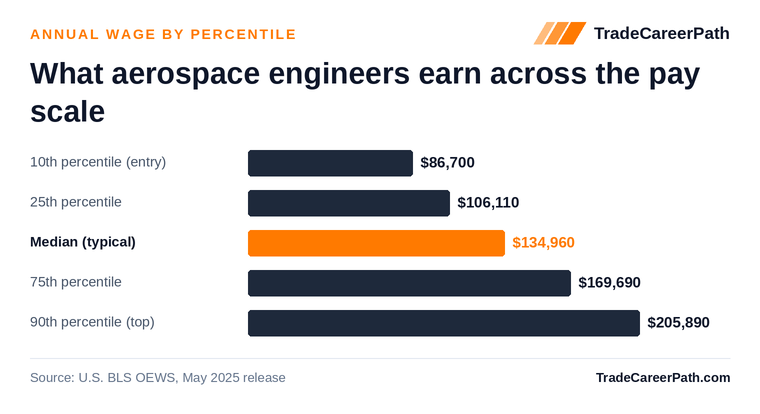
Aerospace engineering is one of the best-paid careers that a trade background can lead into. The national median is $134,960 per year, and even the 10th percentile - roughly where new graduates start - is $86,700, which is above the median for most skilled trades. The 90th percentile reaches $205,890 (BLS OEWS, May 2025).
Where the Jobs and the Money Are
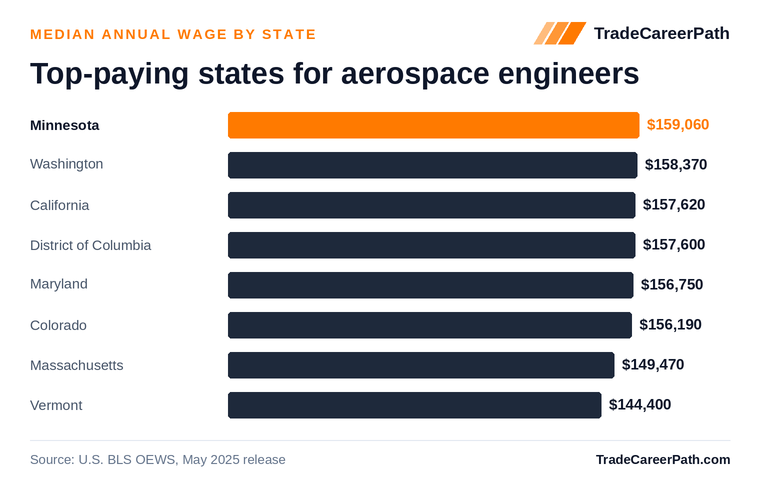
Aerospace employment is concentrated around a handful of hubs: commercial aviation in Washington State, space and defense along Colorado’s Front Range, defense and NASA work in Maryland and the DC area, and the largest single cluster - about 9,170 engineers - in California (BLS OEWS, May 2025).
| State | Median annual wage | Employment |
|---|---|---|
| Minnesota | $159,060 | 140 |
| Washington | $158,370 | 5,760 |
| California | $157,620 | 9,170 |
| District of Columbia | $157,600 | 290 |
| Maryland | $156,750 | 3,180 |
Washington, Colorado, and Maryland stand out for both pay and concentration - aerospace engineers are three or more times as common there as in the average state labor market, which means deeper job markets and more room to change employers without relocating.
How to Become an Aerospace Engineer
1. Earn an ABET-accredited bachelor’s
Aerospace engineering, or mechanical engineering with an aerospace concentration. Accreditation is the one non-negotiable: employers screen for it, graduate schools require it, and the FE/PE licensure path assumes it. For working technicians, the mechanical-engineering route usually offers far more accredited online and evening options - and aerospace employers hire mechanical engineers into aerospace roles as a matter of course.
2. Use your A&P experience
Certified mechanics bring airworthiness and systems knowledge most graduates lack. Say so explicitly: on applications, an A&P plus a few years on airframes or powerplants reads as proof you understand how the hardware actually behaves, fails, and gets fixed. Some schools also grant transfer credit for Part 147 coursework - get a written transfer evaluation before you enroll anywhere.
3. Start in structures, propulsion, or test
Airframers, engine makers, defense contractors, and the FAA all hire at the bachelor’s level. Test engineering and liaison/sustaining engineering (the group that dispositions repairs and production issues) are the classic entry points for former mechanics, because the job is judging real hardware rather than working purely from models.
4. Consider a clearance path
Defense roles often require U.S. citizenship and the ability to obtain a security clearance. A clearance is earned on the job, not in school - but being clearable widens the market substantially, and cleared engineers command a pay premium.
5. Advance
Senior engineer, FAA certification (DER) authority, or engineering management. The fork comes around the ten-year mark: deepen into a technical authority role, or take the leadership track. Both are covered in the career ladder below.
Career Ladder: Titles and Realistic Pay
The BLS wage percentiles map cleanly onto how aerospace careers actually progress. Use this as a sanity check on offers, not a guarantee:
| Stage | Typical titles | Years in | Realistic pay (BLS OEWS, May 2025) |
|---|---|---|---|
| Entry level | Engineer I, test engineer, liaison engineer | 0-3 | ~$86,700-$106,110 (10th-25th pct) |
| Mid-career | Engineer II/III, subsystem owner | 3-10 | ~$134,960 (median) |
| Senior | Senior/staff engineer, technical lead | 10-15 | ~$169,690 (75th pct) |
| Principal / leadership | Principal engineer, DER, engineering manager | 15+ | $205,890+ (90th pct) |
Two notes for career changers. First, prior trade experience compresses this ladder: former A&P mechanics are routinely hired above the bottom of the entry band because they need less supervision around real hardware. Second, the 90th-percentile figures exclude the bonus, clearance premium, and stock components common at defense primes and space companies - senior total compensation often runs well above the base-wage data shown here.
Do You Need a PE License?
Mostly no. Aerospace engineers at manufacturers work under the “industrial exemption” - the company, not the individual engineer, holds design responsibility, so most never license. Two credentials matter more in this industry:
- FAA DER (Designated Engineering Representative): engineers with deep experience can be authorized to approve design data on the FAA’s behalf. It is the aerospace equivalent of the PE stamp, and experienced DERs are scarce and well paid.
- Security clearance: on defense programs, clearability is often the gate that matters most.
If you want the PE anyway - it helps in consulting and test-lab work - the path is: ABET degree, pass the Fundamentals of Engineering (FE) exam (you can sit for it as a senior), four years of qualifying experience, then the PE exam in mechanical or aerospace, per your state board’s rules.
Why an Online Degree Works for This Career
For aviation maintenance technicians, the aerospace engineering bachelor’s converts hands-on airframe and powerplant knowledge into design authority. ABET-accredited online programs (often via mechanical engineering with an aerospace track) serve working technicians, and defense employers prize the maintenance background. Employer tuition assistance is common at airlines, MROs, and defense contractors - many technicians complete the degree with most of the tuition covered, without leaving their job or their seniority.
Job Outlook for 2026 and Beyond
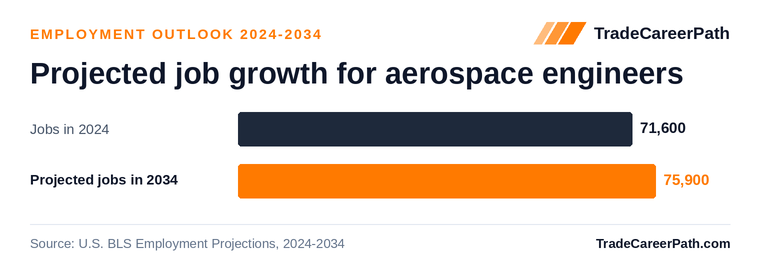
BLS projects aerospace engineering employment to grow +8.3% from 2025 to 2035 - from 68,700 to 74,400 jobs - with about 3,800 openings per year once retirements and occupation changes are counted (BLS Employment Projections, 2025-35). The latest wage data (OEWS, May 2025) puts the median at $134,960, essentially flat against the 2024 figure of $134,830 - pay in this field is already high and stable rather than spiking.
The demand drivers are structural: defense programs are funded years ahead, commercial aviation has a decade-long aircraft backlog, and the space sector keeps adding launch, satellite, and crewed-flight work. For career changers, the more important number is the openings figure - 3,800 seats a year in a 67,710-person occupation means steady hiring, and the industry’s security-clearance and citizenship requirements keep the candidate pool tighter than in most engineering fields.
Cost and Time to Complete the Degree
For aerospace engineers, the credential is: ABET-accredited bachelor’s in aerospace or mechanical engineering. A bachelor’s degree is typically 120 credit hours: four years full-time, and commonly five to six years part-time while working. Transfer credit is the other lever: prior college, military training, apprenticeship coursework, and industry certifications can be worth meaningful credit at transfer-friendly schools, so get a written transfer evaluation before enrolling anywhere. Costs vary widely by school type; in-state public online programs are usually the value benchmark, and employer tuition assistance is common for working adults in this field.
Pros and Cons of Training as an Aerospace Engineer
Pros
- Median pay of $134,960 nationally (BLS OEWS, May 2025)
- BLS projects +8.3% employment growth through 2035
- Field experience from the trades is a genuine hiring advantage
- Accredited online and hybrid degree paths exist for working adults
Cons
- Requires a 4-year degree (typically 120 credit hours)
- Entry-level pay starts near $86,700 at the 10th percentile
- Licensing hurdle: PE license for some roles; security clearance common in defense
Frequently Asked Questions
Can an aircraft mechanic work as an aerospace engineer?
Yes - A&P experience is directly relevant and valued. The requirement is the ABET-accredited bachelor's; online and evening programs exist for working technicians.
How much do aerospace engineers make?
The national median annual wage for aerospace engineers is $134,960 (BLS OEWS, May 2025). The top 10% earn $205,890 or more, while entry-level pay starts around $86,700.
What is the job outlook for aerospace engineers?
BLS projects employment of aerospace engineers to change by +8.3% from 2025 to 2035, with about 3,800 openings per year on average (BLS Employment Projections, 2025-35).
How long does aerospace engineer training take?
The ABET-accredited bachelor's is 120 credit hours: four years full-time, commonly five to six years part-time while working. Transfer credit from prior college, military training, or A&P coursework can meaningfully shorten it at transfer-friendly schools.
Is aerospace engineering hard?
The degree is math-heavy - calculus, differential equations, fluid dynamics, and thermodynamics are unavoidable. Working technicians usually find the systems and hardware courses easier than fresh high-school graduates do, and the physics is easier to absorb when you have already turned wrenches on the hardware.
Should I get an aerospace or mechanical engineering degree?
For working technicians, mechanical engineering with an aerospace concentration is often the smarter buy: far more ABET-accredited online options, and the degree stays marketable outside aerospace. Employers hire mechanical engineers into aerospace roles constantly; the reverse is harder.
Can you train as an aerospace engineer without a degree?
Not with the engineer title - employers require the ABET-accredited bachelor's. Without it, the ceiling is engineering technician or manufacturing/quality roles. An A&P certificate plus experience shortens the degree, but does not replace it.
Do aerospace engineers need a PE license?
Usually no - most work under the industrial exemption. The PE matters for consulting and public-facing sign-off. In aerospace specifically, FAA Designated Engineering Representative (DER) authority and a security clearance open more doors than the PE.
Aerospace Engineer Salary and Requirements by State
Alabama · Alaska · Arizona · Arkansas · California · Colorado · Connecticut · District of Columbia · Florida · Georgia · Hawaii · Idaho · Illinois · Indiana · Kansas · Kentucky · Louisiana · Maryland · Massachusetts · Michigan · Minnesota · Mississippi · Missouri · Nebraska · Nevada · New Jersey · New Mexico · New York · North Carolina · Ohio · Oklahoma · Oregon · Pennsylvania · South Carolina · Tennessee · Texas · Utah · Vermont · Virginia · Washington · Wisconsin
Related Careers and Degree Paths
- Mechanical Engineer - the broader degree that also qualifies you for aerospace roles
- Electrical Engineer - avionics and flight-systems side of the same industry
- HVAC Tech to Mechanical Engineer - the bridge path for mechanical trades
- Online Engineering Degrees for Tradespeople - how to pick an ABET program that fits a work schedule
- All trade careers that require a 4-year degree
Degree and Program Guides
- Online Mechanical Engineering Degrees - the more widely offered online route into aerospace roles
- Online Aviation Degrees - management and safety degrees for A&P mechanics
Sources
- U.S. Bureau of Labor Statistics, Occupational Employment and Wage Statistics (OEWS), May 2025 - Aerospace Engineers (SOC 17-2011)
- U.S. Bureau of Labor Statistics, Employment Projections, 2025-35
- U.S. Bureau of Labor Statistics, Occupational Outlook Handbook - education and licensing requirements
Aerospace Engineer Salary by State
About this guide: Researched and written by the TradeCareerPath Editorial Team. Our editorial team researches and sources every trade school and career guide using federal labor and education data, including BLS OEWS and Employment Projections, DOL apprenticeship records, IPEDS, College Scorecard, and state licensing boards. We follow the editorial standards documented at /editorial-policy/.
Data sources
Figures on this page are sourced from the federal and state datasets below. Methodology: how we rank and source data.
| Data | Provider | Vintage |
|---|---|---|
| Occupational Employment and Wage Statistics (OEWS) | U.S. Bureau of Labor Statistics | May 2025 |
| Employment Projections | U.S. Bureau of Labor Statistics | 2025-2035 |
| Integrated Postsecondary Education Data System | National Center for Education Statistics (IPEDS) | 2024 |
| College Scorecard (school-level outcomes) | U.S. Department of Education | latest release |
| College Scorecard (field-of-study earnings) | U.S. Department of Education | latest release (updated 2026-06-12) |
| Occupational licensing requirements | CareerOneStop (U.S. Department of Labor) | latest release (updated 2026-02-22) |
| Registered apprenticeship programs | CareerOneStop / Apprenticeship.gov (U.S. Department of Labor) | latest release (updated 2025-10-25) |
| O*NET occupation profiles (skills, tasks, tools, job zones) | U.S. Department of Labor (O*NET / Employment & Training Admin.) | O*NET 31.0 (updated 2026-10-14) |