
How to Become an Agricultural Engineer in 2026
Is Agricultural Engineer Right for You?
The U.S. Department of Labor's O*NET profile for Agricultural Engineers (SOC 17-2021) describes the work this way: Apply knowledge of engineering technology and biological science to agricultural problems concerned with power and machinery, electrification, structures, soil and water conservation, and processing of agricultural products.
What the work involves
- Prepare reports, sketches, working drawings, specifications, proposals, and budgets for proposed sites or systems.
- Visit sites to observe environmental problems, to consult with contractors, or to monitor construction activities.
- Meet with clients, such as district or regional councils, farmers, and developers, to discuss their needs.
- Discuss plans with clients, contractors, consultants, and other engineers so that they can be evaluated and necessary changes made.
- Test agricultural machinery and equipment to ensure adequate performance.
Skills and knowledge that matter
Skills: Writing, Speaking, Reading Comprehension, Active Listening, Systems Evaluation, Judgment and Decision Making.
Knowledge: Engineering and Technology, Computers and Electronics, Design, Physics.
Tools and technology you may use
Tools: Desktop computers, Laptop computers, Personal computers, Personal digital assistants PDA, Plotters, Total stations.
Technology: Desktop publishing software, Graphics or photo imaging software, Computer aided design CAD software, Adobe InDesign, Adobe Photoshop, Autodesk AutoCAD.
Typical preparation
O*NET Job Zone Four (Considerable Preparation Needed). Most of these occupations require a four-year bachelor's degree, but some do not. Employees in these occupations usually need several years of work-related experience, on-the-job training, and/or vocational training.
Interest fit
O*NET interest profile: Investigative, Realistic, Conventional. People who enjoy working with ideas, searching for facts, and figuring out problems often find this occupation a good fit.
Source: O*NET 29.1 (updated 2026-06-13)
Quick answer: Training as an agricultural engineer requires a 4-year degree - typically an ABET-accredited bachelor’s in agricultural or biological engineering. The national median pay is $98,590 per year, and BLS projects +5.9% employment change from 2024 to 2034 (BLS OEWS, May 2025; BLS Employment Projections, 2024-34).
Agricultural Engineer at a Glance
| Metric | Detail | Source |
|---|---|---|
| Median annual wage | $98,590 | BLS OEWS, May 2025 |
| Typical wage range | $68,060 (10th pct) - $166,460 (90th pct) | BLS OEWS, May 2025 |
| Employment | 1,480 nationwide | BLS OEWS, May 2025 |
| Projected growth (2024-34) | +5.9%, about 100 openings per year | BLS Employment Projections, 2024-34 |
| Typical education | ABET-accredited bachelor’s in agricultural or biological engineering | BLS Occupational Outlook Handbook |
| License / certification | PE license for public-works and consulting sign-off | State licensing boards |
What Does an Agricultural Engineer Do?
Agricultural engineers design farm equipment, irrigation and drainage systems, grain-handling facilities, and ag-processing plants - the engineering behind the machinery that diesel and equipment mechanics keep running.
Day to day, the work splits along a few well-defined tracks. An equipment engineer at a manufacturer like a tractor or combine maker spends the week in CAD and simulation, running load and hydraulic-circuit analysis, then out at the proving grounds watching prototypes get beaten on and reviewing the sensor data afterward. An irrigation or drainage engineer sizes pumps, designs center-pivot and subsurface-drip systems, models water balance for a specific soil and crop, and stamps plans that have to satisfy state water regulations. A precision-agriculture engineer works closer to software: GPS guidance, variable-rate application maps, yield-monitor calibration, and increasingly the autonomy stack that lets a machine run a field with nobody in the cab. Facilities-side engineers design grain dryers, storage structures, ventilation for livestock buildings, and processing lines - work where a mistake shows up as spoiled grain or dead animals, so the documentation and review culture is serious.
If you are the diesel tech or ag-equipment mechanic this page’s degree path is built for, the shortest way to say the difference: today you diagnose why the hydraulic system failed; as the engineer you decide how that circuit is designed, what it must survive, and what the service manual will tell the next tech to do. Field-service experience is not a footnote here - manufacturers staff their test, reliability, and product-support engineering groups with people who have actually wrenched on the machines, because those engineers spot design-for-serviceability problems the straight-from-campus hires miss.
Skills That Make a Great Agricultural Engineer
- Equipment and machine design
- Irrigation and drainage engineering
- Precision-agriculture technology (GPS guidance, variable-rate systems, telematics)
- Hydraulics and power systems
- Agricultural structures and ventilation basics
- CAD and simulation tools plus data analysis in MATLAB, Python, or GIS software
- Writing: test reports, design reviews, and stamped drawings carry the job
- Practical fluency with how farms actually operate - seasons, downtime costs, operator habits
Agricultural Engineer Salary
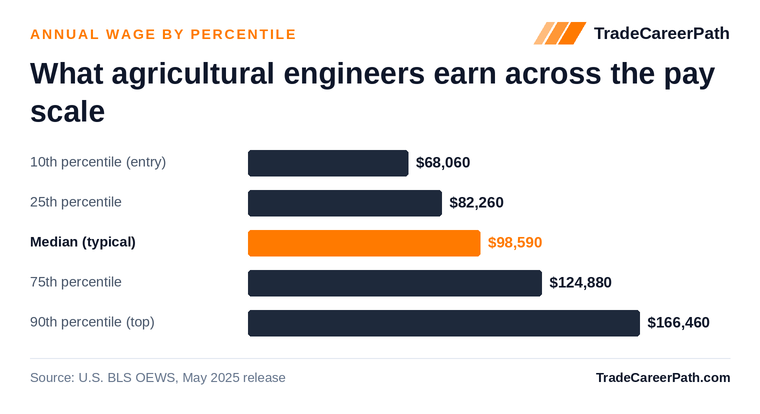
Agricultural engineering pays solidly for a field this specialized. The national median is $98,590 per year, the 10th percentile - roughly where new graduates start - is $68,060, and the 90th percentile reaches $166,460 (BLS OEWS, May 2025). The mean of $108,230 sitting well above the median tells you the top of this field - senior R&D and engineering-management roles at the big equipment makers - pulls the average up hard.
Where the Jobs and the Money Are
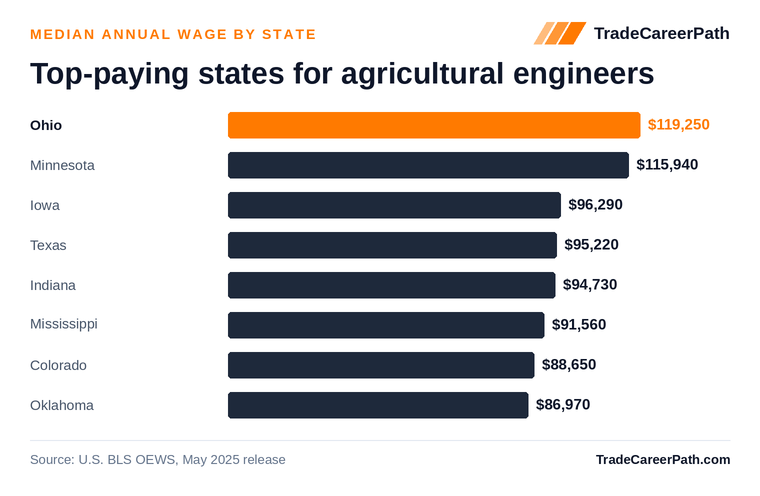
This is a small, geographically concentrated occupation - about 1,480 engineers nationwide, clustered where the equipment makers, land-grant universities, and irrigation industry sit (BLS OEWS, May 2025).
| State | Median annual wage | Employment |
|---|---|---|
| Ohio | $119,250 | 60 |
| Minnesota | $115,940 | 60 |
| Iowa | $96,290 | 100 |
| Texas | $95,220 | 50 |
| Indiana | $94,730 | 150 |
The concentration numbers matter more than the raw counts. Agricultural engineers are about 7.5 times as common in Oklahoma’s labor market as in the average state, 6.56 times in Iowa, and 5.01 times in Indiana - that is where the deep job markets are, with enough employers that you can change jobs without relocating. Indiana leads on headcount at 150, followed by Oklahoma at 120 (median $86,970) and Iowa at 100. The pay leaders are different states: Ohio at $119,250 and Minnesota at $115,940, both smaller markets at 60 engineers each. Texas, despite its farm economy, is actually below-average territory for this occupation (concentration 0.4) - the ag-equipment corridor through the Midwest is where this career lives.
How to Become an Agricultural Engineer
1. Earn an ABET-accredited bachelor’s
Agricultural engineering or biological systems engineering, typically at a land-grant university - the same schools that run the extension services and equipment test labs. Accreditation is the one non-negotiable: employers screen for it and the FE/PE licensure path assumes it. Several land-grant programs offer online or hybrid completion tracks aimed at working adults, and mechanical engineering with an ag focus is a legitimate alternate route with far more online options.
2. Use equipment experience
Dealer and field-service backgrounds are prized by ag-equipment manufacturers - say so explicitly on applications. Years spent diagnosing hydraulic, powertrain, and electronic faults on real machines read as proof you understand how the hardware behaves, fails, and gets fixed. Some schools grant transfer credit for diesel-tech or ag-mechanics coursework; get a written transfer evaluation before you enroll anywhere.
3. Start with a manufacturer or co-op
Equipment makers, irrigation firms, and USDA agencies hire at the bachelor’s level. Test engineering, reliability, and product-support engineering are the classic entry points for former techs, because the job is judging real hardware in the field rather than working purely from models. USDA’s Natural Resources Conservation Service and state agencies hire on the water-and-soil side.
4. Pass the FE exam
Take the Fundamentals of Engineering exam as a senior or right after graduation, while the coursework is fresh. The EIT designation starts the PE clock - and if your career ever moves toward irrigation, drainage, or structures work on public projects, the PE stamp is what lets you sign the drawings. Skipping the FE early is the most common regret in this field.
5. Specialize
Precision agriculture, irrigation design, or equipment R&D. The specialization fork comes early because the field is small: the precision-ag and autonomy track leans into software and pays like tech, irrigation design leads toward consulting and the PE, and equipment R&D at a major manufacturer is the deepest, most stable pool of jobs.
Career Ladder: Titles and Realistic Pay
The BLS wage percentiles map onto how this career actually progresses. Use it as a sanity check on offers, not a guarantee:
| Stage | Typical titles | Years in | Realistic pay (BLS OEWS, May 2025) |
|---|---|---|---|
| Entry level | Engineer I, test engineer, product-support engineer | 0-3 | ~$68,060-$82,260 (10th-25th pct) |
| Mid-career | Engineer II/III, design engineer, irrigation designer | 3-10 | ~$98,590 (median) |
| Senior | Senior engineer, project engineer, PE-stamped consultant | 10-15 | ~$124,880 (75th pct) |
| Principal / leadership | Principal engineer, R&D lead, engineering manager | 15+ | $166,460+ (90th pct) |
Two notes for career changers. First, prior trade experience compresses this ladder: former diesel and equipment techs are routinely hired above the bottom of the entry band because they need less supervision around real machinery and already speak the dealer network’s language. Second, the top band understates what the biggest equipment manufacturers pay - bonus and profit-sharing at the major makers, and billing rates for experienced PE-stamped irrigation consultants, often run above the base-wage data shown here.
Do You Need a PE License?
It depends entirely on which side of the field you land on. Engineers at equipment manufacturers work under the industrial exemption - the company, not the individual engineer, holds design responsibility - so most equipment R&D engineers never license, and it does not hold them back.
The PE becomes mandatory the moment your work touches public infrastructure or consulting: irrigation and drainage designs submitted to state water agencies, agricultural structures that need stamped drawings, and any work you sell directly to clients under your own judgment. The path is standard: ABET degree, pass the FE exam (sit for it as a senior), four years of qualifying experience under licensed engineers, then the PE exam - typically in agricultural and biological engineering or civil, per your state board’s rules. Because this field straddles the exemption line, the smart move is cheap insurance: take the FE early even if you start at a manufacturer, so the consulting door stays open at mid-career.
Why an Online Degree Works for This Career
Diesel techs and ag-equipment mechanics bring exactly the machine knowledge this field is built on. An agricultural or biological engineering bachelor’s (several land-grant universities offer online options) moves you from repairing the equipment to designing it - with precision-ag and automation driving demand. Employer tuition assistance is common at equipment manufacturers and dealer networks, and the part-time online route lets you keep your seniority and income while you finish the 120 credit hours.
Job Outlook for 2026 and Beyond
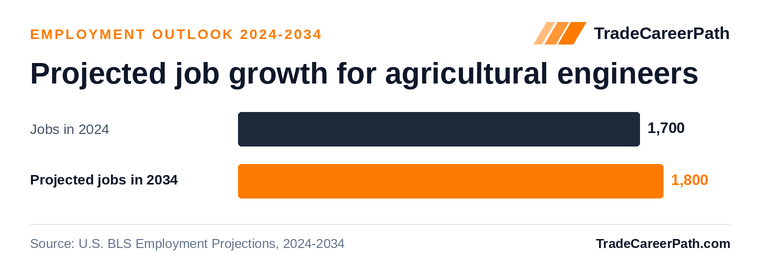
BLS projects agricultural engineering employment to grow +5.9% from 2024 to 2034 - from 1,700 to 1,800 jobs - with about 100 openings per year once retirements and occupation changes are counted (BLS Employment Projections, 2024-34). Be honest with yourself about what those numbers mean: this is one of the smallest engineering occupations, so a healthy growth rate still translates to a modest number of seats. The flip side is that the candidate pool is equally small, and a candidate with genuine equipment experience stands out in a way that is impossible in the giant engineering fields.
The wage trend is the stronger signal. The projections dataset recorded a 2024 median of $84,630; the latest wage data (OEWS, May 2025) puts the median at $98,590. Demand drivers are structural: precision agriculture and machine autonomy need engineers who understand both the software and the iron, water scarcity keeps irrigation-efficiency work funded, and the equipment fleet keeps getting more complex than the labor pool maintaining it.
Cost and Time to Complete the Degree
For agricultural engineers, the credential is: ABET-accredited bachelor’s in agricultural or biological engineering. A bachelor’s degree is typically 120 credit hours: four years full-time, and commonly five to six years part-time while working. Transfer credit is the other lever: prior college, military training, apprenticeship coursework, and industry certifications can be worth meaningful credit at transfer-friendly schools, so get a written transfer evaluation before enrolling anywhere. Costs vary widely by school type; in-state public online programs are usually the value benchmark - and since the strong programs are at land-grant state universities, in-state tuition and the degree you actually want often line up. Employer tuition assistance is common for working adults in this field.
Pros and Cons of Training as an Agricultural Engineer
Pros
- Median pay of $98,590 nationally (BLS OEWS, May 2025)
- BLS projects +5.9% employment growth through 2034
- Field experience from the trades is a genuine hiring advantage
- Accredited online and hybrid degree paths exist for working adults
Cons
- Requires a 4-year degree (typically 120 credit hours)
- Entry-level pay starts near $68,060 at the 10th percentile
- Small occupation - about 100 openings per year nationally, concentrated in the Midwest
- Licensing hurdle: PE license for public-works and consulting sign-off
Frequently Asked Questions
Can a diesel mechanic work as an agricultural engineer?
Yes - ag-equipment manufacturers specifically value engineers with dealership or field-service backgrounds; the requirement is the ABET-accredited bachelor's.
How much do agricultural engineers make?
The national median annual wage for agricultural engineers is $98,590 (BLS OEWS, May 2025). The top 10% earn $166,460 or more, while entry-level pay starts around $68,060.
What is the job outlook for agricultural engineers?
BLS projects employment of agricultural engineers to change by +5.9% from 2024 to 2034 (BLS Employment Projections, 2024-34).
How long does agricultural engineer training take?
The ABET-accredited bachelor's is 120 credit hours: four years full-time, commonly five to six years part-time while working. Transfer credit from prior college, military training, or diesel-tech coursework can meaningfully shorten it at transfer-friendly schools.
Is agricultural engineering hard?
The degree carries the standard engineering core - calculus, physics, statics, fluid mechanics, hydraulics - so expect real math. Working equipment techs usually find the machinery, power-systems, and hydraulics courses far easier than fresh high-school graduates do, because they have already worked on the hardware.
Should I get an agricultural or mechanical engineering degree?
If you know you want equipment, irrigation, or ag-processing work, agricultural or biological systems engineering at a land-grant school is the direct route. Mechanical engineering has far more ABET-accredited online options and stays marketable outside agriculture - and ag-equipment makers hire mechanical engineers constantly. Either degree gets you in; the ag degree signals commitment to the industry.
Can you train as an agricultural engineer without a degree?
Not with the engineer title - employers require the ABET-accredited bachelor's. Without it, the ceiling is technician, service, or product-support roles. Dealer and field-service experience shortens the path and strengthens the resume, but it does not replace the degree.
Do agricultural engineers need a PE license?
It depends on where you work. Engineers at equipment manufacturers typically operate under the industrial exemption and never license. Irrigation, drainage, and agricultural-structures work that touches public projects or consulting requires a PE stamp - so most graduates take the FE exam early to keep that door open.
Agricultural Engineer Salary and Requirements by State
Arkansas · Colorado · Indiana · Iowa · Michigan · Minnesota · Mississippi · Ohio · Oklahoma · Pennsylvania · Texas
Related Careers and Degree Paths
- Mechanical Engineer - the broader degree that ag-equipment makers also hire from
- Civil Engineer - the adjacent PE-track field for water, drainage, and structures work
- Environmental Engineer - the water-quality and land-management side of the same problems
- Diesel Mechanic - the feeder trade this degree path is built for
- Online Engineering Degrees for Tradespeople - how to pick an ABET program that fits a work schedule
Sources
- U.S. Bureau of Labor Statistics, Occupational Employment and Wage Statistics (OEWS), May 2025 - Agricultural Engineers (SOC 17-2021)
- U.S. Bureau of Labor Statistics, Employment Projections, 2024-34
- U.S. Bureau of Labor Statistics, Occupational Outlook Handbook - education and licensing requirements
Agricultural Engineer Salary by State
About this guide: Researched and written by the TradeCareerPath Editorial Team. Our editorial team researches and sources every trade school and career guide using federal labor and education data, including BLS OEWS and Employment Projections, DOL apprenticeship records, IPEDS, College Scorecard, and state licensing boards. We follow the editorial standards documented at /editorial-policy/.
Data sources
Figures on this page are sourced from the federal and state datasets below. Methodology: how we rank and source data.
| Data | Provider | Vintage |
|---|---|---|
| Occupational Employment and Wage Statistics (OEWS) | U.S. Bureau of Labor Statistics | May 2025 |
| Employment Projections | U.S. Bureau of Labor Statistics | 2024-2034 |
| Integrated Postsecondary Education Data System | National Center for Education Statistics (IPEDS) | 2024 |
| College Scorecard (school-level outcomes) | U.S. Department of Education | latest release |
| College Scorecard (field-of-study earnings) | U.S. Department of Education | latest release (updated 2026-06-12) |
| Occupational licensing requirements | CareerOneStop (U.S. Department of Labor) | latest release (updated 2026-02-22) |
| Registered apprenticeship programs | CareerOneStop / Apprenticeship.gov (U.S. Department of Labor) | latest release (updated 2025-10-25) |
| O*NET occupation profiles (skills, tasks, tools, job zones) | U.S. Department of Labor (O*NET / Employment & Training Admin.) | O*NET 29.1 (updated 2026-06-13) |