
How to Become an Aircraft Mechanic (FAA A&P)
Is Aircraft Mechanic (FAA A&P) Right for You?
The U.S. Department of Labor's O*NET profile for Aircraft Mechanics and Service Technicians (SOC 49-3011) describes the work this way: Diagnose, adjust, repair, or overhaul aircraft engines and assemblies, such as hydraulic and pneumatic systems.
What the work involves
- Examine and inspect aircraft components, including landing gear, hydraulic systems, and deicers to locate cracks, breaks, leaks, or other problems.
- Conduct routine and special inspections as required by regulations.
- Inspect completed work to certify that maintenance meets standards and that aircraft are ready for operation.
- Read and interpret maintenance manuals, service bulletins, and other specifications to determine the feasibility and method of repairing or replacing malfunctioning or damaged components.
- Maintain repair logs, documenting all preventive and corrective aircraft maintenance.
Skills and knowledge that matter
Skills: Repairing, Equipment Maintenance, Troubleshooting, Operations Monitoring, Quality Control Analysis, Critical Thinking.
Knowledge: Mechanical, English Language, Engineering and Technology, Customer and Personal Service.
Tools and technology you may use
Tools: Acetylene welding equipment, Adjustable wrenches, Air compressors, Air drills, Aircraft lifting jacks, Aircraft maintenance management systems.
Technology: Facilities management software, Analytical or scientific software, Computer aided manufacturing CAM software, Microsoft Excel, Microsoft Office software, Microsoft Outlook.
Typical preparation
O*NET Job Zone Three (Medium Preparation Needed). Most occupations in this zone require training in vocational schools, related on-the-job experience, or an associate's degree. Employees in these occupations usually need one or two years of training involving both on-the-job experience and informal training with experienced workers. A recognized apprenticeship program may be associated with these occupations.
Interest fit
O*NET interest profile: Realistic, Conventional, Investigative. People who enjoy hands-on, practical work with tools, machines, plants, or materials often find this occupation a good fit.
Source: O*NET 29.1 (updated 2026-06-13)
Ever looked up at a jet slicing through the clouds and thought, someone’s making sure that thing stays in the air?
Well… that someone could be you.
Aircraft mechanics, or A&P Technicians (short for Airframe & Powerplant), are the heartbeat of aviation. They’re the ones who keep every flight safe, every landing smooth, and every pilot confident enough to take off again. This page explains what aircraft mechanics do and the steps to work as an FAA-certified A&P technician. They inspect airframes and engines, diagnose issues, replace parts, and sign off FAA maintenance logs.
And the best part? You don’t need a college degree. Just trade school, solid training, curiosity, and a little grease on your hands.
Quick answers
Do you need a college degree to work as an aircraft mechanic?
No. You can start with trade school and FAA-approved training, such as a Part 147 aviation maintenance school, or equivalent experience in the military.
What does A&P mean in aircraft maintenance?
A&P stands for Airframe & Powerplant. It refers to the two main areas aircraft mechanics train on and test for.
What do aircraft mechanics do day to day?
Common tasks include inspecting engines and airframes, diagnosing mechanical or electrical issues, replacing parts, and signing off FAA maintenance logs.
What are the main steps to work as an A&P technician?
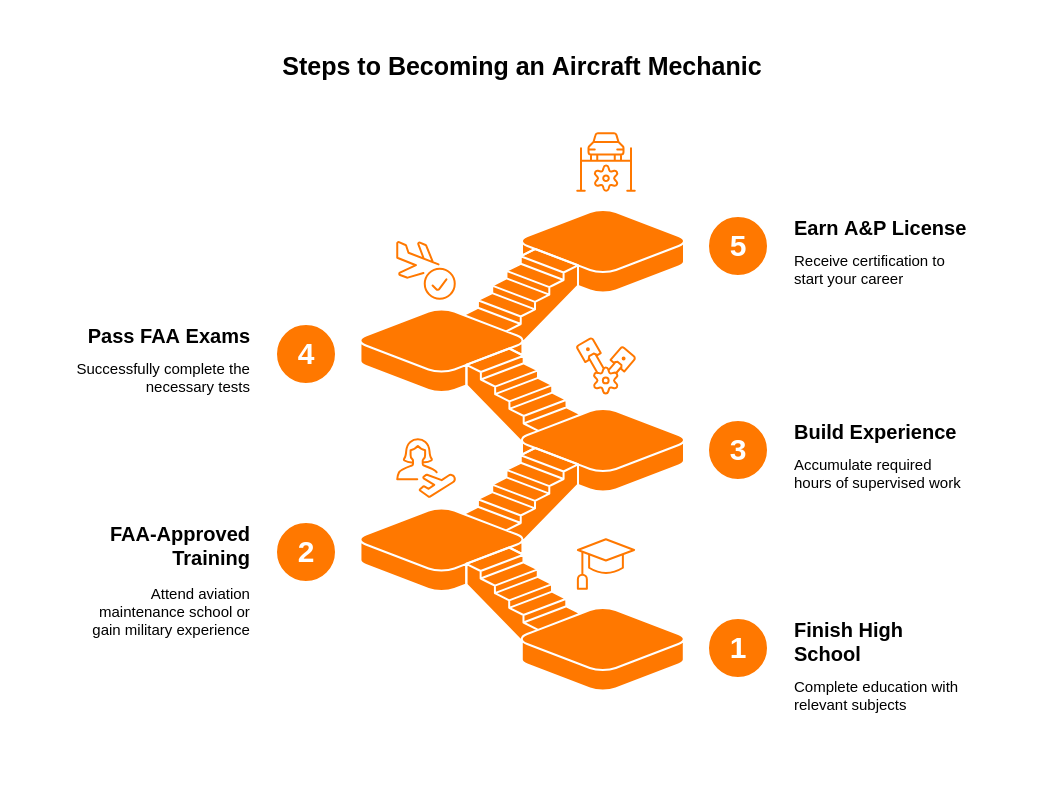
Finish high school or earn a GED, complete FAA-approved training, build about 30 months of supervised work (or 1,900 hours of instruction), pass your FAA exams (General, Airframe, Powerplant), then earn your A&P license.
What does the FAA require before you can be certified?
You must be at least 18, read, write, and speak English, complete a Part 147 training program (or log work experience), and pass the FAA tests (written, oral, and practical).
Where can aircraft mechanics work?
Aircraft mechanics work in commercial airlines, private jet companies, military and defense contractors, aerospace manufacturers, and repair and maintenance facilities.
At a glance
- No college degree required
- Train via Part 147 school or military experience
- Experience requirement: about 30 months or 1,900 hours
- Exams cover General, Airframe, and Powerplant
- FAA eligibility includes age 18+ and English proficiency
- IA can be available after three years as a certified A&P
What Aircraft Mechanics Actually Do
Let’s be honest: this isn’t your typical desk job. You’ll be around the hum of engines, the smell of jet fuel, and the satisfaction of knowing your work literally keeps people alive.
Typical day-to-day tasks
- Inspecting and maintaining aircraft engines, wings, landing gear, everything that makes a plane fly.
- Diagnosing problems with mechanical or electrical systems.
- Using advanced tools and digital diagnostic equipment.
- Replacing parts, signing off FAA maintenance logs, and checking everything twice.
It’s hands-on, detail-heavy work. And every bolt you tighten tells someone, “You’re safe to fly.”
Aviation never sleeps. And neither does the demand for skilled mechanics. From small charter planes to global airlines, A&P-certified techs are always needed.
How to Become an Aircraft Mechanic (5 Steps)
Training as an aircraft mechanic isn’t about memorizing theory: it’s about learning how to think, problem-solve, and stay calm when metal and machinery are in your hands.
Finish high school or earn a GED
Classes like math, physics, and shop help more than you’d think.Complete FAA-approved training
You can attend an FAA Part 147 aviation maintenance school or gain equivalent experience in the military. Part 147 schools are FAA-approved aviation maintenance training programs.Build experience (1,900 hours total)
The FAA requires about 30 months of supervised work or 1,900 hours of instruction.Pass your FAA exams
There are three parts:- General - physics, tools, and materials
- Airframe - structure and systems
- Powerplant - engines and fuel systems
Earn your A&P license and start your career
You can work at airports, airlines, repair stations, or even go solo and start your own business.
Certification & Licensing
FAA eligibility basics
Here’s what the FAA expects before they hand you that A&P certification:
- You’re at least 18 years old
- You can read, write, and speak English
- You’ve finished a Part 147 training program or logged your work experience
- You’ve passed all three FAA tests (written, oral, and practical)
Next credential: Inspection Authorization (IA)
After three years as a certified A&P, you can apply for Inspection Authorization (IA), which the page notes can mean higher pay and more responsibility.
Skills That Make You Great at This
- You notice the details others miss
- You stay calm when things get complex
- You love solving mechanical puzzles
- You’re safety-minded and precise
- You don’t mind getting your hands dirty
The best mechanics are part technician, part detective, and part artist.
Where You’ll Work (and Grow)
Aircraft mechanics work in:
- Commercial airlines
- Private jet companies
- Military and defense contractors
- Aerospace manufacturers (Boeing, Lockheed, etc.)
- Repair and maintenance facilities
Career Growth Paths
- Lead Mechanic or Crew Chief
- Avionics Specialist
- Maintenance Inspector (IA)
- Aviation Maintenance Instructor
Aircraft Mechanic Salary Snapshot
U.S.11,300 openings/yr
Pros & Cons
Pros
- Strong pay and global job demand
- Work with modern aircraft systems
- Every day feels different
- Respect and responsibility
Cons
- Requires high precision and focus
- Sometimes physically demanding
- Shift work and overtime possible
Start Your Aircraft Mechanic Journey
If you’ve ever wanted a career that feels real, one where your work directly impacts safety, performance, and people’s lives, aviation maintenance might just be it.
You don’t have to wait for a degree or a fancy resume. You just have to start.
It’s time to take off.
Industry Organizations & Certifying Bodies
These are the recognized national organizations, unions, certifying bodies, and regulatory authorities that shape this trade. They issue the credentials, sponsor the apprenticeships, publish the codes, and represent workers and employers.
- U.S. Federal Aviation Administration (FAA) Issues the Airframe and Powerplant (A&P) certificate required for aircraft mechanics.
- Aviation Technician Education Council (ATEC) Association of FAA Part 147 aviation maintenance schools.
- Professional Aviation Maintenance Association (PAMA) Professional association for aviation maintenance technicians.
Wage and Employment Charts
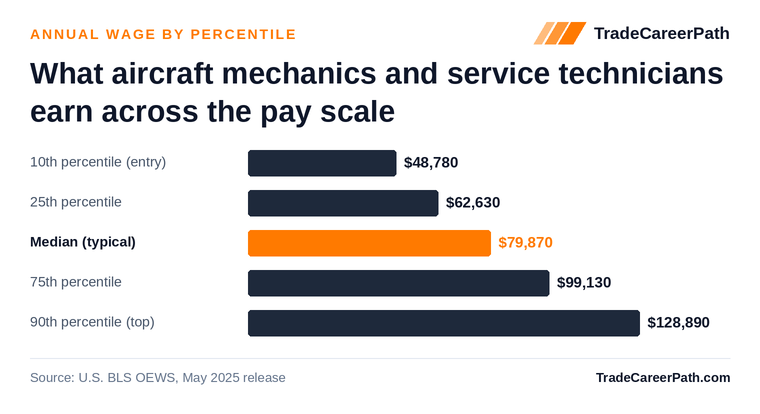
| Percentile | Annual wage |
|---|---|
| 10th | $48,780 |
| 25th | $62,630 |
| 50th (median) | $79,870 |
| 75th | $99,130 |
| 90th | $128,890 |
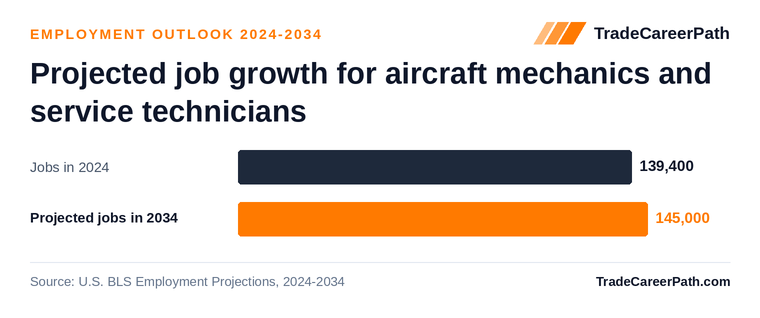
| Year | Employment |
|---|---|
| 2024 | 139,400 |
| 2034 projected | 145,000 |
| Percent change | +4.0% |
Aircraft Mechanic Salary and Requirements by State
Select your state for local wage data, training options, and requirements:
Alabama · Alaska · Arizona · Arkansas · California · Colorado · Connecticut · Delaware · District of Columbia · Florida · Georgia · Hawaii · Idaho · Illinois · Indiana · Iowa · Kansas · Kentucky · Louisiana · Maine · Maryland · Massachusetts · Michigan · Minnesota · Mississippi · Missouri · Montana · Nebraska · Nevada · New Hampshire · New Jersey · New Mexico · New York · North Carolina · North Dakota · Ohio · Oklahoma · Oregon · Pennsylvania · Rhode Island · South Carolina · South Dakota · Tennessee · Texas · Utah · Vermont · Virginia · Washington · West Virginia · Wisconsin · Wyoming
Workplace Safety Snapshot
BLS Survey of Occupational Injuries and Illnesses data (2023-2024) report approximately 233.9 days-away, restricted, or transfer cases per 10,000 full-time-equivalent workers in aircraft mechanics and service technicians (about 2.34 per 100 FTE). Source: BLS Survey of Occupational Injuries and Illnesses, Table R98.
Frequently Asked Questions
How long does aircraft mechanic training take?
It typically takes typically 6 months to 2 years of training. The most common entry path is through a certificate or associate degree program. A high school diploma or GED is generally required to get started.
Do you need a college degree to work as an aircraft mechanic?
No. A college degree is not required to work as an aircraft mechanic. Most people enter the field through a certificate or associate degree program. A high school diploma or GED is typically the only educational prerequisite.
Which states pay aircraft mechanics the most?
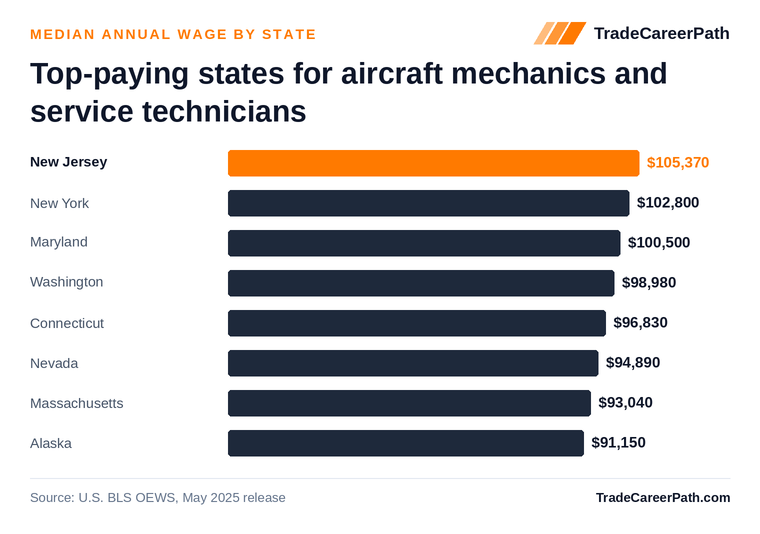
According to the U.S. Bureau of Labor Statistics (May 2025 OEWS), the highest-paying states for aircraft mechanics are New Jersey, New York, and Maryland. Median annual wages: New Jersey ($105,370); New York ($102,800); Maryland ($100,500).
Which states employ the most aircraft mechanics?
BLS reports the largest concentrations of aircraft mechanics in Texas, Florida, and California. Employment levels: Texas (16,850 workers); Florida (14,850 workers); California (12,590 workers) (May 2025).
How much do experienced aircraft mechanics earn?
The top 10% of aircraft mechanics earn more than $128,890 per year, according to BLS Occupational Employment and Wage Statistics (May 2025). Experienced workers in this band typically hold senior credentials, supervisory roles, or specialty certifications.
What is entry-level pay for aircraft mechanics?
BLS reports the bottom 10% of aircraft mechanics earn under $48,780 per year. New workers often start near this level and see pay rise as they accumulate experience and credentials.
How many aircraft mechanics work in the United States?
BLS reports approximately 138,090 aircraft mechanics employed nationwide as of May 2025.
How many job openings are expected for aircraft mechanics each year?
BLS projects approximately 11,300 openings per year for aircraft mechanics from 2024 through 2034, including new positions, retirements, and workers transitioning out. The occupation is projected to grow 4.0% from 2024 to 2034, classified as about as fast as average growth.
How much do aircraft mechanics make per hour?
The median hourly wage for aircraft mechanics is $38.40, according to BLS (May 2025). Hourly pay ranges from about $23.45 (bottom 10%) to $61.97 (top 10%).
How Aircraft Mechanic Pay Compares to Similar Trades
Side-by-side comparison of Mechanic & Engine Technician and the closest related careers, based on U.S. Bureau of Labor Statistics data (May 2025 OEWS + 2024-2034 Employment Projections).
| Career | Median Pay | 10-Year Growth | Annual Openings |
|---|---|---|---|
| Mechanic & Engine Technician this guide | $79,870 | +4.0% | 11,300 |
| Mechanic & Engine Technician | $50,620 | +4.2% | 70,000 |
| Diesel Mechanic | $61,770 | +2.4% | 26,500 |
| Maintenance Technician | $49,590 | +3.8% | 159,800 |
| CNC Machinist | $58,750 | - | 29,500 |
Source: BLS Occupational Employment and Wage Statistics + BLS Employment Projections.
Sources
- U.S. Bureau of Labor Statistics, Occupational Employment and Wage Statistics (May 2025)
- U.S. Bureau of Labor Statistics, Employment Projections 2024-2034
- U.S. Bureau of Labor Statistics, Survey of Occupational Injuries and Illnesses (2023-2024, Table R98)
- U.S. Department of Labor, Wage and Hour Division, Davis-Bacon General Wage Determinations (2026)
Aircraft Mechanic Salary by State
About this guide: Researched and written by the TradeCareerPath Editorial Team. Our editorial team researches and sources every trade school and career guide using federal labor and education data, including BLS OEWS and Employment Projections, DOL apprenticeship records, IPEDS, College Scorecard, and state licensing boards. We follow the editorial standards documented at /editorial-policy/.
Data sources
Figures on this page are sourced from the federal and state datasets below. Methodology: how we rank and source data.
| Data | Provider | Vintage |
|---|---|---|
| Occupational Employment and Wage Statistics (OEWS) | U.S. Bureau of Labor Statistics | May 2025 |
| Employment Projections | U.S. Bureau of Labor Statistics | 2024-2034 |
| Integrated Postsecondary Education Data System | National Center for Education Statistics (IPEDS) | 2024 |
| College Scorecard (school-level outcomes) | U.S. Department of Education | latest release |
| College Scorecard (field-of-study earnings) | U.S. Department of Education | latest release (updated 2026-06-12) |
| Occupational licensing requirements | CareerOneStop (U.S. Department of Labor) | latest release (updated 2026-02-22) |
| Registered apprenticeship programs | CareerOneStop / Apprenticeship.gov (U.S. Department of Labor) | latest release (updated 2025-10-25) |
| O*NET occupation profiles (skills, tasks, tools, job zones) | U.S. Department of Labor (O*NET / Employment & Training Admin.) | O*NET 29.1 (updated 2026-06-13) |