
How to Become an Appliance Repair Technician
Is Appliance Repair Technician Right for You?
The U.S. Department of Labor's O*NET profile for Home Appliance Repairers (SOC 49-9031) describes the work this way: Repair, adjust, or install all types of electric or gas household appliances, such as refrigerators, washers, dryers, and ovens.
What the work involves
- Bill customers for repair work, and collect payment.
- Observe and examine appliances during operation to detect specific malfunctions such as loose parts or leaking fluid.
- Talk to customers or refer to work orders to establish the nature of appliance malfunctions.
- Refer to schematic drawings, product manuals, and troubleshooting guides to diagnose and repair problems.
- Trace electrical circuits, following diagrams, and conduct tests with circuit testers and other equipment to locate shorts and grounds.
Skills and knowledge that matter
Skills: Repairing, Critical Thinking, Troubleshooting, Equipment Maintenance, Speaking, Quality Control Analysis.
Knowledge: Customer and Personal Service, Mechanical, English Language, Administration and Management.
Tools and technology you may use
Tools: Appliance dollies, Bearing removers, Carbon monoxide detectors, Charging hoses, Combustible gas detectors, Condenser brushes.
Technology: Data base user interface and query software, Spreadsheet software, Office suite software, Microsoft Excel, Microsoft Office software, Microsoft Outlook.
Typical preparation
O*NET Job Zone Two (Some Preparation Needed). These occupations usually require a high school diploma. Employees in these occupations need anywhere from a few months to one year of working with experienced employees. A recognized apprenticeship program may be associated with these occupations.
Interest fit
O*NET interest profile: Realistic, Conventional, Investigative. People who enjoy hands-on, practical work with tools, machines, plants, or materials often find this occupation a good fit.
Source: O*NET 29.1 (updated 2026-06-13)
Ever fixed a washer, fridge, or oven and thought, “I could do this for a living”?
Appliance repair technicians make that possible every day.
Appliance repair technicians install, maintain, and repair household and commercial appliances.
They work with mechanical, plumbing, and electrical components to diagnose problems and restore function in everything from refrigerators to laundry machines.
This guide covers typical responsibilities, skills, training paths, certifications, and work settings.
If you enjoy troubleshooting and working with tools, this trade offers a hands-on, steady career with strong demand across residential and commercial markets.
Quick answers
What does an appliance repair technician do?
Appliance repair technicians install, maintain, and repair household and commercial appliances. They diagnose problems and restore function using mechanical, plumbing, and electrical components.
Which appliances do they commonly repair?
Common service calls include refrigerators, dishwashers, ovens, and washing machines. Technicians may also service appliances used in restaurants and other commercial facilities.
Where do appliance repair technicians work?
They work for independent repair companies, retailers and warranty providers, property management departments, manufacturers and distributors, or as self-employed mobile service businesses.
How long does it take to train?
Entry-level training often comes from on-the-job learning or a certificate program, commonly around 6-12 months. Apprenticeships can take 1-2 years, and total training time varies by path.
Do you need certifications?
Certifications are not always required. EPA Section 608 may apply for refrigerant handling, and manufacturer-specific training can improve employability and credibility.
What skills matter most for success?
Strong troubleshooting and diagnostic skills, comfort with hand tools and testing equipment, and a solid understanding of mechanical, electrical, and plumbing systems are key. Customer communication and safety awareness also matter.
At a glance
- Diagnose and repair household and commercial appliances
- Work with mechanical, plumbing, and electrical components
- Commonly service refrigerators, dishwashers, ovens, and washing machines
- Train through on-the-job learning, trade programs, or apprenticeships
- Certifications are optional; EPA Section 608 may apply for refrigerant handling—
What Appliance Repair Technicians Do
Technicians service and repair appliances used in homes, restaurants, and commercial facilities.
Their work blends mechanical, electrical, and diagnostic skills to restore function and efficiency.
Typical Responsibilities
- Inspect, troubleshoot, and repair appliances such as refrigerators, dishwashers, ovens, and washing machines
- Replace parts, wiring, and mechanical components
- Calibrate or test systems after repairs
- Maintain service records and communicate with customers
- Follow safety and electrical standards on every job
Appliance technicians are problem-solvers who combine technical knowledge with practical repair skills to keep modern life running smoothly.
Key Skills and Traits for Success
- Strong troubleshooting and diagnostic ability
- Comfort with hand tools and testing equipment
- Understanding of mechanical, electrical, and plumbing systems
- Clear communication and customer service skills
- Attention to safety and detail
Work Settings for Appliance Repair Technicians
Technicians work in a variety of settings:
- Independent appliance repair companies
- Large retailers and warranty service providers
- Property management and maintenance departments
- Appliance manufacturers and distributors
- Self-employed or mobile service businesses
How to Become an Appliance Repair Technician (5 Steps)
Most technicians train through on-the-job learning or short trade programs lasting 6-12 months.
1. Earn a High School Diploma or GED
Focus on classes in math, physics, and shop to understand basic mechanical and electrical concepts.
2. Complete a Technical or Trade Program
Enroll in an appliance repair or electronics technology program covering troubleshooting, wiring, and safety. Some HVAC programs offer appliance service modules.
3. Gain Hands-On Experience
Work alongside experienced technicians or complete an apprenticeship to develop repair and diagnostic skills.
4. Obtain Industry Certifications
While not always required, certifications such as EPA Section 608 (for refrigerant handling) or manufacturer-specific training improve employability and credibility.
5. Build Experience and Grow Professionally
After gaining experience, technicians may move into supervisory, training, or business ownership roles, or specialize in refrigeration or commercial appliance repair.
Education and Training Paths
| Pathway | Typical Duration | Outcome |
|---|---|---|
| Certificate or Diploma | 6-12 months | Entry-level repair skills |
| On-the-Job Training | 6-12 months | Real-world troubleshooting and installation skills |
| Apprenticeship | 1-2 years | Structured learning with field experience |
| Certification (EPA 608, Manufacturer) | Variable | Specialized credentials and safety compliance |
Career Growth and Advancement
With experience, appliance repair technicians can work as:
- Lead Service Technician - manages repair teams and scheduling
- Specialist Technician - focuses on refrigeration or commercial systems
- Trainer or Technical Instructor - teaches new technicians
- Independent Business Owner - operates a private repair company
Cost and Duration of Training
- Program Cost: varies by school, format and location depending on location and format
- Duration: 6 months to 2 years
- Certification Fees: typically under $200
Appliance repair offers a flexible career path for anyone who enjoys technical problem-solving and practical, real-world work.
Pros and Cons
✅ Pros
- Hands-on, technical work
- Variety of appliances and systems to learn
- Opportunities for self-employment
- Ongoing need for repair and maintenance services
⚠️ Cons
- Physical work and frequent travel to service locations
- Requires continuous learning for new appliance technologies
- Customer-facing work can require flexibility and patience
Take the First Step Toward an Appliance Repair Career
If you enjoy fixing things and working with tools, training as an appliance repair technician can lead to a rewarding technical career that combines independence, skill, and long-term stability.
Explore Popular Trade Programs
Quick Facts: Appliance Repair Technician Training and Outlook

Industry Organizations & Certifying Bodies
These are the recognized national organizations, unions, certifying bodies, and regulatory authorities that shape this trade. They issue the credentials, sponsor the apprenticeships, publish the codes, and represent workers and employers.
- Professional Service Association (PSA) Major-appliance service association; offers Certified Appliance Professional (CAP) credentials.
- International Society of Certified Electronics Technicians (ISCET) Issues the CET (Certified Electronics Technician) appliance credentials.
Wage and Employment Charts
| Percentile | Annual wage |
|---|---|
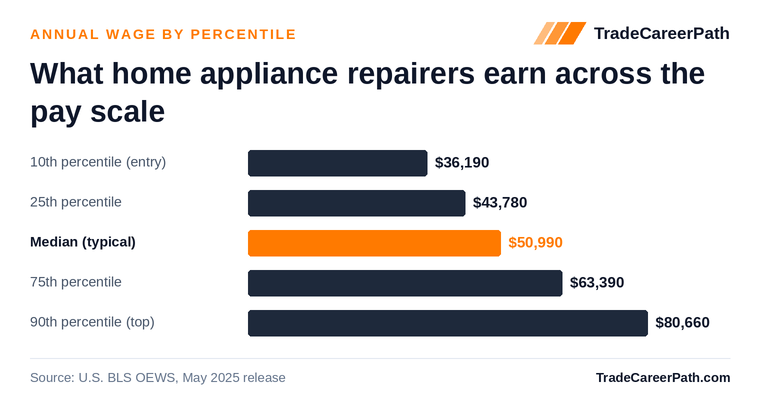
| 10th | $36,190 |
| 25th | $43,780 |
| 50th (median) | $50,990 |
| 75th | $63,390 |
| 90th | $80,660 |
| Year | Employment |
|---|---|
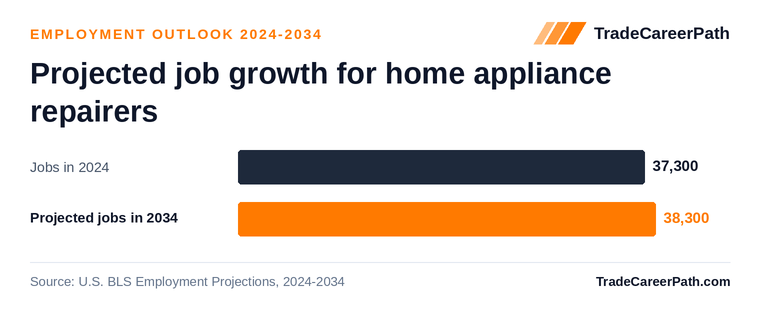
| 2024 | 37,300 |
| 2034 projected | 38,300 |
| Percent change | +2.6% |
Appliance Repair Technician Salary and Requirements by State
Select your state for local wage data, training options, and requirements:
Alabama · Alaska · Arizona · Arkansas · California · Colorado · Connecticut · Delaware · District of Columbia · Florida · Georgia · Hawaii · Idaho · Illinois · Indiana · Iowa · Kansas · Kentucky · Louisiana · Maine · Maryland · Massachusetts · Michigan · Minnesota · Mississippi · Missouri · Montana · Nebraska · Nevada · New Hampshire · New Jersey · New Mexico · New York · North Carolina · North Dakota · Ohio · Oklahoma · Oregon · Pennsylvania · Rhode Island · South Carolina · South Dakota · Tennessee · Texas · Utah · Vermont · Virginia · Washington · West Virginia · Wisconsin · Wyoming
Workplace Safety Snapshot
BLS Survey of Occupational Injuries and Illnesses data (2023-2024) report approximately 368.6 days-away, restricted, or transfer cases per 10,000 full-time-equivalent workers in home appliance repairers (about 3.69 per 100 FTE). Source: BLS Survey of Occupational Injuries and Illnesses, Table R98.
Frequently Asked Questions
How long does appliance repair technician training take?
It typically takes typically 6 months to 2 years of training. The most common entry path is through a certificate or associate degree program. A high school diploma or GED is generally required to get started.
How much do appliance repair technicians make?
The median annual salary for appliance repair technicians is $50,990 according to the Bureau of Labor Statistics (May 2025). Entry-level workers earn around $36,190, while those in the 90th percentile earn over $80,660. Pay varies by state, experience, and specialization.
What is the job outlook for appliance repair technicians?
The Bureau of Labor Statistics projects 2.6% employment growth for this occupation from 2024 to 2034, which is roughly on pace with the overall economy. Approximately 3,100 job openings are expected each year due to growth, retirements, and workers leaving the field.
Do you need a college degree to work as an appliance repair technician?
No. A college degree is not required to work as an appliance repair technician. Most people enter the field through a certificate or associate degree program. A high school diploma or GED is typically the only educational prerequisite.
Which states pay appliance repair technicians the most?
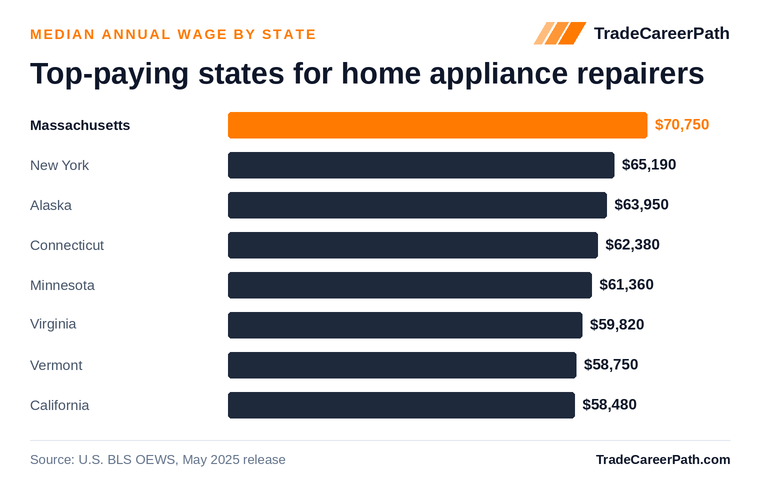
According to the U.S. Bureau of Labor Statistics (May 2025 OEWS), the highest-paying states for appliance repair technicians are Massachusetts, New York, and Alaska. Median annual wages: Massachusetts ($70,750); New York ($65,190); Alaska ($63,950).
Which states employ the most appliance repair technicians?
BLS reports the largest concentrations of appliance repair technicians in Florida, California, and Texas. Employment levels: Florida (3,000 workers); California (2,760 workers); Texas (2,200 workers) (May 2025).
How much do experienced appliance repair technicians earn?
The top 10% of appliance repair technicians earn more than $80,660 per year, according to BLS Occupational Employment and Wage Statistics (May 2025). Experienced workers in this band typically hold senior credentials, supervisory roles, or specialty certifications.
What is entry-level pay for appliance repair technicians?
BLS reports the bottom 10% of appliance repair technicians earn under $36,190 per year. New workers often start near this level and see pay rise as they accumulate experience and credentials.
How many appliance repair technicians work in the United States?
BLS reports approximately 32,150 appliance repair technicians employed nationwide as of May 2025.
How many job openings are expected for appliance repair technicians each year?
BLS projects approximately 3,100 openings per year for appliance repair technicians from 2024 through 2034, including new positions, retirements, and workers transitioning out. The occupation is projected to grow 2.6% from 2024 to 2034, classified as about as fast as average growth.
How much do appliance repair technicians make per hour?
The median hourly wage for appliance repair technicians is $24.51, according to BLS (May 2025). Hourly pay ranges from about $17.40 (bottom 10%) to $38.78 (top 10%).
How Appliance Repair Technician Pay Compares to Similar Trades
Side-by-side comparison of Appliance Repair Technician and the closest related careers, based on U.S. Bureau of Labor Statistics data (May 2025 OEWS + 2024-2034 Employment Projections).
| Career | Median Pay | 10-Year Growth | Annual Openings |
|---|---|---|---|
| Appliance Repair Technician this guide | $50,990 | +2.6% | 3,100 |
| HVAC Technician | $61,010 | +8.1% | 40,100 |
| HVAC Trades Listings | $61,010 | +8.1% | 40,100 |
| Electrician | $63,190 | +9.5% | 81,000 |
| Maintenance Technician | $49,590 | +3.8% | 159,800 |
Source: BLS Occupational Employment and Wage Statistics + BLS Employment Projections.
Sources
- U.S. Bureau of Labor Statistics, Occupational Employment and Wage Statistics (May 2025)
- U.S. Bureau of Labor Statistics, Employment Projections 2024-2034
- U.S. Bureau of Labor Statistics, Survey of Occupational Injuries and Illnesses (2023-2024, Table R98)
- U.S. Department of Labor, Wage and Hour Division, Davis-Bacon General Wage Determinations (2026)
Appliance Repair Technician Salary by State
About this guide: Researched and written by the TradeCareerPath Editorial Team. Our editorial team researches and sources every trade school and career guide using federal labor and education data, including BLS OEWS and Employment Projections, DOL apprenticeship records, IPEDS, College Scorecard, and state licensing boards. We follow the editorial standards documented at /editorial-policy/.
Data sources
Figures on this page are sourced from the federal and state datasets below. Methodology: how we rank and source data.
| Data | Provider | Vintage |
|---|---|---|
| Occupational Employment and Wage Statistics (OEWS) | U.S. Bureau of Labor Statistics | May 2025 |
| Employment Projections | U.S. Bureau of Labor Statistics | 2024-2034 |
| Integrated Postsecondary Education Data System | National Center for Education Statistics (IPEDS) | 2024 |
| College Scorecard (school-level outcomes) | U.S. Department of Education | latest release |
| College Scorecard (field-of-study earnings) | U.S. Department of Education | latest release (updated 2026-06-12) |
| Occupational licensing requirements | CareerOneStop (U.S. Department of Labor) | latest release (updated 2026-02-22) |
| Registered apprenticeship programs | CareerOneStop / Apprenticeship.gov (U.S. Department of Labor) | latest release (updated 2025-10-25) |
| O*NET occupation profiles (skills, tasks, tools, job zones) | U.S. Department of Labor (O*NET / Employment & Training Admin.) | O*NET 29.1 (updated 2026-06-13) |