
How to Become an Architect in 2026
Is Architect Right for You?
The U.S. Department of Labor's O*NET profile for Architects, Except Landscape and Naval (SOC 17-1011) describes the work this way: Plan and design structures, such as private residences, office buildings, theaters, factories, and other structural property.
What the work involves
- Prepare scale drawings or architectural designs, using computer-aided design or other tools.
- Plan or design structures such as residences, office buildings, theatres, factories, or other structural properties in accordance with environmental, safety, or other regulations.
- Meet with clients to review or discuss architectural drawings.
- Prepare contract documents for building contractors.
- Develop final construction plans that include aesthetic representations of the structure or details for its construction.
Skills and knowledge that matter
Skills: Critical Thinking, Operations Analysis, Reading Comprehension, Speaking, Complex Problem Solving, Active Listening.
Knowledge: Design, Building and Construction, Engineering and Technology, Customer and Personal Service.
Tools and technology you may use
Technology: Procurement software, Document management software, Graphics or photo imaging software, Adobe Acrobat, Adobe Creative Cloud software, Adobe Illustrator.
Typical preparation
O*NET Job Zone Five (Extensive Preparation Needed). Most of these occupations require graduate school. For example, they may require a master's degree, and some require a Ph.D., M.D., or J.D. (law degree). Employees may need some on-the-job training, but most of these occupations assume that the person will already have the required skills, knowledge, work-related experience, and/or training.
Interest fit
O*NET interest profile: Realistic, Conventional, Artistic. People who enjoy hands-on, practical work with tools, machines, plants, or materials often find this occupation a good fit.
Source: O*NET 31.0 (updated 2026-10-14)
Quick answer: Training as an architect requires a 4-year degree - typically a NAAB-accredited Bachelor of Architecture (B.Arch, 5 years) or M.Arch. The national median pay is $99,280 per year, and BLS projects +4.3% employment change from 2025 to 2035 (BLS OEWS, May 2025; BLS Employment Projections, 2025-35).
Architect at a Glance
| Metric | Detail | Source |
|---|---|---|
| Median annual wage | $99,280 | BLS OEWS, May 2025 |
| Typical wage range | $62,300 (10th pct) - $161,420 (90th pct) | BLS OEWS, May 2025 |
| Employment | 106,770 nationwide | BLS OEWS, May 2025 |
| Projected growth (2025-35) | +4.3%, about 6,900 openings per year | BLS Employment Projections, 2025-35 |
| Typical education | NAAB-accredited Bachelor of Architecture (B.Arch, 5 years) or M.Arch | BLS Occupational Outlook Handbook |
| License / certification | State architecture license via the ARE exam (required to stamp drawings) | State licensing boards |
What Does an Architect Do?
Architects design buildings and carry legal responsibility for them: they develop the concept, produce the construction documents, coordinate the structural and MEP engineers, get the design through code review and permitting, and then administer the construction contract while the trades build the work.
Day to day, the job splits by phase and specialty. A design architect works the front end - programming, massing, client presentations, and the endless zoning and code analysis that decides what can legally be built on a site. A technical or project architect lives in construction documents: wall sections, waterproofing details, door and finish schedules, and consultant coordination in Revit, where a missed clash between a duct run and a beam becomes a change order. During construction, the architect reviews submittals and shop drawings, answers RFIs, walks the site, and decides whether the built work conforms to the documents. Firms also specialize by market - healthcare, multifamily, schools, industrial - and each has its own code regime and detailing habits.
If you are coming from carpentry, drafting, or construction supervision, here is the honest translation: you already know how buildings actually go together, which is the thing architecture school is weakest at teaching. The superintendent executes the documents; the architect decides what the documents say and stamps them. The RFI you used to write from the field - as an architect, answering it becomes your call, and your name is on the drawings it changes.
Skills That Make a Great Architect
- Design and drafting in Revit/BIM
- Building-code and zoning analysis
- Construction detailing that can actually be built
- Client presentation and communication
- Consultant and permit coordination
- Contract administration: submittals, RFIs, site observation reports
- Writing and sketching: the job runs on clear markups and clear emails
Architect Salary
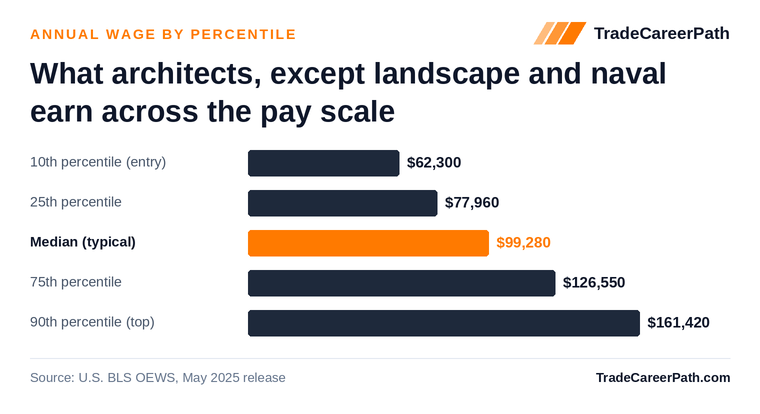
The national median for architects, except landscape and naval is $99,280 per year. The spread is wide and experience-driven: the 10th percentile - roughly unlicensed early-career designers - sits at $62,300, while the 90th percentile, where principals and senior project architects live, reaches $161,420 (BLS OEWS, May 2025). The mean of $106,260 sitting above the median tells you the top of the profession pulls the average up; the license is the gate between the two halves of that range.
Where the Jobs and the Money Are
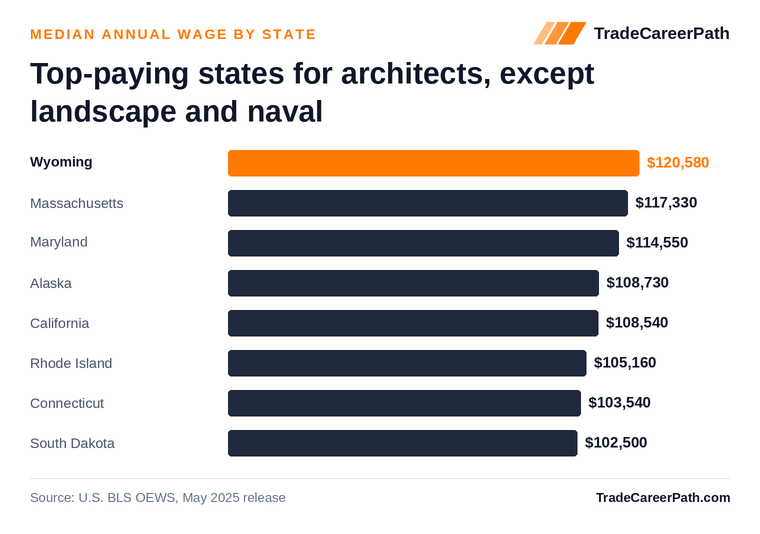
Architecture work follows construction dollars, so it concentrates in big coastal markets. California is the largest cluster at 13,270 architects, New York follows at 10,360, and Texas employs 7,820 (BLS OEWS, May 2025). The top of the pay table looks different - small, high-cost markets like Wyoming and Alaska post high medians on tiny headcounts.
| State | Median annual wage | Employment |
|---|---|---|
| Wyoming | $120,580 | 130 |
| Massachusetts | $117,330 | 4,590 |
| Maryland | $114,550 | 1,800 |
| Alaska | $108,730 | 210 |
| California | $108,540 | 13,270 |
The location-quotient data points to the real hubs. Massachusetts stands out on both measures - architects are 1.84 times as common there as in the average state labor market, and the median is $117,330. New York’s concentration is 1.56, meaning a deep firm market where you can change employers without moving. Wyoming’s $120,580 median comes with a concentration of just 0.65 and 130 jobs statewide - a thin market, not a hub. California pairs scale with a modest premium (concentration 1.06, median $108,540), making it the safest bet for both first jobs and job-hopping.
How to Become an Architect
1. Earn a NAAB-accredited degree
A 5-year B.Arch or a bachelor’s plus M.Arch; NAAB accreditation is required for licensure in most states, so verify it before you enroll anywhere - a non-accredited “architectural studies” degree can leave you unlicensable. If you already hold any bachelor’s, the M.Arch route avoids repeating undergrad, and it is where most of the online and hybrid options for working adults live. Ask every program for a written transfer evaluation: prior college credit, drafting coursework, and construction management classes can shorten the path.
2. Complete AXP experience hours
The Architectural Experience Program logs ~3,740 supervised hours across practice areas - design, documentation, construction administration, and practice management. This is where a trade background pays off twice: some prior construction experience can count toward AXP, and firms hire people who already understand sequencing and site conditions. You can start logging hours while still in school, so get into a firm early rather than waiting for graduation.
3. Pass the ARE
The six-division Architect Registration Examination covers practice management, project management, programming, planning, documentation, and construction evaluation. Most candidates spread the divisions over one to two years while working full-time. Candidates who have run real projects consistently report the construction and evaluation divisions are the ones their field experience carries them through.
4. Get your state license
State boards issue the license to stamp and seal drawings. Requirements vary at the margins - a few states allow extra experience in place of the accredited degree, and timing rules on the ARE differ - so read your own board’s rules before planning the sequence. The license is what legally separates an architect from a designer or drafter, and it is what the pay jump in the career ladder below is built on.
5. Advance
Project architect, principal, or firm ownership; NCARB certification eases multi-state practice, which matters if you follow clients or building types across state lines. The fork comes after licensure: deepen into a technical role running large projects, move toward business development and principal, or hang your own shingle - small-firm ownership is more common in architecture than in almost any other licensed profession.
Career Ladder: Titles and Realistic Pay
The BLS wage percentiles map onto how architecture careers actually progress. Use this as a sanity check on offers, not a guarantee:
| Stage | Typical titles | Years in | Realistic pay (BLS OEWS, May 2025) |
|---|---|---|---|
| Entry level | Architectural designer, intern architect (logging AXP) | 0-3 | ~$62,300-$77,960 (10th-25th pct) |
| Licensed | Architect, project architect | 3-10 | ~$99,280 (median) |
| Senior | Senior project architect, associate | 10-15 | ~$126,550 (75th pct) |
| Principal / owner | Principal, studio director, firm owner | 15+ | $161,420+ (90th pct) |
Two notes for career changers. First, trade experience compresses the bottom of this ladder: former carpenters and supers are worth more than a fresh graduate on any project in construction documents or construction administration, and firms pay for people who can catch buildability problems on paper. Second, the 90th-percentile figure understates the top - firm owners and principals earn profit distributions on top of salary, and none of that shows up in the wage data above.
Do You Need a License? Yes - It Is Mandatory
Architecture is not an industrial-exemption field. You cannot call yourself an architect or stamp and seal construction documents without a state license - full stop. The standard path has three legs, coordinated nationally by NCARB:
- Education: a NAAB-accredited degree (B.Arch or M.Arch) in most states; a minority of states allow a longer experience-based alternative.
- Experience: the AXP, ~3,740 supervised hours logged across defined practice areas.
- Examination: the six-division ARE.
After initial licensure, the NCARB Certificate is the credential worth adding - it packages your record so other state boards can license you by reciprocity, which matters the first time a client hands you a project across a state line. Unlicensed roles exist (drafter, designer, BIM specialist), and plenty of people build careers there - but the license is where the title, the liability, and the money live.
Why an Online Degree Works for This Career
Carpenters, drafters, and construction supervisors bring exactly the buildability knowledge architecture schools cannot teach. NAAB-accredited online and hybrid architecture programs exist for working professionals, pairing remote studios with short residencies - so you can keep your income and start logging AXP hours at a firm while the degree is in progress. Employer tuition help is worth asking about: design-build contractors and larger firms increasingly fund staff through M.Arch programs to grow their own licensed architects.
Job Outlook for 2026 and Beyond
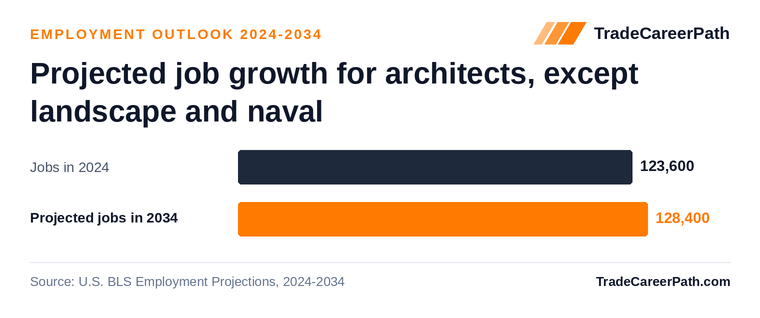
BLS projects employment of architects to grow +4.3% from 2025 to 2035 - from 124,600 to 129,900 jobs - with about 6,900 openings per year once retirements and occupation changes are counted (BLS Employment Projections, 2025-35). That is modest growth, but the openings number is the one that matters for a career changer: most hiring in this field replaces people leaving, not new seats, and it happens every year regardless of the growth rate.
Wages are moving the right direction. The projections dataset pegged the 2024 median at $96,690; the May 2025 OEWS median is $99,280 - a real year-over-year gain. Demand drivers are steady rather than spectacular: renovation and adaptive reuse, healthcare and institutional work, and code-driven energy retrofits all require a stamping architect no matter what the software does. The license is the moat.
Cost and Time to Complete the Degree
For architects, the credential is: NAAB-accredited Bachelor of Architecture (B.Arch, 5 years) or M.Arch. The accredited path is a 5-year Bachelor of Architecture (or a 4-year degree plus a 2-3 year M.Arch), followed by AXP experience hours and the ARE exams; plan on licensure being a decade-scale project, not a degree-scale one. Transfer credit is the other lever: prior college, military training, apprenticeship coursework, and industry certifications can be worth meaningful credit at transfer-friendly schools, so get a written transfer evaluation before enrolling anywhere. Costs vary widely by school type; in-state public online programs are usually the value benchmark, and employer tuition assistance is common for working adults in this field.
Pros and Cons of Training as an Architect
Pros
- Median pay of $99,280 nationally (BLS OEWS, May 2025)
- BLS projects +4.3% employment growth through 2035, about 6,900 openings per year
- Field experience from the trades is a genuine hiring advantage
- Accredited online and hybrid degree paths exist for working adults
Cons
- Requires a 4-year degree (typically 120 credit hours)
- Entry-level pay starts near $62,300 at the 10th percentile
- Licensing hurdle: State architecture license via the ARE exam (required to stamp drawings)
Frequently Asked Questions
Can a carpenter or builder work as an architect?
Yes - field experience is highly valued, and construction hours can count toward AXP experience requirements. The main investment is the NAAB-accredited degree.
How much do architects make?
The national median annual wage for architects, except landscape and naval is $99,280 (BLS OEWS, May 2025). The top 10% earn $161,420 or more, while entry-level pay starts around $62,300.
What is the job outlook for architects?
BLS projects employment of architects, except landscape and naval to change by +4.3% from 2025 to 2035 (BLS Employment Projections, 2025-35).
How long does architect training take?
Plan on eight to eleven years from first enrollment to license: a 5-year B.Arch (or a bachelor's plus a 2-3 year M.Arch), then roughly 3,740 AXP experience hours, then the six-division ARE exam. Working part-time stretches the degree but AXP hours can overlap with your job at a firm.
Is training as an architect hard?
The studio workload is the famous hurdle - long project hours, heavy critique, and a six-part licensing exam most candidates take over one to two years. For people coming from construction, the design and detailing coursework is usually easier than it is for students who have never built anything; the grind is the time commitment, not the concepts.
Should I get a B.Arch or an M.Arch?
If you are starting from scratch, the 5-year B.Arch is the fastest accredited route. If you already hold any bachelor's degree - including construction management or engineering technology - a 2-3 year M.Arch gets you to the same license without repeating undergrad, and most online and hybrid accredited programs for working adults are at the M.Arch level.
Can you train as an architect without a degree?
In most states, no - licensure requires a NAAB-accredited degree. A minority of states allow a long experience-based path in place of the accredited degree, but it takes many more years and limits reciprocity. Without a license you can work as a drafter or designer, but you cannot use the title architect or stamp drawings.
Do architects need a license?
Yes - it is mandatory, not optional. Only a state-licensed architect can use the title and stamp and seal construction documents. The path is a NAAB-accredited degree, roughly 3,740 AXP experience hours, and the six-division ARE exam; NCARB certification then eases practicing across state lines.
Architect Salary and Requirements by State
Alabama · Alaska · Arizona · Arkansas · California · Colorado · Connecticut · Delaware · District of Columbia · Florida · Georgia · Hawaii · Idaho · Illinois · Indiana · Iowa · Kansas · Kentucky · Louisiana · Maine · Maryland · Massachusetts · Michigan · Minnesota · Mississippi · Missouri · Montana · Nebraska · Nevada · New Hampshire · New Jersey · New Mexico · New York · North Carolina · North Dakota · Ohio · Oklahoma · Oregon · Pennsylvania · Rhode Island · South Carolina · South Dakota · Tennessee · Texas · Utah · Vermont · Virginia · Washington · West Virginia · Wisconsin · Wyoming
Related Careers and Degree Paths
- Civil Engineer - the other licensed design profession on every building project
- Construction Manager - runs the build side of the same projects, degree without the studio grind
- Landscape Architect - the sibling license for site and outdoor design
- Interior Designer - the interiors side of architectural practice
- Surveyor - licensed field profession that feeds every site plan
Degree and Program Guides
- Online Architecture Degrees - NAAB accreditation and the ARE licensure path
Sources
- U.S. Bureau of Labor Statistics, Occupational Employment and Wage Statistics (OEWS), May 2025 - Architects, Except Landscape and Naval (SOC 17-1011)
- U.S. Bureau of Labor Statistics, Employment Projections, 2025-35
- U.S. Bureau of Labor Statistics, Occupational Outlook Handbook - education and licensing requirements
Architect Salary by State
About this guide: Researched and written by the TradeCareerPath Editorial Team. Our editorial team researches and sources every trade school and career guide using federal labor and education data, including BLS OEWS and Employment Projections, DOL apprenticeship records, IPEDS, College Scorecard, and state licensing boards. We follow the editorial standards documented at /editorial-policy/.
Data sources
Figures on this page are sourced from the federal and state datasets below. Methodology: how we rank and source data.
| Data | Provider | Vintage |
|---|---|---|
| Occupational Employment and Wage Statistics (OEWS) | U.S. Bureau of Labor Statistics | May 2025 |
| Employment Projections | U.S. Bureau of Labor Statistics | 2025-2035 |
| Integrated Postsecondary Education Data System | National Center for Education Statistics (IPEDS) | 2024 |
| College Scorecard (school-level outcomes) | U.S. Department of Education | latest release |
| College Scorecard (field-of-study earnings) | U.S. Department of Education | latest release (updated 2026-06-12) |
| Occupational licensing requirements | CareerOneStop (U.S. Department of Labor) | latest release (updated 2026-02-22) |
| Registered apprenticeship programs | CareerOneStop / Apprenticeship.gov (U.S. Department of Labor) | latest release (updated 2025-10-25) |
| O*NET occupation profiles (skills, tasks, tools, job zones) | U.S. Department of Labor (O*NET / Employment & Training Admin.) | O*NET 31.0 (updated 2026-10-14) |