
How to Become an Auto Mechanic in 2026
Is Auto Mechanic Right for You?
The U.S. Department of Labor's O*NET profile for Automotive Service Technicians and Mechanics (SOC 49-3023) describes the work this way: Diagnose, adjust, repair, or overhaul automotive vehicles.
What the work involves
- Follow checklists to ensure all important parts are examined, including belts, hoses, steering systems, spark plugs, brake and fuel systems, wheel bearings, and other potentially troublesome areas.
- Test and adjust repaired systems to meet manufacturers' performance specifications.
- Perform routine and scheduled maintenance services, such as oil changes, lubrications, and tune-ups.
- Inspect vehicles for damage and record findings so that necessary repairs can be made.
- Align wheels, axles, frames, torsion bars, and steering mechanisms of automobiles, using special alignment equipment and wheel-balancing machines.
Skills and knowledge that matter
Skills: Troubleshooting, Repairing, Equipment Maintenance, Critical Thinking, Operations Monitoring, Active Listening.
Knowledge: Mechanical, Engineering and Technology, Computers and Electronics, Customer and Personal Service.
Tools and technology you may use
Technology: Facilities management software, Internet browser software, Data base user interface and query software, Apple Safari, Microsoft Edge, Microsoft Excel.
Typical preparation
O*NET Job Zone Three (Medium Preparation Needed). Most occupations in this zone require training in vocational schools, related on-the-job experience, or an associate's degree. Employees in these occupations usually need one or two years of training involving both on-the-job experience and informal training with experienced workers. A recognized apprenticeship program may be associated with these occupations.
Interest fit
O*NET interest profile: Realistic, Conventional, Investigative. People who enjoy hands-on, practical work with tools, machines, plants, or materials often find this occupation a good fit.
Source: O*NET 31.0 (updated 2026-10-14)
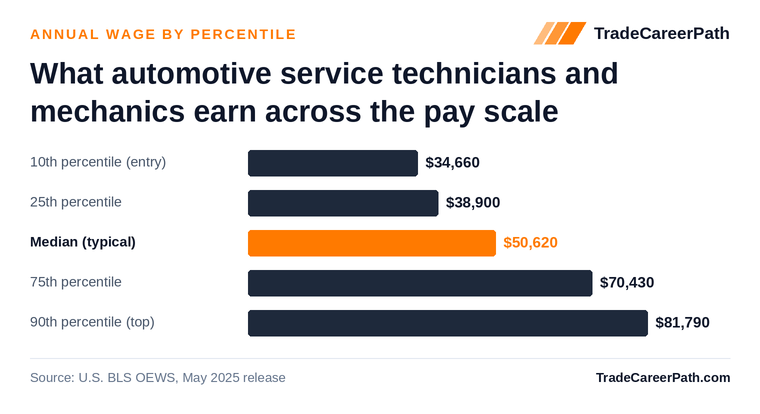
Quick answer: Training as an auto mechanic usually takes 6 months to 2 years of trade school plus hands-on experience. You complete an automotive technology program, build skill through an apprenticeship or entry-level shop job, and can earn the voluntary ASE certification from the National Institute for Automotive Service Excellence. No college degree is required, and ASE is not a legal license, though some states require separate registration for emissions or inspection work. The median auto mechanic salary is $50,620 per year ($24.34/hour), and employers post about 66,200 openings nationwide each year (BLS, May 2025).
Auto mechanics inspect, diagnose, repair, and maintain cars, trucks, and SUVs, including hybrids and electric vehicles. It is a hands-on trade you can enter without a college degree, and skilled technicians stay in steady demand as vehicles grow more complex.
How to Become an Auto Mechanic
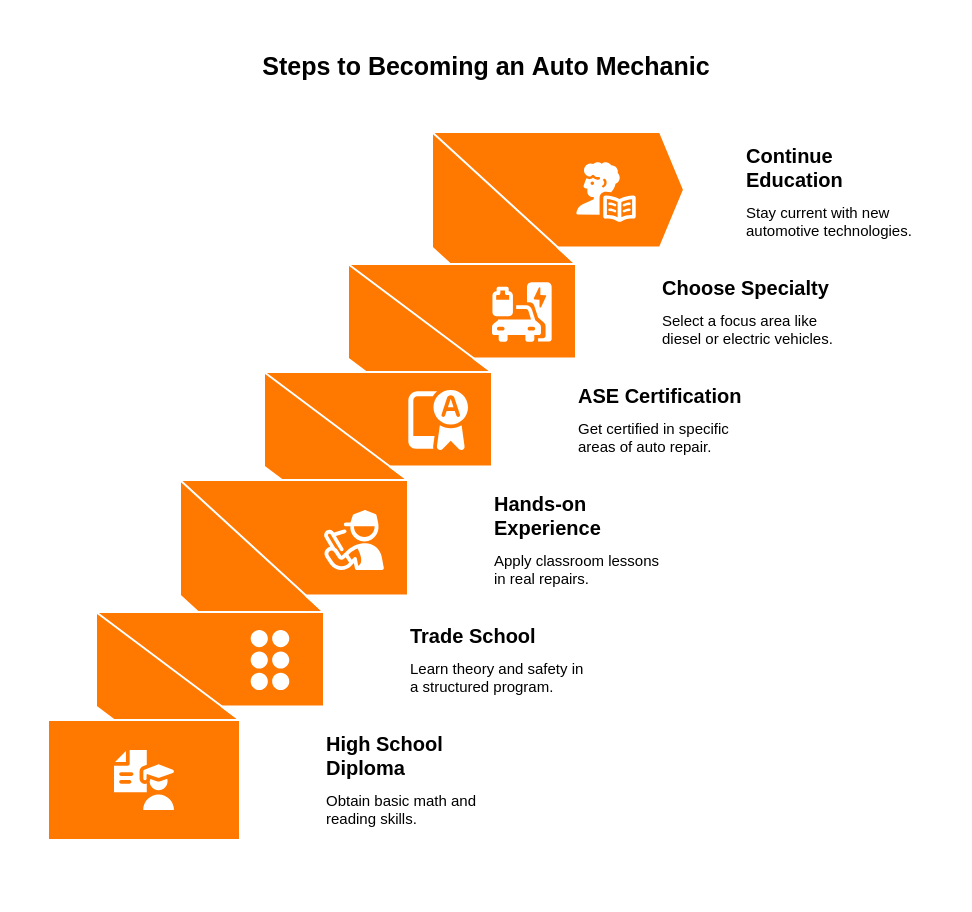
Most people enter the trade in about 6 months to 2 years, depending on the program they choose. There is no single national license to pass. Instead, you build the career through training, hands-on experience, and the voluntary ASE certification.
1. Earn a high school diploma or GED
A high school diploma or GED is the baseline requirement for almost every automotive program and entry-level shop job. Before you enroll, it helps to build the skills the work depends on. Math supports measurements, torque specs, and electrical calculations, while reading comprehension matters for service manuals, wiring diagrams, and the diagnostic trouble codes you will work with daily. Any hands-on or technical classes your school offers, such as auto shop, metalworking, or basic electronics, give you a head start. Being comfortable with computers helps too, since modern repair relies on scan tools, manufacturer software, and online repair databases. If you are changing careers and already hold a diploma, you can move straight to training. Many strong mechanics come from other fields and bring useful skills in problem solving, customer service, and working with tools.
2. Complete an automotive training program
This is the core of your preparation. Enroll in an automotive technology program at a trade school or community college, where you split time between classroom theory and hands-on shop labs. Coursework typically covers engine systems, brakes, steering and suspension, electrical and electronics, heating and air conditioning, transmissions, and computerized diagnostics. When comparing schools, look for accreditation from the ASE Education Foundation (formerly NATEF), which reviews automotive programs at high schools and colleges against industry standards. Accredited programs are more likely to use current equipment and prepare you for ASE exams. Programs commonly run 6 to 18 months for a certificate, while an associate degree takes about two years. Training cost varies by program and school, so confirm current tuition and ask whether tools, uniforms, or certification fees are included before you enroll.
3. Gain hands-on experience
Classroom work prepares you, but employers want to see real repair experience. Look for an apprenticeship or entry-level shop position, such as a lube tech, tire technician, or shop helper, where you work under experienced mechanics and learn the daily workflow of a real shop. Many employers offer paid on-the-job training, so you earn while you build practical skill diagnosing problems, using lifts and diagnostic equipment, and completing repairs to manufacturer specs. This stage is where you get faster, learn to read customers and vehicles, and start to find the work you enjoy most. Keep track of the systems you have worked on and the repairs you can complete independently, since that record helps when you apply for better-paying roles or move into a dealership.
4. Earn ASE certification
ASE certification is voluntary nationwide, but it is the most recognized credential in the trade and can raise your pay and job options. The National Institute for Automotive Service Excellence (ASE) certifies technicians in specific areas such as engine repair, brakes, electrical systems, heating and air conditioning, and hybrid and EV systems. The A-Series covers nine main automotive areas, and passing all of them along with the right experience earns Master Technician status. Most ASE certifications require relevant work experience plus a passing exam score, and they must be renewed periodically. To work on vehicle air conditioning, you also need EPA Section 609 certification. Some states separately require registration or licensing for emissions or safety inspection work, so check your state’s rules before you take on that work.
5. Specialize and advance
With experience and certifications, you can choose a direction that fits your interests and pays well. Common specialties include diesel mechanics, performance and high-end repair, EV and hybrid technology, and fleet maintenance. Manufacturer training programs from automakers such as Toyota, Ford, or GM qualify you for dealership work and brand-specific certifications. Joining a trade group like the Automotive Service Association (ASA) can connect you with shop owners, training, and industry updates. From there, paths include master technician, shop foreman or service manager, and eventually owning your own repair shop. Continuing education matters in this trade because vehicle technology keeps changing, so the techs who stay current with new systems tend to earn the most.
What Does an Auto Mechanic Do?
Auto mechanics inspect, diagnose, repair, and maintain vehicles of all kinds, including cars, trucks, SUVs, hybrids, and electric models. The job blends mechanical work with computer-based diagnostics, since modern vehicles rely on sensors, control modules, and software. Depending on the shop and specialty, daily tasks might include:
- Diagnose engine, electrical, and drivetrain problems using scan tools
- Replace worn parts such as brakes, suspension components, and transmissions
- Perform routine maintenance like oil changes, fluid services, and inspections
- Road-test vehicles and verify repairs meet manufacturer specs
- Explain repairs and estimates to customers
Some technicians go on to specialize in EV technology, performance tuning, or diesel mechanics.
Skills Every Mechanic Needs
- Mechanical and electrical aptitude
- Diagnostic problem solving
- Attention to detail
- Comfort with scan tools and repair software
- Clear communication with customers
- Willingness to keep learning new vehicle technology
Work Settings for Auto Mechanics
Auto mechanics work in a range of environments, including:
- Independent repair shops
- New and used car dealerships
- Fleet service centers for delivery, transit, or government vehicles
- Specialty shops for diesel, performance, or collision work
- Tire and quick-service centers
Where to Get Certified
ASE certification is national, but some states require additional licensing or registration for emissions or inspection work.
| Certification | Details |
|---|---|
| ASE A-Series | Covers 9 main automotive areas including engines, brakes, and transmissions |
| EPA Section 609 | Required to work on vehicle air conditioning systems |
| Manufacturer Training | OEM courses (Toyota, Ford, GM, and others) for dealership techs |
Career Growth and Advancement
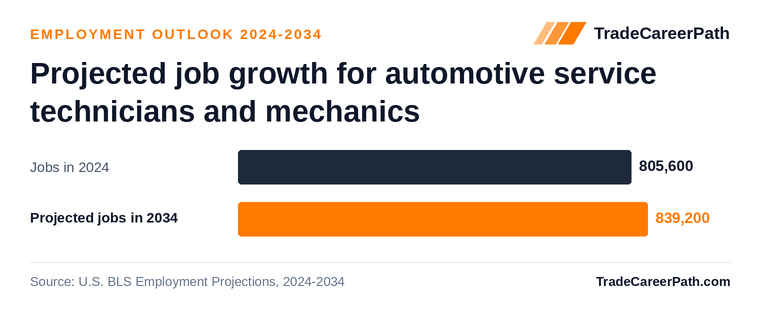
With experience and certifications, auto mechanics can move into roles such as:
- ASE Master Technician who handles complex diagnostics and repairs
- Specialty Technician in diesel, EV, or performance work
- Shop Foreman or Service Manager who oversees a team and workflow
- Shop Owner who runs an independent repair business
Cost and Duration of Training
- Time to complete: trade school certificate programs often run 6 to 18 months; an associate degree takes about 2 years
- Program cost: varies by program and school, so confirm current tuition before enrolling; many programs cost less than a traditional four-year degree
- Certification: ASE and EPA Section 609 carry their own exam fees and renewal requirements
Many mechanics complete trade school first, then move into a shop or dealership while studying for ASE exams.
Explore mechanic programs by state or find local options using the program finder above.
Pros and Cons of the Automotive Trade
Pros
- Learn a lifelong, in-demand skill without a college degree
- Steady job stability and growth for ASE-certified techs
- Clear paths to specialize or own a shop
- Hands-on work with constant problem solving
Cons
- Physically demanding work
- Exposure to noise, fumes, and heavy equipment
- Must keep certifications current as technology changes
Quick Facts: Auto Mechanic Salary, Education, and Outlook
Start Your Mechanic Career
Whether you want to repair daily drivers, work on diesel fleets, or service the latest EVs, skilled auto mechanics stay in demand. Find a training program that fits your goals and start building a hands-on career.
Industry Organizations & Certifying Bodies
These are the recognized national organizations, unions, certifying bodies, and regulatory authorities that shape this trade. They issue the credentials, sponsor the apprenticeships, publish the codes, and represent workers and employers.
- National Institute for Automotive Service Excellence (ASE) Industry-standard ASE certifications across all automotive service specialties.
- Automotive Service Association (ASA) Independent repair-shop trade association.
- National Automotive Technicians Education Foundation (NATEF / ASE Education) Accredits automotive training programs at high schools and colleges.
Wage and Employment Charts
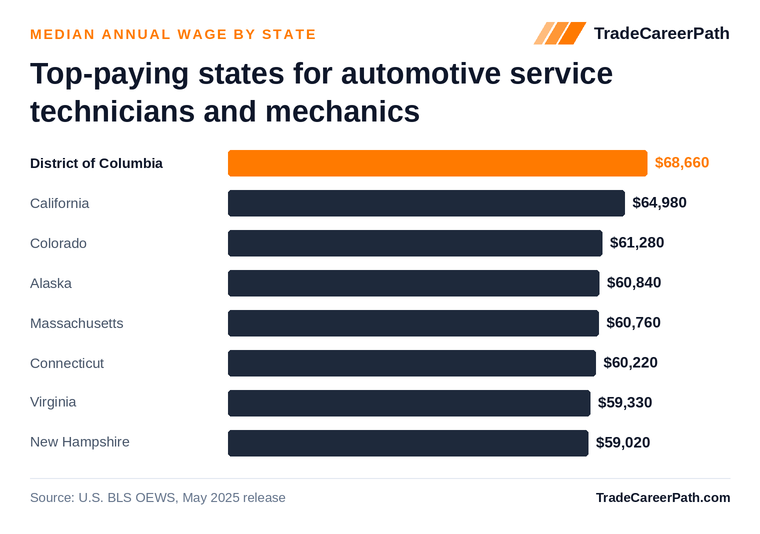
Auto Mechanic Salary and Requirements by State
Select your state for local wage data, training options, and requirements:
Alabama · Alaska · Arizona · Arkansas · California · Colorado · Connecticut · Delaware · District of Columbia · Florida · Georgia · Hawaii · Idaho · Illinois · Indiana · Iowa · Kansas · Kentucky · Louisiana · Maine · Maryland · Massachusetts · Michigan · Minnesota · Mississippi · Missouri · Montana · Nebraska · Nevada · New Hampshire · New Jersey · New Mexico · New York · North Carolina · North Dakota · Ohio · Oklahoma · Oregon · Pennsylvania · Rhode Island · South Carolina · South Dakota · Tennessee · Texas · Utah · Vermont · Virginia · Washington · West Virginia · Wisconsin · Wyoming
Workplace Safety Snapshot
BLS Survey of Occupational Injuries and Illnesses data (2023-2024) report approximately 286.5 days-away, restricted, or transfer cases per 10,000 full-time-equivalent workers in automotive service technicians and mechanics (about 2.87 per 100 FTE). Source: BLS Survey of Occupational Injuries and Illnesses, Table R98.
Frequently Asked Questions
How long does auto mechanic training take?
Most people finish a trade school automotive program in about 6 months to 2 years, then build skill on the job. A high school diploma or GED is generally required to get started. Many techs keep training for years as they add ASE certifications and learn new vehicle systems.
Do you need a college degree to work as an auto mechanic?
No. A college degree is not required to work as an auto mechanic. Most people enter the field through an automotive technology program at a trade school or community college. A high school diploma or GED is typically the only educational prerequisite.
How much does auto mechanic training cost?
Training cost varies by program, school, and length, so check current tuition with each school you are considering. Many trade school automotive programs cost less than a traditional four-year degree, and some employers help cover tools, certification fees, or continuing education.
Is ASE certification required to be an auto mechanic?
ASE certification from the National Institute for Automotive Service Excellence is voluntary nationwide, not a legal license. Many shops and dealerships prefer or require it because it shows verified skill. Some states also require separate registration or licensing for emissions or safety inspection work.
Is it hard to train as an auto mechanic?
Entry is fairly accessible because no college degree is required and most people finish training in 6 months to 2 years. The work itself is hands-on and technical, with steady learning as diagnostic tools and vehicle technology change.
Can you train to be an auto mechanic online?
Some classroom theory can be taken online, but auto mechanic training depends heavily on hands-on shop practice. Most students complete labs in person at a trade school or community college, often paired with apprenticeship or entry-level shop work.
How much do auto mechanics earn?
The median auto mechanic wage is $50,620 per year, or about $24.34 per hour (BLS, May 2025). Pay rises with ASE certifications, specialties such as diesel or EV work, and dealership or fleet roles.
How Auto Mechanic Pay Compares to Similar Trades
Side-by-side comparison of Mechanic & Engine Technician and the closest related careers, based on U.S. Bureau of Labor Statistics data (May 2025 OEWS + 2025-2035 Employment Projections).
| Career | Median Pay | 10-Year Growth | Annual Openings |
|---|---|---|---|
| Mechanic & Engine Technician this guide | $50,620 | +5.0% | 66,200 |
| Diesel Mechanic | $61,770 | +3.6% | 24,400 |
| Maintenance Technician | $49,590 | +4.2% | 148,700 |
| Heavy Equipment Operator | $59,850 | +4.6% | 39,200 |
| Mechanic & Engine Technician | $79,870 | +5.4% | 11,400 |
Source: BLS Occupational Employment and Wage Statistics + BLS Employment Projections.
Sources
- U.S. Bureau of Labor Statistics, Occupational Employment and Wage Statistics (May 2025)
- U.S. Bureau of Labor Statistics, Employment Projections 2025-2035
- U.S. Bureau of Labor Statistics, Survey of Occupational Injuries and Illnesses (2023-2024, Table R98)
- U.S. Department of Labor, Wage and Hour Division, Davis-Bacon General Wage Determinations (2026)
Auto Mechanic Salary by State
About this guide: Researched and written by the TradeCareerPath Editorial Team. Our editorial team researches and sources every trade school and career guide using federal labor and education data, including BLS OEWS and Employment Projections, DOL apprenticeship records, IPEDS, College Scorecard, and state licensing boards. We follow the editorial standards documented at /editorial-policy/.
Data sources
Figures on this page are sourced from the federal and state datasets below. Methodology: how we rank and source data.
| Data | Provider | Vintage |
|---|---|---|
| Occupational Employment and Wage Statistics (OEWS) | U.S. Bureau of Labor Statistics | May 2025 |
| Employment Projections | U.S. Bureau of Labor Statistics | 2025-2035 |
| Integrated Postsecondary Education Data System | National Center for Education Statistics (IPEDS) | 2024 |
| College Scorecard (school-level outcomes) | U.S. Department of Education | latest release |
| College Scorecard (field-of-study earnings) | U.S. Department of Education | latest release (updated 2026-06-12) |
| Occupational licensing requirements | CareerOneStop (U.S. Department of Labor) | latest release (updated 2026-02-22) |
| Registered apprenticeship programs | CareerOneStop / Apprenticeship.gov (U.S. Department of Labor) | latest release (updated 2025-10-25) |
| O*NET occupation profiles (skills, tasks, tools, job zones) | U.S. Department of Labor (O*NET / Employment & Training Admin.) | O*NET 31.0 (updated 2026-10-14) |