
How to Become an Automotive Service Technician (2026)
Is Automotive Service Technician Right for You?
The U.S. Department of Labor's O*NET profile for Automotive Service Technicians and Mechanics (SOC 49-3023) describes the work this way: Diagnose, adjust, repair, or overhaul automotive vehicles.
What the work involves
- Inspect vehicles for damage and record findings so that necessary repairs can be made.
- Test drive vehicles and test components and systems, using equipment such as infrared engine analyzers, compression gauges, and computerized diagnostic devices.
- Test and adjust repaired systems to meet manufacturers' performance specifications.
- Repair, reline, replace, and adjust brakes.
- Review work orders and discuss work with supervisors.
Skills and knowledge that matter
Skills: Repairing, Troubleshooting, Operations Monitoring, Critical Thinking, Equipment Maintenance, Operation and Control.
Knowledge: Mechanical, Customer and Personal Service, Computers and Electronics, Engineering and Technology.
Tools and technology you may use
Tools: 2-channel lab scopes, 3 pound sledge hammers, 5 pound sledge hammers, 5-gas emissions analyzers, Adjustable wrenches, Air chisels.
Technology: Facilities management software, Data base user interface and query software, Analytical or scientific software, Microsoft Excel, Microsoft Office software, Microsoft Outlook.
Typical preparation
O*NET Job Zone Three (Medium Preparation Needed). Most occupations in this zone require training in vocational schools, related on-the-job experience, or an associate's degree. Employees in these occupations usually need one or two years of training involving both on-the-job experience and informal training with experienced workers. A recognized apprenticeship program may be associated with these occupations.
Interest fit
O*NET interest profile: Realistic, Conventional, Investigative. People who enjoy hands-on, practical work with tools, machines, plants, or materials often find this occupation a good fit.
Source: O*NET 29.1 (updated 2026-06-13)
Want a career where you diagnose problems, work with your hands, and keep people moving?
Automotive service technicians (also called automotive mechanics or auto techs) inspect, maintain, and repair cars and light trucks. Most people get started through trade school, a dealership program, or an apprenticeship.
If you’re the person friends call when a check engine light pops on, you’ll probably like this work. You can get your foot in the door in 6-24 months, then build your skills (and pay) from there.
Quick answers
At a glance
- Role: Inspect, maintain, diagnose, and repair cars and light trucks.
- Typical start paths: Trade school, a dealership program, or an apprenticeship.
- Getting started: You can get your foot in the door in 6-24 months, then build your skills from there.
- Common workplaces: Independent repair shops, dealerships, fleet maintenance, and multi-service centers.
- Certifications mentioned: ASE A-Series, EPA Section 609 (A/C work), OEM training, and state inspection/emissions (where required).
What does an automotive service technician do?
Automotive service technicians inspect, maintain, diagnose, and repair cars and light trucks. Day-to-day work can include scan tool diagnostics, routine maintenance, repairs, road tests, and explaining recommendations.
How do most people enter the field?
Most people get started through trade school, a dealership program, or an apprenticeship. Many techs start as a lube tech, tire tech, or apprentice to build shop experience.
How long does it take to get started?
You can get your foot in the door in 6-24 months, then build your skills from there.
Where do automotive service technicians work?
Most technicians work in independent repair shops, dealership service departments, fleet maintenance, or tire/quick-lube and multi-service centers.
What certifications come up most often?
Certifications will not replace experience, but they can help you get hired and move up faster. This page highlights ASE credentials, EPA Section 609 for automotive A/C refrigerants, OEM training, and (in some states) inspection/emissions credentials.
What are common specialties?
Common specialties include electrical diagnostics, drivability, brakes/suspension, A/C, transmission, diesel, and hybrid/EV repair.
What Does an Automotive Service Technician Do?
Automotive service technicians do a little bit of everything: routine maintenance, diagnostics, and repairs that range from quick fixes to head-scratchers. On a typical day, you might:
- Diagnose warning lights and drivability issues using scan tools
- Perform routine maintenance (oil, brakes, tires, filters, fluids)
- Repair or replace parts (suspension, steering, cooling, exhaust, electrical)
- Test systems and road-test vehicles to confirm fixes
- Explain recommendations and estimates to customers or service advisors
Modern cars are rolling computers. If you enjoy electrical diagnostics (and you’re not afraid of hybrids/EVs), you’ll have plenty to dig into.
Where Automotive Service Technicians Work
Most technicians work in:
- Independent repair shops
- Dealership service departments (OEM training opportunities)
- Fleet maintenance (delivery, utility, municipal, and company vehicles)
- Tire, quick-lube, and multi-service centers
Quick reality check: entry-level work is often maintenance-heavy at first. If you stick with it and keep learning diagnostics, the job gets more interesting (and usually pays better).
How to Become an Automotive Service Technician (6 Steps)
There isn’t one “right” path, but the fastest way to improve is a mix of training, shop time, and a few well-chosen certifications.
1. Earn a High School Diploma or GED
Math, basic physics, and shop classes help. Communication matters too, because you'll explain repairs and write notes.
2. Complete an Automotive Technology Program (Recommended)
Trade schools and community colleges teach fundamentals like engines, brakes, electronics, diagnostics, and safety. Many programs include shop lab time on real vehicles.
3. Get Entry-Level Shop Experience
Start as a lube tech, tire tech, or apprentice. The early days can be repetitive (oil, tires, brakes), but that's where you get fast, learn tools, and start building real diagnostic instincts.
4. Earn ASE and/or OEM Certifications
ASE credentials can open doors and bump pay. Dealerships often have structured manufacturer (OEM) training, which can be a big advantage if you like working on specific brands.
5. Specialize
Common specialties include electrical diagnostics, drivability, brakes/suspension, A/C, transmission, diesel, and hybrid/EV repair.
6. Keep Learning as Tech Changes
New models, ADAS systems, and EV platforms mean ongoing training. Some people love that. Others find it exhausting. Either way, staying current is part of the job now.
Certifications to Know (ASE, EPA, and More)
Don’t get too hung up on alphabet soup. Certifications won’t replace experience, but they can help you get hired, move up faster, or negotiate better pay.
| Certification | What it’s for |
|---|---|
| ASE A-Series | Core automotive systems (engines, brakes, electrical, suspension, HVAC, etc.) |
| ASE L1 / L3 | Advanced engine performance (and EV/hybrid-related specialty credentials) |
| EPA Section 609 | Required to service automotive A/C refrigerants |
| State Inspection / Emissions | Some states require separate licensing for inspection and emissions testing |
| OEM Training | Brand-specific diagnostics and repair procedures (dealership pathways) |
For a deep dive, see our ASE certification guide.
Tools and Skills You’ll Use
You don’t need a giant tool collection on day one, but you should be comfortable with:
- Hand tools (ratchets, torque wrenches, sockets) and shop safety
- Digital multimeters and electrical testing
- Scan tools and service information systems
- A simple rule: test before you replace parts
Strong technicians also learn how to communicate clearly: what failed, what it affects, and what the options are. Half the job is fixing the car; the other half is explaining it without making anyone feel dumb.
Pros and cons of the career
Pros
- You can enter the field faster than a four-year degree
- The work stays varied (and you can specialize if you want to)
- Skills transfer across shops, brands, and fleets
Cons
- It’s physical work (and sometimes frustrating work)
- Tools cost money, especially as you level up
- Pay plans vary; flat-rate can reward speed, but it can be rough while you’re learning
Automotive service technician salary and outlook
Auto Technician Salary Snapshot
U.S.70,000 openings/yr
Ready to Start?
If you want a hands-on career that still feels technical, automotive service fits. Start with training, get into a shop as early as you can, and add certifications when they actually help your next step.
Industry Organizations & Certifying Bodies
These are the recognized national organizations, unions, certifying bodies, and regulatory authorities that shape this trade. They issue the credentials, sponsor the apprenticeships, publish the codes, and represent workers and employers.
- National Institute for Automotive Service Excellence (ASE) Industry-standard ASE certifications across all automotive service specialties.
- Automotive Service Association (ASA) Independent repair-shop trade association.
- ASE Education Foundation Accredits automotive training programs.
Wage and Employment Charts
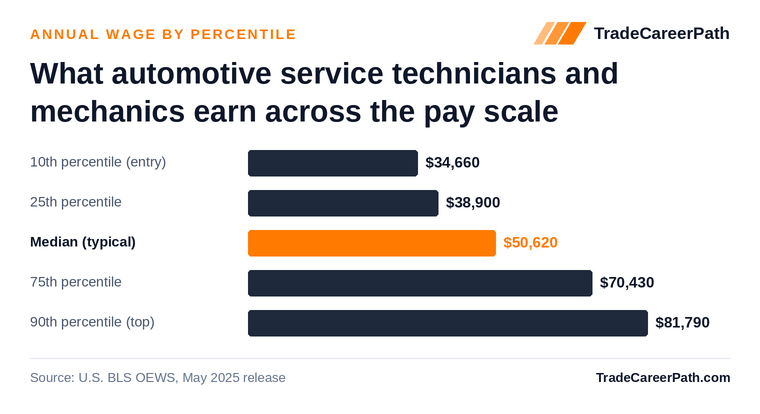
| Percentile | Annual wage |
|---|---|
| 10th | $34,660 |
| 25th | $38,900 |
| 50th (median) | $50,620 |
| 75th | $70,430 |
| 90th | $81,790 |
| Year | Employment |
|---|---|
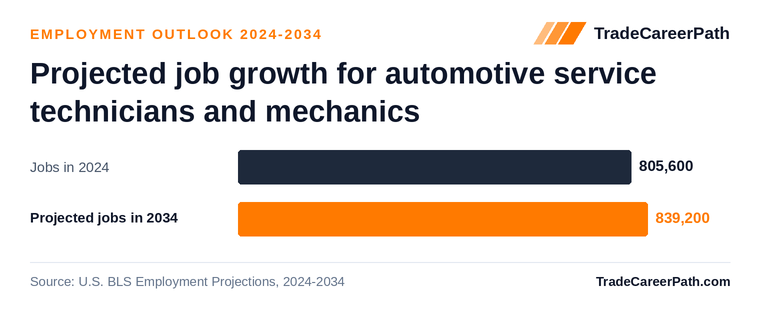
| 2024 | 805,600 |
| 2034 projected | 839,200 |
| Percent change | +4.2% |
Automotive Service Technician Salary and Requirements by State
Select your state for local wage data, training options, and requirements:
Alabama · Alaska · Arizona · Arkansas · California · Colorado · Connecticut · Delaware · District of Columbia · Florida · Georgia · Hawaii · Idaho · Illinois · Indiana · Iowa · Kansas · Kentucky · Louisiana · Maine · Maryland · Massachusetts · Michigan · Minnesota · Mississippi · Missouri · Montana · Nebraska · Nevada · New Hampshire · New Jersey · New Mexico · New York · North Carolina · North Dakota · Ohio · Oklahoma · Oregon · Pennsylvania · Rhode Island · South Carolina · South Dakota · Tennessee · Texas · Utah · Vermont · Virginia · Washington · West Virginia · Wisconsin · Wyoming
Workplace Safety Snapshot
BLS Survey of Occupational Injuries and Illnesses data (2023-2024) report approximately 286.5 days-away, restricted, or transfer cases per 10,000 full-time-equivalent workers in automotive service technicians and mechanics (about 2.87 per 100 FTE). Source: BLS Survey of Occupational Injuries and Illnesses, Table R98.
Frequently Asked Questions
How long does automotive service technician training take?
It typically takes typically 6 months to 2 years of training. The most common entry path is through a certificate or associate degree program. A high school diploma or GED is generally required to get started.
How much do automotive service technicians make?
The median annual salary for automotive service technicians is $50,620 according to the Bureau of Labor Statistics (May 2025). Entry-level workers earn around $34,660, while those in the 90th percentile earn over $81,790. Pay varies by state, experience, and specialization.
What is the job outlook for automotive service technicians?
The Bureau of Labor Statistics projects 4.2% employment growth for this occupation from 2024 to 2034, which is about as fast as average. Approximately 70,000 job openings are expected each year due to growth, retirements, and workers leaving the field.
Do you need a college degree to work as an automotive service technician?
No. A college degree is not required to work as an automotive service technician. Most people enter the field through a certificate or associate degree program. A high school diploma or GED is typically the only educational prerequisite.
Which states pay automotive service technicians the most?
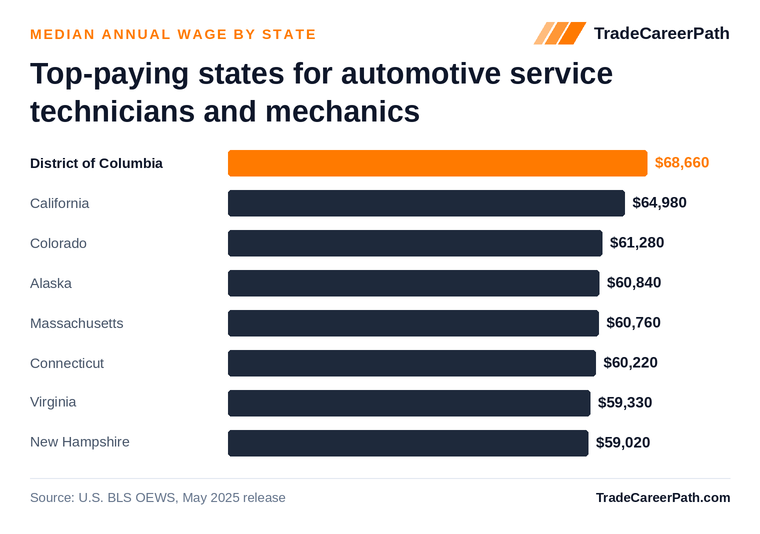
According to the U.S. Bureau of Labor Statistics (May 2025 OEWS), the highest-paying states for automotive service technicians are District of Columbia, California, and Colorado. Median annual wages: District of Columbia ($68,660); California ($64,980); Colorado ($61,280).
Which states employ the most automotive service technicians?
BLS reports the largest concentrations of automotive service technicians in Texas, California, and Florida. Employment levels: Texas (69,750 workers); California (65,420 workers); Florida (49,930 workers) (May 2025).
How much do experienced automotive service technicians earn?
The top 10% of automotive service technicians earn more than $81,790 per year, according to BLS Occupational Employment and Wage Statistics (May 2025). Experienced workers in this band typically hold senior credentials, supervisory roles, or specialty certifications.
What is entry-level pay for automotive service technicians?
BLS reports the bottom 10% of automotive service technicians earn under $34,660 per year. New workers often start near this level and see pay rise as they accumulate experience and credentials.
How many automotive service technicians work in the United States?
BLS reports approximately 704,640 automotive service technicians employed nationwide as of May 2025.
How many job openings are expected for automotive service technicians each year?
BLS projects approximately 70,000 openings per year for automotive service technicians from 2024 through 2034, including new positions, retirements, and workers transitioning out. The occupation is projected to grow 4.2% from 2024 to 2034, classified as about as fast as average growth.
How much do automotive service technicians make per hour?
The median hourly wage for automotive service technicians is $24.34, according to BLS (May 2025). Hourly pay ranges from about $16.66 (bottom 10%) to $39.32 (top 10%).
Sources
- U.S. Bureau of Labor Statistics, Occupational Employment and Wage Statistics (May 2025)
- U.S. Bureau of Labor Statistics, Employment Projections 2024-2034
- U.S. Bureau of Labor Statistics, Survey of Occupational Injuries and Illnesses (2023-2024, Table R98)
- U.S. Department of Labor, Wage and Hour Division, Davis-Bacon General Wage Determinations (2026)
Automotive Service Technician Salary by State
About this guide: Researched and written by the TradeCareerPath Editorial Team. Our editorial team researches and sources every trade school and career guide using federal labor and education data, including BLS OEWS and Employment Projections, DOL apprenticeship records, IPEDS, College Scorecard, and state licensing boards. We follow the editorial standards documented at /editorial-policy/.
Data sources
Figures on this page are sourced from the federal and state datasets below. Methodology: how we rank and source data.
| Data | Provider | Vintage |
|---|---|---|
| Occupational Employment and Wage Statistics (OEWS) | U.S. Bureau of Labor Statistics | May 2025 |
| Employment Projections | U.S. Bureau of Labor Statistics | 2024-2034 |
| Integrated Postsecondary Education Data System | National Center for Education Statistics (IPEDS) | 2024 |
| College Scorecard (school-level outcomes) | U.S. Department of Education | latest release |
| College Scorecard (field-of-study earnings) | U.S. Department of Education | latest release (updated 2026-06-12) |
| Occupational licensing requirements | CareerOneStop (U.S. Department of Labor) | latest release (updated 2026-02-22) |
| Registered apprenticeship programs | CareerOneStop / Apprenticeship.gov (U.S. Department of Labor) | latest release (updated 2025-10-25) |
| O*NET occupation profiles (skills, tasks, tools, job zones) | U.S. Department of Labor (O*NET / Employment & Training Admin.) | O*NET 29.1 (updated 2026-06-13) |