
How to Become a Biomedical Engineer in 2026
Is Biomedical Engineer Right for You?
The U.S. Department of Labor's O*NET profile for Bioengineers and Biomedical Engineers (SOC 17-2031) describes the work this way: Apply knowledge of engineering, biology, chemistry, computer science, and biomechanical principles to the design, development, and evaluation of biological, agricultural, and health systems and products, such as artificial organs, prostheses, instrumentation, medical information systems, and health management and care delivery systems.
What the work involves
- Evaluate the safety, efficiency, and effectiveness of biomedical equipment.
- Prepare technical reports, data summary documents, or research articles for scientific publication, regulatory submissions, or patent applications.
- Design or develop medical diagnostic or clinical instrumentation, equipment, or procedures, using the principles of engineering and biobehavioral sciences.
- Conduct research, along with life scientists, chemists, and medical scientists, on the engineering aspects of the biological systems of humans and animals.
- Adapt or design computer hardware or software for medical science uses.
Skills and knowledge that matter
Skills: Reading Comprehension, Active Listening, Writing, Speaking, Mathematics, Science.
Knowledge: Engineering and Technology, Computers and Electronics, Mathematics, Design.
Tools and technology you may use
Technology: Enterprise resource planning ERP software, Development environment software, Medical software, Adobe Illustrator, Adobe Photoshop, Autodesk AutoCAD.
Typical preparation
O*NET Job Zone Four (Considerable Preparation Needed). Most of these occupations require a four-year bachelor's degree, but some do not. Employees in these occupations usually need several years of work-related experience, on-the-job training, and/or vocational training.
Interest fit
O*NET interest profile: Investigative, Realistic, Conventional. People who enjoy working with ideas, searching for facts, and figuring out problems often find this occupation a good fit.
Source: O*NET 31.0 (updated 2026-10-14)
Quick answer: Training as a biomedical engineer requires a 4-year degree - typically an ABET-accredited bachelor’s in biomedical engineering. The national median pay is $109,370 per year, and BLS projects +7.6% employment change from 2025 to 2035 (BLS OEWS, May 2025; BLS Employment Projections, 2025-35).
Biomedical Engineer at a Glance
| Metric | Detail | Source |
|---|---|---|
| Median annual wage | $109,370 | BLS OEWS, May 2025 |
| Typical wage range | $71,850 (10th pct) - $168,180 (90th pct) | BLS OEWS, May 2025 |
| Employment | 23,480 nationwide | BLS OEWS, May 2025 |
| Projected growth (2025-35) | +7.6%, about 1,200 openings per year | BLS Employment Projections, 2025-35 |
| Typical education | ABET-accredited bachelor’s in biomedical engineering | BLS Occupational Outlook Handbook |
| License / certification | No license for most roles | None for most roles |
What Does a Biomedical Engineer Do?
Biomedical engineers design medical devices, imaging systems, prosthetics, and hospital equipment - the engineering layer above the biomedical equipment technicians who install, calibrate, and repair that gear in the field.
Day to day, the work depends on the sub-specialty. A device design engineer takes an implantable or diagnostic product from concept through verification - picking materials that survive sterilization, running risk analysis, and proving the design meets its requirements. A test or quality engineer writes verification and validation protocols, runs them, and documents everything to FDA Quality System Regulation and ISO 13485 standards, because in this industry an undocumented test never happened. An imaging engineer works on MRI, CT, and ultrasound systems - a blend of electronics, software, and physics. A clinical engineer sits inside a hospital system, managing the device fleet, evaluating new equipment purchases, and investigating incidents. Regulatory affairs engineers build the submissions (510(k), PMA) that get a product legally onto the market. Across all of them, the paperwork burden is real: design history files, traceability matrices, and design reviews shape the routine as much as the engineering itself.
If you are coming from medical equipment repair, the shortest way to say it: the BMET keeps the device working and safe in the field; the engineer decides how the device is designed, tested, and cleared in the first place. The service bulletins, failure trends, and usability complaints you have been reporting upstream for years - as an engineer, those land on your desk, and your field experience tells you which ones are real.
Skills That Make a Great Biomedical Engineer
- Medical-device design standards
- Electronics and mechanical systems
- Regulatory knowledge (FDA QSR, ISO 13485)
- Verification and validation testing
- Clinical-environment awareness
- Risk analysis (FMEA, ISO 14971) and human-factors thinking
- CAD, LabVIEW/MATLAB or Python for test and data analysis
- Writing: protocols, design-history documentation, and regulatory submissions carry the job
Biomedical Engineer Salary
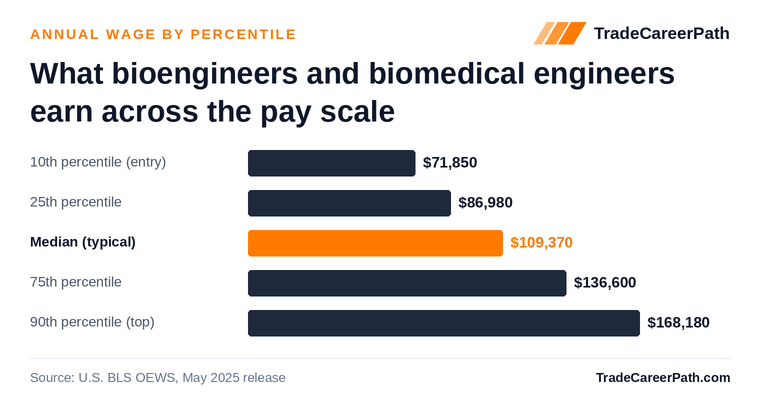
Biomedical engineering pays well above most of the trades that feed into it. The national median is $109,370 per year, and the 10th percentile - roughly where new graduates start - is $71,850, in line with what experienced BMETs earn after years in the field. The 75th percentile is $136,600, and the top 10% earn $168,180 or more (BLS OEWS, May 2025).
Where the Jobs and the Money Are
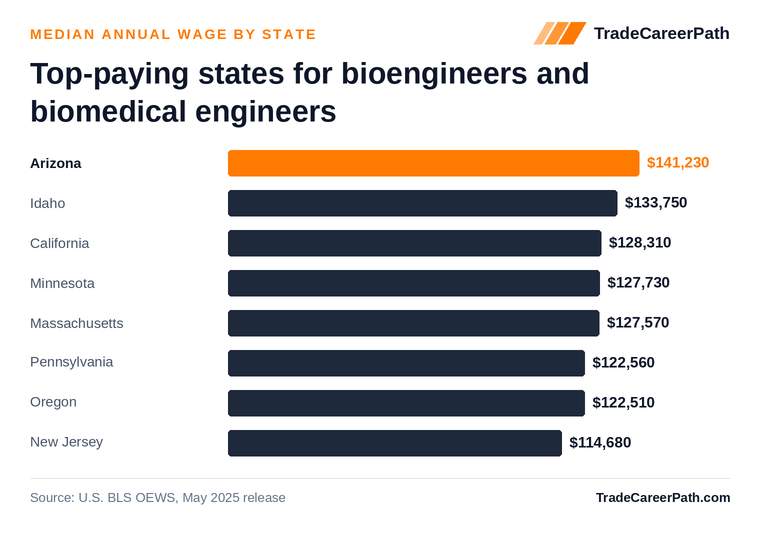
This is a small, concentrated occupation - 23,480 jobs nationwide, and BLS publishes state data for only 37 states (BLS OEWS, May 2025). The industry clusters around device-manufacturing hubs: the Boston medical-device corridor, the Twin Cities implantables cluster, and California’s diagnostics and imaging companies.
| State | Median annual wage | Employment |
|---|---|---|
| Arizona | $141,230 | 610 |
| Idaho | $133,750 | - |
| California | $128,310 | 2,750 |
| Minnesota | $127,730 | 1,230 |
| Massachusetts | $127,570 | 4,740 |
Massachusetts is the standout on both counts: 4,740 engineers - the largest state cluster - and a location quotient of 8.63, meaning biomedical engineers are far more common there than in the average state labor market. Minnesota’s concentration (location quotient 2.76) reflects the pacemaker and implantables industry around Minneapolis. Deep markets like these matter for career changers: more employers within commuting range means more room to change jobs and negotiate without relocating. Texas has the third-largest headcount at 2,050 but a lower median of $92,600, so weigh cost of living against the wage gap.
How to Become a Biomedical Engineer
1. Earn an ABET-accredited bachelor’s
Biomedical engineering, or electrical/mechanical engineering with a biomedical focus. Accreditation is the one non-negotiable: employers screen for it and the FE/PE licensure path assumes it. For working technicians, the electrical or mechanical route usually offers more accredited online and evening options - and device manufacturers hire electrical and mechanical engineers into biomedical roles as a matter of course, so the broader degree carries less risk if you ever leave the industry.
2. Use device experience
BMET and field-service backgrounds are valued in test, quality, and field-engineering roles. Say so explicitly: on applications, years of hands-on time with infusion pumps, imaging systems, and patient monitors reads as proof you understand how the hardware actually behaves, fails, and gets used on a hospital floor - knowledge most new graduates simply do not have. Some schools grant transfer credit for BMET or military biomedical coursework; get a written transfer evaluation before you enroll anywhere.
3. Start in test, quality, or field engineering
Device manufacturers hire at the bachelor’s level, and these three functions are the classic entry points for former technicians because the job is judging real hardware rather than working purely from models. Regulatory knowledge accelerates everything: an entry-level engineer who already speaks FDA QSR and ISO 13485 is immediately useful on audits, CAPAs, and design reviews, and quality engineering is chronically short-staffed at device companies.
4. Specialize
Imaging, implantables, diagnostics, or regulatory affairs. Pick based on where you want to live as much as what interests you - implantables concentrate in Minnesota, devices and diagnostics in Massachusetts and California. Regulatory affairs is the sleeper option: it is document-heavy rather than lab-heavy, pays well, and experienced regulatory engineers are scarce because most engineers avoid the paperwork.
5. Advance
Senior engineer, quality management, or R&D leadership. The fork comes around the ten-year mark: deepen into a technical or regulatory authority role, or take the management track running a quality system or an R&D group. Both are covered in the career ladder below, and both benefit from the same thing - a track record of getting products through verification and clearance without surprises.
Career Ladder: Titles and Realistic Pay
The BLS wage percentiles map cleanly onto how device-industry careers actually progress. Use this as a sanity check on offers, not a guarantee:
| Stage | Typical titles | Years in | Realistic pay (BLS OEWS, May 2025) |
|---|---|---|---|
| Entry level | Engineer I, test engineer, quality engineer, field engineer | 0-3 | ~$71,850-$86,980 (10th-25th pct) |
| Mid-career | Engineer II/III, V&V lead, sustaining engineer | 3-10 | ~$109,370 (median) |
| Senior | Senior/staff engineer, quality manager, regulatory lead | 10-15 | ~$136,600 (75th pct) |
| Principal / leadership | Principal engineer, R&D manager, director of quality | 15+ | $168,180+ (90th pct) |
Two notes for career changers. First, prior BMET or field-service experience compresses this ladder: former technicians are routinely hired above the bottom of the entry band because they need less supervision around real clinical hardware and already know the regulatory environment. Second, the figures here are base wages - bonus and stock components at larger device companies push senior total compensation above the percentile data shown.
Do You Need a PE License?
Mostly no. Biomedical engineers at device manufacturers work under the “industrial exemption” - the company, not the individual engineer, holds design responsibility, so most never license. The credentials that actually move a device-industry career are regulatory and quality ones:
- Regulatory fluency: demonstrated FDA QSR/ISO 13485 experience, and for regulatory-affairs roles, the RAC (Regulatory Affairs Certification) is the recognized marker.
- Quality certifications: ASQ credentials such as Certified Quality Engineer carry weight in quality and manufacturing roles.
- Clinical engineering certification: hospital-side clinical engineers can pursue the CCE credential.
If you want the PE anyway - it helps in consulting, forensic, and some hospital-facing work - the path is: ABET degree, pass the Fundamentals of Engineering (FE) exam (you can sit for it as a senior), four years of qualifying experience, then the PE exam, per your state board’s rules.
Why an Online Degree Works for This Career
Medical equipment repairers (BMETs) are the natural feeders: you already know the devices, the standards, and the hospital environment. The bachelor’s converts service expertise into design and quality-engineering roles at device manufacturers. ABET-accredited online programs (often via electrical or mechanical engineering with a biomedical track) serve working technicians, and hospital systems and device makers commonly offer tuition assistance - many BMETs complete the degree with most of the tuition covered, without leaving their job or their seniority.
Job Outlook for 2026 and Beyond
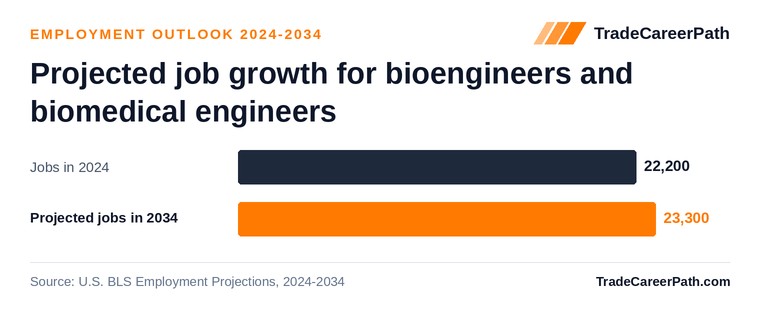
BLS projects employment of bioengineers and biomedical engineers to grow +7.6% from 2025 to 2035 - from 23,800 to 25,700 jobs - with about 1,200 openings per year once retirements and occupation changes are counted (BLS Employment Projections, 2025-35). The latest wage data (OEWS, May 2025) puts the median at $109,370, up from the 2024 figure of $106,950 - pay in this field is high and still climbing.
The demand drivers are demographic and durable: an aging population needs more implants, imaging, and monitoring, and every new device generation needs engineers to design, verify, and clear it. Be honest about the scale, though - this is a small occupation, and 1,200 openings a year means hiring is steady but not abundant. That cuts both ways for career changers: fewer seats, but a BMET background is a genuine differentiator in a candidate pool full of new graduates who have never touched clinical equipment.
Cost and Time to Complete the Degree
For biomedical engineers, the credential is: ABET-accredited bachelor’s in biomedical engineering. A bachelor’s degree is typically 120 credit hours: four years full-time, and commonly five to six years part-time while working. Transfer credit is the other lever: prior college, military training, apprenticeship coursework, and industry certifications can be worth meaningful credit at transfer-friendly schools, so get a written transfer evaluation before enrolling anywhere. Costs vary widely by school type; in-state public online programs are usually the value benchmark, and employer tuition assistance is common for working adults in this field.
Pros and Cons of Training as a Biomedical Engineer
Pros
- Median pay of $109,370 nationally (BLS OEWS, May 2025)
- BLS projects +7.6% employment growth through 2035
- Field experience from the trades is a genuine hiring advantage
- Accredited online and hybrid degree paths exist for working adults
Cons
- Requires a 4-year degree (typically 120 credit hours)
- Entry-level pay starts near $71,850 at the 10th percentile
- Small occupation (23,480 jobs, about 1,200 openings per year) concentrated in a few hub states
Frequently Asked Questions
Can a medical equipment repairer work as a biomedical engineer?
Yes - BMET experience plus the ABET bachelor's is a recognized path into device manufacturers, where field familiarity with the equipment is a hiring advantage.
How much do biomedical engineers make?
The national median annual wage for bioengineers and biomedical engineers is $109,370 (BLS OEWS, May 2025). The top 10% earn $168,180 or more, while entry-level pay starts around $71,850.
What is the job outlook for biomedical engineers?
BLS projects employment of bioengineers and biomedical engineers to change by +7.6% from 2025 to 2035 (BLS Employment Projections, 2025-35).
How long does biomedical engineer training take?
The ABET-accredited bachelor's is 120 credit hours: four years full-time, commonly five to six years part-time while working. Transfer credit from prior college, military training, or BMET coursework can meaningfully shorten it at transfer-friendly schools.
Is biomedical engineering hard?
The degree is demanding - calculus, physics, circuits, and biology all show up, and device work adds regulatory coursework on top. Working BMETs and field-service techs usually find the instrumentation and systems courses easier than fresh high-school graduates do, because they have already troubleshot the real hardware.
Should I get a biomedical or electrical/mechanical engineering degree?
For working technicians, electrical or mechanical engineering with a biomedical focus is often the smarter buy: more ABET-accredited online options, and the degree stays marketable outside the device industry. Device manufacturers hire electrical and mechanical engineers into biomedical roles constantly; the reverse is harder.
Can you train as a biomedical engineer without a degree?
Not with the engineer title - employers require the ABET-accredited bachelor's. Without it, the ceiling is BMET, field-service, or engineering-technician roles. BMET experience shortens the degree through transfer credit and makes you a stronger hire, but it does not replace it.
Do biomedical engineers need a PE license?
Usually no - most work at device manufacturers under the industrial exemption, so the company holds design responsibility. Regulatory and quality credentials (FDA QSR/ISO 13485 knowledge, RAC, ASQ certifications) generally matter more for advancement. If you want the PE, the path is ABET degree, FE exam, qualifying experience, then the PE exam per your state board.
Biomedical Engineer Salary and Requirements by State
Alabama · Arizona · Arkansas · California · Colorado · Connecticut · District of Columbia · Florida · Georgia · Idaho · Illinois · Indiana · Iowa · Kentucky · Louisiana · Maryland · Massachusetts · Michigan · Minnesota · Mississippi · Missouri · Nebraska · Nevada · New Hampshire · New Jersey · New York · North Carolina · Ohio · Oklahoma · Oregon · Pennsylvania · South Carolina · Tennessee · Texas · Utah · Virginia · Wisconsin
Related Careers and Degree Paths
- Electrical Engineer - the electronics and instrumentation side of the same device work
- Mechanical Engineer - the broader degree that device manufacturers also hire from
- Electronics Engineer - imaging and monitoring hardware runs on this discipline
- Online Engineering Degrees for Tradespeople - how to pick an ABET program that fits a work schedule
- All trade careers that require a 4-year degree
Sources
- U.S. Bureau of Labor Statistics, Occupational Employment and Wage Statistics (OEWS), May 2025 - Bioengineers and Biomedical Engineers (SOC 17-2031)
- U.S. Bureau of Labor Statistics, Employment Projections, 2025-35
- U.S. Bureau of Labor Statistics, Occupational Outlook Handbook - education and licensing requirements
Biomedical Engineer Salary by State
About this guide: Researched and written by the TradeCareerPath Editorial Team. Our editorial team researches and sources every trade school and career guide using federal labor and education data, including BLS OEWS and Employment Projections, DOL apprenticeship records, IPEDS, College Scorecard, and state licensing boards. We follow the editorial standards documented at /editorial-policy/.
Data sources
Figures on this page are sourced from the federal and state datasets below. Methodology: how we rank and source data.
| Data | Provider | Vintage |
|---|---|---|
| Occupational Employment and Wage Statistics (OEWS) | U.S. Bureau of Labor Statistics | May 2025 |
| Employment Projections | U.S. Bureau of Labor Statistics | 2025-2035 |
| Integrated Postsecondary Education Data System | National Center for Education Statistics (IPEDS) | 2024 |
| College Scorecard (school-level outcomes) | U.S. Department of Education | latest release |
| College Scorecard (field-of-study earnings) | U.S. Department of Education | latest release (updated 2026-06-12) |
| Occupational licensing requirements | CareerOneStop (U.S. Department of Labor) | latest release (updated 2026-02-22) |
| Registered apprenticeship programs | CareerOneStop / Apprenticeship.gov (U.S. Department of Labor) | latest release (updated 2025-10-25) |
| O*NET occupation profiles (skills, tasks, tools, job zones) | U.S. Department of Labor (O*NET / Employment & Training Admin.) | O*NET 31.0 (updated 2026-10-14) |