
How to Become a Bookkeeper in 2026
Is Bookkeeper Right for You?
The U.S. Department of Labor's O*NET profile for Bookkeeping, Accounting, and Auditing Clerks (SOC 43-3031) describes the work this way: Compute, classify, and record numerical data to keep financial records complete. Perform any combination of routine calculating, posting, and verifying duties to obtain primary financial data for use in maintaining accounting records. May also check the accuracy of figures, calculations, and postings pertaining to business transactions recorded by other workers.
What the work involves
- Operate computers programmed with accounting software to record, store, and analyze information.
- Check figures, postings, and documents for correct entry, mathematical accuracy, and proper codes.
- Comply with federal, state, and company policies, procedures, and regulations.
- Operate 10-key calculators, typewriters, and copy machines to perform calculations and produce documents.
- Receive, record, and bank cash, checks, and vouchers.
Skills and knowledge that matter
Skills: Mathematics, Reading Comprehension, Critical Thinking, Active Listening, Writing, Speaking.
Knowledge: Customer and Personal Service, Administrative, Mathematics, English Language.
Tools and technology you may use
Tools: 10-key calculators, Desktop computers, Financial calculators, Image scanners, Ledger sheets, Notebook computers.
Technology: Accounting software, Enterprise resource planning ERP software, Customer relationship management CRM software, Adobe Acrobat, Epic Systems, Google Docs.
Typical preparation
O*NET Job Zone Three (Medium Preparation Needed). Most occupations in this zone require training in vocational schools, related on-the-job experience, or an associate's degree. Employees in these occupations usually need one or two years of training involving both on-the-job experience and informal training with experienced workers. A recognized apprenticeship program may be associated with these occupations.
Interest fit
O*NET interest profile: Conventional, Enterprising, Investigative. People who enjoy structured, detail-oriented work with clear procedures and data often find this occupation a good fit.
Source: O*NET 29.1 (updated 2026-06-13)
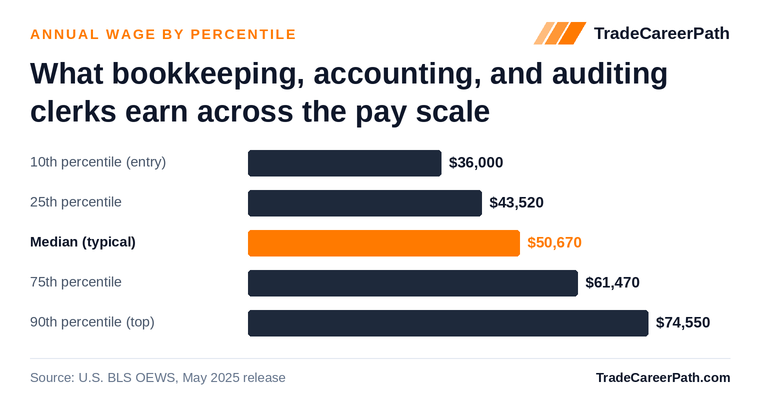
Quick answer: Training as a bookkeeper usually takes 6 to 12 months through a certificate program, or about 2 years with an associate degree. You learn accounting basics and software like QuickBooks, Xero, and Excel, get hands-on experience, and can earn an optional certification such as the Certified Bookkeeper (CB) or Certified Public Bookkeeper (CPB). No degree or license is required. The median bookkeeper salary is $50,670 per year ($24.36/hour), and the BLS projects about 170,000 openings nationwide each year for bookkeeping, accounting, and auditing clerks (BLS, May 2025).
Bookkeepers record and organize the financial transactions that keep a business running, from invoices and payroll to bank reconciliations. If you are organized, detail-oriented, and comfortable with numbers and software, bookkeeping is one of the most accessible entry points into business and finance, and a lot of it can be done remotely.
How to Become a Bookkeeper
Most people enter the field in under a year. There is no license to earn and no single exam you must pass. You build the career through short, focused training, hands-on practice with accounting software, and an optional certification once you have experience.
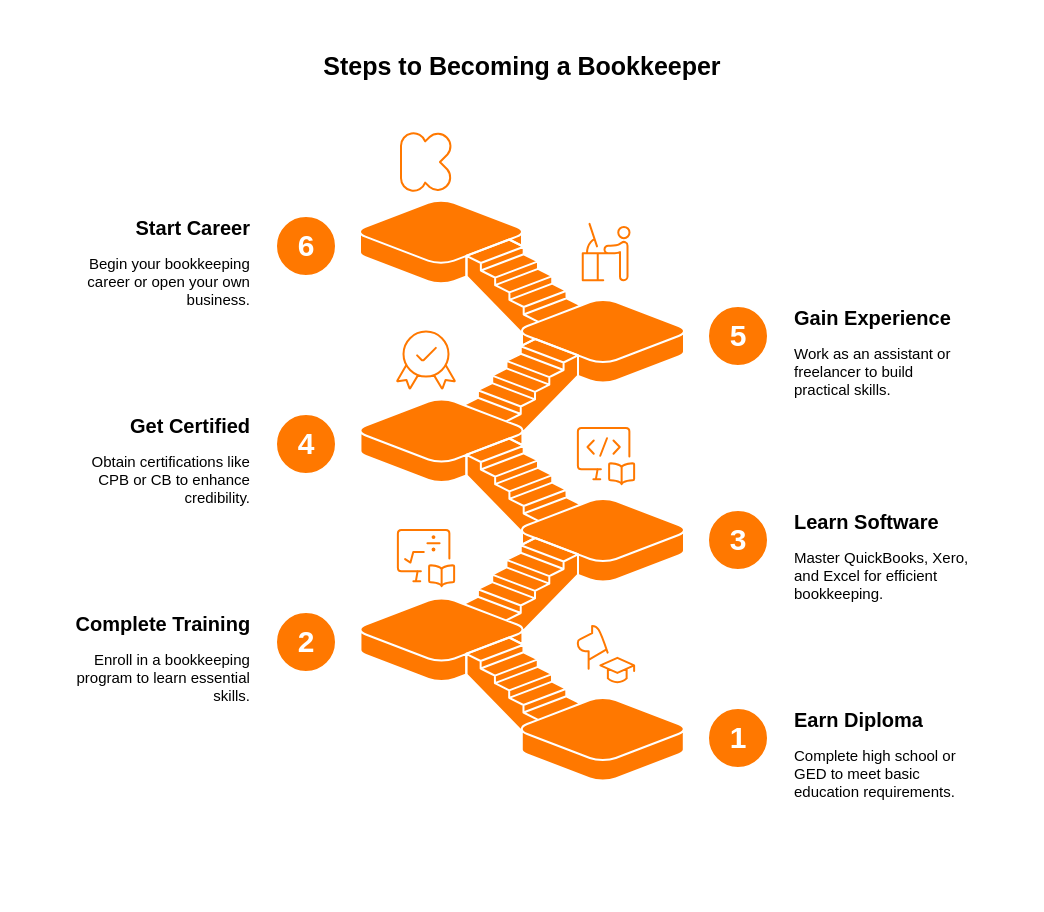
1. Earn a high school diploma or GED
A high school diploma or GED is the baseline requirement for most bookkeeping programs and entry-level jobs. Before you enroll, it helps to build the skills the work depends on: basic math, careful attention to detail, and comfort with computers. Any class that involves business, accounting, or spreadsheets is good preparation, and so is anything that sharpens your organization and follow-through. You do not need to be a math whiz. Day-to-day bookkeeping is more about consistency and accuracy than advanced calculation. If you are changing careers and already hold a diploma or a degree in another field, you can move straight to training. Many strong bookkeepers come from unrelated backgrounds and bring useful skills in organization, communication, and customer service that transfer directly to managing a company’s books.
2. Complete a bookkeeping training program
This is the core of your preparation, and you have a few formats to choose from. Certificate programs typically take about 6 to 12 months and are popular with adults who want to move into bookkeeping quickly. Associate degree programs take roughly 2 years and combine general-education credits with accounting coursework, which can help if you later move toward accounting roles. Either way, the curriculum tends to cover the same foundations: accounting fundamentals such as debits, credits, and the general ledger; how to record and reconcile transactions; payroll basics; and hands-on training in QuickBooks and Microsoft Excel. Many programs are available fully online, which lets working students learn at a flexible pace. Costs vary widely by program and school, so compare tuition, length, and the software covered before you commit, and confirm the program’s accreditation.
3. Learn key bookkeeping software
Modern bookkeeping runs on software, so fluency with the main tools is what makes you employable. QuickBooks is the most widely used small-business accounting platform, and getting comfortable with QuickBooks Online is often the single most valuable skill you can build. Xero is a popular cloud alternative, especially with firms that serve online and remote clients. Microsoft Excel remains essential for analysis, cleanup, and reporting that the accounting platforms do not handle well. Practice the everyday workflows employers expect: entering invoices and bills, categorizing transactions, running payroll, reconciling bank and credit-card accounts, and producing simple reports like a profit-and-loss statement. Because these platforms are cloud based, you can practice from anywhere, and that same flexibility is what makes remote and freelance bookkeeping possible.
4. Gain practical experience
Coursework prepares you, but employers want to see that you can actually keep a set of books. Start with an entry-level or assistant role, such as accounting clerk, accounts-payable clerk, or bookkeeping assistant, where you work under the supervision of an experienced bookkeeper or accountant. These roles let you practice real tasks, like reconciling accounts and closing out a month, and they build the references hiring managers look for. If a job is hard to land right away, offer to keep the books for a small business, nonprofit, or family member to build a track record. Freelance and virtual bookkeeping is another on-ramp: even a couple of small clients gives you hands-on experience and something concrete to show. As you go, note the industries and software you have worked with, since specialization can make you more valuable.
5. Consider optional certification
Certification is voluntary and not legally required, but it can strengthen your resume and signal that you know the work, which is especially useful for freelancers and small-business specialists. The most recognized options are the Certified Bookkeeper (CB) credential from the American Institute of Professional Bookkeepers (AIPB) and the Certified Public Bookkeeper (CPB) credential from the National Association of Certified Public Bookkeepers (NACPB). Both generally combine an exam with an experience requirement and test core bookkeeping knowledge. Software-vendor certifications, such as the QuickBooks ProAdvisor program, are also widely used in the industry and show employers and clients that you can run the platform they rely on. Check each organization’s site for current eligibility rules and fees before you commit to a path.
6. Apply for jobs or start your own business
Bookkeepers work for small businesses, accounting firms, corporate finance departments, nonprofits, and government offices, and many work remotely. Tailor your resume to the role, highlight the software you know, and point to the hands-on experience you built in step 4. If you would rather work for yourself, bookkeeping has a low barrier to starting a freelance or virtual practice: you can serve clients in cloud software from home and grow by referral. Whichever route you take, on-the-job experience and any certifications you have earned can open the door to senior bookkeeper, full-charge bookkeeper, or office-manager roles, and they create a clear path toward accounting or finance positions over time.
What Does a Bookkeeper Do?
Bookkeepers record and organize financial transactions for a business. They make sure the money coming in and out is tracked and documented accurately, which keeps the company’s records clean for owners, accountants, and tax season.
Daily tasks often include:
- Recording invoices and payments
- Managing payroll and employee expenses
- Reconciling bank and credit-card statements
- Preparing balance sheets and financial reports
- Working with accountants during tax season
Bookkeepers help keep businesses financially healthy and compliant. It is a critical role for many small organizations that do not have a full finance team.
Skills That Make Great Bookkeepers
- Strong attention to detail
- Organization and time management
- Data entry accuracy
- Understanding of accounting principles
- Tech skills (Excel, QuickBooks, cloud systems)
- Communication and confidentiality
The best bookkeepers blend reliability with analytical thinking. Business owners trust them with sensitive financial information.
Work Settings for Bookkeepers
Bookkeepers work in a range of environments, including:
- Small businesses and startups
- Accounting and bookkeeping firms
- Corporate finance departments
- Nonprofit organizations
- Remote, home-based, or freelance practices
A lot of bookkeeping is done in cloud software, so remote and virtual work is common.
Popular Bookkeeper Certifications
| Certification | Issued By | Description |
|---|---|---|
| Certified Bookkeeper (CB) | American Institute of Professional Bookkeepers (AIPB) | Recognized national certification for bookkeepers. |
| Certified Public Bookkeeper (CPB) | National Association of Certified Public Bookkeepers (NACPB) | Suited to small-business and online bookkeeping. |
| QuickBooks ProAdvisor | Intuit | Focuses on QuickBooks Online software mastery. |
Certification is optional but signals expertise, especially useful for freelancers and small-business specialists.
Career Growth and Advancement
With experience, bookkeepers may move into roles such as:
- Full-charge or senior bookkeeper who manages the entire books for a company
- Office or accounting manager who oversees finance staff and workflows
- Accounting clerk or staff accountant for those who continue into accounting
- Independent bookkeeper who builds a freelance or virtual client base
Cost and Duration of Training
- Time to complete: about 6 to 12 months for a certificate, or roughly 2 years for an associate degree
- Program cost: varies by program and school, so compare tuition, length, and software coverage before enrolling
- Certification: optional; check the issuing organization for current fees and requirements
Many bookkeeping programs are available online, which helps students learn at a flexible pace.
Pros and Cons
Pros
- Quick path into a stable business career
- Flexible work: in-office, remote, or freelance
- No degree or license required to start
- Clear ladder into accounting or finance
Cons
- Repetitive tasks can work as routine
- Tight deadlines during tax season
- Need to keep up with software and tax rules
Quick Facts: Bookkeeper Salary, Education, and Outlook
Start Your Bookkeeping Career
If you are organized, detail-oriented, and comfortable with numbers, bookkeeping offers a practical and affordable entry into business and finance. No degree is required, and you can find a program near you to start building the skills employers want.
Industry Organizations & Certifying Bodies
These are the recognized national organizations, unions, certifying bodies, and regulatory authorities that shape this trade. They issue the credentials, sponsor the apprenticeships, publish the codes, and represent workers and employers.
- American Institute of Professional Bookkeepers (AIPB) Issues the Certified Bookkeeper (CB) credential.
- National Association of Certified Public Bookkeepers (NACPB) Issues the Certified Public Bookkeeper (CPB) credential.
- QuickBooks ProAdvisor / Xero Advisor Certification Software-vendor certifications widely used in the bookkeeping industry.
Wage and Employment Charts
Bookkeeper Salary and Requirements by State
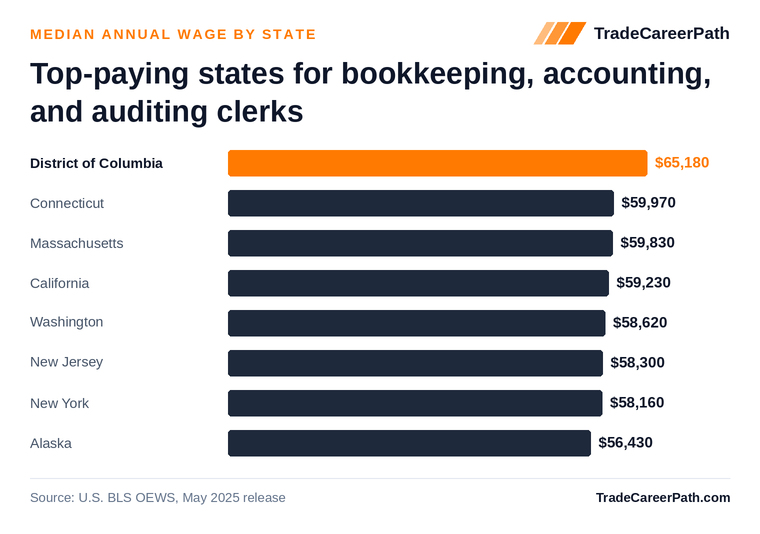
Select your state for local wage data, training options, and requirements:
Alabama · Alaska · Arizona · Arkansas · California · Colorado · Connecticut · Delaware · District of Columbia · Florida · Georgia · Hawaii · Idaho · Illinois · Indiana · Iowa · Kansas · Kentucky · Louisiana · Maine · Maryland · Massachusetts · Michigan · Minnesota · Mississippi · Missouri · Montana · Nebraska · Nevada · New Hampshire · New Jersey · New Mexico · New York · North Carolina · North Dakota · Ohio · Oklahoma · Oregon · Pennsylvania · Rhode Island · South Carolina · South Dakota · Tennessee · Texas · Utah · Vermont · Virginia · Washington · West Virginia · Wisconsin · Wyoming
Workplace Safety Snapshot
BLS Survey of Occupational Injuries and Illnesses data (2023-2024) report approximately 9.9 days-away, restricted, or transfer cases per 10,000 full-time-equivalent workers in bookkeeping, accounting, and auditing clerks (about 0.10 per 100 FTE). Source: BLS Survey of Occupational Injuries and Illnesses, Table R98.
Frequently Asked Questions
How long does bookkeeper training take?
Many people start in under a year. Career-focused certificate programs often run about 6 to 12 months, while an associate degree takes roughly 2 years. A high school diploma or GED is generally the only educational prerequisite to begin.
Do you need a college degree to work as a bookkeeper?
No. A college degree is not required to work as a bookkeeper. Most people enter the field through a certificate program or an associate degree. A high school diploma or GED is typically the only educational prerequisite.
How much does bookkeeping training cost?
Costs vary widely by program and school. Short online certificate courses tend to cost less than associate degree programs at a community college. Compare tuition, length, and software training before you enroll, and check whether financial aid is available.
Is bookkeeping certification required?
No, certification is optional. It is not legally required to work as a bookkeeper, but credentials can help you stand out. Common options include the Certified Bookkeeper (CB) from the American Institute of Professional Bookkeepers, the Certified Public Bookkeeper (CPB) from the National Association of Certified Public Bookkeepers, and the QuickBooks ProAdvisor certification.
Is it hard to train as a bookkeeper?
Entry is relatively accessible because no degree or license is required and training is short. The work itself rewards accuracy and consistency, so comfort with numbers, attention to detail, and familiarity with software like QuickBooks and Excel matter more than advanced math.
Can you train as a bookkeeper online?
Yes. Many schools offer bookkeeping certificate and associate degree programs fully online, and the software covered, such as QuickBooks and Xero, is cloud based. Confirm the program's accreditation before you enroll.
Can bookkeepers work remotely?
Yes. A lot of bookkeeping is done in cloud accounting software, so many professionals work from home, support clients remotely, or run a virtual bookkeeping business.
How Bookkeeper Pay Compares to Similar Trades
Side-by-side comparison of Bookkeeper and the closest related careers, based on U.S. Bureau of Labor Statistics data (May 2025 OEWS + 2024-2034 Employment Projections).
| Career | Median Pay | 10-Year Growth | Annual Openings |
|---|---|---|---|
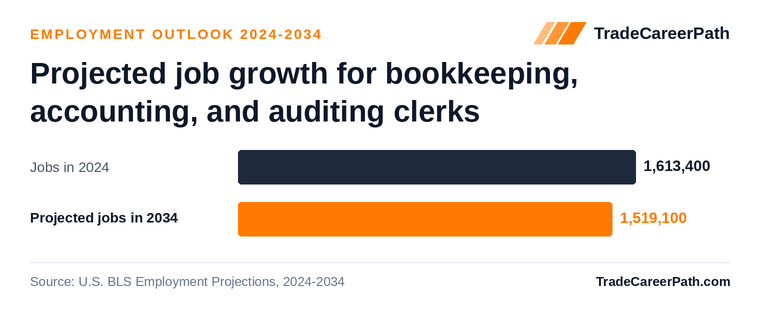
| Bookkeeper this guide | $50,670 | -5.8% | 170,000 |
| Medical Billing & Coding | $51,140 | +7.1% | 14,200 |
| Medical Biller | $51,140 | +7.1% | 14,200 |
| Medical Coder | $51,140 | +7.1% | 14,200 |
| Medical Office Administration | $45,930 | +4.2% | 85,900 |
Source: BLS Occupational Employment and Wage Statistics + BLS Employment Projections.
Degree and Program Guides
- Online Accounting Degrees - the degree that moves you from clerk to accountant
Sources
- U.S. Bureau of Labor Statistics, Occupational Employment and Wage Statistics (May 2025)
- U.S. Bureau of Labor Statistics, Employment Projections 2024-2034
- U.S. Bureau of Labor Statistics, Survey of Occupational Injuries and Illnesses (2023-2024, Table R98)
- U.S. Department of Labor, Wage and Hour Division, Davis-Bacon General Wage Determinations (2026)
Bookkeeper Salary by State
About this guide: Researched and written by the TradeCareerPath Editorial Team. Our editorial team researches and sources every trade school and career guide using federal labor and education data, including BLS OEWS and Employment Projections, DOL apprenticeship records, IPEDS, College Scorecard, and state licensing boards. We follow the editorial standards documented at /editorial-policy/.
Data sources
Figures on this page are sourced from the federal and state datasets below. Methodology: how we rank and source data.
| Data | Provider | Vintage |
|---|---|---|
| Occupational Employment and Wage Statistics (OEWS) | U.S. Bureau of Labor Statistics | May 2025 |
| Employment Projections | U.S. Bureau of Labor Statistics | 2024-2034 |
| Integrated Postsecondary Education Data System | National Center for Education Statistics (IPEDS) | 2024 |
| College Scorecard (school-level outcomes) | U.S. Department of Education | latest release |
| College Scorecard (field-of-study earnings) | U.S. Department of Education | latest release (updated 2026-06-12) |
| Occupational licensing requirements | CareerOneStop (U.S. Department of Labor) | latest release (updated 2026-02-22) |
| Registered apprenticeship programs | CareerOneStop / Apprenticeship.gov (U.S. Department of Labor) | latest release (updated 2025-10-25) |
| O*NET occupation profiles (skills, tasks, tools, job zones) | U.S. Department of Labor (O*NET / Employment & Training Admin.) | O*NET 29.1 (updated 2026-06-13) |