
How to Become a Brick and Block Mason
Is Brick and Block Mason Right for You?
The U.S. Department of Labor's O*NET profile for Brickmasons and Blockmasons (SOC 47-2021) describes the work this way: Lay and bind building materials, such as brick, structural tile, concrete block, cinder block, glass block, and terra-cotta block, with mortar and other substances, to construct or repair walls, partitions, arches, sewers, and other structures.
What the work involves
- Measure distance from reference points and mark guidelines to lay out work, using plumb bobs and levels.
- Construct corners by fastening in plumb position a corner pole or building a corner pyramid of bricks, and filling in between the corners using a line from corner to corner to guide each course, or layer, of brick.
- Apply and smooth mortar or other mixture over work surface.
- Calculate angles and courses and determine vertical and horizontal alignment of courses.
- Break or cut bricks, tiles, or blocks to size, using trowel edge, hammer, or power saw.
Skills and knowledge that matter
Skills: Critical Thinking, Coordination, Time Management, Speaking, Quality Control Analysis, Operations Monitoring.
Knowledge: Building and Construction, Mathematics, English Language, Public Safety and Security.
Tools and technology you may use
Tools: Adhesive trowels, Adjustable widemouth pliers, Adjustable wrenches, Air compressors, Angle grinders, Block and tackle equipment.
Technology: Analytical or scientific software, Project management software, Accounting software, Intuit QuickBooks, Microsoft Excel, Microsoft Office software.
Typical preparation
O*NET Job Zone Two (Some Preparation Needed). These occupations usually require a high school diploma. Employees in these occupations need anywhere from a few months to one year of working with experienced employees. A recognized apprenticeship program may be associated with these occupations.
Interest fit
O*NET interest profile: Realistic, Conventional, Investigative. People who enjoy hands-on, practical work with tools, machines, plants, or materials often find this occupation a good fit.
Source: O*NET 29.1 (updated 2026-06-13)
Have you ever admired a solid brick wall or a detailed stone walkway and thought, “I’d love to build that”?
Brick and block masons turn blueprints into long-lasting structures.
Masons work with materials like brick, block, and stone to build and repair walls, foundations, chimneys, and decorative structures.
This trade blends physical skill and craftsmanship with precision and design sense.
If you enjoy hands-on work, problem-solving, and creating structures that last, masonry offers a durable and respected construction career.
Quick answers
- What does a brick and block mason do? Brick and block masons construct and repair structures made of brick, concrete block, and other masonry materials. They also work with stone for walls, foundations, chimneys, and decorative structures.
- How long does brick and block mason training take? It typically takes about 3-4 years to work as a fully qualified mason through an apprenticeship or structured training. Certificate programs can teach fundamentals in 6-12 months.
- Do you need trade school to get started? Trade school is one option, and apprenticeships are another common path. Apprenticeships often combine classroom instruction with paid fieldwork over 3-4 years.
- What skills and traits help most? Strong hand-eye coordination, attention to detail, and comfort with geometry, measurement, and layout are important. Stamina and safe handling of heavy materials also matter.
- Where do brick and block masons work? Common settings include residential and commercial construction, industrial facilities, restoration work, and masonry contracting companies. Some work on local government and infrastructure projects or as independent contractors.
- Do you need certification or a license? Requirements can vary by state and employer. Some roles require safety or trade credentials such as OSHA-10 or journeyman-level certifications.
At a glance
- Work includes building and repairing walls, foundations, chimneys, and decorative structures
- Typical training is a 3-4 year apprenticeship or structured program
- Start with a high school diploma or GED
- Common settings include residential, commercial, industrial, and restoration projects
- Costs: program tuition varies by school and format - apprenticeships with paid training cost far less; certification fees are usually under $200
What Brick and Block Masons Do
Brick and block masons (also called bricklayers) construct and repair structures made of brick, concrete block, and other masonry materials.
They work on residential, commercial, and industrial buildings.
Typical Responsibilities
- Read blueprints and building plans to determine material layout
- Mix and spread mortar to bond materials
- Cut and shape brick or block to fit design specifications
- Lay bricks and blocks in precise rows and patterns
- Repair or replace damaged masonry
- Use levels, plumb lines, and trowels for accuracy
Brick and block masons combine skill, endurance, and an eye for detail to build structures that stand the test of time.
Key Skills and Traits for Success
- Strong hand-eye coordination and attention to detail
- Ability to lift and position heavy materials safely
- Understanding of geometry and measurement
- Steady hands and stamina for repetitive tasks
- Precision, patience, and craftsmanship
- Familiarity with construction safety standards
Work Settings for Brick and Block Masons
Brick and block masons can be found working in:
- Residential and commercial construction projects
- Industrial facilities and restoration work
- Masonry and contracting companies
- Local government and infrastructure projects
- Independent contractor or small business settings
How to Become a Brick and Block Mason (5 Steps)
It typically takes 3-4 years to work as a fully qualified mason through an apprenticeship or structured training program.
1. Earn a High School Diploma or GED
Focus on classes like math, geometry, and shop. These build the skills needed for measuring, layout, and working with construction tools.
2. Enroll in a Masonry or Construction Program
Trade schools and community colleges offer masonry programs that typically teach the fundamentals of bricklaying, safety, and blueprint reading.
3. Join an Apprenticeship Program
Apprenticeships, often sponsored by unions or contractor associations, combine classroom instruction with paid fieldwork over 3-4 years.
4. Get Certified or Licensed (If Required)
Some states or employers require safety or trade certifications such as OSHA-10 or journeyman-level credentials.
5. Build Experience and Advance
With time, masons can work as lead installers, foremen, or even start their own contracting business specializing in brick and block work.
Education and Training Paths
| Pathway | Typical Duration | Outcome |
|---|---|---|
| Certificate or Diploma Program | 6-12 months | Basic masonry skills |
| Apprenticeship | 3-4 years | Journeyman-level proficiency |
| Associate Degree | 2 years | Broader construction management knowledge |
| Safety Certification (OSHA, NCCER) | 1-3 months | Workplace safety and compliance credentials |
Career Growth and Advancement
With experience, brick and block masons can move into:
- Masonry Foreman or Crew Leader - supervises job sites and teams
- Estimator or Project Supervisor - manages costs and schedules
- Restoration Mason - specializes in historical or architectural repairs
- Independent Contractor - runs a private masonry business
Cost and Duration of Training
- Program Cost: varies by school, format and location depending on location and format
- Duration: 6 months to 4 years (certificate to apprenticeship)
- Certification Fees: usually under $200
Masonry combines durability, artistry, and technical skill. It’s a rewarding path for builders who take pride in seeing their work stand tall for decades.
Pros and Cons
✅ Pros
- Visible results and pride in craftsmanship
- High demand for skilled masons in construction
- Opportunities for self-employment
- Variety of projects and environments
⚠️ Cons
- Physically demanding outdoor work
- Exposure to weather and jobsite conditions
- Precision and stamina required for repetitive tasks
Take the First Step Toward a Masonry Career
If you enjoy hands-on work and building things that last, training as a brick and block mason offers a practical, creative trade path in the construction industry.
Quick Facts: Brick and Block Mason Training and Outlook
Industry Organizations & Certifying Bodies
These are the recognized national organizations, unions, certifying bodies, and regulatory authorities that shape this trade. They issue the credentials, sponsor the apprenticeships, publish the codes, and represent workers and employers.
- International Union of Bricklayers and Allied Craftworkers (BAC) Primary masonry union; runs the International Masonry Training and Education Foundation.
- Mason Contractors Association of America (MCAA) Masonry contractor association.
Federal Prevailing Wages by State
The U.S. Department of Labor sets Davis-Bacon prevailing wages that contractors must pay on federally funded construction projects. These are minimum hourly rates, not averages - actual market pay can be higher. Across 38 states with active 2026 determinations, the average total compensation (base + fringe) for brick masons is $51.51/hour. Massachusetts pays the highest rate ($93.97/hr total), while Texas reports the lowest active determination ($18.00/hr total).
| State | Base Hourly | Fringe Hourly | Total Hourly | Annualized* |
|---|---|---|---|---|
| Massachusetts | $60.26 | $33.71 | $93.97 | $195,458 |
| Hawaii | $48.03 | $32.23 | $80.26 | $166,941 |
| New Jersey | $45.20 | $33.26 | $78.46 | $163,197 |
| Rhode Island | $46.86 | $29.14 | $76.00 | $158,080 |
| Oregon | $49.60 | $25.15 | $74.75 | $155,480 |
| Minnesota | $46.47 | $27.12 | $73.59 | $153,067 |
| Wisconsin | $45.72 | $27.42 | $73.14 | $152,131 |
| Maine | $43.91 | $28.47 | $72.38 | $150,550 |
| Nevada | $50.90 | $19.93 | $70.83 | $147,326 |
| Michigan | $40.71 | $28.21 | $68.92 | $143,354 |
| California | $46.73 | $19.02 | $65.75 | $136,760 |
| Alaska | $52.77 | $12.36 | $65.13 | $135,470 |
| Delaware | $34.19 | $27.98 | $62.17 | $129,314 |
| Pennsylvania | $36.99 | $24.67 | $61.66 | $128,253 |
| Ohio | $36.89 | $22.13 | $59.02 | $122,762 |
| Indiana | $36.00 | $20.46 | $56.46 | $117,437 |
| Nebraska | $34.80 | $19.94 | $54.74 | $113,859 |
| District of Columbia | $38.80 | $15.17 | $53.97 | $112,258 |
| Maryland | $37.50 | $14.78 | $52.28 | $108,742 |
| Kentucky | $35.00 | $17.13 | $52.13 | $108,430 |
| Idaho | $32.05 | $18.27 | $50.32 | $104,666 |
| Montana | $33.11 | $17.18 | $50.29 | $104,603 |
| Illinois | $29.51 | $20.35 | $49.86 | $103,709 |
| Colorado | $32.93 | $14.29 | $47.22 | $98,218 |
| Iowa | $29.80 | $17.16 | $46.96 | $97,677 |
| Kansas | $29.07 | $15.61 | $44.68 | $92,934 |
| South Dakota | $38.16 | $5.59 | $43.75 | $91,000 |
| West Virginia | $27.50 | $12.35 | $39.85 | $82,888 |
| North Dakota | $24.46 | $13.96 | $38.42 | $79,914 |
| Missouri | $27.66 | $5.88 | $33.54 | $69,763 |
| New Mexico | $20.36 | $5.74 | $26.10 | $54,288 |
| Utah | $23.88 | $0.00 | $23.88 | $49,670 |
| Arkansas | $20.00 | $0.00 | $20.00 | $41,600 |
| Louisiana | $20.00 | $0.00 | $20.00 | $41,600 |
| Oklahoma | $20.00 | $0.00 | $20.00 | $41,600 |
| Alabama | $19.81 | $0.00 | $19.81 | $41,205 |
| North Carolina | $19.13 | $0.00 | $19.13 | $39,790 |
| Texas | $18.00 | $0.00 | $18.00 | $37,440 |
* Annualized total = total hourly × 2,080 hours (40-hour week, 52 weeks). Actual annual pay varies with overtime, project length, and benefits utilization.
Source: U.S. Department of Labor, Wage and Hour Division - Davis-Bacon General Wage Determinations, 2026. Rates reflect the lowest base rate within each statewide determination for brick mason classifications.
Wage and Employment Charts
| Percentile | Annual wage |
|---|---|
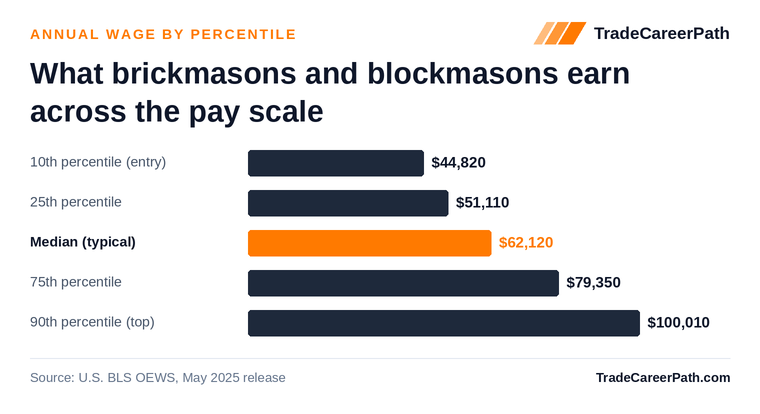
| 10th | $44,820 |
| 25th | $51,110 |
| 50th (median) | $62,120 |
| 75th | $79,350 |
| 90th | $100,010 |
| Year | Employment |
|---|---|
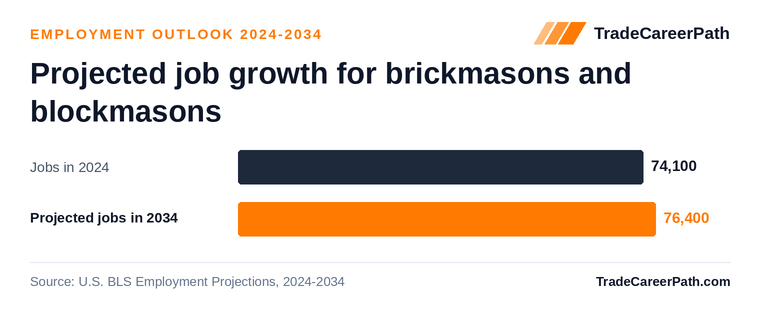
| 2024 | 74,100 |
| 2034 projected | 76,400 |
| Percent change | +3.2% |
Brick and Block Mason Salary and Requirements by State
Select your state for local wage data, training options, and requirements:
Alabama · Alaska · Arizona · Arkansas · California · Colorado · Connecticut · Delaware · District of Columbia · Florida · Georgia · Hawaii · Idaho · Illinois · Indiana · Iowa · Kansas · Kentucky · Louisiana · Maine · Maryland · Massachusetts · Michigan · Minnesota · Mississippi · Missouri · Montana · Nebraska · Nevada · New Hampshire · New Jersey · New Mexico · New York · North Carolina · North Dakota · Ohio · Oklahoma · Oregon · Pennsylvania · Rhode Island · South Carolina · South Dakota · Tennessee · Texas · Utah · Vermont · Virginia · Washington · West Virginia · Wisconsin · Wyoming
Workplace Safety Snapshot
BLS Survey of Occupational Injuries and Illnesses data (2023-2024) report approximately 181.6 days-away, restricted, or transfer cases per 10,000 full-time-equivalent workers in brickmasons and blockmasons (about 1.82 per 100 FTE). Source: BLS Survey of Occupational Injuries and Illnesses, Table R98.
Frequently Asked Questions
How long does brick and block mason training take?
It typically takes typically 6 months to 2 years of training. The most common entry path is through a certificate or associate degree program. A high school diploma or GED is generally required to get started.
How much do brick and block masons make?
The median annual salary for brick and block masons is $62,120 according to the Bureau of Labor Statistics (May 2025). Entry-level workers earn around $44,820, while those in the 90th percentile earn over $100,010. Pay varies by state, experience, and specialization.
What is the job outlook for brick and block masons?
The Bureau of Labor Statistics projects 3.2% employment growth for this occupation from 2024 to 2034, which is roughly on pace with the overall economy. Approximately 5,600 job openings are expected each year due to growth, retirements, and workers leaving the field.
Do you need a college degree to work as a brick and block mason?
No. A college degree is not required to work as a brick and block mason. Most people enter the field through a certificate or associate degree program. A high school diploma or GED is typically the only educational prerequisite.
Which states pay brick and block masons the most?
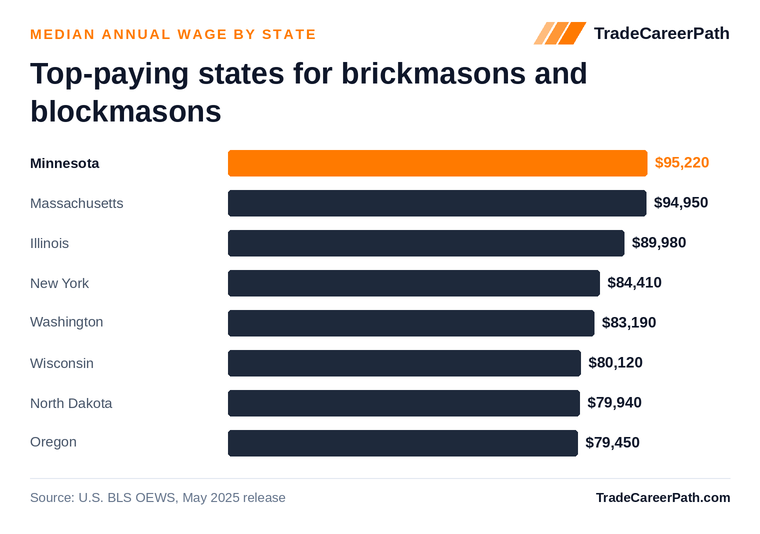
According to the U.S. Bureau of Labor Statistics (May 2025 OEWS), the highest-paying states for brick and block masons are Minnesota, Massachusetts, and Illinois. Median annual wages: Minnesota ($95,220); Massachusetts ($94,950); Illinois ($89,980).
Which states employ the most brick and block masons?
BLS reports the largest concentrations of brick and block masons in Texas, California, and New York. Employment levels: Texas (4,300 workers); California (3,820 workers); New York (3,790 workers) (May 2025).
How much do experienced brick and block masons earn?
The top 10% of brick and block masons earn more than $100,010 per year, according to BLS Occupational Employment and Wage Statistics (May 2025). Experienced workers in this band typically hold senior credentials, supervisory roles, or specialty certifications.
What is entry-level pay for brick and block masons?
BLS reports the bottom 10% of brick and block masons earn under $44,820 per year. New workers often start near this level and see pay rise as they accumulate experience and credentials.
How many brick and block masons work in the United States?
BLS reports approximately 52,550 brick and block masons employed nationwide as of May 2025.
How many job openings are expected for brick and block masons each year?
BLS projects approximately 5,600 openings per year for brick and block masons from 2024 through 2034, including new positions, retirements, and workers transitioning out. The occupation is projected to grow 3.2% from 2024 to 2034, classified as about as fast as average growth.
How much do brick and block masons make per hour?
The median hourly wage for brick and block masons is $29.87, according to BLS (May 2025). Hourly pay ranges from about $21.55 (bottom 10%) to $48.08 (top 10%).
How Brick and Block Mason Pay Compares to Similar Trades
Side-by-side comparison of Brick and Block Mason and the closest related careers, based on U.S. Bureau of Labor Statistics data (May 2025 OEWS + 2024-2034 Employment Projections).
| Career | Median Pay | 10-Year Growth | Annual Openings |
|---|---|---|---|
| Brick and Block Mason this guide | $62,120 | +3.2% | 5,600 |
| Floor Installing Listings | $55,690 | +10.1% | 4,200 |
| Carpentry | $60,580 | +4.5% | 74,100 |
| Roofer | $55,440 | +5.9% | 12,700 |
| Flooring Installer | $56,460 | +9.5% | 2,700 |
Source: BLS Occupational Employment and Wage Statistics + BLS Employment Projections.
Sources
- U.S. Bureau of Labor Statistics, Occupational Employment and Wage Statistics (May 2025)
- U.S. Bureau of Labor Statistics, Employment Projections 2024-2034
- U.S. Bureau of Labor Statistics, Survey of Occupational Injuries and Illnesses (2023-2024, Table R98)
- U.S. Department of Labor, Wage and Hour Division, Davis-Bacon General Wage Determinations (2026)
Brick and Block Mason Salary by State
About this guide: Researched and written by the TradeCareerPath Editorial Team. Our editorial team researches and sources every trade school and career guide using federal labor and education data, including BLS OEWS and Employment Projections, DOL apprenticeship records, IPEDS, College Scorecard, and state licensing boards. We follow the editorial standards documented at /editorial-policy/.
Data sources
Figures on this page are sourced from the federal and state datasets below. Methodology: how we rank and source data.
| Data | Provider | Vintage |
|---|---|---|
| Occupational Employment and Wage Statistics (OEWS) | U.S. Bureau of Labor Statistics | May 2025 |
| Employment Projections | U.S. Bureau of Labor Statistics | 2024-2034 |
| Integrated Postsecondary Education Data System | National Center for Education Statistics (IPEDS) | 2024 |
| College Scorecard (school-level outcomes) | U.S. Department of Education | latest release |
| College Scorecard (field-of-study earnings) | U.S. Department of Education | latest release (updated 2026-06-12) |
| Occupational licensing requirements | CareerOneStop (U.S. Department of Labor) | latest release (updated 2026-02-22) |
| Registered apprenticeship programs | CareerOneStop / Apprenticeship.gov (U.S. Department of Labor) | latest release (updated 2025-10-25) |
| O*NET occupation profiles (skills, tasks, tools, job zones) | U.S. Department of Labor (O*NET / Employment & Training Admin.) | O*NET 29.1 (updated 2026-06-13) |