
How to Become a Cabinet Maker: Training and Skills
Is Cabinet Maker Right for You?
The U.S. Department of Labor's O*NET profile for Cabinetmakers and Bench Carpenters (SOC 51-7011) describes the work this way: Cut, shape, and assemble wooden articles or set up and operate a variety of woodworking machines, such as power saws, jointers, and mortisers to surface, cut, or shape lumber or to fabricate parts for wood products.
What the work involves
- Verify dimensions or check the quality or fit of pieces to ensure adherence to specifications.
- Produce or assemble components of articles, such as store fixtures, office equipment, cabinets, or high-grade furniture.
- Measure and mark dimensions of parts on paper or lumber stock prior to cutting, following blueprints, to ensure a tight fit and quality product.
- Set up or operate machines, including power saws, jointers, mortisers, tenoners, molders, or shapers, to cut, mold, or shape woodstock or wood substitutes.
- Establish the specifications of articles to be constructed or repaired, or plan the methods or operations for shaping or assembling parts, based on blueprints, drawings, diagrams, or oral or written instructions.
Skills and knowledge that matter
Skills: Operations Monitoring, Quality Control Analysis, Operation and Control, Monitoring, Troubleshooting, Time Management.
Knowledge: Mathematics, Building and Construction, Production and Processing, Mechanical.
Tools and technology you may use
Tools: Adjustable hand wrenches, Adjustable jigs, Angle dividers, Awls, Back saws, Band clamps.
Technology: Computer aided design CAD software, Project management software, Facilities management software, Autodesk AutoCAD, Microsoft Excel, Microsoft Outlook.
Typical preparation
O*NET Job Zone Two (Some Preparation Needed). These occupations usually require a high school diploma. Employees in these occupations need anywhere from a few months to one year of working with experienced employees. A recognized apprenticeship program may be associated with these occupations.
Interest fit
O*NET interest profile: Realistic, Conventional, Artistic. People who enjoy hands-on, practical work with tools, machines, plants, or materials often find this occupation a good fit.
Source: O*NET 29.1 (updated 2026-06-13)
Ever admired a custom-built kitchen or handcrafted cabinet and thought, “I’d love to create that”?
Cabinet makers turn wood, design, and precision into lasting functional art.
Cabinet makers, also known as bench carpenters, design and build cabinets, furniture, and fixtures.
They combine woodworking skill with creative craftsmanship to produce products that enhance homes, businesses, and architectural spaces.
If you enjoy working with your hands, problem-solving, and seeing tangible results, cabinetry offers a craft-based trade career that balances art and engineering.
Quick answers
At a glance
- Typical time to work as skilled: 1-3 years, depending on training and experience
- Common training paths: certificate or diploma (6-12 months), apprenticeship (2-3 years), or associate degree (2 years)
- Entry-level education: high school diploma or GED
- Program cost range: varies by school, format and location depending on school and tools required
- Certifications: optional (fees are usually under $200)
What does a cabinet maker do?
Cabinet makers design and build cabinets, furniture, and fixtures. The work often includes reading plans, measuring and assembling parts, and finishing surfaces.
How long does cabinet maker training take?
Training as a skilled cabinet maker typically takes 1-3 years, depending on training and experience. Training options range from short programs to multi-year apprenticeships.
What education or training is common?
Many cabinet makers start with a high school diploma or GED. Training paths include certificate or diploma programs, apprenticeships, and associate degrees.
Where do cabinet makers work?
Cabinet makers work in manufacturing shops, custom woodworking and millwork companies, remodeling and construction firms, and interior design or architecture projects. Some are self-employed.
Are certifications required?
Certifications are optional. Some cabinet makers add training in CAD, CNC machinery, or finishing, and certification fees are usually under $200.
What Cabinet Makers Do
Cabinet makers craft custom or production-line wooden furniture and fixtures, including cabinets, shelving, and detailed interior components.
Their work combines precision measurement, design, and finish techniques.
Typical Responsibilities
- Read blueprints, sketches, and design plans
- Measure, cut, and assemble wood components
- Operate hand tools, power tools, and CNC machinery
- Sand, stain, and finish surfaces to desired textures or colors
- Install cabinetry or fixtures in homes or commercial spaces
Cabinet makers merge artistry with technical precision to produce furniture and installations that fit perfectly and last for years.
Key Skills and Traits for Success
- Strong attention to detail and manual dexterity
- Basic math and measurement skills
- Knowledge of tools, machinery, and materials
- Patience and craftsmanship for finishing work
- Creative design thinking
- Understanding of safety practices and shop procedures
Work Settings for Cabinet Makers
Cabinet makers work in:
- Furniture and cabinetry manufacturing shops
- Custom woodworking and millwork companies
- Residential remodeling and construction firms
- Interior design and architecture projects
- Independent woodworking studios or self-employed businesses
How to Become a Cabinet Maker (5 Steps)
Training as a skilled cabinet maker typically takes 1-3 years, depending on training and experience.
1. Earn a High School Diploma or GED
Focus on math, design, and woodworking classes to build measurement and technical drawing skills.
2. Complete a Woodworking or Cabinetry Program
Trade schools and community colleges offer programs that typically teach cabinet design, joinery, and CNC operation.
3. Gain On-the-Job Experience
Work under experienced cabinet makers or finish carpenters to learn real-world techniques and precision standards.
4. Develop Specialized Skills or Certifications
Training in computer-aided design (CAD), CNC machinery, or finishing can open additional opportunities in custom or industrial production.
5. Build a Portfolio and Advance
Showcase your work through photos or project documentation to attract clients or advance into supervisory or business ownership roles.
Education and Training Paths
| Pathway | Typical Duration | Outcome |
|---|---|---|
| Certificate or Diploma Program | 6-12 months | Entry-level woodworking skills |
| Apprenticeship | 2-3 years | Journeyman-level proficiency |
| Associate Degree | 2 years | Design and production training |
| Specialty Certification | 1-3 months | CNC, safety, or finishing credentials |
Career Growth and Advancement
Cabinet makers can move into roles such as:
- Lead Carpenter or Shop Supervisor - oversees production teams
- Furniture Designer or Custom Builder - creates original works
- Estimator or Project Coordinator - manages design and material planning
- Independent Contractor - runs a woodworking or cabinetry business
Cost and Duration of Training
- Program Cost: varies by school, format and location depending on school and tools required
- Duration: 6 months to 3 years
- Certification Fees: usually under $200
Cabinet making is a craft that combines precision and creativity. It’s ideal for people who take pride in tangible results and lifelong skill development.
Pros and Cons
Pros
- Creative and hands-on work
- Variety of projects and styles
- Potential for self-employment
- Long-term skill development and craftsmanship
Cons
- Physical and detailed work requiring patience
- Dust and noise exposure in workshop settings
- Income can vary based on project workload
Take the First Step Toward a Cabinetry Career
If you’re detail-oriented and love bringing designs to life through craftsmanship, training as a cabinet maker offers a rewarding path in woodworking and design.
Quick Facts: Cabinet Maker Training and Outlook
Industry Organizations & Certifying Bodies
These are the recognized national organizations, unions, certifying bodies, and regulatory authorities that shape this trade. They issue the credentials, sponsor the apprenticeships, publish the codes, and represent workers and employers.
- Architectural Woodwork Institute (AWI) Industry standards and quality certification for architectural cabinetry.
- Woodwork Career Alliance (WCA) Skill credentialing for cabinet and millwork professionals.
Wage and Employment Charts
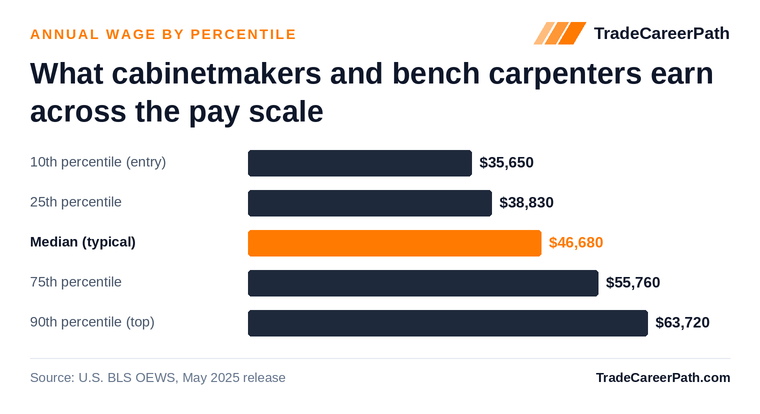
| Percentile | Annual wage |
|---|---|
| 10th | $35,650 |
| 25th | $38,830 |
| 50th (median) | $46,680 |
| 75th | $55,760 |
| 90th | $63,720 |
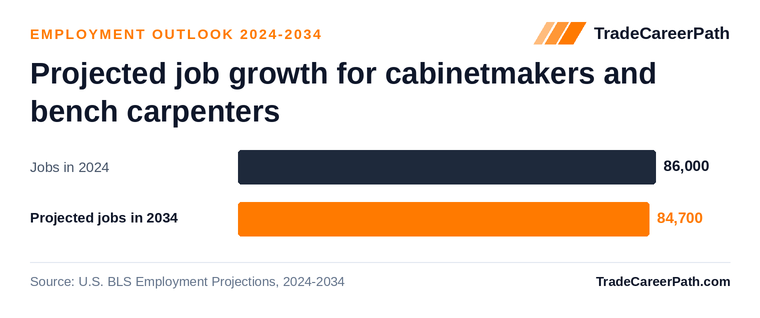
| Year | Employment |
|---|---|
| 2024 | 86,000 |
| 2034 projected | 84,700 |
| Percent change | -1.6% |
Cabinet Maker Salary and Requirements by State
Select your state for local wage data, training options, and requirements:
Alabama · Alaska · Arizona · Arkansas · California · Colorado · Connecticut · Delaware · District of Columbia · Florida · Georgia · Hawaii · Idaho · Illinois · Indiana · Iowa · Kansas · Kentucky · Louisiana · Maine · Maryland · Massachusetts · Michigan · Minnesota · Mississippi · Missouri · Montana · Nebraska · Nevada · New Hampshire · New Jersey · New Mexico · New York · North Carolina · North Dakota · Ohio · Oklahoma · Oregon · Pennsylvania · Rhode Island · South Carolina · South Dakota · Tennessee · Texas · Utah · Vermont · Virginia · Washington · West Virginia · Wisconsin · Wyoming
Workplace Safety Snapshot
BLS Survey of Occupational Injuries and Illnesses data (2023-2024) report approximately 243.1 days-away, restricted, or transfer cases per 10,000 full-time-equivalent workers in cabinetmakers and bench carpenters (about 2.43 per 100 FTE). Source: BLS Survey of Occupational Injuries and Illnesses, Table R98.
Frequently Asked Questions
How long does cabinet maker training take?
It typically takes typically 6 months to 2 years of training. The most common entry path is through a certificate or associate degree program. A high school diploma or GED is generally required to get started.
How much do cabinet makers make?
The median annual salary for cabinet makers is $46,680 according to the Bureau of Labor Statistics (May 2025). Entry-level workers earn around $35,650, while those in the 90th percentile earn over $63,720. Pay varies by state, experience, and specialization.
What is the job outlook for cabinet makers?
The Bureau of Labor Statistics projects -1.6% employment growth for this occupation from 2024 to 2034, which is roughly on pace with the overall economy. Approximately 8,100 job openings are expected each year due to growth, retirements, and workers leaving the field.
Do you need a college degree to work as a cabinet maker?
No. A college degree is not required to work as a cabinet maker. Most people enter the field through a certificate or associate degree program. A high school diploma or GED is typically the only educational prerequisite.
Which states pay cabinet makers the most?
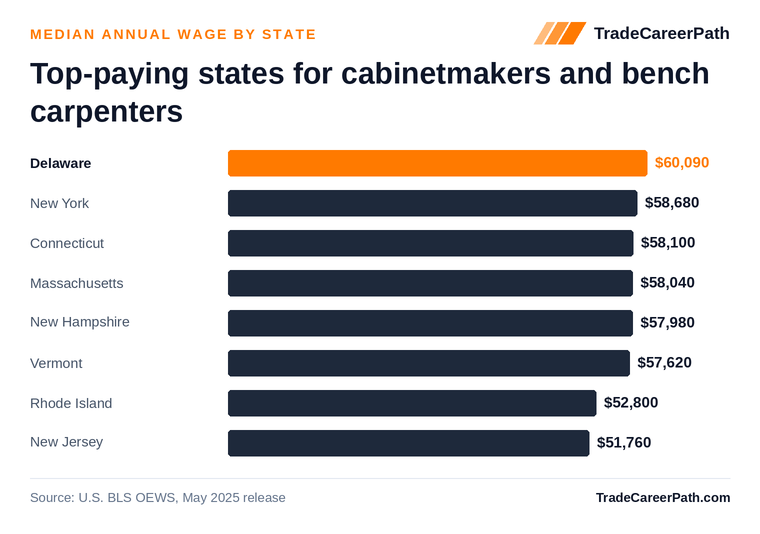
According to the U.S. Bureau of Labor Statistics (May 2025 OEWS), the highest-paying states for cabinet makers are Delaware, New York, and Connecticut. Median annual wages: Delaware ($60,090); New York ($58,680); Connecticut ($58,100).
Which states employ the most cabinet makers?
BLS reports the largest concentrations of cabinet makers in California, Indiana, and Texas. Employment levels: California (7,360 workers); Indiana (5,980 workers); Texas (5,530 workers) (May 2025).
How much do experienced cabinet makers earn?
The top 10% of cabinet makers earn more than $63,720 per year, according to BLS Occupational Employment and Wage Statistics (May 2025). Experienced workers in this band typically hold senior credentials, supervisory roles, or specialty certifications.
What is entry-level pay for cabinet makers?
BLS reports the bottom 10% of cabinet makers earn under $35,650 per year. New workers often start near this level and see pay rise as they accumulate experience and credentials.
How many cabinet makers work in the United States?
BLS reports approximately 77,170 cabinet makers employed nationwide as of May 2025.
How many job openings are expected for cabinet makers each year?
BLS projects approximately 8,100 openings per year for cabinet makers from 2024 through 2034, including new positions, retirements, and workers transitioning out. The occupation is projected to grow -1.6% from 2024 to 2034, classified as in decline growth.
How much do cabinet makers make per hour?
The median hourly wage for cabinet makers is $22.44, according to BLS (May 2025). Hourly pay ranges from about $17.14 (bottom 10%) to $30.64 (top 10%).
How Cabinet Maker Pay Compares to Similar Trades
Side-by-side comparison of Cabinet Maker and the closest related careers, based on U.S. Bureau of Labor Statistics data (May 2025 OEWS + 2024-2034 Employment Projections).
| Career | Median Pay | 10-Year Growth | Annual Openings |
|---|---|---|---|
| Cabinet Maker this guide | $46,680 | -1.6% | 8,100 |
| Carpentry | $60,580 | +4.5% | 74,100 |
| Woodworker | $46,680 | -1.6% | 8,100 |
| Interior Designer | $67,190 | +3.2% | 7,800 |
| Flooring Installer | $56,460 | +9.5% | 2,700 |
Source: BLS Occupational Employment and Wage Statistics + BLS Employment Projections.
Sources
- U.S. Bureau of Labor Statistics, Occupational Employment and Wage Statistics (May 2025)
- U.S. Bureau of Labor Statistics, Employment Projections 2024-2034
- U.S. Bureau of Labor Statistics, Survey of Occupational Injuries and Illnesses (2023-2024, Table R98)
- U.S. Department of Labor, Wage and Hour Division, Davis-Bacon General Wage Determinations (2026)
Cabinet Maker Salary by State
About this guide: Researched and written by the TradeCareerPath Editorial Team. Our editorial team researches and sources every trade school and career guide using federal labor and education data, including BLS OEWS and Employment Projections, DOL apprenticeship records, IPEDS, College Scorecard, and state licensing boards. We follow the editorial standards documented at /editorial-policy/.
Data sources
Figures on this page are sourced from the federal and state datasets below. Methodology: how we rank and source data.
| Data | Provider | Vintage |
|---|---|---|
| Occupational Employment and Wage Statistics (OEWS) | U.S. Bureau of Labor Statistics | May 2025 |
| Employment Projections | U.S. Bureau of Labor Statistics | 2024-2034 |
| Integrated Postsecondary Education Data System | National Center for Education Statistics (IPEDS) | 2024 |
| College Scorecard (school-level outcomes) | U.S. Department of Education | latest release |
| College Scorecard (field-of-study earnings) | U.S. Department of Education | latest release (updated 2026-06-12) |
| Occupational licensing requirements | CareerOneStop (U.S. Department of Labor) | latest release (updated 2026-02-22) |
| Registered apprenticeship programs | CareerOneStop / Apprenticeship.gov (U.S. Department of Labor) | latest release (updated 2025-10-25) |
| O*NET occupation profiles (skills, tasks, tools, job zones) | U.S. Department of Labor (O*NET / Employment & Training Admin.) | O*NET 29.1 (updated 2026-06-13) |