
Carpenter to Civil Engineer: From Building It to Designing It (2026)
Quick answer: Yes. A carpenter becomes a civil engineer by earning the accredited bachelor’s degree, usually part-time over five to six years while working, less with transfer credit. The national median moves from $60,580 (carpenter) to $100,840 (civil engineer), per BLS OEWS, May 2025, and your field experience is an asset the whole way.
The Numbers
| Role | National median pay | Source |
|---|---|---|
| Carpenter | $60,580 | BLS OEWS, May 2025 |
| Civil Engineer | $100,840 | BLS OEWS, May 2025 |
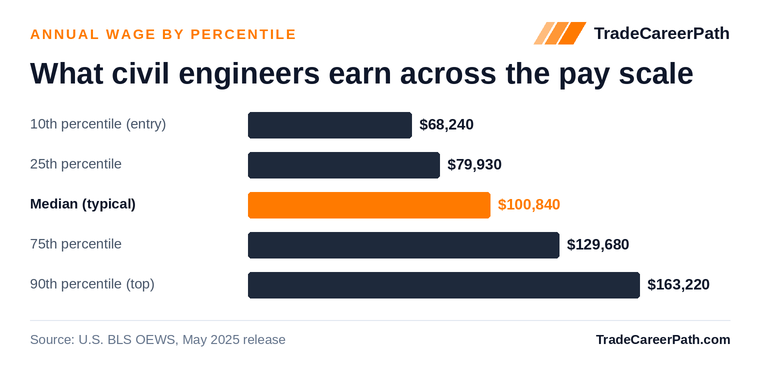
That is roughly $40,260 more per year at the median - and unlike the trade, the engineering side keeps climbing past mid-career: the 75th percentile for civil engineers is $129,680 and the 90th is $163,220 (BLS OEWS, May 2025). Civil engineering is also a big occupation - 367,840 jobs nationwide - so the demand is broad rather than concentrated in a few metros.
Full career details, percentiles, and state-by-state pay: Civil Engineer career guide.
What Your Experience Is Worth
You know how structures actually go together: framing, formwork, sequencing, and what a buildable drawing looks like versus one that gets RFI’d to death. Civil engineers with field years produce designs crews respect.
That matters more in civil than in almost any other engineering discipline, because civil work lives or dies on constructability. A structural detail that cannot physically be formed, a rebar layout no crew can tie, a concrete pour scheduled with no access - these are the mistakes that fresh graduates make and that you already know how to avoid. Firms that do design-build and construction engineering actively look for candidates who have been on the tools, and former carpenters routinely get hired into field engineering and construction engineering roles before the diploma is even finished.
What Transfers
Apprenticeship coursework and construction-technology credits can transfer, especially into civil engineering technology programs; the math sequence (through calculus) is the usual on-ramp for working carpenters.
Ask every program for a written transfer-credit evaluation before enrolling; it is free, and the difference between schools can be a full year of your life.
The Path, Step by Step
- Close the math gap first. Most working tradespeople start with algebra-to-calculus refreshers at a community college; cheap, online, and it de-risks the whole plan.
- Pick an accredited program built for working adults. ABET accreditation is non-negotiable here - civil is the field where you will want the PE license; evening, online, or hybrid formats.
- Submit everything for transfer credit. Apprenticeship records, certifications, military training, and old college credits.
- Keep working your trade. Your income funds the degree, and your daily work keeps compounding into exactly the experience employers want attached to the diploma.
- Move sideways before you graduate. Design-adjacent roles (drafting, field engineering, QA) often open to students partway through and convert to engineering titles at graduation.
What the Work Is Like on the Other Side
Civil engineers design and oversee the infrastructure that carpenters and other trades build: buildings, bridges, roads, water systems, foundations, and site work. Day to day, that means running structural and load calculations, producing and reviewing drawings, writing specifications, and answering the RFIs and submittals coming up from the field - the paperwork you have watched from the other end for years.
The job splits roughly into two lanes, and your background fits both. Design-side engineers work in an office on calculations, models, and plan sets, with periodic site visits to check that what got built matches what got drawn. Construction-side engineers (field engineers, construction engineers, resident engineers) live on the project: verifying formwork and shoring, resolving conflicts between the drawings and the dirt, reviewing pay applications, and making the engineering calls when reality does not match the plans. Former carpenters tend to start construction-side, where reading a structure by eye is a daily advantage, and move toward design or management from there.
The honest trade-offs: you swap physical wear for deadline pressure and liability. Everything you sign is documented and reviewable, seismic and load codes dictate your decisions, and on public projects a licensed engineer’s stamp - eventually yours - is what makes the drawings legal. The work is less weather-dependent and easier on the body, but the responsibility follows you home in a way a framing package never did.
Civil Engineer Career Ladder: Titles and Realistic Pay
The BLS wage percentiles map cleanly onto how civil careers actually progress. Use this as a sanity check on offers, not a guarantee:
| Stage | Typical titles | Years in | Realistic pay (BLS OEWS, May 2025) |
|---|---|---|---|
| Entry level | Engineer I, field engineer, EIT | 0-4 | ~$68,240-$79,930 (10th-25th pct) |
| Mid-career | Engineer II/III, project engineer (PE) | 4-10 | ~$100,840 (median) |
| Senior | Senior engineer, project manager | 10-15 | ~$129,680 (75th pct) |
| Principal / leadership | Principal, department head, firm partner | 15+ | $163,220+ (90th pct) |
Two notes for career changers. First, the jump from entry to mid-career pay in civil is gated by the PE license more than by years - passing it is the single biggest raise on this ladder. Second, prior trade experience compresses the bottom band: former carpenters need less supervision on site and are often hired above the entry floor, and note that the entry band’s low end of $68,240 is already above the $60,580 carpenter median.
Where Civil Engineers Earn the Most
| State | Median annual wage | Employment |
|---|---|---|
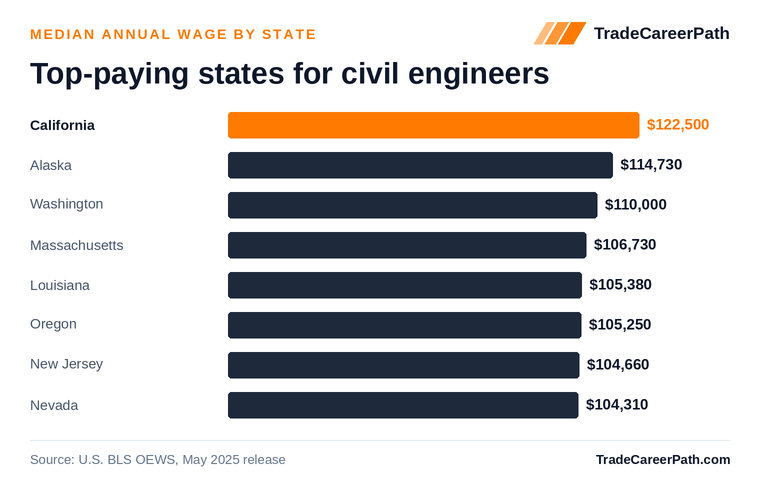
| California | $122,500 | 55,180 |
| Alaska | $114,730 | 1,670 |
| Washington | $110,000 | 12,590 |
| Massachusetts | $106,730 | 9,450 |
| Louisiana | $105,380 | 3,780 |
California is both the highest-paying state and by far the largest market, with 55,180 civil engineers - seismic requirements and the sheer volume of infrastructure work keep demand deep there. But unlike aerospace or software, civil engineering does not force relocation: Texas employs 34,870 at a $96,860 median and Florida 23,750 at $98,570 (BLS OEWS, May 2025), and every state has public works, DOT, and municipal engineering jobs. Wherever you are swinging a hammer now, there is almost certainly a civil engineering market within commuting distance.
Job Outlook for 2026 and Beyond
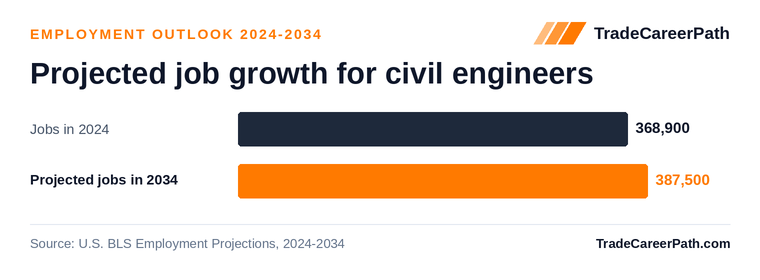
BLS projects civil engineering employment to grow +5.0% from 2024 to 2034 - from 368,900 to 387,500 jobs - with about 23,600 openings per year once retirements and occupation changes are counted (BLS Employment Projections, 2024-34). The latest wage data puts the median at $100,840 (OEWS, May 2025), up from the $99,590 figure in the 2024 projections base.
For a career changer, the openings number is the one that matters: 23,600 seats a year is a genuinely large hiring pipeline, driven by aging roads, bridges, and water systems that need replacement regardless of the economic cycle, plus a wave of retirements in an occupation that skews older. Public-sector and infrastructure work also makes civil one of the more recession-resistant engineering fields - when private construction slows, government projects tend to keep moving.
The PE License: Not Optional in This Field
Civil is the engineering discipline where licensure actually rules the career. Most engineering fields let you work a whole career under the “industrial exemption” - civil does not, in practice, because so much of the work is public infrastructure, and only a licensed Professional Engineer can sign and seal the plans. Unlicensed civil engineers hit a ceiling early: no stamping authority, limited project responsibility, and a hard cap on advancement at most firms.
The path is standardized:
- Accredited degree - ABET accreditation is what state boards expect; a non-accredited degree can add years of required experience or block licensure entirely, which is why it is the one thing to verify before enrolling anywhere.
- FE exam - the Fundamentals of Engineering exam, which you can typically sit for as a senior. Passing makes you an EIT (Engineer in Training).
- Four years of qualifying experience under licensed engineers. Field experience from your carpentry years generally does not count toward this clock, but it makes the four years far more productive.
- PE exam in civil engineering, then licensure through your state board. Requirements vary somewhat by state, so check your board’s rules early.
Plan for the license from day one - choose the ABET program, take the FE before graduation while the coursework is fresh, and treat the PE as part of the degree plan rather than an afterthought.
If This Path Is Not Quite Right
Related jumps from the same starting point:
- Construction Project Manager - run the projects instead of designing them; no PE required
- Construction Cost Estimator - your material and labor knowledge priced into an office career
- Architect - the design side of buildings; note it has its own mandatory licensure path
- Surveyor - outdoor, technical, and state-licensed, with a shorter school commitment
Or browse all trade careers that require a 4-year degree.
Frequently Asked Questions
Can a carpenter really work as a civil engineer?
Yes. The requirement is the accredited bachelor's degree; nothing about starting in the trade blocks the path, and employers consistently treat field experience as an advantage rather than a detour.
How long does it take while working full-time?
Typically five to six years part-time for the bachelor's, less with transfer credit. Apprenticeship coursework and construction-technology credits can transfer, especially into civil engineering technology programs.
What is the pay difference?
The national median is $60,580 for carpenters versus $100,840 for the degree role (BLS OEWS, May 2025), a difference of about $40,260 per year at the median.
Is civil engineering hard for someone coming from the trades?
The math is the real hurdle - calculus, statics, and structural analysis are unavoidable. But carpenters usually find the design and construction courses easier than fresh high-school graduates do, because loads, spans, and sequencing are things you have already handled with your hands.
Should I get a civil engineering or construction management degree?
Civil engineering if you want design authority and the PE stamp; construction management if you want to run projects and stay closer to the field. The civil degree is harder and takes more math, but it keeps both doors open - construction management does not lead back to the engineer title.
Can you train as a civil engineer without a degree?
Effectively no. The engineer title and the PE license both assume an accredited bachelor's - most state boards require an ABET-accredited degree or add years of extra experience without one. Without the degree, the ceiling is engineering technician or field/CAD roles.
Do civil engineers need a PE license?
Yes, in practice. Civil is the one engineering field where the PE is effectively required to advance - only licensed engineers can sign and seal plans for public work. The path is an accredited degree, the FE exam, four years of qualifying experience, then the PE exam.
What is the job outlook for civil engineers?
BLS projects employment to grow +5.0% from 2024 to 2034, from 368,900 to 387,500 jobs, with about 23,600 openings per year on average (BLS Employment Projections, 2024-34).
Degree and Program Guides
- Online Civil Engineering Degrees - accredited program options for this path
Sources
- U.S. Bureau of Labor Statistics, Occupational Employment and Wage Statistics (OEWS), May 2025 - Civil Engineers (SOC 17-2051)
- U.S. Bureau of Labor Statistics, Employment Projections, 2024-34
- U.S. Bureau of Labor Statistics, Occupational Outlook Handbook - education and licensing requirements
Carpenter to Civil Engineer Salary by State
About this guide: Researched and written by the TradeCareerPath Editorial Team. Our editorial team researches and sources every trade school and career guide using federal labor and education data, including BLS OEWS and Employment Projections, DOL apprenticeship records, IPEDS, College Scorecard, and state licensing boards. We follow the editorial standards documented at /editorial-policy/.
Data sources
Figures on this page are sourced from the federal and state datasets below. Methodology: how we rank and source data.
| Data | Provider | Vintage |
|---|---|---|
| Occupational Employment and Wage Statistics (OEWS) | U.S. Bureau of Labor Statistics | May 2025 |
| Employment Projections | U.S. Bureau of Labor Statistics | 2024-2034 |
| Integrated Postsecondary Education Data System | National Center for Education Statistics (IPEDS) | 2024 |
| College Scorecard (school-level outcomes) | U.S. Department of Education | latest release |
| College Scorecard (field-of-study earnings) | U.S. Department of Education | latest release (updated 2026-06-12) |
| Occupational licensing requirements | CareerOneStop (U.S. Department of Labor) | latest release (updated 2026-02-22) |
| Registered apprenticeship programs | CareerOneStop / Apprenticeship.gov (U.S. Department of Labor) | latest release (updated 2025-10-25) |
| O*NET occupation profiles (skills, tasks, tools, job zones) | U.S. Department of Labor (O*NET / Employment & Training Admin.) | O*NET 29.1 (updated 2026-06-13) |