
How to Become a Carpenter in 2026
Is Carpenter Right for You?
The U.S. Department of Labor's O*NET profile for Carpenters (SOC 47-2031) describes the work this way: Construct, erect, install, or repair structures and fixtures made of wood and comparable materials, such as concrete forms; building frameworks, including partitions, joists, studding, and rafters; and wood stairways, window and door frames, and hardwood floors. May also install cabinets, siding, drywall, and batt or roll insulation. Includes brattice builders who build doors or brattices (ventilation walls or partitions) in underground passageways.
What the work involves
- Follow established safety rules and regulations and maintain a safe and clean environment.
- Measure and mark cutting lines on materials, using a ruler, pencil, chalk, and marking gauge.
- Assemble and fasten materials to make frameworks or props, using hand tools and wood screws, nails, dowel pins, or glue.
- Study specifications in blueprints, sketches, or building plans to prepare project layout and determine dimensions and materials required.
- Shape or cut materials to specified measurements, using hand tools, machines, or power saws.
Skills and knowledge that matter
Skills: Monitoring, Critical Thinking, Active Listening, Coordination, Speaking, Reading Comprehension.
Knowledge: Building and Construction, Mathematics, Administration and Management, Design.
Tools and technology you may use
Tools: A-frame levels, Air compressors, Auger bits, Baluster jigs, Band saws, Bandsaws.
Technology: Project management software, Computer aided design CAD software, Accounting software, Intuit QuickBooks, Microsoft Excel, Microsoft Office software.
Typical preparation
O*NET Job Zone Two (Some Preparation Needed). These occupations usually require a high school diploma. Employees in these occupations need anywhere from a few months to one year of working with experienced employees. A recognized apprenticeship program may be associated with these occupations.
Interest fit
O*NET interest profile: Realistic, Conventional, Artistic. People who enjoy hands-on, practical work with tools, machines, plants, or materials often find this occupation a good fit.
Source: O*NET 29.1 (updated 2026-06-13)
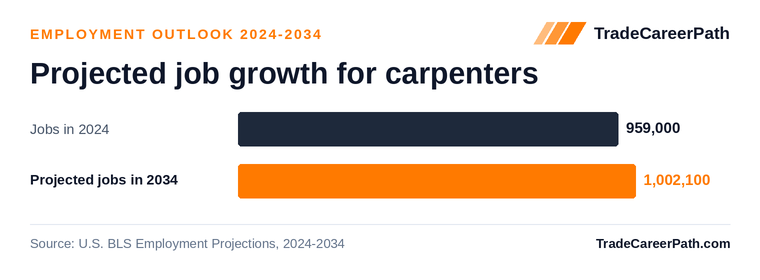
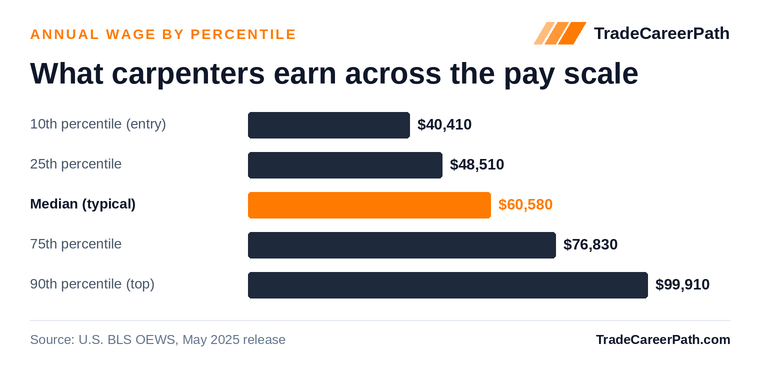
Quick answer: Training as a carpenter usually takes 3 to 4 years through a registered apprenticeship that pays you while you train, or a shorter 6 to 12 month trade school program followed by on-the-job experience. There is no single national license, though many employers value an NCCER carpentry credential and OSHA 10 or 30 safety training, and some states require contractor registration or a journeyman card. Training costs vary by program and school. The median carpenter salary is $60,580 per year ($29.12/hour), and the field is projected to have about 74,100 openings nationwide each year (BLS, May 2025).
Carpenters build, install, and repair the wood, metal, and composite structures behind nearly every construction project, from framing and roofing to cabinetry and remodeling. If you like working with your hands, solving problems, and seeing finished results, carpentry is a direct path into a skilled trade without a college degree.
How to Become a Carpenter
Most people reach journeyman carpenter status in about three to four years, depending on whether they learn mainly through a paid apprenticeship or start with a trade school program. There is no single licensing exam to pass nationwide. You build the career through training, paid jobsite experience, and credentials that prove your skills.
1. Earn a high school diploma or GED
A high school diploma or GED is the baseline requirement for most registered apprenticeships and trade school programs. Before you apply, it helps to build the skills carpentry depends on every day. Math is central to the trade, so geometry, algebra, and any class that uses fractions and measurement will serve you well on the job. Shop, woodworking, and drafting classes give you early exposure to tools, materials, and reading plans. Physical stamina matters too, since carpenters spend long days lifting, climbing, and standing. If you are changing careers and already hold a diploma, you can move straight to applying for an apprenticeship. Many strong carpenters come from other fields and bring useful skills in organization, reliability, and teamwork that crews value just as much as raw experience.
2. Enroll in an apprenticeship or trade school
This is the core of how carpenters learn the trade, and you have two main routes. A registered apprenticeship combines paid jobsite work with classroom instruction, typically over three to four years. Apprenticeships are sponsored by unions such as the United Brotherhood of Carpenters and Joiners of America (UBC), which runs the Carpenters International Training Fund, and by contractor groups like Associated Builders and Contractors (ABC) and the Associated General Contractors of America (AGC). A trade school or vocational program of roughly 6 to 12 months teaches framing, finishing, tool use, and safety in a structured setting, which can shorten your path to a first job or apprenticeship slot. Many programs build their classroom curriculum around the NCCER (National Center for Construction Education and Research) standards. Costs vary by program and school, so request current pricing before you enroll. Apprenticeships are often paid, which means you can earn wages while you learn.
3. Build hands-on jobsite experience
Carpentry is learned by doing. Whether you enter through an apprenticeship or a trade school, you build real competency by working alongside experienced carpenters on active jobsites. Early on you will measure, cut, and assemble materials, set concrete forms, raise framing, and install doors, windows, and trim under close supervision. Apprenticeship hours are paid and count toward the on-the-job total you need to reach journeyman status, so this stage is both training and a paycheck. Pay attention to how skilled carpenters sequence a job, keep tolerances tight, and maintain safety on a busy site. Ask questions, volunteer for varied tasks, and treat every project as a chance to add a skill, since the breadth of work you can do directly shapes how employable and well paid you work as.
4. Earn safety and skill credentials
There is no single national carpentry license, but credentials make you more hireable and can support higher pay. Most employers expect OSHA 10 or OSHA 30 safety training, which covers hazard recognition and jobsite safety standards. An NCCER carpentry credential documents that you have met a standardized, employer-recognized curriculum, which transfers across states and companies. Specialty certifications in areas such as scaffold building, green construction, or remodeling can set you apart for specific work. Requirements also vary by state and specialty: some states require contractor registration or a journeyman card before you work independently or bid jobs. Check your state’s licensing board and your local UBC or ABC chapter to confirm exactly what your area requires before you take on independent work.
5. Find work and advance
Unions, general contractors, home builders, and apprenticeship sponsors all hire carpenters. Apply directly through UBC, ABC, and AGC chapters, which often connect members to openings, and tailor your resume to the kind of work you want, such as residential framing, commercial finishing, or cabinetry. Highlight the hours, credentials, and project types you have logged. Once you are working steadily, experience opens the door to specialization and leadership. Carpenters move into roles such as lead carpenter, foreman, estimator, or finish-carpentry specialist, and many eventually start their own contracting businesses. Continued training and a clean safety record are the surest ways to keep advancing and increase your earning potential over time.
What Carpenters Do
Carpenters construct, install, and repair building frameworks and structures made from wood, metal, and other materials. Their work spans large commercial builds, residential framing, and fine interior finishing.
Typical Responsibilities
- Measure, cut, and assemble wood and building materials
- Read and interpret blueprints or construction drawings
- Install doors, windows, flooring, and cabinetry
- Build concrete forms, scaffolding, and framing structures
- Maintain jobsite tools and safety standards
Carpenters combine precision and creativity to turn raw materials into finished structures.
Key Skills for Success in Carpentry
- Strong attention to measurement and detail
- Familiarity with power tools and safety procedures
- Ability to interpret blueprints and building codes
- Solid math and geometry skills
- Problem-solving and teamwork on dynamic jobsites
Common Work Settings
Carpenters are needed in a variety of environments:
- Residential and commercial construction
- Remodeling and renovation projects
- Industrial and infrastructure builds
- Furniture and cabinet-making workshops
- Maintenance and facilities departments
Education and Training Pathways
| Pathway | Typical Duration | Outcome |
|---|---|---|
| Trade School Program | 6 to 12 months | Entry-level carpentry knowledge |
| Apprenticeship | 3 to 4 years | Comprehensive hands-on training |
| Associate Degree | 2 years | Broader technical and management foundation |
| Continuing Education | Ongoing | Skill upgrades or specialization |
Carpentry Requirements by State
Requirements vary across states. Some require contractor registration or journeyman credentials, while others rely on employer training standards.
| State | Guide |
|---|---|
| Texas | Carpentry in Texas |
| Florida | Carpentry in Florida |
| California | Carpentry in California |
View All State Carpentry Requirements
Career Development and Advancement
As experience grows, carpenters can move into roles such as:
- Lead Carpenter or Foreman who supervises teams on construction sites
- Estimator or Project Coordinator who manages materials and timelines
- Cabinet Maker or Finish Carpenter who specializes in fine craftsmanship
- Construction Supervisor or Contractor who oversees major building projects
Carpentry offers room for lifelong skill growth and creative problem-solving.
Training Duration and Cost Overview
- Training Period: 3 to 4 years for a full apprenticeship, or 6 to 12 months for many trade school programs
- Learning Focus: Safety, structural framing, and finishing techniques
- Format: Classroom, lab, and supervised field training
Program structures and costs vary by provider, and registered apprenticeships are often paid. Always review program details and current pricing directly from the school or training organization.
Pros and Considerations
Highlights
- Hands-on, creative, and detail-oriented work
- Paid apprenticeship paths and no degree required
- Skills transferable across industries
- Opportunities for self-employment
Considerations
- Physically demanding and tool-intensive work
- Seasonal variations in project availability
- Strict safety and compliance requirements
- Precision is critical to project quality
Find Carpentry Training Near You
Quick Facts: Carpentry Salary, Training, and Outlook

Industry Organizations & Certifying Bodies
These are the recognized national organizations, unions, certifying bodies, and regulatory authorities that shape this trade. They issue the credentials, sponsor the apprenticeships, publish the codes, and represent workers and employers.
- United Brotherhood of Carpenters and Joiners of America (UBC) Primary carpentry union; operates the Carpenters International Training Fund.
- Associated General Contractors of America (AGC) Major construction contractor association with carpentry workforce programs.
- NCCER (National Center for Construction Education and Research) Standardized carpentry curriculum and credential.
- Associated Builders and Contractors (ABC) Merit-shop association sponsoring carpentry apprenticeships.
Federal Prevailing Wages by State
The U.S. Department of Labor sets Davis-Bacon prevailing wages that contractors must pay on federally funded construction projects. These are minimum hourly rates, not averages - actual market pay can be higher. Across 48 states with active 2026 determinations, the average total compensation (base + fringe) for carpenters is $41.51/hour. New Jersey pays the highest rate ($116.67/hr total), while Oklahoma reports the lowest active determination ($14.96/hr total).
| State | Base Hourly | Fringe Hourly | Total Hourly | Annualized* |
|---|---|---|---|---|
| New Jersey | $57.42 | $59.25 | $116.67 | $242,674 |
| Nevada | $50.77 | $28.28 | $79.05 | $164,424 |
| Rhode Island | $47.88 | $30.50 | $78.38 | $163,030 |
| Alaska | $50.79 | $26.42 | $77.21 | $160,597 |
| Wisconsin | $45.46 | $31.52 | $76.98 | $160,118 |
| Connecticut | $42.03 | $29.19 | $71.22 | $148,138 |
| Oregon | $52.62 | $16.81 | $69.43 | $144,414 |
| Massachusetts | $39.28 | $27.90 | $67.18 | $139,734 |
| Minnesota | $36.55 | $29.03 | $65.58 | $136,406 |
| California | $39.15 | $26.18 | $65.33 | $135,886 |
| Delaware | $38.27 | $25.34 | $63.61 | $132,309 |
| Washington | $44.21 | $17.28 | $61.49 | $127,899 |
| Indiana | $34.70 | $25.98 | $60.68 | $126,214 |
| Ohio | $36.29 | $23.79 | $60.08 | $124,966 |
| Pennsylvania | $38.92 | $20.06 | $58.98 | $122,678 |
| Michigan | $36.76 | $21.11 | $57.87 | $120,370 |
| Illinois | $31.39 | $25.99 | $57.38 | $119,350 |
| Missouri | $31.51 | $22.25 | $53.76 | $111,821 |
| Maryland | $34.41 | $14.49 | $48.90 | $101,712 |
| District of Columbia | $34.41 | $14.33 | $48.74 | $101,379 |
| Colorado | $33.11 | $12.17 | $45.28 | $94,182 |
| Alabama | $30.26 | $14.78 | $45.04 | $93,683 |
| West Virginia | $24.19 | $16.23 | $40.42 | $84,074 |
| Kentucky | $20.76 | $8.63 | $29.39 | $61,131 |
| Iowa | $21.75 | $7.54 | $29.29 | $60,923 |
| Montana | $20.51 | $7.13 | $27.64 | $57,491 |
| Vermont | $18.81 | $7.96 | $26.77 | $55,682 |
| New Mexico | $19.79 | $6.14 | $25.93 | $53,934 |
| New Hampshire | $25.00 | $0.00 | $25.00 | $52,000 |
| Utah | $19.51 | $4.71 | $24.22 | $50,378 |
| Nebraska | $19.35 | $4.29 | $23.64 | $49,171 |
| Maine | $19.77 | $3.38 | $23.15 | $48,152 |
| Kansas | $18.74 | $3.86 | $22.60 | $47,008 |
| North Carolina | $18.11 | $2.63 | $20.74 | $43,139 |
| South Dakota | $15.96 | $4.15 | $20.11 | $41,829 |
| Arizona | $18.42 | $1.46 | $19.88 | $41,350 |
| Idaho | $17.71 | $1.82 | $19.53 | $40,622 |
| Tennessee | $17.59 | $1.81 | $19.40 | $40,352 |
| Arkansas | $16.08 | $2.77 | $18.85 | $39,208 |
| Georgia | $18.00 | $0.00 | $18.00 | $37,440 |
| Texas | $15.13 | $2.63 | $17.76 | $36,941 |
| Louisiana | $16.86 | $0.00 | $16.86 | $35,069 |
| Florida | $14.79 | $1.81 | $16.60 | $34,528 |
| Mississippi | $16.13 | $0.00 | $16.13 | $33,550 |
| North Dakota | $15.78 | $0.00 | $15.78 | $32,822 |
| Virginia | $15.60 | $0.00 | $15.60 | $32,448 |
| South Carolina | $14.46 | $0.78 | $15.24 | $31,699 |
| Oklahoma | $14.96 | $0.00 | $14.96 | $31,117 |
* Annualized total = total hourly × 2,080 hours (40-hour week, 52 weeks). Actual annual pay varies with overtime, project length, and benefits utilization.
Source: U.S. Department of Labor, Wage and Hour Division - Davis-Bacon General Wage Determinations, 2026. Rates reflect the lowest base rate within each statewide determination for carpenter classifications.
Wage and Employment Charts
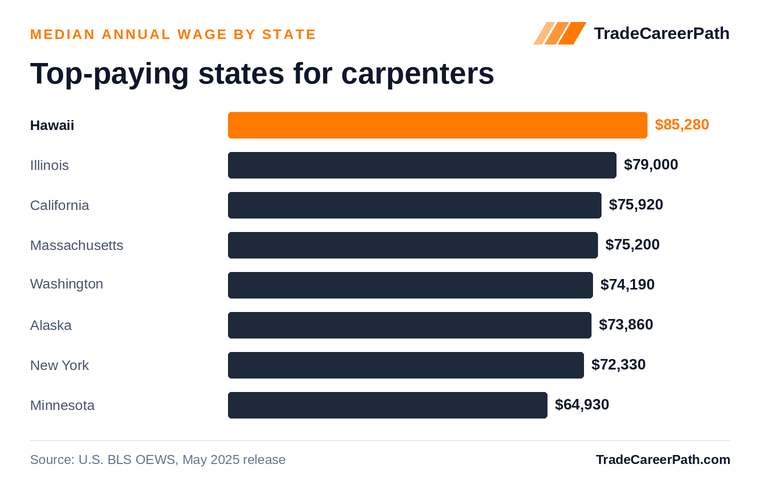
Carpenter Salary and Requirements by State
Select your state for local wage data, training options, and requirements:
Alabama · Alaska · Arizona · Arkansas · California · Colorado · Connecticut · Delaware · District of Columbia · Florida · Georgia · Hawaii · Idaho · Illinois · Indiana · Iowa · Kansas · Kentucky · Louisiana · Maine · Maryland · Massachusetts · Michigan · Minnesota · Mississippi · Missouri · Montana · Nebraska · Nevada · New Hampshire · New Jersey · New Mexico · New York · North Carolina · North Dakota · Ohio · Oklahoma · Oregon · Pennsylvania · Rhode Island · South Carolina · South Dakota · Tennessee · Texas · Utah · Vermont · Virginia · Washington · West Virginia · Wisconsin · Wyoming
Workplace Safety Snapshot
BLS Survey of Occupational Injuries and Illnesses data (2023-2024) report approximately 243.9 days-away, restricted, or transfer cases per 10,000 full-time-equivalent workers in carpenters (about 2.44 per 100 FTE). Source: BLS Survey of Occupational Injuries and Illnesses, Table R98.
Frequently Asked Questions
How long does carpenter training take?
Most carpenters reach journeyman level in 3 to 4 years through a registered apprenticeship that pairs paid on-the-job hours with classroom instruction. A shorter trade school program of 6 to 12 months can teach core skills first, but you still build full competency on the job. A high school diploma or GED is generally required to start.
Do you need a college degree to work as a carpenter?
No. A college degree is not required to work as a carpenter. Most people enter through an apprenticeship or trade school combined with on-the-job training. A high school diploma or GED is typically the only educational prerequisite.
How much does carpentry training cost?
Costs vary widely by program and school. Registered apprenticeships, including those run through the United Brotherhood of Carpenters and Joiners of America or Associated Builders and Contractors, are often paid, so apprentices earn wages while they train. Trade school tuition varies, so request current pricing directly from each program before enrolling.
Do carpenters need a license or certification?
Requirements depend on your state and specialty. There is no single national carpentry license, but many employers value an NCCER carpentry credential and OSHA 10 or OSHA 30 safety training. Some states require contractor registration or a journeyman card, so check your state rules before working independently.
Is it hard to train as a carpenter?
Entry is accessible because no degree is required and apprenticeships pay while you learn. The work is physically demanding and detail driven, involving precise measurement, blueprint reading, and safe use of power tools, so it rewards patience and steady practice.
Can you train to be a carpenter online?
Some classroom theory, such as blueprint reading, math, and the NCCER curriculum, can be studied online or in a hybrid format. The hands-on portion, however, must be completed in person on real jobsites or in a shop, since carpentry is a physical, tool-based trade.
What is the median pay for a carpenter?
The median carpenter wage is $60,580 per year, or $29.12 per hour (BLS, May 2025). The lowest 10 percent earned about $40,410 and the highest 10 percent earned about $99,910, with pay shaped by region, specialty, and union membership.
How Carpenter Pay Compares to Similar Trades
Side-by-side comparison of Carpentry and the closest related careers, based on U.S. Bureau of Labor Statistics data (May 2025 OEWS + 2024-2034 Employment Projections).
| Career | Median Pay | 10-Year Growth | Annual Openings |
|---|---|---|---|
| Carpentry this guide | $60,580 | +4.5% | 74,100 |
| Construction Worker | $47,120 | +7.3% | 129,400 |
| Construction Manager | $114,990 | +8.7% | 46,800 |
| Flooring Installer | $56,460 | +9.5% | 2,700 |
| Home Inspector | $74,690 | -0.8% | 14,800 |
Source: BLS Occupational Employment and Wage Statistics + BLS Employment Projections.
Advance Your Career with a Degree
Experienced Carpenter professionals often step up into degree-track careers where field experience is a hiring advantage:
- Civil Engineer - median pay $100,840 (BLS OEWS, May 2025); requires a 4-year degree
- Architect - median pay $99,280 (BLS OEWS, May 2025); requires a 4-year degree
- Construction Cost Estimator - median pay $78,740 (BLS OEWS, May 2025); requires a 4-year degree
- CTE Teacher (Shop Teacher) - median pay $66,270 (BLS OEWS, May 2025); requires a 4-year degree
- Construction Project Manager - median pay $102,320 (BLS OEWS, May 2025); requires a 4-year degree
- Carpenter to civil engineer - from building it to designing it
See all trade careers that require a 4-year degree.
Degree and Program Guides
- Online Civil Engineering Degrees - the degree route into design and PM work
- Online Project Management Degrees - moving from the crew to the office
Sources
- U.S. Bureau of Labor Statistics, Occupational Employment and Wage Statistics (May 2025)
- U.S. Bureau of Labor Statistics, Employment Projections 2024-2034
- U.S. Bureau of Labor Statistics, Survey of Occupational Injuries and Illnesses (2023-2024, Table R98)
- U.S. Department of Labor, Wage and Hour Division, Davis-Bacon General Wage Determinations (2026)
Carpenter Salary by State
About this guide: Researched and written by the TradeCareerPath Editorial Team. Our editorial team researches and sources every trade school and career guide using federal labor and education data, including BLS OEWS and Employment Projections, DOL apprenticeship records, IPEDS, College Scorecard, and state licensing boards. We follow the editorial standards documented at /editorial-policy/.
Data sources
Figures on this page are sourced from the federal and state datasets below. Methodology: how we rank and source data.
| Data | Provider | Vintage |
|---|---|---|
| Occupational Employment and Wage Statistics (OEWS) | U.S. Bureau of Labor Statistics | May 2025 |
| Employment Projections | U.S. Bureau of Labor Statistics | 2024-2034 |
| Integrated Postsecondary Education Data System | National Center for Education Statistics (IPEDS) | 2024 |
| College Scorecard (school-level outcomes) | U.S. Department of Education | latest release |
| College Scorecard (field-of-study earnings) | U.S. Department of Education | latest release (updated 2026-06-12) |
| Occupational licensing requirements | CareerOneStop (U.S. Department of Labor) | latest release (updated 2026-02-22) |
| Registered apprenticeship programs | CareerOneStop / Apprenticeship.gov (U.S. Department of Labor) | latest release (updated 2025-10-25) |
| O*NET occupation profiles (skills, tasks, tools, job zones) | U.S. Department of Labor (O*NET / Employment & Training Admin.) | O*NET 29.1 (updated 2026-06-13) |