
How to Become a Chemical Engineer in 2026
Is Chemical Engineer Right for You?
The U.S. Department of Labor's O*NET profile for Chemical Engineers (SOC 17-2041) describes the work this way: Design chemical plant equipment and devise processes for manufacturing chemicals and products, such as gasoline, synthetic rubber, plastics, detergents, cement, paper, and pulp, by applying principles and technology of chemistry, physics, and engineering.
What the work involves
- Develop safety procedures to be employed by workers operating equipment or working in close proximity to ongoing chemical reactions.
- Troubleshoot problems with chemical manufacturing processes.
- Monitor and analyze data from processes and experiments.
- Evaluate chemical equipment and processes to identify ways to optimize performance or to ensure compliance with safety and environmental regulations.
- Design and plan layout of equipment.
Skills and knowledge that matter
Skills: Science, Critical Thinking, Reading Comprehension, Complex Problem Solving, Active Learning, Judgment and Decision Making.
Knowledge: Engineering and Technology, Chemistry, Mathematics, Design.
Tools and technology you may use
Technology: Analytical or scientific software, Computer aided design CAD software, Development environment software, Autodesk AutoCAD, C, C++.
Typical preparation
O*NET Job Zone Four (Considerable Preparation Needed). Most of these occupations require a four-year bachelor's degree, but some do not. Employees in these occupations usually need several years of work-related experience, on-the-job training, and/or vocational training.
Interest fit
O*NET interest profile: Realistic, Investigative, Conventional. People who enjoy hands-on, practical work with tools, machines, plants, or materials often find this occupation a good fit.
Source: O*NET 31.0 (updated 2026-10-14)
Quick answer: Training as a chemical engineer requires a 4-year degree - typically an ABET-accredited bachelor’s in chemical engineering. The national median pay is $125,040 per year, and BLS projects +4.7% employment change from 2025 to 2035 (BLS OEWS, May 2025; BLS Employment Projections, 2025-35).
Chemical Engineer at a Glance
| Metric | Detail | Source |
|---|---|---|
| Median annual wage | $125,040 | BLS OEWS, May 2025 |
| Typical wage range | $79,420 (10th pct) - $182,880 (90th pct) | BLS OEWS, May 2025 |
| Employment | 21,070 nationwide | BLS OEWS, May 2025 |
| Projected growth (2025-35) | +4.7%, about 1,100 openings per year | BLS Employment Projections, 2025-35 |
| Typical education | ABET-accredited bachelor’s in chemical engineering | BLS Occupational Outlook Handbook |
| License / certification | PE license for consulting and some senior roles | State licensing boards |
What Does a Chemical Engineer Do?
Chemical engineers design and run the processes that make fuels, chemicals, pharmaceuticals, and food at industrial scale - reactor design, separations, process safety, and plant optimization - and they own the engineering decisions behind the units that operators and instrument techs run every shift.
Day to day, the work depends on the seat. A process engineer at a refinery monitors unit performance, troubleshoots why a distillation column is off-spec, and runs the calculations behind a proposed rate increase. A process-safety engineer leads HAZOP reviews, sizes relief valves, and maintains the PSM documentation regulators audit. A production or plant engineer lives closer to operations: chasing downtime, planning turnarounds, and dispositioning the daily list of “can we keep running with this?” questions. In pharma and food, the same skill set shows up as scale-up work - turning a lab recipe into a validated production process - with batch records and FDA-facing documentation instead of P&ID redlines. In every branch, the job is written down: management-of-change forms, safety reviews, and engineering calculations that someone else will audit.
If you are coming from the operator side, the shortest way to say it: the board operator runs the unit within the limits; the engineer sets the limits and proves they are safe. The alarm setpoints, the operating envelope, the answer to “why did the unit trip” - those work as your calls, and your operations background means you will make them with a realism that engineers who have never held a radio simply do not have.
Skills That Make a Great Chemical Engineer
- Process design and unit operations
- Thermodynamics, kinetics, and transport phenomena
- Process safety management (PSM/HAZOP, relief-system design)
- P&ID literacy and management of change
- Plant troubleshooting and root-cause analysis
- Process simulation tools (Aspen HYSYS/Plus) plus Excel or Python for analysis
- Writing: MOCs, safety reviews, and engineering calculations carry the job
Chemical Engineer Salary
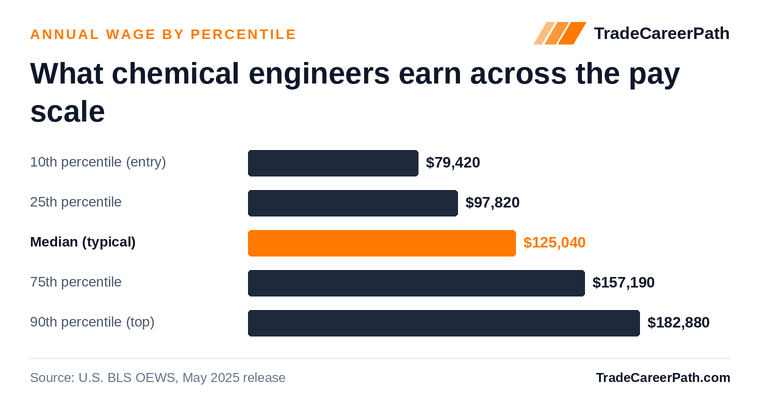
Chemical engineering is one of the best-paid destinations a plant background can lead to. The national median is $125,040 per year, and the 10th percentile - roughly where new graduates start - is $79,420, already comparable to what senior operators earn. The 75th percentile is $157,190, and the top 10% earn $182,880 or more (BLS OEWS, May 2025). The mean of $129,980 sits above the median, which tells you the top of this field pulls hard.
Where the Jobs and the Money Are
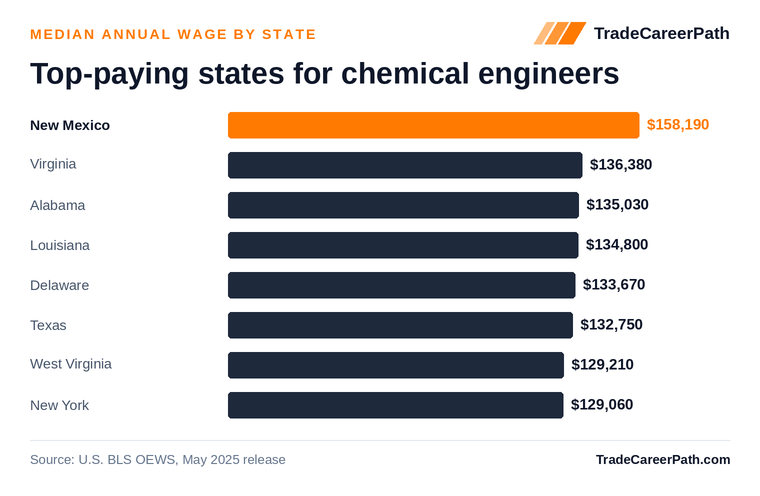
This is a small, concentrated occupation - 21,070 engineers nationwide, clustered where the process industry is. The Gulf Coast refining and petrochemical corridor is the center of gravity: Texas alone employs 2,610 chemical engineers at a $132,750 median, and Louisiana’s concentration is 2.8 times the national average. Massachusetts (1,460 jobs, driven by pharma and biotech) and Ohio (1,030) round out the big employment states (BLS OEWS, May 2025).
| State | Median annual wage | Employment |
|---|---|---|
| New Mexico | $158,190 | 160 |
| Virginia | $136,380 | 790 |
| Alabama | $135,030 | 600 |
| Louisiana | $134,800 | 730 |
| Delaware | $133,670 | 370 |
The concentration numbers matter more than the raw medians. Delaware’s chemical-industry legacy gives it 5.59 times the national concentration of chemical engineers, and Louisiana (2.8x) and Alabama (2.08x) are similarly dense - meaning deeper job markets and more room to change employers without relocating. New Mexico tops the pay table at $158,190, but with only 160 positions it is a thin market; Texas offers the opposite trade: a $132,750 median across the country’s largest pool of jobs.
How to Become a Chemical Engineer
1. Earn an ABET-accredited bachelor’s
Chemical engineering, from an ABET-accredited program - accreditation is the one non-negotiable, because employers screen for it and the FE/PE licensure path assumes it. Fully online chemical engineering bachelor’s programs are rarer than in mechanical or electrical, largely because of the lab requirements, so working operators should look hard at hybrid and evening formats near industrial corridors, and at schools that accept process-technology associate credits in transfer. Get a written transfer evaluation before you enroll anywhere.
2. Use operations experience
Board-operator and process-tech time is a genuine differentiator with refiners and chemical makers. Say so explicitly on applications: years running a crude unit, an FCC, or a batch train reads as proof you understand how processes actually behave, upset, and recover - the exact judgment new graduates lack. Several major operators also tuition-fund the degree for operators they want to keep, so ask about tuition assistance before you pay a school directly.
3. Start as a process or production engineer
Refineries, chemical plants, and pharma manufacturers hire at the bachelor’s level. Production and contact engineering - the roles embedded in the unit, working daily with operations - are the classic entry points for former operators, because the job is judging real equipment rather than working purely from models. Expect the first years to be troubleshooting, small projects, and management-of-change work rather than grand process design.
4. Build process-safety depth
PSM/HAZOP experience is the fastest-appreciating skill in the field. Every covered process facility needs engineers who can lead hazard reviews, size relief systems, and keep the PSM program audit-ready, and there are not enough of them. For a former operator this is the natural specialty: you have seen what near-misses actually look like, which makes your hazard scenarios credible in a way a purely academic reviewer’s are not.
5. Advance
Senior process engineer, operations management, or process-safety leadership. The fork comes around the ten-year mark: deepen into a technical-authority role (senior process or process-safety engineer), or take the leadership track into operations management - a path where ex-operators with a degree have an outsized advantage, because they can lead the people they used to work beside. Both tracks are covered in the career ladder below.
Career Ladder: Titles and Realistic Pay
The BLS wage percentiles map cleanly onto how chemical engineering careers actually progress. Use this as a sanity check on offers, not a guarantee:
| Stage | Typical titles | Years in | Realistic pay (BLS OEWS, May 2025) |
|---|---|---|---|
| Entry level | Process engineer I, production/contact engineer | 0-3 | ~$79,420-$97,820 (10th-25th pct) |
| Mid-career | Process engineer II/III, unit engineer | 3-10 | ~$125,040 (median) |
| Senior | Senior process engineer, process-safety lead | 10-15 | ~$157,190 (75th pct) |
| Principal / leadership | Principal engineer, operations manager, PSM leader | 15+ | $182,880+ (90th pct) |
Two notes for career changers. First, prior plant experience compresses this ladder: former board operators are routinely hired above the bottom of the entry band because they need far less supervision around live units. Second, the figures shown are base-wage data - refining and chemical majors commonly add bonus and profit-sharing on top, and turnaround-heavy years can push total compensation well past the percentiles shown here.
Do You Need a PE License?
Mostly no. Chemical engineers at manufacturers work under the “industrial exemption” - the company, not the individual engineer, holds design responsibility, so most plant engineers never license. Two things typically matter more in this industry:
- Process-safety credentials and experience: leading HAZOPs, PSM program ownership, and relief-system design work are the qualifications that get chemical engineers recruited.
- The FE exam, taken early: even if you never pursue the PE, passing the Fundamentals of Engineering exam as a senior (or soon after graduating) keeps the option open cheaply.
If you want the PE - it matters for consulting, expert-witness work, and some senior roles where public-facing sign-off is required - the path is: ABET degree, pass the FE exam, four years of qualifying experience, then the PE exam, per your state board’s rules.
Why an Online Degree Works for This Career
Refinery and plant operators live inside these processes already; the ABET bachelor’s moves you from running the board to designing the unit. Process-experienced engineers are prized for exactly the operational judgment new graduates lack. Hybrid and transfer-friendly programs serve working operators - process-technology associate credits sometimes transfer - and employer tuition assistance is common at refiners and chemical makers, so many operators complete the degree with much of the tuition covered, without giving up their seniority or shift pay.
Job Outlook for 2026 and Beyond
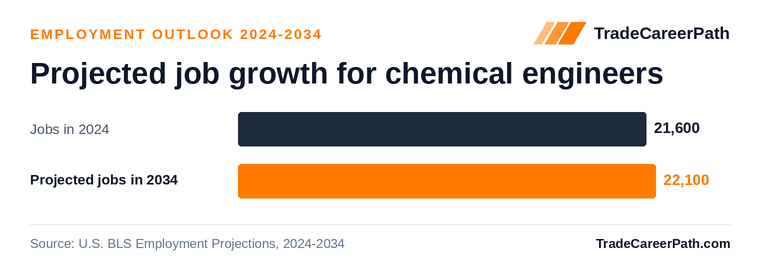
BLS projects chemical engineering employment to grow +4.7% from 2025 to 2035 - from 21,900 to 22,900 jobs - with about 1,100 openings per year once retirements and occupation changes are counted (BLS Employment Projections, 2025-35). The latest wage data (OEWS, May 2025) puts the median at $125,040, up from the 2024 figure of $121,860 - pay is rising even though headcount growth is modest.
Read those numbers honestly: this is a small occupation that grows slowly, and the openings figure - 1,100 seats a year against 21,070 jobs - is what actually drives hiring, mostly through retirements in an experienced workforce. The demand is shifting, not shrinking: traditional refining is a replacement market, while battery materials, renewable fuels, semiconductor chemicals, and pharma manufacturing keep adding process roles. For a career changer with operations experience, a slow-growth field full of retiring engineers is not a bad market to enter - the competition is thinner than the growth rate suggests.
Cost and Time to Complete the Degree
For chemical engineers, the credential is: ABET-accredited bachelor’s in chemical engineering. A bachelor’s degree is typically 120 credit hours: four years full-time, and commonly five to six years part-time while working. Transfer credit is the other lever: prior college, military training, apprenticeship coursework, and industry certifications can be worth meaningful credit at transfer-friendly schools, so get a written transfer evaluation before enrolling anywhere. Costs vary widely by school type; in-state public online programs are usually the value benchmark, and employer tuition assistance is common for working adults in this field.
Pros and Cons of Training as a Chemical Engineer
Pros
- Median pay of $125,040 nationally, with the 75th percentile at $157,190 (BLS OEWS, May 2025)
- Field experience from operations is a genuine hiring advantage
- Accredited hybrid and transfer-friendly degree paths exist for working adults
Cons
- Requires a 4-year degree (typically 120 credit hours), with limited fully-online options
- Entry-level pay starts near $79,420 at the 10th percentile
- Small occupation (21,070 jobs) with modest +4.7% projected growth, concentrated in industrial regions
Frequently Asked Questions
Can a plant operator work as a chemical engineer?
Yes - operations experience plus the ABET-accredited bachelor's is a hiring combination refiners actively seek; some employers tuition-fund the degree for operators.
How much do chemical engineers make?
The national median annual wage for chemical engineers is $125,040 (BLS OEWS, May 2025). The top 10% earn $182,880 or more, while entry-level pay starts around $79,420.
What is the job outlook for chemical engineers?
BLS projects employment of chemical engineers to change by +4.7% from 2025 to 2035 (BLS Employment Projections, 2025-35).
How long does chemical engineer training take?
The ABET-accredited bachelor's is typically 120 credit hours: four years full-time, commonly five to six years part-time while working. Process-technology associate credits sometimes transfer, which can meaningfully shorten it at transfer-friendly schools.
Is chemical engineering hard?
It is one of the most math- and chemistry-heavy engineering degrees - thermodynamics, kinetics, and transport phenomena are unavoidable. Operators and process techs usually have an easier time than fresh high-school graduates, because the coursework describes equipment and processes they already run every day.
Should I get a chemical engineering or chemistry degree?
For plant work, chemical engineering. A chemistry degree leads to lab and analytical roles; the chemical engineering bachelor's is what refiners, chemical makers, and pharma plants require for process engineer positions, and it is the degree that feeds the FE/PE licensure path.
Can you train as a chemical engineer without a degree?
Not with the engineer title - employers require the ABET-accredited bachelor's. Without it, the ceiling is senior operator, process technician, or shift-supervision roles. Operations experience shortens and strengthens the degree path, but does not replace it.
Do chemical engineers need a PE license?
Usually no - most work at manufacturers under the industrial exemption, where the company holds design responsibility. The PE matters for consulting and public-facing sign-off. In this field, process-safety depth (PSM/HAZOP experience) typically moves a career further than the PE stamp.
Chemical Engineer Salary and Requirements by State
Alabama · Alaska · Arkansas · Colorado · Connecticut · Delaware · Florida · Georgia · Idaho · Illinois · Indiana · Iowa · Kansas · Kentucky · Louisiana · Maryland · Massachusetts · Michigan · Minnesota · Mississippi · Missouri · Montana · Nebraska · New Hampshire · New Jersey · New Mexico · New York · North Carolina · North Dakota · Ohio · Oklahoma · Oregon · Pennsylvania · Rhode Island · South Carolina · Texas · Utah · Virginia · Washington · West Virginia · Wisconsin
Related Careers and Degree Paths
- Petroleum Engineer - the upstream side of the same energy industry
- Environmental Engineer - permitting, emissions, and remediation work at the same facilities
- Mechanical Engineer - the broader degree that plants also hire for rotating equipment and projects
- Chemist - the lab-side alternative if analysis interests you more than plant operations
- Online Engineering Degrees for Tradespeople - how to pick an ABET program that fits a work schedule
Degree and Program Guides
- Which Engineering Degree Fits Your Trade - comparing engineering disciplines by trade background
Sources
- U.S. Bureau of Labor Statistics, Occupational Employment and Wage Statistics (OEWS), May 2025 - Chemical Engineers (SOC 17-2041)
- U.S. Bureau of Labor Statistics, Employment Projections, 2025-35
- U.S. Bureau of Labor Statistics, Occupational Outlook Handbook - education and licensing requirements
Chemical Engineer Salary by State
About this guide: Researched and written by the TradeCareerPath Editorial Team. Our editorial team researches and sources every trade school and career guide using federal labor and education data, including BLS OEWS and Employment Projections, DOL apprenticeship records, IPEDS, College Scorecard, and state licensing boards. We follow the editorial standards documented at /editorial-policy/.
Data sources
Figures on this page are sourced from the federal and state datasets below. Methodology: how we rank and source data.
| Data | Provider | Vintage |
|---|---|---|
| Occupational Employment and Wage Statistics (OEWS) | U.S. Bureau of Labor Statistics | May 2025 |
| Employment Projections | U.S. Bureau of Labor Statistics | 2025-2035 |
| Integrated Postsecondary Education Data System | National Center for Education Statistics (IPEDS) | 2024 |
| College Scorecard (school-level outcomes) | U.S. Department of Education | latest release |
| College Scorecard (field-of-study earnings) | U.S. Department of Education | latest release (updated 2026-06-12) |
| Occupational licensing requirements | CareerOneStop (U.S. Department of Labor) | latest release (updated 2026-02-22) |
| Registered apprenticeship programs | CareerOneStop / Apprenticeship.gov (U.S. Department of Labor) | latest release (updated 2025-10-25) |
| O*NET occupation profiles (skills, tasks, tools, job zones) | U.S. Department of Labor (O*NET / Employment & Training Admin.) | O*NET 31.0 (updated 2026-10-14) |