
How to Become a Chemist in 2026
Is Chemist Right for You?
The U.S. Department of Labor's O*NET profile for Chemists (SOC 19-2031) describes the work this way: Conduct qualitative and quantitative chemical analyses or experiments in laboratories for quality or process control or to develop new products or knowledge.
What the work involves
- Develop, improve, or customize products, equipment, formulas, processes, or analytical methods.
- Analyze organic or inorganic compounds to determine chemical or physical properties, composition, structure, relationships, or reactions, using chromatography, spectroscopy, or spectrophotometry techniques.
- Induce changes in composition of substances by introducing heat, light, energy, or chemical catalysts for quantitative or qualitative analysis.
- Conduct quality control tests.
- Write technical papers or reports or prepare standards and specifications for processes, facilities, products, or tests.
Skills and knowledge that matter
Skills: Science, Reading Comprehension, Critical Thinking, Speaking, Active Listening, Writing.
Knowledge: Chemistry, English Language, Mathematics, Production and Processing.
Tools and technology you may use
Technology: Analytical or scientific software, Office suite software, Presentation software, C, C++, Extensible markup language XML.
Typical preparation
O*NET Job Zone Four (Considerable Preparation Needed). Most of these occupations require a four-year bachelor's degree, but some do not. Employees in these occupations usually need several years of work-related experience, on-the-job training, and/or vocational training.
Interest fit
O*NET interest profile: Investigative, Realistic, Conventional. People who enjoy working with ideas, searching for facts, and figuring out problems often find this occupation a good fit.
Source: O*NET 31.0 (updated 2026-10-14)
Quick answer: Training as a chemist requires a 4-year degree - typically a Bachelor’s in chemistry or biochemistry. The national median pay is $91,240 per year, and BLS projects +6.4% employment change from 2025 to 2035 (BLS OEWS, May 2025; BLS Employment Projections, 2025-35).
Chemist at a Glance
| Metric | Detail | Source |
|---|---|---|
| Median annual wage | $91,240 | BLS OEWS, May 2025 |
| Typical wage range | $58,460 (10th pct) - $160,830 (90th pct) | BLS OEWS, May 2025 |
| Employment | 82,770 nationwide | BLS OEWS, May 2025 |
| Projected growth (2025-35) | +6.4%, about 5,900 openings per year | BLS Employment Projections, 2025-35 |
| Typical education | Bachelor’s in chemistry or biochemistry | BLS Occupational Outlook Handbook |
| License / certification | No license required | None for most roles |
What Does a Chemist Do?
Chemists analyze materials and develop products and processes - and they make the calls that lab technicians and plant operators execute. It is the degree role directly above the bench and the production floor, and most of the work happens in industrial labs, not academia.
Day to day, the work splits by specialty. An analytical chemist runs HPLC, GC, and spectroscopy methods to answer one question over and over: what is in this sample, and how much? A QC chemist tests raw materials and finished batches against specifications and decides whether a lot ships, gets reworked, or gets rejected. A formulation chemist builds the recipe - a coating that levels without sagging, a lotion that stays stable at 45 degrees Celsius, a polymer blend that survives UV exposure - then iterates through stability testing until it holds. A process chemist works closest to the trades: scaling a reaction from a 2-liter flask to a 5,000-gallon reactor, troubleshooting yield drops, and writing the batch records operators run from. In regulated industries (pharma, food, personal care), everything is documented under GMP or GLP quality systems, so writing deviations, method validations, and investigation reports is as much of the job as the wet chemistry.
If you are coming up from a lab-tech, sterile-processing, or plant-operator role, the shortest way to say it: the technician runs the test or the batch; the chemist decides what the test means and what the batch spec should be. The out-of-spec result you flag today becomes your investigation to close tomorrow. And if you come from the beauty trades, cosmetic chemistry is the same shift - your product knowledge about how formulas feel, spread, and fail on real clients becomes formulation judgment that fresh chemistry graduates simply do not have.
Skills That Make a Great Chemist
- Analytical instrumentation (HPLC, GC, FTIR, mass spec, UV-Vis spectroscopy)
- Rigorous lab technique and method validation
- Formulation development and stability testing
- Data interpretation, statistics, and design of experiments
- GMP/GLP documentation in regulated industries
- Lab safety protocols and chemical hygiene
- Writing: batch records, investigation reports, and test methods carry the job
Chemist Salary
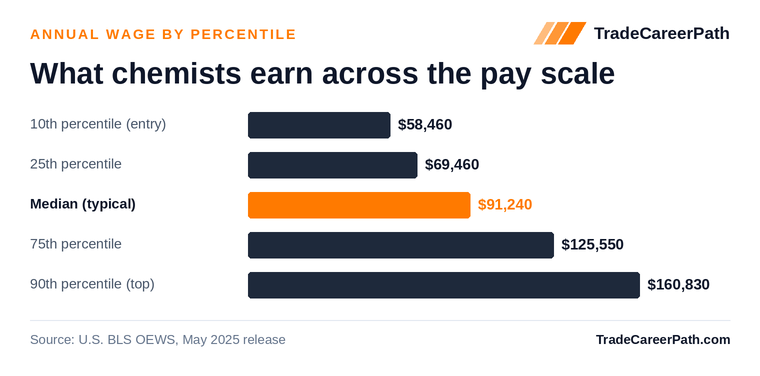
Chemistry pays a solid professional wage without the license hurdles of engineering or healthcare. The national median is $91,240 per year, entry-level pay starts around $58,460 at the 10th percentile, and the 90th percentile reaches $160,830 - senior R&D and lab-leadership money (BLS OEWS, May 2025). The mean of $100,450 sitting well above the median tells you the top of this field pulls hard: pharma, specialty chemicals, and federal labs pay far better than routine contract-lab work.
Where the Jobs and the Money Are
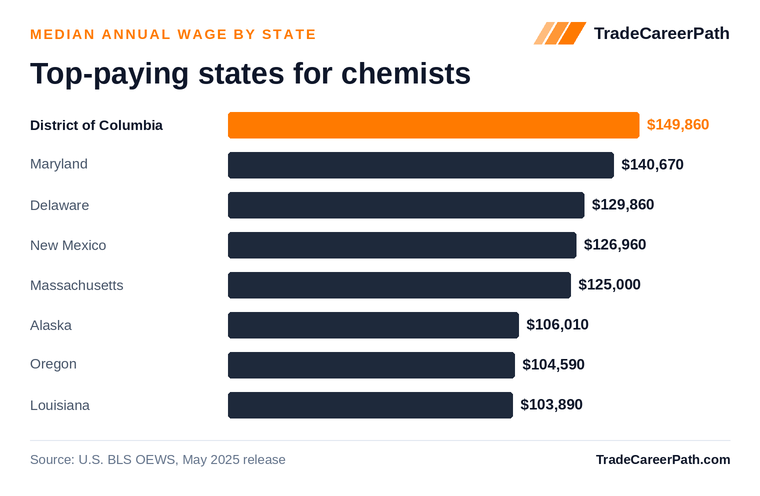
Chemist pay and chemist headcount are in different places. The best-paying markets cluster around federal science and pharma, while the biggest job markets are California with 9,820 chemists, Pennsylvania with 6,800, and New Jersey with 5,280 (BLS OEWS, May 2025).
| State | Median annual wage | Employment |
|---|---|---|
| District of Columbia | $149,860 | 280 |
| Maryland | $140,670 | 2,480 |
| Delaware | $129,860 | 1,200 |
| New Mexico | $126,960 | 280 |
| Massachusetts | $125,000 | 3,430 |
Concentration matters as much as the median. Delaware is the standout - chemists are more than four times as common there as in the average state labor market, a legacy of the chemical industry that still means deep hiring. New Jersey and Pennsylvania both run at more than twice the average concentration on pharma and specialty chemicals, so those markets offer room to change employers without relocating even though their medians ($84,450 and $77,090) sit below the top-pay states.
How to Become a Chemist
1. Build lab or process experience
QC technician and operator roles are the standard on-ramp, and if you are reading this from one of them, you are already on it. Bench time matters here the way field time matters in the trades: employers hiring bachelor’s-level chemists strongly prefer candidates who have already run instruments, followed SOPs, and handled out-of-spec results. If you are not in a lab yet, a QC tech job at a manufacturer or contract lab is worth taking before or during the degree.
2. Earn the bachelor’s degree
Chemistry or biochemistry; ACS-approved programs carry the most weight - the American Chemical Society’s curriculum standard is the closest thing this field has to ABET. Chemistry degrees need physical labs, so most working-adult programs are hybrid: online lectures with on-campus intensives or local lab blocks. Get a written transfer evaluation first - prior college, military training, and lab coursework can be worth meaningful credit at transfer-friendly schools.
3. Start in QC or analytical chemistry
Manufacturers, contract labs, and consumer-products firms hire at the bachelor’s level, and QC/analytical roles are where most careers start because the work maps directly onto what technicians already know. It is the classic entry point for career changers: you are judging real product against real specs rather than working from theory, and your operator’s-eye view of how batches actually fail is an advantage from day one.
4. Specialize
Formulation, analytical, polymer, or cosmetic chemistry by industry. Specialization is where pay separates from the entry band - a formulation chemist who owns a product line, or an analytical chemist who validates methods under GMP, is much harder to replace than a generalist running routine tests. Match the specialty to your background: process and polymer work for plant operators, cosmetic formulation for beauty-trade veterans, pharma QC for sterile-processing techs.
5. Advance
Senior chemist, lab manager, or R&D leadership - often with a master’s, which many chemists complete part-time on employer tuition assistance. The fork comes around the ten-year mark: deepen into a technical authority role (principal scientist, subject-matter expert) or take the management track running a lab or quality organization. Both are covered in the career ladder below.
Career Ladder: Titles and Realistic Pay
The BLS wage percentiles map cleanly onto how industrial chemistry careers actually progress. Use this as a sanity check on offers, not a guarantee:
| Stage | Typical titles | Years in | Realistic pay (BLS OEWS, May 2025) |
|---|---|---|---|
| Entry level | QC chemist, Chemist I, analytical chemist | 0-3 | ~$58,460-$69,460 (10th-25th pct) |
| Mid-career | Chemist II/III, formulation chemist | 3-10 | ~$91,240 (median) |
| Senior | Senior chemist, lab supervisor, method-development lead | 10-15 | ~$125,550 (75th pct) |
| Principal / leadership | Principal scientist, lab manager, R&D or QC director | 15+ | $160,830+ (90th pct) |
Two notes for career changers. First, prior bench experience compresses this ladder: former lab techs and operators are routinely hired above the bottom of the entry band because they need no ramp-up on instruments, safety, or documentation. Second, industry choice moves the whole table - the same title pays meaningfully more in pharma, specialty chemicals, and federal work than in routine contract-lab testing.
Do You Need a License?
No. There is no state license for chemists - unlike engineering or nursing, nothing legally gates the title, and the credential that matters is the bachelor’s itself, ideally ACS-approved. What functions as the gate instead is demonstrated competence: documented instrument experience, and in regulated industries a working knowledge of GMP (pharma, cosmetics, food) or GLP (testing labs) quality systems, which employers treat as a real qualification.
Optional certifications exist in specialties like clinical chemistry and hazardous-materials handling, but none is a general hiring requirement. Put your development budget into instrumentation skills and a master’s degree instead; both move pay more than any certificate in this field.
Why an Online Degree Works for This Career
Lab techs, sterile-processing techs, and plant operators feed this career, and there is a niche path from the beauty trades too: cosmetic chemistry, where estheticians’ product knowledge meets formulation science. Chemistry degrees need labs, so most programs are hybrid: online coursework with on-campus or local lab blocks. That structure suits working technicians well - the lecture material fits around shift work, the lab intensives are scheduled in blocks you can plan around, and employer tuition assistance is common at manufacturers and pharma companies, so many techs finish the degree without leaving their job or their seniority.
Job Outlook for 2026 and Beyond
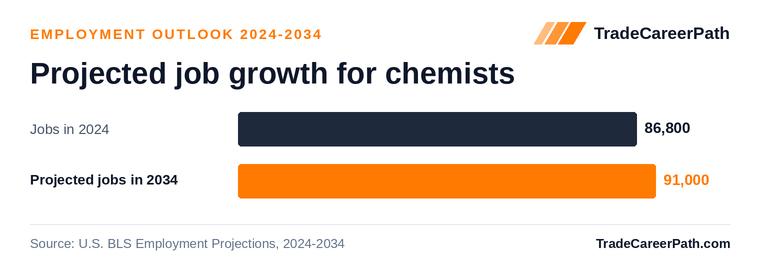
BLS projects chemist employment to grow +6.4% from 2025 to 2035 - from 84,900 to 90,300 jobs - with about 5,900 openings per year once retirements and occupation changes are counted (BLS Employment Projections, 2025-35). The wage trend is the more striking number: the May 2025 median of $91,240 is up sharply from the 2024 figure of $84,150, real movement in a single year for an established occupation.
The demand drivers are steady rather than spectacular: pharma and biotech quality work, consumer-products formulation, environmental and materials testing, and reshored chemical and battery manufacturing all keep hiring at the bachelor’s level. For career changers the openings figure is the number that matters - 5,900 seats a year in an 82,770-person occupation means consistent turnover-driven hiring, and QC and analytical roles at manufacturers are where most of those seats open first.
Cost and Time to Complete the Degree
For chemists, the credential is: Bachelor’s in chemistry or biochemistry. A bachelor’s degree is typically 120 credit hours: four years full-time, and commonly five to six years part-time while working. Transfer credit is the other lever: prior college, military training, apprenticeship coursework, and industry certifications can be worth meaningful credit at transfer-friendly schools, so get a written transfer evaluation before enrolling anywhere. Costs vary widely by school type; in-state public online programs are usually the value benchmark, and employer tuition assistance is common for working adults in this field.
Pros and Cons of Training as a Chemist
Pros
- Median pay of $91,240 nationally (BLS OEWS, May 2025)
- BLS projects +6.4% employment growth through 2035, about 5,900 openings per year
- No license required - the degree is the only formal gate
- Field experience from the trades is a genuine hiring advantage
- Accredited online and hybrid degree paths exist for working adults
Cons
- Requires a 4-year degree (typically 120 credit hours), with in-person lab requirements
- Entry-level pay starts near $58,460 at the 10th percentile
- Top pay usually requires a master's or a move into pharma or federal work
Frequently Asked Questions
Can I work as a cosmetic chemist from the beauty industry?
Yes - cosmetic chemistry is a recognized specialty, and product-line experience from esthetics or salon work pairs well with a chemistry bachelor's for formulation roles at beauty and personal-care manufacturers.
How much do chemists make?
The national median annual wage for chemists is $91,240 (BLS OEWS, May 2025). The top 10% earn $160,830 or more, while entry-level pay starts around $58,460.
What is the job outlook for chemists?
BLS projects employment of chemists to change by +6.4% from 2025 to 2035 (BLS Employment Projections, 2025-35).
How long does chemist training take?
The bachelor's in chemistry or biochemistry is 120 credit hours: four years full-time, commonly five to six years part-time while working. Transfer credit from prior college, military training, or lab-tech coursework can meaningfully shorten it at transfer-friendly schools.
Is a chemistry degree hard?
It is lab- and math-heavy - general, organic, and physical chemistry plus calculus and statistics are unavoidable, and physical chemistry is the classic weed-out course. Working lab techs and plant operators usually find the instrumentation and applied courses easier than fresh graduates do, because they have already run the equipment the coursework describes.
Should I major in chemistry or biochemistry?
Chemistry is the broader buy - it covers QC, formulation, polymer, and process work across manufacturing. Biochemistry points toward pharma, biotech, and clinical labs. If you want the widest hiring pool, an ACS-approved chemistry degree is the safer default; either one qualifies you for the chemist title.
Can you train as a chemist without a degree?
Not with the chemist title - employers require the bachelor's. Without it, the ceiling is lab technician, QC technician, or process operator. Bench experience shortens the degree through transfer credit and makes you a stronger hire, but it does not replace the credential.
Do chemists need a license?
No - there is no state license for chemists. What matters instead is the ACS-approved degree, documented instrument experience (HPLC, GC, spectroscopy), and in regulated industries, familiarity with GMP and GLP quality systems. Optional professional certifications exist but are rarely a hiring gate.
Chemist Salary and Requirements by State
Alabama · Alaska · Arizona · Arkansas · California · Colorado · Connecticut · Delaware · District of Columbia · Florida · Georgia · Hawaii · Idaho · Illinois · Indiana · Iowa · Kansas · Kentucky · Louisiana · Maine · Maryland · Massachusetts · Michigan · Minnesota · Mississippi · Missouri · Montana · Nebraska · Nevada · New Hampshire · New Jersey · New Mexico · New York · North Carolina · North Dakota · Ohio · Oklahoma · Oregon · Pennsylvania · Rhode Island · South Carolina · South Dakota · Tennessee · Texas · Utah · Vermont · Virginia · Washington · West Virginia · Wisconsin · Wyoming
Related Careers and Degree Paths
- Chemical Engineer - the engineering side of the same plants: process design and scale-up rather than analysis and formulation
- Food Scientist - formulation chemistry applied to food and beverage manufacturing
- Environmental Scientist - field and lab analysis for water, soil, and compliance work
- Geoscientist - the earth-materials branch of the physical sciences, common in energy and mining
- Esthetician - the beauty-trade starting point for the cosmetic chemistry path
Sources
- U.S. Bureau of Labor Statistics, Occupational Employment and Wage Statistics (OEWS), May 2025 - Chemists (SOC 19-2031)
- U.S. Bureau of Labor Statistics, Employment Projections, 2025-35
- U.S. Bureau of Labor Statistics, Occupational Outlook Handbook - education and licensing requirements
Chemist Salary by State
About this guide: Researched and written by the TradeCareerPath Editorial Team. Our editorial team researches and sources every trade school and career guide using federal labor and education data, including BLS OEWS and Employment Projections, DOL apprenticeship records, IPEDS, College Scorecard, and state licensing boards. We follow the editorial standards documented at /editorial-policy/.
Data sources
Figures on this page are sourced from the federal and state datasets below. Methodology: how we rank and source data.
| Data | Provider | Vintage |
|---|---|---|
| Occupational Employment and Wage Statistics (OEWS) | U.S. Bureau of Labor Statistics | May 2025 |
| Employment Projections | U.S. Bureau of Labor Statistics | 2025-2035 |
| Integrated Postsecondary Education Data System | National Center for Education Statistics (IPEDS) | 2024 |
| College Scorecard (school-level outcomes) | U.S. Department of Education | latest release |
| College Scorecard (field-of-study earnings) | U.S. Department of Education | latest release (updated 2026-06-12) |
| Occupational licensing requirements | CareerOneStop (U.S. Department of Labor) | latest release (updated 2026-02-22) |
| Registered apprenticeship programs | CareerOneStop / Apprenticeship.gov (U.S. Department of Labor) | latest release (updated 2025-10-25) |
| O*NET occupation profiles (skills, tasks, tools, job zones) | U.S. Department of Labor (O*NET / Employment & Training Admin.) | O*NET 31.0 (updated 2026-10-14) |