
How to Become a Civil Engineer in 2026
Is Civil Engineer Right for You?
The U.S. Department of Labor's O*NET profile for Civil Engineers (SOC 17-2051) describes the work this way: Perform engineering duties in planning, designing, and overseeing construction and maintenance of building structures and facilities, such as roads, railroads, airports, bridges, harbors, channels, dams, irrigation projects, pipelines, power plants, and water and sewage systems.
What the work involves
- Direct engineering activities, ensuring compliance with environmental, safety, or other governmental regulations.
- Manage and direct the construction, operations, or maintenance activities at project site.
- Inspect project sites to monitor progress and ensure conformance to design specifications and safety or sanitation standards.
- Compute load and grade requirements, water flow rates, or material stress factors to determine design specifications.
- Plan and design transportation or hydraulic systems or structures, using computer-assisted design or drawing tools.
Skills and knowledge that matter
Skills: Active Listening, Reading Comprehension, Speaking, Mathematics, Critical Thinking, Complex Problem Solving.
Knowledge: Design, Engineering and Technology, Building and Construction, Mathematics.
Tools and technology you may use
Technology: Document management software, File versioning software, Computer aided design CAD software, Adobe Acrobat, Apache Subversion SVN, Autodesk AutoCAD.
Typical preparation
O*NET Job Zone Four (Considerable Preparation Needed). Most of these occupations require a four-year bachelor's degree, but some do not. Employees in these occupations usually need several years of work-related experience, on-the-job training, and/or vocational training.
Interest fit
O*NET interest profile: Realistic, Investigative, Conventional. People who enjoy hands-on, practical work with tools, machines, plants, or materials often find this occupation a good fit.
Source: O*NET 31.0 (updated 2026-10-14)
Quick answer: Training as a civil engineer requires a 4-year degree - typically an ABET-accredited bachelor’s in civil engineering. The national median pay is $100,840 per year, and BLS projects +6.4% employment change from 2025 to 2035 (BLS OEWS, May 2025; BLS Employment Projections, 2025-35).
Civil Engineer at a Glance
| Metric | Detail | Source |
|---|---|---|
| Median annual wage | $100,840 | BLS OEWS, May 2025 |
| Typical wage range | $68,240 (10th pct) - $163,220 (90th pct) | BLS OEWS, May 2025 |
| Employment | 367,840 nationwide | BLS OEWS, May 2025 |
| Projected growth (2025-35) | +6.4%, about 22,700 openings per year | BLS Employment Projections, 2025-35 |
| Typical education | ABET-accredited bachelor’s in civil engineering | BLS Occupational Outlook Handbook |
| License / certification | PE (Professional Engineer) license required to approve plans and lead projects | State licensing boards |
What Does a Civil Engineer Do?
Civil engineers design and take responsibility for the built environment: roads, bridges, water and sewer systems, foundations, grading, and site development. They produce the sealed drawings that crews build from, and they answer for whether the design stands up - literally.
Day to day, the work depends on the sub-specialty. A structural engineer sizes beams, columns, and connections, checks loads against code, and reviews shop drawings before steel gets fabricated. A geotechnical engineer reads soil borings and decides what kind of foundation the ground will actually carry. A transportation engineer designs roadway geometry, drainage, and traffic control, often for a state DOT or its consultants. A water-resources engineer models stormwater and designs the culverts, ponds, and levees that keep sites dry. Land-development engineers - the biggest employment pool in private consulting - turn raw parcels into permitted, buildable site plans. Most civil engineers split their week between design software (Civil 3D, structural analysis packages), permit and code review, and site visits where they answer RFIs, observe construction, and resolve the gap between the drawings and what the ground turned out to be.
If you are coming from construction, the shortest way to say it: the crew builds what the plans say; the civil engineer decides what the plans say and stamps them. The footing detail you argued about on site, the utility conflict the plans missed - those decisions work as your job. Field people who move into design produce drawings that can actually be built, and hiring managers know it.
Skills That Make a Great Civil Engineer
- Structural and load analysis
- Soils, concrete, and materials knowledge
- AutoCAD / Civil 3D drafting and design modeling
- Hydrology and stormwater fundamentals
- Building-code, ADA, and permit compliance
- Project budgeting, scheduling, and change-order management
- Construction sequencing - knowing how the thing actually gets built
- Writing: design reports, permit submittals, and RFI responses carry the job
Civil Engineer Salary
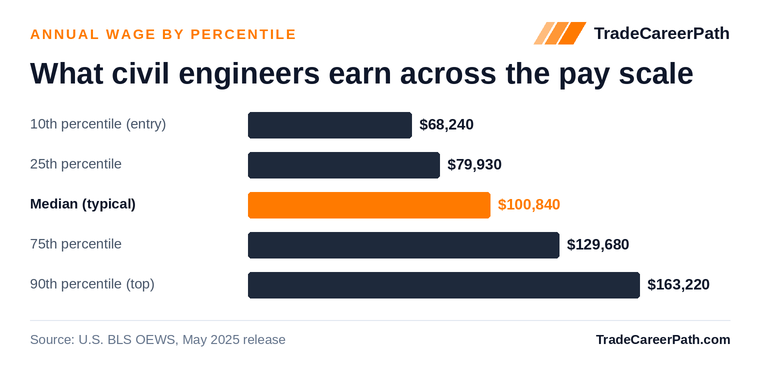
Civil engineering pays a solid professional wage with an unusually reliable floor. The national median is $100,840 per year, and the 10th percentile - roughly where new graduates start - is $68,240, climbing to $79,930 at the 25th percentile within the first few years. The 75th percentile is $129,680, and the 90th percentile reaches $163,220 (BLS OEWS, May 2025). The big jumps in this field track the license: pay moves when the PE does.
Where the Jobs and the Money Are
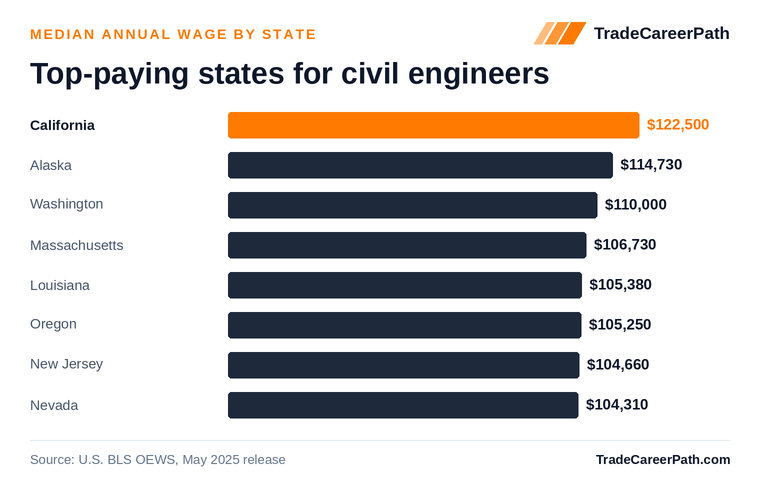
Unlike most engineering fields, civil work exists everywhere there are roads and water lines - all 51 reporting states have wage data for this occupation. But pay and depth of market still cluster. California is the largest market by far with 55,180 civil engineers, followed by Texas at 34,870 and Florida at 23,750 (BLS OEWS, May 2025).
| State | Median annual wage | Employment |
|---|---|---|
| California | $122,500 | 55,180 |
| Alaska | $114,730 | 1,670 |
| Washington | $110,000 | 12,590 |
| Massachusetts | $106,730 | 9,450 |
| Louisiana | $105,380 | 3,780 |
Alaska is the standout concentration play: civil engineers are more than twice as common there as in the average state labor market, and the median reflects it. California and Washington combine above-average concentration with big, deep markets - lots of employers to move between without relocating. Texas and Florida sit near the national average for concentration but hire in volume; Louisiana makes the top-pay list on industrial and coastal work despite a below-average concentration.
How to Become a Civil Engineer
1. Earn an ABET-accredited bachelor’s
ABET accreditation is effectively mandatory - it is required for PE licensure in every state, and employers screen for it. For working tradespeople, ABET-accredited online and hybrid civil engineering programs exist specifically because this field draws so many career changers from construction. Before enrolling anywhere, get a written transfer evaluation: prior college credits, military training, and apprenticeship-related coursework can reduce the 120 credit hours at transfer-friendly schools.
2. Pass the FE exam
The Fundamentals of Engineering exam, typically taken in your final year or at graduation, makes you an Engineer in Training (EIT). It is a broad, computer-based exam covering math, statics, materials, and the civil breadth topics. Take it as close to graduation as possible - the coursework is fresh, and the EIT designation starts your experience clock and gets your resume into the staff-engineer pile.
3. Gain 4 years of supervised experience
Work under licensed PEs on design and construction projects. This is a paid staff-engineer job, not an internship - you are drafting, calculating, and reviewing submittals while a PE checks and seals your work. Career changers should target firms doing land development, municipal, or heavy-civil work, where field judgment is scarce and valued. Document everything: your state board will want an experience record signed off by your supervising PEs.
4. Pass the PE exam
The Principles and Practice of Engineering exam grants the license to seal drawings and hold responsible charge. It is a depth exam in your discipline - civil candidates choose structural, geotechnical, transportation, water resources, or construction. Passing it is the single biggest career event in this profession: the stamp is what separates the engineer who checks work from the engineer whose work gets checked, and compensation follows accordingly.
5. Specialize
Structural, geotechnical, transportation, or water resources - and increasingly, construction engineering as its own track. Specialization deepens after the PE: structural engineers can pursue the SE license for high-seismic and complex buildings, while transportation engineers ride decades of funded public infrastructure programs. Former tradespeople often gravitate to construction engineering and site/civil work, where a field background is a daily advantage rather than a footnote.
Career Ladder: Titles and Realistic Pay
The BLS wage percentiles map cleanly onto how civil careers actually progress. Use this as a sanity check on offers, not a guarantee:
| Stage | Typical titles | Years in | Realistic pay (BLS OEWS, May 2025) |
|---|---|---|---|
| Entry level | Engineer I, staff engineer, EIT | 0-4 | ~$68,240-$79,930 (10th-25th pct) |
| Mid-career | Project engineer, PE | 4-10 | ~$100,840 (median) |
| Senior | Senior engineer, project manager | 10-15 | ~$129,680 (75th pct) |
| Principal / leadership | Principal, department manager, firm partner | 15+ | $163,220+ (90th pct) |
Two notes for career changers. First, trade experience compresses the entry band: a former foreman or superintendent who can already read plans, price work, and manage subs is routinely hired above the bottom of the range and moves to project engineer faster. Second, the top of this ladder understates ownership economics - civil consulting is a profession of small and mid-size firms, and principals and partners earn profit distributions on top of the base-wage data shown here.
The PE License: Effectively Required
Civil engineering is the one engineering discipline where licensure is not optional in any practical sense. Because civil work is public-facing - roads, bridges, water systems, buildings - the industrial exemption that lets manufacturers employ unlicensed engineers rarely applies. Only a licensed PE can seal drawings, submit permit plans, hold responsible charge, or serve as engineer of record.
You can work for years as a staff engineer without the license, but the ceiling is low and hard: no stamp, no project leadership, and a permanent discount on your billing rate. The path is fixed nationwide with minor state variations: ABET degree, FE exam, four years of qualifying experience under licensed PEs, then the PE exam through your state board. Plan for the PE from day one - firms expect it, and many pay for exam prep.
Why an Online Degree Works for This Career
Civil engineering is a natural degree destination for construction tradespeople and supervisors - field experience plus the engineering credential is a powerful combination. ABET-accredited online and hybrid civil engineering programs exist specifically for working construction professionals, and employer tuition assistance is common at contractors and engineering firms alike. Many career changers keep their construction job through the degree, then move into a staff-engineer role at a firm that values someone who has actually built what they will now design.
Job Outlook for 2026 and Beyond
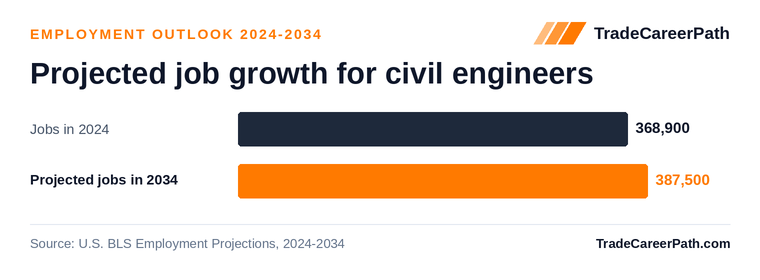
BLS projects civil engineering employment to grow +6.4% from 2025 to 2035 - from 380,600 to 405,100 jobs - with about 22,700 openings per year once retirements and occupation changes are counted (BLS Employment Projections, 2025-35). The latest wage data (OEWS, May 2025) puts the median at $100,840, up from the 2024 figure of $99,590 - steady growth rather than a spike, in a field where pay is anchored by public-sector and infrastructure budgets.
The demand drivers are structural: aging roads, bridges, and water systems need replacement on multi-decade funded programs; population growth in the South and West keeps land development busy; and climate-resilience work - flood control, coastal protection, stormwater - is a growing practice area. For career changers, the openings number is the one that matters: 22,700 seats a year in a 367,840-person occupation means constant hiring, and the four-year licensure pipeline keeps the supply of PEs tight.
Cost and Time to Complete the Degree
For civil engineers, the credential is: ABET-accredited bachelor’s in civil engineering. A bachelor’s degree is typically 120 credit hours: four years full-time, and commonly five to six years part-time while working. Transfer credit is the other lever: prior college, military training, apprenticeship coursework, and industry certifications can be worth meaningful credit at transfer-friendly schools, so get a written transfer evaluation before enrolling anywhere. Costs vary widely by school type; in-state public online programs are usually the value benchmark, and employer tuition assistance is common for working adults in this field.
Pros and Cons of Training as a Civil Engineer
Pros
- Median pay of $100,840 nationally (BLS OEWS, May 2025)
- BLS projects +6.4% employment growth through 2035, about 22,700 openings per year
- Field experience from the trades is a genuine hiring advantage
- Accredited online and hybrid degree paths exist for working adults
- Work exists in every state - you are not tied to a handful of industry hubs
Cons
- Requires a 4-year degree (typically 120 credit hours)
- Entry-level pay starts near $68,240 at the 10th percentile
- Licensing hurdle: PE (Professional Engineer) license required to approve plans and lead projects - roughly eight years from first class to full licensure
Frequently Asked Questions
Can construction workers work as civil engineers?
Yes - field experience is a genuine advantage. The path is an ABET-accredited bachelor's (online/hybrid options exist for working adults), then the FE and PE exams.
Is the PE license required?
You can work as a staff engineer without it, but only licensed PEs can approve plans and hold responsible charge - it is the ceiling-remover of the profession.
How much do civil engineers make?
The national median annual wage for civil engineers is $100,840 (BLS OEWS, May 2025). The top 10% earn $163,220 or more, while entry-level pay starts around $68,240.
What is the job outlook for civil engineers?
BLS projects employment of civil engineers to change by +6.4% from 2025 to 2035 (BLS Employment Projections, 2025-35).
How long does civil engineer training take?
The ABET-accredited bachelor's is 120 credit hours: four years full-time, commonly five to six years part-time while working. Full PE licensure adds four years of supervised experience after graduation, so plan on roughly eight years to the license - but you are working and earning as a staff engineer for the second half.
Is civil engineering hard?
The degree is math-heavy - calculus, statics, structural analysis, and fluid mechanics are unavoidable. Tradespeople who have built foundations, run pipe, or read structural drawings usually find the applied courses easier than fresh high-school graduates do, because the physics describes work they have already done with their hands.
Should I get a civil engineering or construction management degree?
Civil engineering if you want design authority and the PE stamp; construction management if you want to run crews, schedules, and budgets without the licensure track. The engineering degree keeps both doors open - civil engineers move into construction management constantly, but the reverse move requires going back for the ABET degree.
Can you train as a civil engineer without a degree?
Not in practice. PE licensure in every state assumes an ABET-accredited bachelor's, and employers screen for it. Without the degree, the ceiling is engineering technician, inspector, or field supervisor roles. Trade experience and prior coursework can shorten the degree, but they do not replace it.
Civil Engineer Salary and Requirements by State
Alabama · Alaska · Arizona · Arkansas · California · Colorado · Connecticut · Delaware · District of Columbia · Florida · Georgia · Hawaii · Idaho · Illinois · Indiana · Iowa · Kansas · Kentucky · Louisiana · Maine · Maryland · Massachusetts · Michigan · Minnesota · Mississippi · Missouri · Montana · Nebraska · Nevada · New Hampshire · New Jersey · New Mexico · New York · North Carolina · North Dakota · Ohio · Oklahoma · Oregon · Pennsylvania · Rhode Island · South Carolina · South Dakota · Tennessee · Texas · Utah · Vermont · Virginia · Washington · West Virginia · Wisconsin · Wyoming
Related Careers and Degree Paths
- Carpenter to Civil Engineer - the bridge path for structural trades
- Construction Manager - run the build instead of designing it, no PE track required
- Surveyor - the licensed profession civil engineers work beside on every site
- Environmental Engineer - the water, waste, and permitting side of the same projects
- Online Engineering Degrees for Tradespeople - how to pick an ABET program that fits a work schedule
Degree and Program Guides
- Online Civil Engineering Degrees - accredited programs and the FE-to-PE sequence
Sources
- U.S. Bureau of Labor Statistics, Occupational Employment and Wage Statistics (OEWS), May 2025 - Civil Engineers (SOC 17-2051)
- U.S. Bureau of Labor Statistics, Employment Projections, 2025-35
- U.S. Bureau of Labor Statistics, Occupational Outlook Handbook - education and licensing requirements
Civil Engineer Salary by State
About this guide: Researched and written by the TradeCareerPath Editorial Team. Our editorial team researches and sources every trade school and career guide using federal labor and education data, including BLS OEWS and Employment Projections, DOL apprenticeship records, IPEDS, College Scorecard, and state licensing boards. We follow the editorial standards documented at /editorial-policy/.
Data sources
Figures on this page are sourced from the federal and state datasets below. Methodology: how we rank and source data.
| Data | Provider | Vintage |
|---|---|---|
| Occupational Employment and Wage Statistics (OEWS) | U.S. Bureau of Labor Statistics | May 2025 |
| Employment Projections | U.S. Bureau of Labor Statistics | 2025-2035 |
| Integrated Postsecondary Education Data System | National Center for Education Statistics (IPEDS) | 2024 |
| College Scorecard (school-level outcomes) | U.S. Department of Education | latest release |
| College Scorecard (field-of-study earnings) | U.S. Department of Education | latest release (updated 2026-06-12) |
| Occupational licensing requirements | CareerOneStop (U.S. Department of Labor) | latest release (updated 2026-02-22) |
| Registered apprenticeship programs | CareerOneStop / Apprenticeship.gov (U.S. Department of Labor) | latest release (updated 2025-10-25) |
| O*NET occupation profiles (skills, tasks, tools, job zones) | U.S. Department of Labor (O*NET / Employment & Training Admin.) | O*NET 31.0 (updated 2026-10-14) |