
CNA to RN: How Nursing Assistants Work as Registered Nurses (2026)
Quick answer: CNAs work as RNs by completing an ADN (about 2 years) or BSN (4 years) and passing the NCLEX-RN. There is no formal CNA-to-RN license bridge the way there is for LPNs, but your patient-care experience earns admissions preference, sharpens clinicals, and often comes with employer tuition help. The payoff is the biggest raise in healthcare: the median jumps from $42,260 (CNA) to $97,550 (RN), per BLS OEWS, May 2025.
The CNA to RN Pay Ladder
| Credential | National median pay | Source |
|---|---|---|
| Certified Nursing Assistant (CNA) | $42,260 | BLS OEWS, May 2025 |
| Licensed Practical Nurse (LPN) | $64,400 | BLS OEWS, May 2025 |
| Registered Nurse (RN) | $97,550 | BLS OEWS, May 2025 |
More than doubling the median is why CNA to RN is the most-searched jump in healthcare. You can climb it in one step or two.
Your Three Routes
CNA straight to ADN (about 2 years)
The associate degree in nursing is the fastest full jump. Community-college ADN programs are the value pick, and many give admissions weight to documented CNA experience. You graduate NCLEX-RN eligible.
CNA straight to BSN (4 years)
The bachelor’s route costs more time up front but lands at the credential hospital systems increasingly require, and it never needs a second bridge later. Online-hybrid BSN programs pair remote coursework with clinical placements arranged near you; see the RN career guide for where it leads.
CNA to LPN to RN (the two-step)
Some CNAs step through the LPN license first (about 1 year) to start earning nurse pay sooner, then use an LPN to RN bridge (12 to 18 months). More total months, but you earn $64,400-median LPN pay while you climb.
Why CNA Experience Matters
- Admissions. Nursing programs are competitive; documented patient-care hours are a real differentiator.
- Clinicals. CNAs walk into clinical rotations already comfortable with patients, transfers, and vitals; that confidence shows in evaluations.
- Employer tuition help. Hospitals and long-term-care systems commonly fund nursing school for CNAs they want to keep; ask before you pay for anything.
- Certainty. You already know you can do the work. Most nursing-school attrition is people discovering they cannot.
What the Work Is Like on the Other Side
As a CNA you already live on the unit, so the setting won’t surprise you - but the job changes fundamentally. The shortest way to say it: the CNA carries out care and reports what they see; the RN decides what the care will be and is legally accountable for it.
Day to day, an RN runs assessments at the start of every shift and any time a patient’s condition shifts - listening to lungs, reading labs and telemetry, deciding whether the change you would have reported as a CNA needs a phone call to the physician, a medication, or a rapid response. RNs administer medications, including IV drugs that demand dose calculations and an understanding of interactions; they build and update the care plan that CNAs and LPNs work from; they educate patients and families before discharge; and they document everything in a chart that carries legal weight.
The part nobody advertises: delegation. The RN assigns and supervises the work of CNAs and LPNs on the team, which means one day you will be directing people doing the job you do now. Good former CNAs tend to be good at this - they delegate respectfully because they remember which requests were reasonable and which were not.
The physicality drops but never disappears - fewer total lifts and boosts than a CNA shift, more sustained cognitive load. Twelve-hour shifts, nights, weekends, and holidays remain the norm in hospitals, though clinics, schools, home health, and case management offer daytime schedules once you have a year or two of acute-care experience.
The variety is also wider than most CNAs see from the floor. RNs move between medical-surgical units, ICU, emergency, operating room, labor and delivery, oncology, dialysis, and outpatient settings - and switching specialties usually means an internal transfer and some orientation, not another degree. If the part of your CNA job you like best is the patients, bedside nursing keeps that and adds authority. If the part you like best is figuring out what is going on with a patient, that instinct is the actual job.
RN Salary: What the Jump Is Really Worth
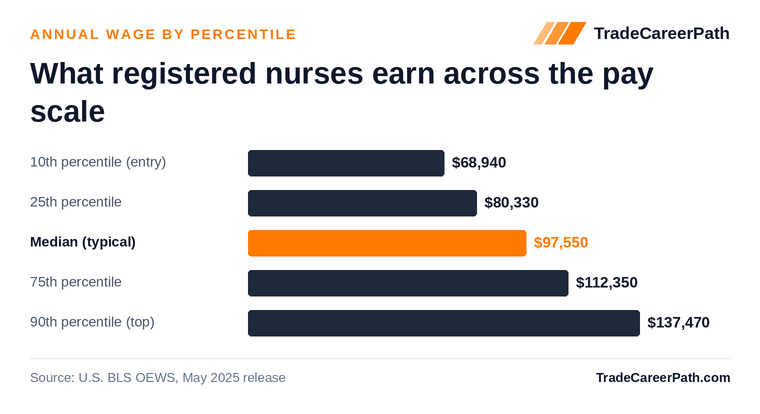
The national median for registered nurses is $97,550 per year, with a mean of $101,420 (BLS OEWS, May 2025). Just as important for a career changer: the 10th percentile - roughly where new graduates start - is $68,940, which already clears the CNA median by a wide margin. The 90th percentile reaches $137,470.
Career Ladder: RN Titles and Realistic Pay
The BLS wage percentiles map onto how hospital nursing careers actually progress. Use this as a sanity check on offers, not a guarantee:
| Stage | Typical titles | Years in | Realistic pay (BLS OEWS, May 2025) |
|---|---|---|---|
| New graduate | Staff nurse (RN I), residency-program RN | 0-2 | ~$68,940-$80,330 (10th-25th pct) |
| Established | Staff nurse (RN II/III), preceptor | 2-8 | ~$97,550 (median) |
| Senior | Charge nurse, specialty RN (ICU, ER, OR), case manager | 8-15 | ~$112,350 (75th pct) |
| Leadership / advanced | Nurse manager, clinical educator, travel or advanced roles | 15+ | $137,470+ (90th pct) |
Two notes for CNAs reading this. First, your experience compresses the bottom of the ladder - former CNAs typically hit full speed on a unit faster than new grads who have never worked bedside, and many are hired onto the unit where they already teched. Second, base wage is not the whole number: shift differentials for nights and weekends, overtime, and certification premiums routinely push hospital RN take-home above the percentiles shown here, and travel contracts can go well beyond them.
Where RNs Earn the Most
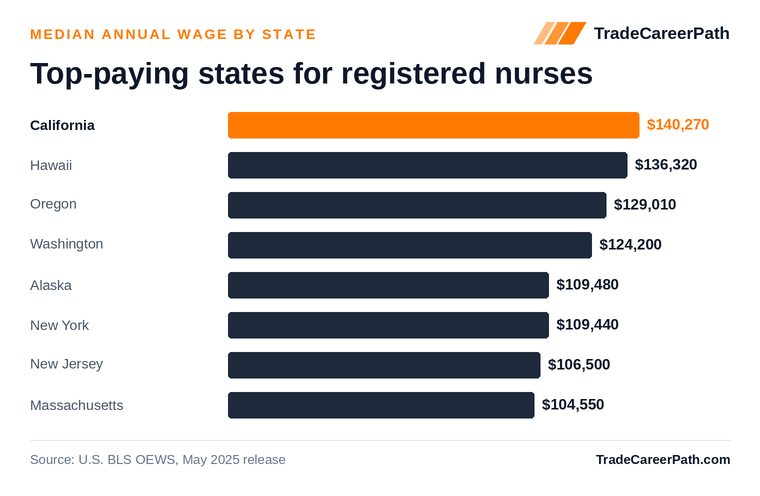
Nursing pay tracks cost of living and union density more than anything else, which is why the West Coast dominates the top of the table (BLS OEWS, May 2025):
| State | Median annual wage | RN employment |
|---|---|---|
| California | $140,270 | 338,940 |
| Hawaii | $136,320 | 12,940 |
| Oregon | $129,010 | 39,730 |
| Washington | $124,200 | 69,260 |
| Alaska | $109,480 | 7,510 |
California’s median of $140,270 is the highest in the nation and comes with the largest RN workforce - 338,940 nurses. For sheer number of jobs, Texas (271,380 RNs at a $95,970 median) and Florida (229,940 RNs at $84,190) round out the big three. Unlike many careers, you do not have to relocate to find RN work - BLS publishes wage data for all 51 state-level jurisdictions, and every one of them is hiring.
Job Outlook: Openings Are the Real Story
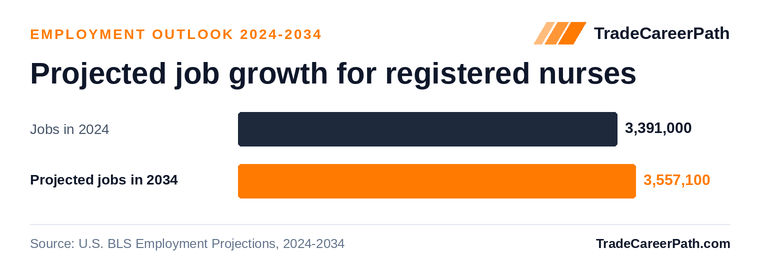
BLS projects RN employment to grow from 3,465,400 in 2024 to 3,660,100 in 2034 - a gain of +5.6% (BLS Employment Projections, 2025-35). The growth rate looks modest; the openings number does not. BLS expects about 180,800 openings per year once retirements and occupation changes are counted. In an occupation of 3,379,720 workers (BLS OEWS, May 2025), that is a hiring market that never really closes - which is exactly what you want when you are two years of school away from entering it.
For a CNA, this is the most important table on the page. An aging population needs more care, a large cohort of RNs is retiring, and hospitals in most markets are running persistent vacancies. Wages reflect it: the projections dataset put the 2024 median at $93,600, and the May 2025 OEWS median is $97,550.
Licensing: NCLEX-RN and Your State Board
Unlike CNA certification, the RN license is mandatory everywhere and there are no exceptions or grandfathering paths. The sequence is the same in all 50 states:
- Graduate from a state-approved nursing program - ADN, BSN, or a hospital diploma program. Approval matters: a program your state board does not recognize leaves you ineligible to test, no matter what you paid.
- Apply to your state board of nursing for licensure by examination. Expect a background check and fingerprinting in most states.
- Pass the NCLEX-RN. It is a computerized adaptive exam covering safe care, pharmacology, physiological adaptation, and health promotion - a licensing exam, not a school final, and programs publish their first-time pass rates. Check that number before you enroll anywhere.
- Maintain the license through your state’s renewal cycle, typically every two years with continuing-education requirements that vary by state.
One practical advantage: most states participate in the Nurse Licensure Compact, so a multistate license issued by your compact home state lets you practice in other compact states without relicensing - the mechanism that makes travel nursing work. Your CNA certification does not shortcut any of this, but the clinical hours behind it are exactly what the NCLEX’s judgment-based questions reward.
Frequently Asked Questions
How long does it take to go from CNA to RN?
About 2 years through an ADN program or 4 years through a BSN. There is no shortened CNA-to-RN license bridge, but CNA experience strengthens admissions and clinicals, and some programs award credit for healthcare coursework.
Can I go from CNA to RN online?
Coursework can be online or hybrid, but every accredited nursing program includes in-person clinical hours arranged at facilities near you.
How much more does an RN make than a CNA?
The national median for registered nurses is $97,550 versus $42,260 for nursing assistants (BLS OEWS, May 2025), a difference of about $55,000 per year at the median.
Should I work as an LPN first?
The two-step route (CNA to LPN to RN) gets you to nurse-level pay in about a year and keeps you earning while you finish. The direct ADN or BSN route is faster to the RN license itself. It depends on whether income during school or total time matters more.
Is nursing school hard for CNAs?
The science load - anatomy, pharmacology, pathophysiology - is heavy for everyone, and clinical schedules are unforgiving. CNAs have a real edge, though: you already handle patients, vitals, and hospital routines, so clinicals feel like a harder version of a job you know rather than a foreign environment. Most nursing-school attrition is people discovering they dislike patient care - you already know you don't.
Should I get an ADN or a BSN?
Both lead to the same NCLEX-RN and the same license. The ADN is about 2 years and cheaper; the BSN takes 4 years but is increasingly preferred by hospital systems and required for many leadership roles. A common CNA play: earn the ADN, start working at the RN median of $97,550 (BLS OEWS, May 2025), then finish an employer-funded RN-to-BSN online.
Can you train as an RN without a degree?
No. Every state requires graduation from an approved nursing program - at minimum an associate degree (a few hospital-based diploma programs survive) - before you can sit for the NCLEX-RN. CNA experience shortens nothing by itself; it strengthens admissions and clinicals, but the degree and the exam are non-negotiable.
What license do you need to be an RN?
Every state requires an active RN license from its board of nursing. You qualify by graduating from a state-approved ADN, BSN, or diploma program and passing the NCLEX-RN. Most states belong to the Nurse Licensure Compact, letting one multistate license cover practice in other compact states.
Keep Climbing
- How to Become a Registered Nurse: the full guide
- LPN to RN bridge programs
- RN to BSN online
- Paramedic to RN bridge
- Medical Assistant to RN
- All trade careers that require a 4-year degree
Degree and Program Guides
- Online Nursing Degrees - all nursing routes compared
- BSN vs ADN - choosing your RN degree level
Sources
- U.S. Bureau of Labor Statistics, Occupational Employment and Wage Statistics (OEWS), May 2025 - Registered Nurses (SOC 29-1141); Nursing Assistants (31-1131); Licensed Practical and Licensed Vocational Nurses (29-2061)
- U.S. Bureau of Labor Statistics, Employment Projections, 2025-35 - Registered Nurses
- U.S. Bureau of Labor Statistics, Occupational Outlook Handbook - Registered Nurses: education and licensure
Cna to Rn Salary by State
About this guide: Researched and written by the TradeCareerPath Editorial Team. Our editorial team researches and sources every trade school and career guide using federal labor and education data, including BLS OEWS and Employment Projections, DOL apprenticeship records, IPEDS, College Scorecard, and state licensing boards. We follow the editorial standards documented at /editorial-policy/.
Data sources
Figures on this page are sourced from the federal and state datasets below. Methodology: how we rank and source data.
| Data | Provider | Vintage |
|---|---|---|
| Occupational Employment and Wage Statistics (OEWS) | U.S. Bureau of Labor Statistics | May 2025 |
| Employment Projections | U.S. Bureau of Labor Statistics | 2025-2035 |
| Integrated Postsecondary Education Data System | National Center for Education Statistics (IPEDS) | 2024 |
| College Scorecard (school-level outcomes) | U.S. Department of Education | latest release |
| College Scorecard (field-of-study earnings) | U.S. Department of Education | latest release (updated 2026-06-12) |
| Occupational licensing requirements | CareerOneStop (U.S. Department of Labor) | latest release (updated 2026-02-22) |
| Registered apprenticeship programs | CareerOneStop / Apprenticeship.gov (U.S. Department of Labor) | latest release (updated 2025-10-25) |
| O*NET occupation profiles (skills, tasks, tools, job zones) | U.S. Department of Labor (O*NET / Employment & Training Admin.) | O*NET 31.0 (updated 2026-10-14) |