
How to Become a CNC Machinist in 2026
Is CNC Machinist Right for You?
The U.S. Department of Labor's O*NET profile for Machinists (SOC 51-4041) describes the work this way: Set up and operate a variety of machine tools to produce precision parts and instruments out of metal. Includes precision instrument makers who fabricate, modify, or repair mechanical instruments. May also fabricate and modify parts to make or repair machine tools or maintain industrial machines, applying knowledge of mechanics, mathematics, metal properties, layout, and machining procedures.
What the work involves
- Calculate dimensions or tolerances, using instruments, such as micrometers or vernier calipers.
- Machine parts to specifications, using machine tools, such as lathes, milling machines, shapers, or grinders.
- Measure, examine, or test completed units to check for defects and ensure conformance to specifications, using precision instruments, such as micrometers.
- Set up, adjust, or operate basic or specialized machine tools used to perform precision machining operations.
- Program computers or electronic instruments, such as numerically controlled machine tools.
Skills and knowledge that matter
Skills: Operation and Control, Critical Thinking, Monitoring, Operations Monitoring, Active Listening, Speaking.
Knowledge: Mathematics, Mechanical, Production and Processing, Design.
Tools and technology you may use
Technology: Computer aided design CAD software, Analytical or scientific software, Computer aided manufacturing CAM software, Autodesk AutoCAD, Dassault Systemes SolidWorks, Microsoft Excel.
Typical preparation
O*NET Job Zone Three (Medium Preparation Needed). Most occupations in this zone require training in vocational schools, related on-the-job experience, or an associate's degree. Employees in these occupations usually need one or two years of training involving both on-the-job experience and informal training with experienced workers. A recognized apprenticeship program may be associated with these occupations.
Interest fit
O*NET interest profile: Realistic, Conventional, Investigative. People who enjoy hands-on, practical work with tools, machines, plants, or materials often find this occupation a good fit.
Source: O*NET 31.0 (updated 2026-10-14)
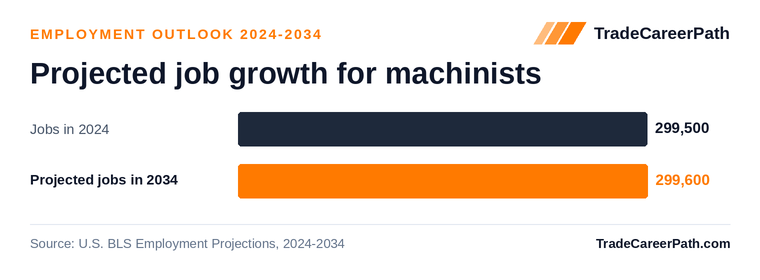
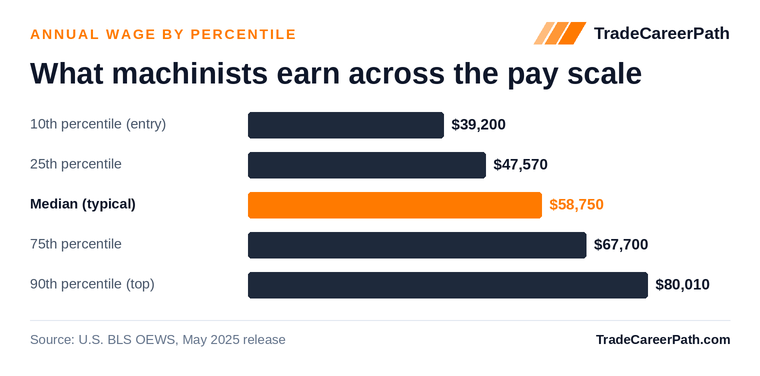
Quick answer: Training as a CNC machinist usually takes 6 months to 2 years. You complete a certificate or associate degree in precision machining (or a paid apprenticeship), build hands-on shop experience, and can earn an optional, widely recognized NIMS certification. Costs vary by program and school, and no license is required to start in most shops. The median machinist salary is $58,750 per year ($28.24/hour), and employers post about 26,100 openings nationwide each year (BLS, May 2025).
CNC machinists run computer-controlled mills, lathes, and grinders that cut raw metal and plastic into precise finished parts. They read blueprints, set up and calibrate machines, and inspect their work against tight tolerances. If you like hands-on problem solving and seeing real results from your work, this trade is a direct path into advanced manufacturing without a four-year degree.
How to Become a CNC Machinist
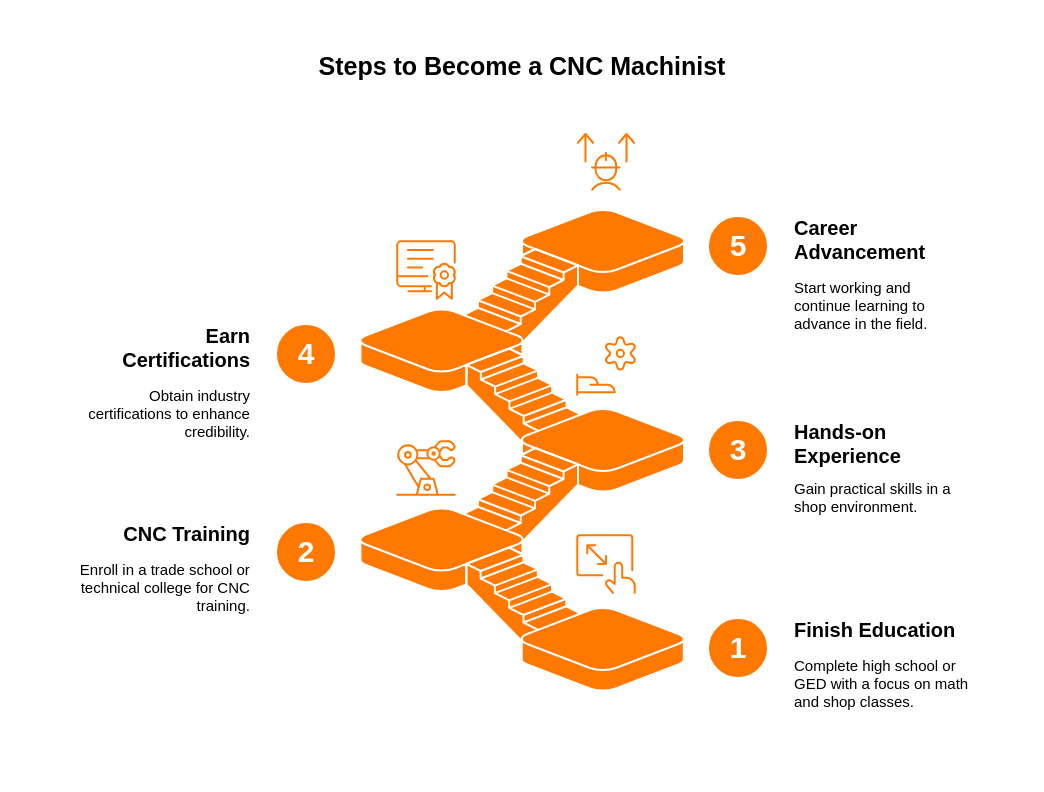
Most people enter the trade in about six months to two years, depending on the path they choose. There is no single license to pass. You build the career through training, hands-on shop experience, and optional certification.
1. Earn a high school diploma or GED
A high school diploma or GED is the baseline for nearly every machining program and most entry-level shop jobs. The math you use on the job is practical, not abstract: fractions, decimals, basic trigonometry, and unit conversions all come up when you set offsets, read a print, or calculate feeds and speeds. Algebra and geometry are the most useful classes to focus on, and any shop, drafting, or CAD course gives you a head start. Comfort with computers matters too, since modern machines run on programmed code and many shops use digital measurement and inspection tools. If you are switching careers and already hold a diploma or another degree, you can move straight to training. Plenty of strong machinists came from unrelated jobs and brought useful habits in organization, attention to detail, and following a process exactly.
2. Complete a CNC training program
This is the core credential, and you have a few formats to choose from. Certificate programs are focused and hands-on, while associate degree programs in precision machining or manufacturing technology add more classroom depth and general-education credits. Both teach blueprint and GD&T reading, shop math, metallurgy basics, machine setup, and G-code programming, often using CAD/CAM software to turn a part drawing into tool paths. The most valuable part is time at the machine: setting up mills and lathes, selecting and loading tooling, dialing in offsets, and inspecting parts with micrometers, calipers, and gauges. Costs vary by program and school, so contact schools directly for current tuition. When comparing programs, ask how much hands-on machine time you get, whether the equipment matches what local shops actually run, and whether the program prepares you for NIMS credentials. Many programs blend online coursework with in-person lab time.
3. Gain hands-on shop experience
Coursework prepares you, but employers want proof you can produce accurate parts. The strongest route is an apprenticeship, where you earn a paycheck while learning under experienced machinists; trade associations such as the National Tooling and Machining Association (NTMA) and the Precision Machined Products Association (PMPA) support apprenticeship and workforce programs in the industry. If a formal apprenticeship is not available, an entry-level role as a machine operator or shop helper gets you inside a shop where you can learn setup, tooling, and quality inspection on real jobs. Pay attention to how experienced machinists troubleshoot a bad finish, a worn tool, or an out-of-tolerance dimension, because that judgment is what separates an operator from a skilled machinist. Keep track of the part types, materials, and machines you have run so you can describe them clearly when you apply for better roles.
4. Earn NIMS or other industry certifications
Certification is voluntary in most cases, but it gives employers an objective signal of your skills. The most widely recognized credentials come from the National Institute for Metalworking Skills (NIMS), which offers stackable certifications across areas like measurement and inspection, job planning, turning, milling, and CNC operation. Each NIMS credential pairs a knowledge exam with a hands-on performance test, so passing one shows you can actually make parts to spec, not just answer questions. Many training programs build NIMS testing into the curriculum, and some shops will sponsor or reimburse certification once you are hired. Industry associations such as NTMA and PMPA also support skills standards and training that align with these credentials. Earning a few NIMS certifications early can help you stand out for apprenticeships and higher-paying roles.
5. Apply for jobs and advance
Machine shops, aerospace and automotive manufacturers, defense contractors, and medical device makers all hire CNC machinists. Tailor your resume to the work you want, list the machines and controls you have run, and mention any NIMS credentials. Apprenticeship sponsors, technical school career offices, and trade associations like NTMA and PMPA are good places to hear about openings. Once you are working, the trade rewards people who keep learning: with experience you can move into CNC programming, quality control inspection, tool and die making, or shop supervision and management, each of which can raise your earning potential.
What Does a CNC Machinist Do?
CNC stands for Computer Numerical Control. Machinists use computer-controlled equipment to cut, drill, shape, and finish metal and plastic parts with precision, often holding tolerances measured in thousandths of an inch. The job blends reading and planning with hands-on setup and inspection.
Typical Responsibilities
- Read blueprints, CAD files, and GD&T specifications
- Set up and calibrate machines like mills, lathes, and grinders
- Load material, select tooling, and monitor production runs
- Inspect parts with micrometers, calipers, and gauges
- Adjust offsets and machine settings for accuracy and safety
Skilled machinists turn code and raw stock into the precise parts that keep cars, aircraft, and equipment running.
Skills That Make You Great at This
- Patience and precision, since small mistakes scrap expensive parts
- Comfort with computers, measurement, and shop math
- Problem solving and troubleshooting under deadline pressure
- Mechanical reasoning and an eye for detail
- Focus and pride in craftsmanship
Work Settings for CNC Machinists
CNC machinists work in many environments, including:
- Aerospace and automotive manufacturing
- Defense and industrial equipment shops
- Medical device fabrication
- Metal and plastics production
- Independent precision machine shops
Education and Certification Paths
| Pathway | Typical Duration | Outcome |
|---|---|---|
| Certificate | 6 to 18 months | Focused, hands-on entry preparation |
| Apprenticeship | Varies by sponsor | Earn while you learn in a shop |
| Associate Degree | About 2 years | More advanced, broader credential |
| NIMS Certifications | Stackable | Verify specific machining skills |
Career Growth and Advancement
With experience, CNC machinists can move into roles such as:
- CNC Programmer who writes and optimizes tool paths
- Tool and Die Maker building precision tooling and molds
- Quality Control Inspector verifying parts against specifications
- Manufacturing Supervisor who leads a shop floor or team
Cost and Duration of Training
- Program cost: varies by program, format, and school; certificate programs are usually less than degree programs, and apprenticeships pay you while you train
- Time to complete: about six months to two years
- Certification: NIMS credentials are optional and may carry exam fees
Many programs offer online coursework for the classroom portions, but hands-on machine training happens in a shop or lab.
Pros and Cons
Pros
- Hands-on, skilled work with visible results
- Steady demand across many industries
- Clear path into manufacturing without a four-year degree
- Room to advance into programming, inspection, or supervision
Cons
- Long hours on your feet
- Repetitive tasks during long production runs
- Noisy shop environment with safety demands
Quick Facts: CNC Machinist Salary, Education, and Outlook
Industry Organizations & Certifying Bodies
These are the recognized national organizations, unions, certifying bodies, and regulatory authorities that shape this trade. They issue the credentials, sponsor the apprenticeships, publish the codes, and represent workers and employers.
- National Institute for Metalworking Skills (NIMS) Industry-standard machining and CNC operator credentials.
- National Tooling and Machining Association (NTMA) Manufacturing trade association with apprenticeship programs.
- Precision Machined Products Association (PMPA) Precision machining trade association and workforce programs.
Wage and Employment Charts
CNC Machinist Salary and Requirements by State
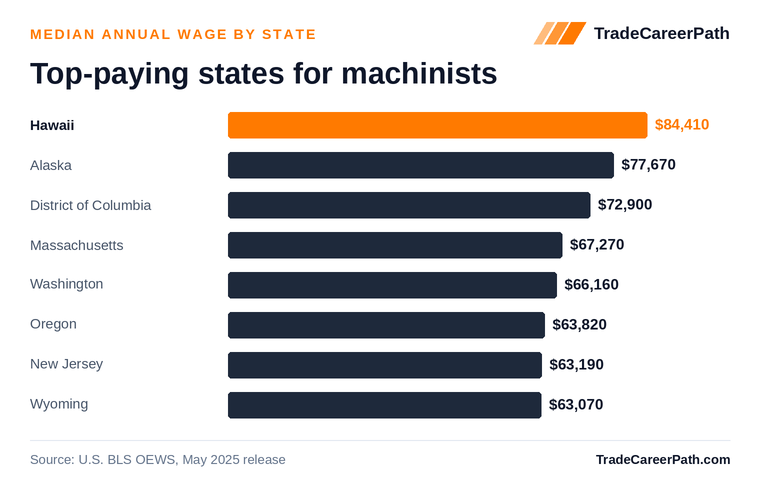
Select your state for local wage data, training options, and requirements:
Alabama · Alaska · Arizona · Arkansas · California · Colorado · Connecticut · Delaware · District of Columbia · Florida · Georgia · Hawaii · Idaho · Illinois · Indiana · Iowa · Kansas · Kentucky · Louisiana · Maine · Maryland · Massachusetts · Michigan · Minnesota · Mississippi · Missouri · Montana · Nebraska · Nevada · New Hampshire · New Jersey · New Mexico · New York · North Carolina · North Dakota · Ohio · Oklahoma · Oregon · Pennsylvania · Rhode Island · South Carolina · South Dakota · Tennessee · Texas · Utah · Vermont · Virginia · Washington · West Virginia · Wisconsin · Wyoming
Workplace Safety Snapshot
BLS Survey of Occupational Injuries and Illnesses data (2023-2024) report approximately 177.0 days-away, restricted, or transfer cases per 10,000 full-time-equivalent workers in machinists (about 1.77 per 100 FTE). Source: BLS Survey of Occupational Injuries and Illnesses, Table R98.
Frequently Asked Questions
How long does CNC machinist training take?
It typically takes 6 months to 2 years of training. The most common entry path is a certificate program or an associate degree, and many machinists also learn through paid apprenticeships. A high school diploma or GED is generally required to get started.
Do you need a college degree to work as a CNC machinist?
No. A college degree is not required to work as a CNC machinist. Most people enter the field through a certificate or associate degree program, or through an apprenticeship. A high school diploma or GED is typically the only educational prerequisite.
How much does CNC machinist training cost?
Costs vary by program, format, and school. Certificate programs are usually less expensive than associate degree programs, and apprenticeships let you earn while you learn. Contact schools directly for current tuition before you enroll.
Is certification required to work as a CNC machinist?
Certification is voluntary in most cases rather than legally required. Credentials from the National Institute for Metalworking Skills (NIMS) are widely recognized and can strengthen your resume, but many people start in entry-level shop roles without one.
Is it hard to train as a CNC machinist?
Entry is relatively accessible because no degree is required and most people finish training in 6 months to 2 years. The work itself demands precision, patience, and comfort with blueprints, measurement, and machine setup, so the learning curve continues on the job.
Can you train as a CNC machinist online?
Some coursework, such as blueprint reading, math, and G-code basics, can be completed online. The hands-on machine setup and operation must be learned in a shop or lab, so most programs blend online study with in-person training or a shop placement.
How many CNC machinists work in the United States?
BLS reports approximately 287,050 machinists employed nationwide as of May 2025, with about 26,100 openings projected each year over the 2024 to 2034 period.
How Cnc Machinist Pay Compares to Similar Trades
Side-by-side comparison of CNC Machinist and the closest related careers, based on U.S. Bureau of Labor Statistics data (May 2025 OEWS + 2025-2035 Employment Projections).
| Career | Median Pay | 10-Year Growth | Annual Openings |
|---|---|---|---|
| CNC Machinist this guide | $58,750 | +1.0% | 26,100 |
| Welding | $53,750 | +2.4% | 40,300 |
| Gunsmith / Firearms Technician | $68,990 | +2.5% | 1,000 |
| Maintenance Technician | $49,590 | +4.2% | 148,700 |
| Mechanic & Engine Technician | $50,620 | +5.0% | 66,200 |
Source: BLS Occupational Employment and Wage Statistics + BLS Employment Projections.
Advance Your Career with a Degree
Experienced CNC Machinist professionals often step up into degree-track careers where field experience is a hiring advantage:
- Mechanical Engineer - median pay $104,110 (BLS OEWS, May 2025); requires a 4-year degree
- Industrial Engineer - median pay $102,440 (BLS OEWS, May 2025); requires a 4-year degree
- Welding Engineer - median pay $112,860 (BLS OEWS, May 2025); requires a 4-year degree
- Industrial Production Manager - median pay $126,060 (BLS OEWS, May 2025); requires a 4-year degree
- Machinist to industrial engineer - the shop-floor degree path
See all trade careers that require a 4-year degree.
Degree and Program Guides
- Online Industrial Engineering Degrees - the degree route into process and manufacturing engineering
Sources
- U.S. Bureau of Labor Statistics, Occupational Employment and Wage Statistics (May 2025)
- U.S. Bureau of Labor Statistics, Employment Projections 2025-2035
- U.S. Bureau of Labor Statistics, Survey of Occupational Injuries and Illnesses (2023-2024, Table R98)
- U.S. Department of Labor, Wage and Hour Division, Davis-Bacon General Wage Determinations (2026)
Cnc Machinist Salary by State
About this guide: Researched and written by the TradeCareerPath Editorial Team. Our editorial team researches and sources every trade school and career guide using federal labor and education data, including BLS OEWS and Employment Projections, DOL apprenticeship records, IPEDS, College Scorecard, and state licensing boards. We follow the editorial standards documented at /editorial-policy/.
Data sources
Figures on this page are sourced from the federal and state datasets below. Methodology: how we rank and source data.
| Data | Provider | Vintage |
|---|---|---|
| Occupational Employment and Wage Statistics (OEWS) | U.S. Bureau of Labor Statistics | May 2025 |
| Employment Projections | U.S. Bureau of Labor Statistics | 2025-2035 |
| Integrated Postsecondary Education Data System | National Center for Education Statistics (IPEDS) | 2024 |
| College Scorecard (school-level outcomes) | U.S. Department of Education | latest release |
| College Scorecard (field-of-study earnings) | U.S. Department of Education | latest release (updated 2026-06-12) |
| Occupational licensing requirements | CareerOneStop (U.S. Department of Labor) | latest release (updated 2026-02-22) |
| Registered apprenticeship programs | CareerOneStop / Apprenticeship.gov (U.S. Department of Labor) | latest release (updated 2025-10-25) |
| O*NET occupation profiles (skills, tasks, tools, job zones) | U.S. Department of Labor (O*NET / Employment & Training Admin.) | O*NET 31.0 (updated 2026-10-14) |