
How to Become a Computer Hardware Engineer in 2026
Is Computer Hardware Engineer Right for You?
The U.S. Department of Labor's O*NET profile for Computer Hardware Engineers (SOC 17-2061) describes the work this way: Research, design, develop, or test computer or computer-related equipment for commercial, industrial, military, or scientific use. May supervise the manufacturing and installation of computer or computer-related equipment and components.
What the work involves
- Update knowledge and skills to keep up with rapid advancements in computer technology.
- Design and develop computer hardware and support peripherals, including central processing units (CPUs), support logic, microprocessors, custom integrated circuits, and printers and disk drives.
- Confer with engineering staff and consult specifications to evaluate interface between hardware and software and operational and performance requirements of overall system.
- Build, test, and modify product prototypes, using working models or theoretical models constructed with computer simulation.
- Write detailed functional specifications that document the hardware development process and support hardware introduction.
Skills and knowledge that matter
Skills: Reading Comprehension, Critical Thinking, Active Listening, Writing, Speaking, Complex Problem Solving.
Knowledge: Computers and Electronics, Engineering and Technology, Design, Mathematics.
Tools and technology you may use
Technology: File versioning software, Analytical or scientific software, Computer aided design CAD software, Apache Subversion SVN, Autodesk AutoCAD, C.
Typical preparation
O*NET Job Zone Four (Considerable Preparation Needed). Most of these occupations require a four-year bachelor's degree, but some do not. Employees in these occupations usually need several years of work-related experience, on-the-job training, and/or vocational training.
Interest fit
O*NET interest profile: Realistic, Investigative, Conventional. People who enjoy hands-on, practical work with tools, machines, plants, or materials often find this occupation a good fit.
Source: O*NET 31.0 (updated 2026-10-14)
Quick answer: Training as a computer hardware engineer requires a 4-year degree - typically an ABET-accredited bachelor’s in computer or electrical engineering. The national median pay is $161,740 per year, and BLS projects +9.1% employment change from 2025 to 2035 (BLS OEWS, May 2025; BLS Employment Projections, 2025-35).
Computer Hardware Engineer at a Glance
| Metric | Detail | Source |
|---|---|---|
| Median annual wage | $161,740 | BLS OEWS, May 2025 |
| Typical wage range | $92,940 (10th pct) - $225,330 (90th pct) | BLS OEWS, May 2025 |
| Employment | 76,660 nationwide | BLS OEWS, May 2025 |
| Projected growth (2025-35) | +9.1%, about 4,100 openings per year | BLS Employment Projections, 2025-35 |
| Typical education | ABET-accredited bachelor’s in computer or electrical engineering | BLS Occupational Outlook Handbook |
| License / certification | No license required | None for most roles |
What Does a Computer Hardware Engineer Do?
Computer hardware engineers design processors, circuit boards, networking equipment, and embedded systems - the design layer above the electronics technicians and tower techs who install, test, and repair that hardware in the field. They decide what goes on the board, verify the design actually works at speed and temperature, and own the fix when it does not.
Day to day, the work splits by sub-specialty. A digital design engineer writes and simulates HDL (Verilog or VHDL) for chips and FPGAs, then spends design reviews defending timing closure and power budgets. A board-level engineer does schematic capture and PCB layout, sweats signal integrity on high-speed traces, and sits at the bench during bring-up with a scope and a logic analyzer chasing why the prototype will not boot. A validation or test engineer builds the test plans and automated rigs that hammer new hardware across voltage, temperature, and workload corners before it ships. An embedded engineer lives at the boundary between silicon and firmware, writing the low-level C that makes the board usable. Everything is documented and reviewed - a respin of a board or a chip costs real money, so the culture rewards people who find problems before fabrication, not after.
If you are coming from electronics or telecom work, the shortest way to say it: the technician finds the fault and swaps the board; the engineer decides why the board failed and changes the design so it stops failing. Your instinct for how hardware actually misbehaves - thermal drift, flaky connectors, marginal signals that pass on the bench and fail in the field - is exactly the judgment validation teams struggle to teach new graduates.
Skills That Make a Great Computer Hardware Engineer
- Digital logic and computer architecture
- HDL design (Verilog/VHDL)
- PCB layout and signal integrity
- Embedded firmware fundamentals (C and assembly basics)
- Lab bring-up and test equipment - scopes, logic analyzers, JTAG debuggers
- Scripting for test automation (Python is the default)
- Power, thermal, and cost trade-off analysis
- Writing: design documents, test reports, and failure analyses carry the job
Computer Hardware Engineer Salary
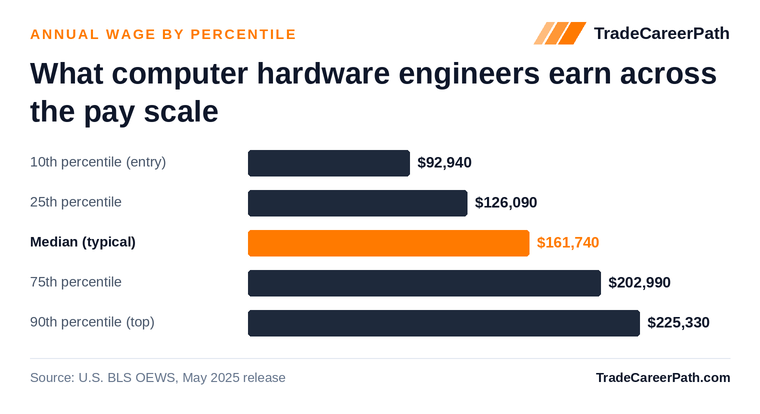
Hardware engineering pays at the very top of the bachelor’s-entry occupations BLS tracks. The national median is $161,740 per year, and even the 10th percentile - roughly where new graduates start - is $92,940, above the median of nearly every skilled trade. The 75th percentile is $202,990, and the top 10% earn $225,330 or more (BLS OEWS, May 2025). At major chip and systems companies, stock and bonus often sit on top of those base-wage figures.
Where the Jobs and the Money Are
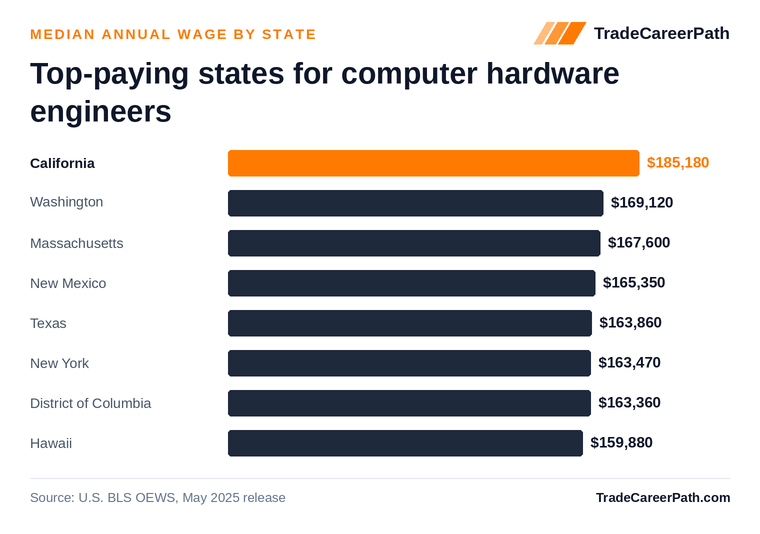
This is a concentrated occupation: 76,660 engineers nationwide, and the biggest single cluster by far - 19,820 of them - is in California, where the median hits $185,180 (BLS OEWS, May 2025).
| State | Median annual wage | Employment |
|---|---|---|
| California | $185,180 | 19,820 |
| Washington | $169,120 | 1,800 |
| Massachusetts | $167,600 | 3,150 |
| New Mexico | $165,350 | 5,260 |
| Texas | $163,860 | 7,390 |
The location-quotient data tells the real story. Hardware engineers are more than twice as concentrated in California as in the average state labor market, and New Mexico is the outlier of the whole table - the occupation is over twelve times as common there as nationally, driven by semiconductor fabrication around Albuquerque, at a $165,350 median. Texas combines a deep market (7,390 jobs, anchored by Austin and Dallas chip work) with no state income tax, which makes its $163,860 median go further than the raw number suggests. Massachusetts runs well above average concentration too, on the strength of its defense-electronics and networking cluster.
How to Become a Computer Hardware Engineer
1. Earn an ABET-accredited bachelor’s
Computer engineering or electrical engineering with a hardware focus. Accreditation is the one non-negotiable: employers screen for it and graduate schools require it. For working technicians, electrical engineering usually offers more ABET-accredited online and evening options, and hardware employers hire EE graduates into computer-hardware roles as a matter of course - pick the accredited program that fits your schedule over the one with the fancier name.
2. Build bench-to-design skills
HDL (Verilog/VHDL), PCB design tools, and embedded C round out field experience. This is where your trade background compounds: you already know how to use a scope and read a schematic, so put your coursework on a bench. A cheap FPGA dev board and a home-built PCB project do double duty - they cement the theory and work as the portfolio that gets your first interview.
3. Start in test, validation, or embedded roles
Hardware validation is the classic bridge role for technicians moving into engineering, because the job is judging real hardware rather than working purely from models. Chip companies, server and networking equipment makers, and defense-electronics firms all staff large validation teams at the bachelor’s level, and a candidate who has already spent years finding faults in fielded equipment interviews well for them.
4. Specialize
Chip design, embedded systems, networking hardware, or hardware security. The fork usually comes two to five years in. Digital and chip design is the deepest technical track; embedded systems keeps you closest to the firmware boundary; networking and server hardware trades some depth for breadth; hardware security is a smaller but fast-growing niche. Specialists who own a domain are the ones who reach the top of the pay bands below.
5. Advance
Senior/staff hardware engineer or engineering management. Around the ten-year mark you choose: deepen into a staff or principal role as the technical authority on a product line, or move into managing a design or validation team. Both tracks reach the top of the wage distribution; neither requires a license, though many senior engineers add a master’s along the way, often employer-funded.
Career Ladder: Titles and Realistic Pay
The BLS wage percentiles map cleanly onto how hardware careers actually progress. Use this as a sanity check on offers, not a guarantee:
| Stage | Typical titles | Years in | Realistic pay (BLS OEWS, May 2025) |
|---|---|---|---|
| Entry level | Hardware engineer I, validation engineer, test engineer | 0-3 | ~$92,940-$126,090 (10th-25th pct) |
| Mid-career | Hardware engineer II/III, board or block owner | 3-10 | ~$161,740 (median) |
| Senior | Senior/staff hardware engineer, technical lead | 10-15 | ~$202,990 (75th pct) |
| Principal / leadership | Principal engineer, hardware engineering manager | 15+ | $225,330+ (90th pct) |
Two notes for career changers. First, prior trade experience compresses this ladder: former electronics techs are routinely hired above the bottom of the entry band because they need little supervision around lab equipment and real boards. Second, these are base-wage figures - at semiconductor and big-tech employers, stock grants and bonuses commonly push senior total compensation well above the 90th-percentile number shown here.
Do You Need a License?
No. Computer hardware engineers work in private industry under the industrial exemption - the company, not the individual engineer, carries design responsibility - and PE licensure is essentially absent from this field. There is no state exam between you and the job; the ABET degree is the gate.
What matters instead is demonstrated capability. A project portfolio (FPGA work, a board you designed and brought up), and where relevant some industry certifications - networking credentials for network-hardware roles, embedded or security certificates for those niches - can strengthen a resume, but treat them as seasoning. No certification substitutes for the degree, and none is required after it.
Why an Online Degree Works for This Career
Electronics technicians and telecom/tower techs already read schematics and chase signals for a living. An online computer or electrical engineering bachelor’s converts that bench and field skill into design roles at one of the highest BLS medians of any bachelor’s-entry occupation. ABET-accredited online EE programs serve working technicians specifically, lab kits ship to your door for the hands-on courses, and employer tuition assistance is common at electronics manufacturers, telecoms, and defense contractors - many techs finish the degree without leaving their job or their seniority.
Job Outlook for 2026 and Beyond
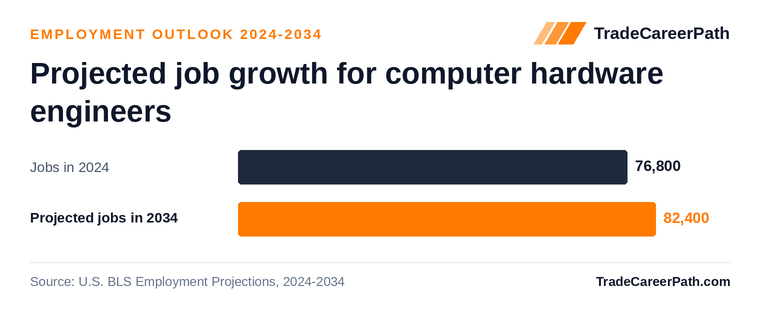
BLS projects computer hardware engineering employment to grow +9.1% from 2025 to 2035 - from 76,100 to 83,000 jobs - with about 4,100 openings per year once retirements and occupation changes are counted (BLS Employment Projections, 2025-35). The latest wage data (OEWS, May 2025) puts the median at $161,740, up from the 2024 figure of $155,020 - pay in this field is high and still climbing.
The demand drivers are structural: AI accelerators and the data-center buildout, CHIPS Act-funded domestic semiconductor fabs, and the steady spread of embedded processors into vehicles, medical devices, and industrial equipment. For career changers, the more useful number is the openings figure - roughly 4,100 seats a year in a 76,660-person occupation means steady hiring, and the small size of the field cuts both ways: fewer total jobs than software, but far fewer qualified candidates, especially ones who can hold a soldering iron.
Cost and Time to Complete the Degree
For computer hardware engineers, the credential is: ABET-accredited bachelor’s in computer or electrical engineering. A bachelor’s degree is typically 120 credit hours: four years full-time, and commonly five to six years part-time while working. Transfer credit is the other lever: prior college, military training, apprenticeship coursework, and industry certifications can be worth meaningful credit at transfer-friendly schools, so get a written transfer evaluation before enrolling anywhere. Costs vary widely by school type; in-state public online programs are usually the value benchmark, and employer tuition assistance is common for working adults in this field.
Pros and Cons of Training as a Computer Hardware Engineer
Pros
- Median pay of $161,740 nationally (BLS OEWS, May 2025)
- BLS projects +9.1% employment growth through 2035, about 4,100 openings a year
- No license required - the degree is the only gate
- Field experience from the trades is a genuine hiring advantage in validation and test
- Accredited online and hybrid degree paths exist for working adults
Cons
- Requires a 4-year degree (typically 120 credit hours) with heavy math
- Entry-level pay starts near $92,940 at the 10th percentile
- Jobs concentrate in a handful of hubs - relocation may be part of the deal
Frequently Asked Questions
Can an electronics technician work as a hardware engineer?
Yes - validation and test engineering teams actively hire experienced technicians who complete the bachelor's, and the pay jump to the BLS median for this occupation is among the largest of any trade-to-degree path.
How much do computer hardware engineers make?
The national median annual wage for computer hardware engineers is $161,740 (BLS OEWS, May 2025). The top 10% earn $225,330 or more, while entry-level pay starts around $92,940.
What is the job outlook for computer hardware engineers?
BLS projects employment of computer hardware engineers to change by +9.1% from 2025 to 2035 (BLS Employment Projections, 2025-35).
How long does computer hardware engineer training take?
The ABET-accredited bachelor's is 120 credit hours: four years full-time, commonly five to six years part-time while working. Transfer credit from prior college, military electronics training, or certification coursework can meaningfully shorten it at transfer-friendly schools.
Is computer hardware engineering hard?
The degree is math-heavy - calculus, circuits, and digital logic are unavoidable - but working electronics techs usually find the hardware labs and troubleshooting coursework easier than fresh high-school graduates do. The theory lands faster when you have already probed real boards with a scope.
Should I get a computer engineering or electrical engineering degree?
Either works. Electrical engineering with a digital-systems focus usually offers more ABET-accredited online options and stays marketable across the wider electronics industry; computer engineering goes deeper on architecture and embedded software. Employers hire both into hardware roles constantly.
Can you train as a computer hardware engineer without a degree?
Not with the engineer title at most employers - the ABET-accredited bachelor's is the screen. Without it, the ceiling is engineering technician, test technician, or field service roles. Bench experience shortens the degree through transfer credit, but does not replace it.
Do computer hardware engineers need a license?
No. Hardware engineers work in private industry under the industrial exemption, and PE licensure is rare in this field. Vendor and industry certifications in networking, embedded systems, or security can help at the margins, but the degree plus a project portfolio is what employers actually screen for.
Computer Hardware Engineer Salary and Requirements by State
Alabama · Arizona · Arkansas · California · Colorado · Delaware · District of Columbia · Florida · Georgia · Hawaii · Idaho · Illinois · Indiana · Iowa · Kansas · Kentucky · Louisiana · Maryland · Massachusetts · Michigan · Minnesota · Mississippi · Missouri · Nebraska · Nevada · New Hampshire · New Jersey · New Mexico · New York · North Carolina · Ohio · Oklahoma · Rhode Island · South Carolina · South Dakota · Tennessee · Texas · Utah · Virginia · Washington · Wisconsin
Related Careers and Degree Paths
- Electrical Engineer - the broader degree that also qualifies you for hardware roles
- Electronics Engineer - the adjacent discipline covering circuits beyond computers
- Computer Network Architect - the systems side of the same networking hardware
- Electrician to Engineer - the bridge path for electrical trades
- Online Engineering Degrees for Tradespeople - how to pick an ABET program that fits a work schedule
Degree and Program Guides
- Online Electrical Engineering Degrees - the accredited degree behind hardware roles
Sources
- U.S. Bureau of Labor Statistics, Occupational Employment and Wage Statistics (OEWS), May 2025 - Computer Hardware Engineers (SOC 17-2061)
- U.S. Bureau of Labor Statistics, Employment Projections, 2025-35
- U.S. Bureau of Labor Statistics, Occupational Outlook Handbook - education and licensing requirements
Computer Hardware Engineer Salary by State
About this guide: Researched and written by the TradeCareerPath Editorial Team. Our editorial team researches and sources every trade school and career guide using federal labor and education data, including BLS OEWS and Employment Projections, DOL apprenticeship records, IPEDS, College Scorecard, and state licensing boards. We follow the editorial standards documented at /editorial-policy/.
Data sources
Figures on this page are sourced from the federal and state datasets below. Methodology: how we rank and source data.
| Data | Provider | Vintage |
|---|---|---|
| Occupational Employment and Wage Statistics (OEWS) | U.S. Bureau of Labor Statistics | May 2025 |
| Employment Projections | U.S. Bureau of Labor Statistics | 2025-2035 |
| Integrated Postsecondary Education Data System | National Center for Education Statistics (IPEDS) | 2024 |
| College Scorecard (school-level outcomes) | U.S. Department of Education | latest release |
| College Scorecard (field-of-study earnings) | U.S. Department of Education | latest release (updated 2026-06-12) |
| Occupational licensing requirements | CareerOneStop (U.S. Department of Labor) | latest release (updated 2026-02-22) |
| Registered apprenticeship programs | CareerOneStop / Apprenticeship.gov (U.S. Department of Labor) | latest release (updated 2025-10-25) |
| O*NET occupation profiles (skills, tasks, tools, job zones) | U.S. Department of Labor (O*NET / Employment & Training Admin.) | O*NET 31.0 (updated 2026-10-14) |