
How to Become a Computer Network Architect in 2026
Is Computer Network Architect Right for You?
The U.S. Department of Labor's O*NET profile for Computer Network Architects (SOC 15-1241) describes the work this way: Design and implement computer and information networks, such as local area networks (LAN), wide area networks (WAN), intranets, extranets, and other data communications networks. Perform network modeling, analysis, and planning, including analysis of capacity needs for network infrastructures. May also design network and computer security measures. May research and recommend network and data communications hardware and software.
What the work involves
- Develop disaster recovery plans.
- Develop or recommend network security measures, such as firewalls, network security audits, or automated security probes.
- Develop and implement solutions for network problems.
- Maintain networks by performing activities such as file addition, deletion, or backup.
- Coordinate network operations, maintenance, repairs, or upgrades.
Skills and knowledge that matter
Skills: Critical Thinking, Reading Comprehension, Complex Problem Solving, Programming, Systems Evaluation, Active Listening.
Knowledge: Computers and Electronics, Engineering and Technology, Telecommunications, English Language.
Tools and technology you may use
Technology: Access software, Development environment software, Video creation and editing software, Adobe After Effects, AJAX, Amazon DynamoDB.
Typical preparation
O*NET Job Zone Four (Considerable Preparation Needed). Most of these occupations require a four-year bachelor's degree, but some do not. Employees in these occupations usually need several years of work-related experience, on-the-job training, and/or vocational training.
Interest fit
O*NET interest profile: Investigative, Conventional, Realistic. People who enjoy working with ideas, searching for facts, and figuring out problems often find this occupation a good fit.
Source: O*NET 31.0 (updated 2026-10-14)
Quick answer: Training as a computer network architect requires a 4-year degree - typically a Bachelor’s in computer science, IT, or network engineering. The national median pay is $134,050 per year, and BLS projects +7.7% employment change from 2025 to 2035 (BLS OEWS, May 2025; BLS Employment Projections, 2025-35).
Computer Network Architect at a Glance
| Metric | Detail | Source |
|---|---|---|
| Median annual wage | $134,050 | BLS OEWS, May 2025 |
| Typical wage range | $79,900 (10th pct) - $202,680 (90th pct) | BLS OEWS, May 2025 |
| Employment | 179,740 nationwide | BLS OEWS, May 2025 |
| Projected growth (2025-35) | +7.7%, about 9,600 openings per year | BLS Employment Projections, 2025-35 |
| Typical education | Bachelor’s in computer science, IT, or network engineering | BLS Occupational Outlook Handbook |
| License / certification | No license; Cisco (CCNP/CCIE) and cloud certifications carry heavy weight | None for most roles |
What Does a Computer Network Architect Do?
Computer network architects design the data networks everything else runs on: datacenter fabrics, fiber backbones, campus and enterprise networks, WANs, and cloud interconnects. The tech or installer builds and terminates the network; the architect decides what gets built - which topology, which routing protocols, which hardware, and how it all fails over when something breaks at 2 a.m.
Day to day, the work splits by sub-specialty. A datacenter network architect designs leaf-spine fabrics and capacity plans for the AI and cloud buildout - deciding how many links, at what speeds, with what oversubscription ratio, and how the fabric scales when the next hall comes online. An enterprise or campus architect maps out office and branch networks: segmentation, wireless coverage, VPN and SD-WAN design, and the security zones that keep an intrusion in one department from spreading. A service-provider or WAN architect designs the long-haul side - BGP peering, MPLS or segment routing, and the interconnects that tie sites and clouds together. All of them spend serious time on documentation: network diagrams, addressing plans, and migration runbooks that engineering and installation teams execute from. At the design review before a major cutover, the architect is the one defending the drawing.
If you are coming up from tower work, fiber and low-voltage installation, or datacenter tech duty, the shortest way to say it: you already know what the physical layer actually looks like - how cable runs get routed, where heat and power constrain a rack, why a bad termination takes a link down. The architect’s job is layering the logical design on top of that physical reality, and architects who have never touched the plant routinely produce designs field crews have to quietly fix. Your hands-on knowledge is what makes your designs installable - do not leave it off the resume.
Skills That Make a Great Computer Network Architect
- Routing and switching at scale (BGP, OSPF, spanning tree and its modern replacements)
- Network security architecture: segmentation, firewalls, zero-trust design
- Cloud networking (AWS/Azure VPCs, transit gateways, hybrid interconnects)
- Capacity planning and traffic modeling
- Automation basics: Python or Ansible for pushing and validating configs
- Documentation and diagramming - the design document is the product
- Vendor evaluation and cost justification: architects sign off on serious hardware spend
Computer Network Architect Salary
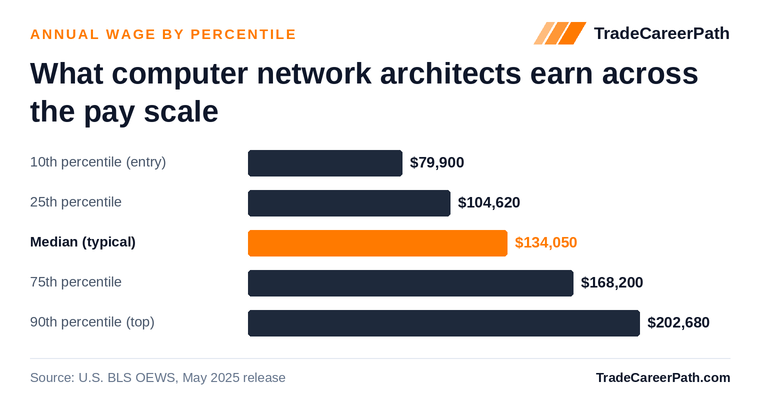
This is one of the highest-paying careers a physical-layer background can lead into. The national median is $134,050 per year, and even the 10th percentile - roughly where people enter architect-track roles - is $79,900, above the median for most installation trades. The 90th percentile reaches $202,680 (BLS OEWS, May 2025).
Where the Jobs and the Money Are
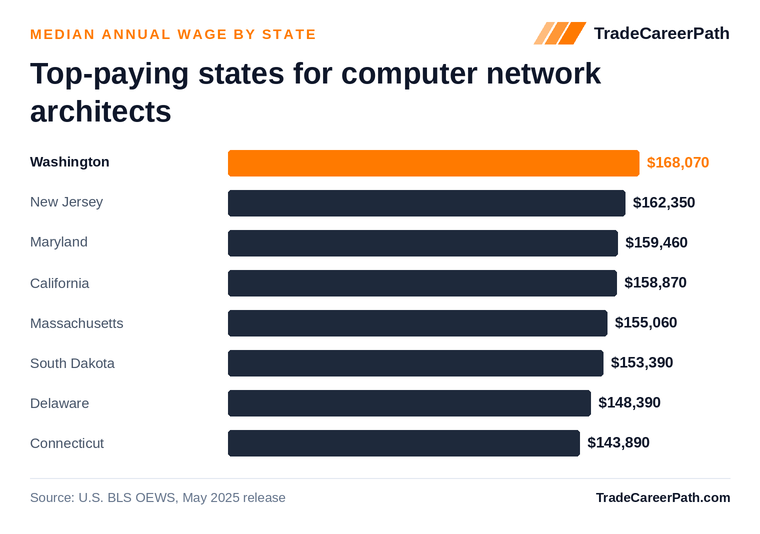
Network architecture work clusters around cloud regions, federal contracting, and telecom hubs. The single biggest concentration is Colorado - about 16,380 architects, nearly five times the occupation’s share of the average state labor market - anchored by the Denver-area telecom and cloud corridor. California employs 14,870 and Texas 13,650, and the top of the pay table is a mix of cloud country and the federal belt (BLS OEWS, May 2025).
| State | Median annual wage | Employment |
|---|---|---|
| Washington | $168,070 | 4,730 |
| New Jersey | $162,350 | 5,660 |
| Maryland | $159,460 | 5,860 |
| California | $158,870 | 14,870 |
| Massachusetts | $155,060 | 6,270 |
Maryland and Massachusetts stand out for combining top-five pay with well-above-average concentration - architects there are roughly one and a half to nearly two times as common as in the average state market, driven by defense and federal networks around DC and the Boston tech corridor. That density matters for a career changer: multiple employers competing for the same skills means you can change jobs without changing zip codes. Washington pays the most outright, on the strength of the hyperscale cloud operators headquartered there - and unlike most highly paid tech jobs, this one also exists in every state, because every hospital system and mid-size enterprise needs the network designed by somebody.
How to Become a Computer Network Architect
1. Build network-side experience
Tower, fiber, structured cabling, or datacenter tech work is the physical-layer foundation - and it counts, so log it deliberately. Ask to be on the jobs that touch switches and routers, not just cable: rack-and-stack, circuit turn-ups, cutovers, anything where you see how the logical network maps onto the plant you build. If your employer has a NOC or network engineering group, tell them where you are headed; internal moves are the most affordable bridge in this field.
2. Earn the bachelor’s degree
Computer science, IT, or network engineering - online programs are standard in this field, and nobody in networking blinks at an online credential backed by certifications. For working techs, an IT or network engineering program is usually the straighter line: the coursework overlaps the Cisco track, and many programs bake certification prep into the curriculum. Get a written transfer evaluation before enrolling anywhere - prior college, military training, and existing certifications can reduce a 120-credit program.
3. Stack routing certifications
CCNA first - it is the entry ticket that gets a physical-layer tech taken seriously for network roles. Then CCNP, which is the working credential for network engineers and the minimum expectation for architect-track candidates. Increasingly, cloud networking certifications (AWS Advanced Networking, Azure network engineer tracks) matter just as much, because almost every enterprise design now has a cloud edge. Certs and the degree are not either/or here; the field genuinely expects both.
4. Move up through network engineering
Nobody is hired into their first architect job from outside networking. The bridge roles are NOC technician, network administrator, and network engineer - jobs where you operate the designs someone else drew, learn where they fail, and start owning small design decisions yourself. Plan on several years here. The engineers who make architect fastest volunteer for migrations and design reviews, because that is where design judgment gets built.
5. Advance
Senior and principal architect roles, datacenter network design at cloud and colocation operators, or the leadership track into infrastructure management. The fork mirrors other technical fields: deepen into a technical-authority role (a CCIE plus datacenter or service-provider specialization) or move into managing the teams and budgets. Both tracks are mapped against real pay bands in the career ladder below.
Career Ladder: Titles and Realistic Pay
The BLS wage percentiles map cleanly onto how networking careers actually progress. Use this as a sanity check on offers, not a guarantee:
| Stage | Typical titles | Years in | Realistic pay (BLS OEWS, May 2025) |
|---|---|---|---|
| Entry level | NOC technician, network administrator, junior network engineer | 0-3 | ~$79,900-$104,620 (10th-25th pct) |
| Mid-career | Network engineer, network architect | 3-10 | ~$134,050 (median) |
| Senior | Senior network architect, datacenter network architect | 10-15 | ~$168,200 (75th pct) |
| Principal / leadership | Principal architect, CCIE-level specialist, infrastructure manager | 15+ | $202,680+ (90th pct) |
Two notes for career changers. First, physical-layer experience compresses this ladder: a fiber or datacenter tech with a fresh CCNA typically enters above the bottom of the entry band, because they already troubleshoot the layer where most outages actually start. Second, the 90th-percentile figure understates the top of this market - cloud providers and large financials pay senior architects substantial bonus and stock on top of the base wages the BLS data captures.
Do You Need a License?
No. There is no state license for computer network architects - no exam, no board, no continuing-education mandate. This occupation runs on industry certifications instead: Cisco’s CCNA/CCNP/CCIE ladder is the traditional currency, Juniper and cloud-vendor tracks (AWS, Azure) serve the same role in their ecosystems, and security certifications add weight for architects who own segmentation design. Two practical implications: there is no legal gate between you and the work - hiring managers decide, not a state board - and certifications expire, so budget ongoing study the way an electrician budgets code-update classes. On federal and defense networks, a security clearance can matter more than any certification.
Why an Online Degree Works for This Career
Tower techs, fiber and low-voltage installers, and datacenter technicians already build these networks; the bachelor’s plus routing certifications moves you from pulling and terminating to designing. BLS projects double-digit growth for the occupation, the work is inherently remote-friendly, and online degrees are fully normalized in IT hiring - the certifications validate the skills either way. Employer tuition assistance is common at telecoms, ISPs, and datacenter operators, so many techs finish the degree with most of the tuition covered, without giving up their seniority or their paycheck.
Job Outlook for 2026 and Beyond
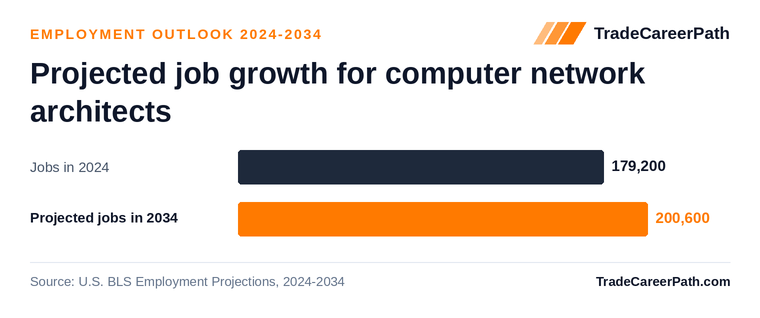
BLS projects employment of computer network architects to grow +7.7% from 2025 to 2035 - from 181,800 to 195,800 jobs - with about 9,600 openings per year once retirements and occupation changes are counted (BLS Employment Projections, 2025-35). Wages are moving too: the latest data (OEWS, May 2025) puts the median at $134,050, up from the 2024 figure of $130,390 - real wage growth in an occupation that already pays in the top tier.
The demand drivers are structural: the AI datacenter buildout is, at the physical layer, a network buildout, and enterprises keep re-architecting for cloud and zero-trust security. For a career changer, the openings number matters most - 9,600 seats a year in a 179,740-person occupation means steady, broad hiring, not a lottery.
Cost and Time to Complete the Degree
For network architects, the credential is: Bachelor’s in computer science, IT, or network engineering. A bachelor’s degree is typically 120 credit hours: four years full-time, and commonly five to six years part-time while working. Transfer credit is the other lever: prior college, military training, apprenticeship coursework, and industry certifications can be worth meaningful credit at transfer-friendly schools - many programs in this field award credit for a current CCNA - so get a written transfer evaluation before enrolling anywhere. Costs vary widely by school type; in-state public online programs are usually the value benchmark, and employer tuition assistance is common for working adults in this field. Budget separately for certification exams along the way; they are a fraction of tuition but not optional.
Pros and Cons of Training as a Computer Network Architect
Pros
- Median pay of $134,050 nationally (BLS OEWS, May 2025)
- BLS projects +7.7% employment growth through 2035, about 9,600 openings per year
- Field experience from the trades is a genuine hiring advantage
- No state license - certifications and experience are the only gates
- Accredited online and hybrid degree paths exist for working adults
Cons
- Requires a 4-year degree (typically 120 credit hours) plus years in network engineering first
- Entry-level pay starts near $79,900 at the 10th percentile
- Certifications expire - ongoing study is part of the job for a whole career
Frequently Asked Questions
Can a tower or fiber tech work as a network architect?
Yes - physical-layer experience is a real foundation, and the path runs through network engineering roles plus a bachelor's and routing certifications. BLS projects 7.7% growth for network architects from 2025 to 2035, driven by datacenter and cloud expansion.
How much do network architects make?
The national median annual wage for computer network architects is $134,050 (BLS OEWS, May 2025). The top 10% earn $202,680 or more, while entry-level pay starts around $79,900.
What is the job outlook for network architects?
BLS projects employment of computer network architects to change by +7.7% from 2025 to 2035 (BLS Employment Projections, 2025-35).
How long does computer network architect training take?
The bachelor's is 120 credit hours - four years full-time, commonly five to six part-time while working - plus several years in network engineering roles before the architect title. Transfer credit for prior college, military training, and industry certifications can meaningfully shorten it at transfer-friendly schools.
Is training as a network architect hard?
The degree is less math-heavy than engineering, but the certification track (CCNA, then CCNP) demands real study, and architect roles require years of hands-on network engineering first. Techs who already pull, terminate, and troubleshoot networks usually find the material far more concrete than students who have never touched the hardware.
Should I get a computer science or an IT/network engineering degree?
For working techs, an IT or network engineering degree is usually the more direct buy: the coursework maps onto the CCNA/CCNP track and there are many accredited online options. Computer science keeps more doors open toward software and cloud roles but front-loads programming and math you may not need for network design.
Can you train as a network architect without a degree?
Sometimes - this field weighs certifications and experience heavily, and some architects get there on a CCNP/CCIE plus years of engineering work alone. But most employers list the bachelor's, and skipping it narrows the field and slows promotion, so the degree-plus-certs combination is the reliable path.
Do network architects need a license?
No state license exists for this occupation. Industry certifications fill that role: Cisco's CCNP and CCIE are the traditional currency, and cloud networking certifications from AWS and Azure now carry comparable weight in hiring.
Computer Network Architect Salary and Requirements by State
Alabama · Alaska · Arizona · Arkansas · California · Colorado · Connecticut · Delaware · District of Columbia · Florida · Georgia · Hawaii · Idaho · Illinois · Indiana · Iowa · Kansas · Kentucky · Louisiana · Maine · Maryland · Massachusetts · Michigan · Minnesota · Mississippi · Missouri · Montana · Nebraska · Nevada · New Hampshire · New Jersey · New Mexico · New York · North Carolina · North Dakota · Ohio · Oklahoma · Oregon · Pennsylvania · Rhode Island · South Carolina · South Dakota · Tennessee · Texas · Utah · Vermont · Virginia · Washington · West Virginia · Wisconsin · Wyoming
Related Careers and Degree Paths
- Tower Technician - the classic physical-layer feeder trade for this career
- Computer Hardware Engineer - the hardware-design side of the same infrastructure
- Electrical Engineer - power and signal engineering behind the network plant
- Online Cybersecurity Degrees for Techs - the security-focused branch of the same degree decision
- All trade careers that require a 4-year degree
Degree and Program Guides
- Online Information Technology Degrees - degree and certification stacking for network roles
Sources
- U.S. Bureau of Labor Statistics, Occupational Employment and Wage Statistics (OEWS), May 2025 - Computer Network Architects (SOC 15-1241)
- U.S. Bureau of Labor Statistics, Employment Projections, 2025-35
- U.S. Bureau of Labor Statistics, Occupational Outlook Handbook - education and licensing requirements
Computer Network Architect Salary by State
About this guide: Researched and written by the TradeCareerPath Editorial Team. Our editorial team researches and sources every trade school and career guide using federal labor and education data, including BLS OEWS and Employment Projections, DOL apprenticeship records, IPEDS, College Scorecard, and state licensing boards. We follow the editorial standards documented at /editorial-policy/.
Data sources
Figures on this page are sourced from the federal and state datasets below. Methodology: how we rank and source data.
| Data | Provider | Vintage |
|---|---|---|
| Occupational Employment and Wage Statistics (OEWS) | U.S. Bureau of Labor Statistics | May 2025 |
| Employment Projections | U.S. Bureau of Labor Statistics | 2025-2035 |
| Integrated Postsecondary Education Data System | National Center for Education Statistics (IPEDS) | 2024 |
| College Scorecard (school-level outcomes) | U.S. Department of Education | latest release |
| College Scorecard (field-of-study earnings) | U.S. Department of Education | latest release (updated 2026-06-12) |
| Occupational licensing requirements | CareerOneStop (U.S. Department of Labor) | latest release (updated 2026-02-22) |
| Registered apprenticeship programs | CareerOneStop / Apprenticeship.gov (U.S. Department of Labor) | latest release (updated 2025-10-25) |
| O*NET occupation profiles (skills, tasks, tools, job zones) | U.S. Department of Labor (O*NET / Employment & Training Admin.) | O*NET 31.0 (updated 2026-10-14) |