
How to Become a Construction Manager (5 Steps)
Is Construction Manager Right for You?
The U.S. Department of Labor's O*NET profile for Construction Managers (SOC 11-9021) describes the work this way: Plan, direct, or coordinate, usually through subordinate supervisory personnel, activities concerned with the construction and maintenance of structures, facilities, and systems. Participate in the conceptual development of a construction project and oversee its organization, scheduling, budgeting, and implementation. Includes managers in specialized construction fields, such as carpentry or plumbing.
What the work involves
- Inspect or review projects to monitor compliance with building and safety codes or other regulations.
- Develop or implement quality control programs.
- Plan, schedule, or coordinate construction project activities to meet deadlines.
- Prepare and submit budget estimates, progress reports, or cost tracking reports.
- Direct and supervise construction or related workers.
Skills and knowledge that matter
Skills: Judgment and Decision Making, Management of Personnel Resources, Active Listening, Critical Thinking, Coordination, Complex Problem Solving.
Knowledge: Building and Construction, Administration and Management, Mathematics, Engineering and Technology.
Tools and technology you may use
Technology: Word processing software, Document management software, Graphics or photo imaging software, Adobe Acrobat, Adobe Creative Cloud software, Autodesk AutoCAD.
Typical preparation
O*NET Job Zone Four (Considerable Preparation Needed). Most of these occupations require a four-year bachelor's degree, but some do not. Employees in these occupations usually need several years of work-related experience, on-the-job training, and/or vocational training.
Interest fit
O*NET interest profile: Enterprising, Conventional, Realistic. People who enjoy starting projects, leading others, and making decisions often find this occupation a good fit.
Source: O*NET 31.0 (updated 2026-10-14)
Ever drive by a big construction site and wonder, who’s keeping this entire thing on track?
The cranes, crews, budgets, timelines, all moving in perfect coordination?
That’s the work of a construction manager.
They’re the bridge between the hands-on tradespeople and the business side of building. If you’ve got leadership skills, attention to detail, and love seeing projects come to life, this career’s worth a serious look.
Quick answers
What does a construction manager do?
A construction manager oversees every phase of a building project, from blueprints to the final inspection. They coordinate people, schedules, budgets, and job-site safety.
What are common day-to-day responsibilities?
Common responsibilities include coordinating subcontractors, reviewing plans and blueprints, estimating costs, managing budgets, and meeting with clients, architects, and inspectors.
What are the 5 steps to work as a construction manager?
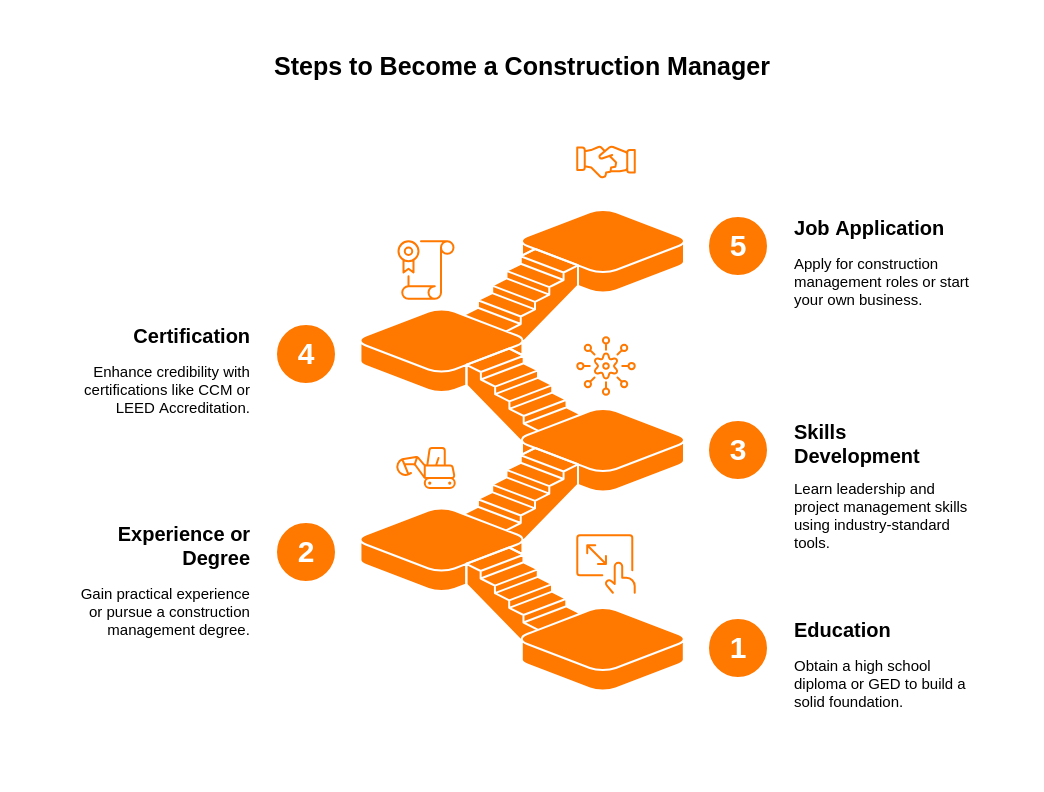
This page outlines a 5-step path: earn a diploma or GED, build experience or earn a degree, develop leadership skills, consider certification, and apply for jobs or start a business.
Do you need a degree to work as a construction manager?
Not always. Many start as carpenters, electricians, or site foremen and move into management, while others earn a construction management or civil engineering degree (2-4 years).
Do construction managers need a license?
Licensing varies by state and project type. Some projects require a general contractor or construction manager license, especially for large-scale work or public works.
Are certifications required?
Certifications are optional, but can boost credibility. This page lists options like CCM (CMAA), AC or CPC (AIC), and LEED Accreditation.
At a glance
- Role: Oversee building projects from plan to final inspection
- Day-to-day: Coordinate crews, budgets, schedules, and safety
- Typical path: Diploma or GED, then experience or a construction management/civil engineering degree (2-4 years)
- Tools mentioned: MS Project, Primavera, Procore
- Credentials: Licensing can vary by state; certifications are optional
What Does a Construction Manager Do?
Construction managers (often called general contractors or project managers) oversee every phase of a building project, from blueprints to the final inspection. They plan, coordinate, and lead crews to make sure projects are done safely, on time, and within budget.
Daily responsibilities
- Coordinating subcontractors and scheduling crews
- Reviewing and interpreting plans and blueprints
- Estimating costs and managing budgets
- Ensuring code compliance and job-site safety
- Meeting with clients, architects, and inspectors
Think of it like being a conductor of a massive orchestra: hundreds of moving parts, all working toward the same end result.
Construction managers are in high demand, especially as major infrastructure and housing projects continue to grow nationwide.
How to Become a Construction Manager (5 Steps)
Here’s the roadmap most managers follow to build their careers:
Get your high school diploma or GED
You’ll need a solid foundation in math, communication, and business.Earn experience or a construction management degree
Many start as carpenters, electricians, or site foremen before moving into management.
Others go straight into a construction management or civil engineering degree (2-4 years).Develop leadership and project management skills
Learn how to handle budgets, schedules, and teams. Tools like MS Project, Primavera, and Procore are industry standards.Get certified (optional but powerful)
Certifications boost your credibility and can help land larger projects. Consider:- Certified Construction Manager (CCM) - CMAA
- Associate Constructor (AC) or Certified Professional Constructor (CPC) - AIC
- LEED Accreditation - U.S. Green Building Council
Apply for jobs or start your own contracting business
Construction managers work for general contractors, engineering firms, government agencies, and even run their own companies.
Licensing and certification
Licensing varies by state and the type of projects you manage.
You may need a general contractor license or construction manager license, especially for large-scale projects or public works.
Common requirements
- Proof of experience or degree
- Passing state exam on codes and laws
- Proof of liability insurance and bonding
Even if it’s not required in your area, getting certified through CMAA or AIC can make a big difference in pay and career advancement.
Skills for construction managers
- Strong leadership and communication
- Budgeting and cost estimation
- Problem-solving and adaptability
- Time management
- Safety awareness and code knowledge
The best managers don’t just give orders; they inspire people to build something great together.
Construction Manager Salary Snapshot
U.S.49,700 openings/yr
Pros and cons of construction management
Pros:
- High earning potential
- Leadership and autonomy
- Every project feels different
- Opportunities for self-employment
Cons:
- Long hours and pressure to meet deadlines
- Responsibility for safety and costs
- Weather and site conditions can delay progress
Start Your Construction Management Career
Construction management is one of the few careers where you can blend business, engineering, and leadership and see the results of your work every day.
If you’re ready to go from the job site to the driver’s seat, now’s the time to start.
You’re not just managing projects; you’re building the future.
Industry Organizations & Certifying Bodies
These are the recognized national organizations, unions, certifying bodies, and regulatory authorities that shape this trade. They issue the credentials, sponsor the apprenticeships, publish the codes, and represent workers and employers.
- Construction Management Association of America (CMAA) Issues the Certified Construction Manager (CCM) credential.
- American Institute of Constructors (AIC) Issues the Associate Constructor (AC) and Certified Professional Constructor (CPC) credentials.
- Project Management Institute (PMI) PMP and CAPM credentials widely used by construction managers.
Wage and Employment Charts
Construction Manager Salary and Requirements by State
Select your state for local wage data, training options, and requirements:
Alabama · Alaska · Arizona · Arkansas · California · Colorado · Connecticut · Delaware · District of Columbia · Florida · Georgia · Hawaii · Idaho · Illinois · Indiana · Iowa · Kansas · Kentucky · Louisiana · Maine · Maryland · Massachusetts · Michigan · Minnesota · Mississippi · Missouri · Montana · Nebraska · Nevada · New Hampshire · New Jersey · New Mexico · New York · North Carolina · North Dakota · Ohio · Oklahoma · Oregon · Pennsylvania · Rhode Island · South Carolina · South Dakota · Tennessee · Texas · Utah · Vermont · Virginia · Washington · West Virginia · Wisconsin · Wyoming
Workplace Safety Snapshot
BLS Survey of Occupational Injuries and Illnesses data (2023-2024) report approximately 72.8 days-away, restricted, or transfer cases per 10,000 full-time-equivalent workers in construction managers (about 0.73 per 100 FTE). Source: BLS Survey of Occupational Injuries and Illnesses, Table R98.
Frequently Asked Questions
How long does construction manager training take?
It typically takes typically 6 months to 2 years of training. The most common entry path is through a certificate or associate degree program. A high school diploma or GED is generally required to get started.
How much do construction managers make?
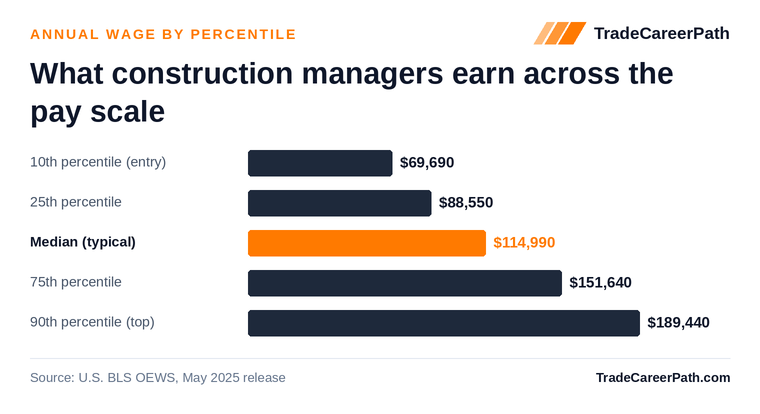
The median annual salary for construction managers is $114,990 according to the Bureau of Labor Statistics (May 2025). Entry-level workers earn around $69,690, while those in the 90th percentile earn over $189,440. Pay varies by state, experience, and specialization.
What is the job outlook for construction managers?
The Bureau of Labor Statistics projects 9.1% employment growth for this occupation from 2025 to 2035, which is faster than average. Approximately 49,700 job openings are expected each year due to growth, retirements, and workers leaving the field.
Do you need a college degree to work as a construction manager?
No. A college degree is not required to work as a construction manager. Most people enter the field through a certificate or associate degree program. A high school diploma or GED is typically the only educational prerequisite.
Which states pay construction managers the most?
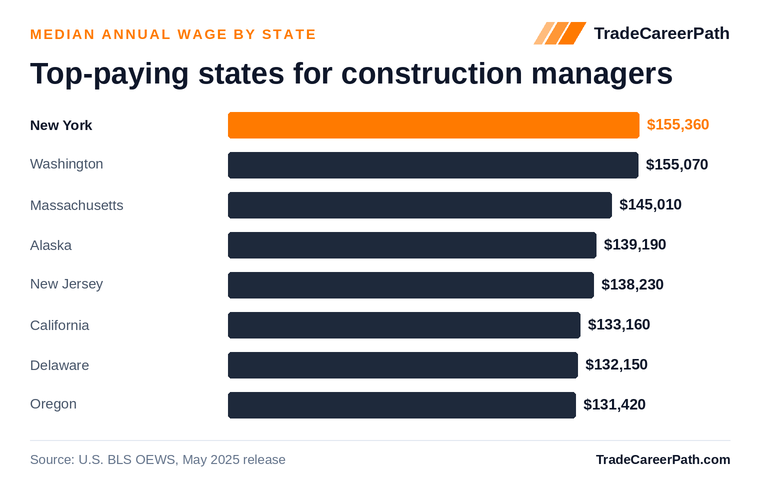
According to the U.S. Bureau of Labor Statistics (May 2025 OEWS), the highest-paying states for construction managers are New York, Washington, and Massachusetts. Median annual wages: New York ($155,360); Washington ($155,070); Massachusetts ($145,010).
Which states employ the most construction managers?
BLS reports the largest concentrations of construction managers in Texas, California, and Florida. Employment levels: Texas (59,060 workers); California (34,750 workers); Florida (34,010 workers) (May 2025).
How much do experienced construction managers earn?
The top 10% of construction managers earn more than $189,440 per year, according to BLS Occupational Employment and Wage Statistics (May 2025). Experienced workers in this band typically hold senior credentials, supervisory roles, or specialty certifications.
What is entry-level pay for construction managers?
BLS reports the bottom 10% of construction managers earn under $69,690 per year. New workers often start near this level and see pay rise as they accumulate experience and credentials.
How many construction managers work in the United States?
BLS reports approximately 380,360 construction managers employed nationwide as of May 2025.
How many job openings are expected for construction managers each year?
BLS projects approximately 49,700 openings per year for construction managers from 2025 through 2035, including new positions, retirements, and workers transitioning out. The occupation is projected to grow 9.1% from 2025 to 2035, classified as much faster than average growth.
Is construction manager a growing career?
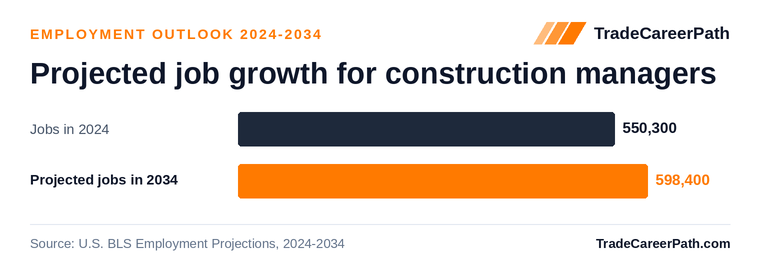
Yes. BLS projects 9.1% employment growth for construction managers between 2025 and 2035, classified as much faster than average. Employment is projected to rise from approximately 550,300 jobs in 2024 to 598,400 in 2034.
How much do construction managers make per hour?
The median hourly wage for construction managers is $55.28, according to BLS (May 2025). Hourly pay ranges from about $33.50 (bottom 10%) to $91.08 (top 10%).
How Construction Manager Pay Compares to Similar Trades
Side-by-side comparison of Construction Manager and the closest related careers, based on U.S. Bureau of Labor Statistics data (May 2025 OEWS + 2025-2035 Employment Projections).
| Career | Median Pay | 10-Year Growth | Annual Openings |
|---|---|---|---|
| Construction Manager this guide | $114,990 | +9.1% | 49,700 |
| Construction Worker | $47,120 | +7.3% | 120,000 |
| Carpentry | $60,580 | +3.9% | 62,800 |
| Home Inspector | $74,690 | - | 14,800 |
| Heavy Equipment Operator | $59,850 | +4.6% | 39,200 |
Source: BLS Occupational Employment and Wage Statistics + BLS Employment Projections.
Advance Your Career with a Degree
Experienced Construction Manager professionals often step up into degree-track careers where field experience is a hiring advantage:
- Civil Engineer - median pay $100,840 (BLS OEWS, May 2025); requires a 4-year degree
- Land Surveyor - median pay $75,440 (BLS OEWS, May 2025); requires a 4-year degree
- Architect - median pay $99,280 (BLS OEWS, May 2025); requires a 4-year degree
- Construction Cost Estimator - median pay $78,740 (BLS OEWS, May 2025); requires a 4-year degree
- Construction Project Manager - median pay $102,320 (BLS OEWS, May 2025); requires a 4-year degree
See all trade careers that require a 4-year degree.
Sources
- U.S. Bureau of Labor Statistics, Occupational Employment and Wage Statistics (May 2025)
- U.S. Bureau of Labor Statistics, Employment Projections 2025-2035
- U.S. Bureau of Labor Statistics, Survey of Occupational Injuries and Illnesses (2023-2024, Table R98)
- U.S. Department of Labor, Wage and Hour Division, Davis-Bacon General Wage Determinations (2026)
Construction Manager Salary by State
About this guide: Researched and written by the TradeCareerPath Editorial Team. Our editorial team researches and sources every trade school and career guide using federal labor and education data, including BLS OEWS and Employment Projections, DOL apprenticeship records, IPEDS, College Scorecard, and state licensing boards. We follow the editorial standards documented at /editorial-policy/.
Data sources
Figures on this page are sourced from the federal and state datasets below. Methodology: how we rank and source data.
| Data | Provider | Vintage |
|---|---|---|
| Occupational Employment and Wage Statistics (OEWS) | U.S. Bureau of Labor Statistics | May 2025 |
| Employment Projections | U.S. Bureau of Labor Statistics | 2025-2035 |
| Integrated Postsecondary Education Data System | National Center for Education Statistics (IPEDS) | 2024 |
| College Scorecard (school-level outcomes) | U.S. Department of Education | latest release |
| College Scorecard (field-of-study earnings) | U.S. Department of Education | latest release (updated 2026-06-12) |
| Occupational licensing requirements | CareerOneStop (U.S. Department of Labor) | latest release (updated 2026-02-22) |
| Registered apprenticeship programs | CareerOneStop / Apprenticeship.gov (U.S. Department of Labor) | latest release (updated 2025-10-25) |
| O*NET occupation profiles (skills, tasks, tools, job zones) | U.S. Department of Labor (O*NET / Employment & Training Admin.) | O*NET 31.0 (updated 2026-10-14) |