
How to Become a Construction Project Manager in 2026
Is Construction Project Manager Right for You?
The U.S. Department of Labor's O*NET profile for Project Management Specialists (SOC 13-1082) describes the work this way: Analyze and coordinate the schedule, timeline, procurement, staffing, and budget of a product or service on a per project basis. Lead and guide the work of technical staff. May serve as a point of contact for the client or customer.
What the work involves
- Communicate with key stakeholders to determine project requirements and objectives.
- Identify project needs such as resources, staff, or finances by reviewing project objectives and schedules.
- Submit project deliverables to clients, ensuring adherence to quality standards.
- Confer with project personnel to identify and resolve problems.
- Plan, schedule, or coordinate project activities to meet deadlines.
Skills and knowledge that matter
Skills: Active Listening, Critical Thinking, Writing, Monitoring, Judgment and Decision Making, Reading Comprehension.
Knowledge: English Language, Administration and Management, Administrative, Customer and Personal Service.
Tools and technology you may use
Technology: Word processing software, Document management software, Desktop publishing software, Adobe Acrobat, Adobe InDesign, Adobe Photoshop.
Typical preparation
O*NET Job Zone Four (Considerable Preparation Needed). Most of these occupations require a four-year bachelor's degree, but some do not. Employees in these occupations usually need several years of work-related experience, on-the-job training, and/or vocational training.
Interest fit
O*NET interest profile: Enterprising, Conventional, Social. People who enjoy starting projects, leading others, and making decisions often find this occupation a good fit.
Source: O*NET 31.0 (updated 2026-10-14)
Quick answer: Training as a construction project manager requires a 4-year degree - typically a Bachelor’s in construction management, engineering technology, or business. The national median pay is $102,320 per year, and BLS projects +6.7% employment change from 2025 to 2035 (BLS OEWS, May 2025; BLS Employment Projections, 2025-35).
Construction Project Manager at a Glance
| Metric | Detail | Source |
|---|---|---|
| Median annual wage | $102,320 | BLS OEWS, May 2025 |
| Typical wage range | $61,580 (10th pct) - $167,970 (90th pct) | BLS OEWS, May 2025 |
| Employment | 1,066,670 nationwide | BLS OEWS, May 2025 |
| Projected growth (2025-35) | +6.7%, about 76,500 openings per year | BLS Employment Projections, 2025-35 |
| Typical education | Bachelor’s in construction management, engineering technology, or business | BLS Occupational Outlook Handbook |
| License / certification | No license; PMP and CCM certifications are the recognized standards | None for most roles |
What Does a Construction Project Manager Do?
Construction project managers run projects end to end: they own the schedule, the budget, the subcontracts, and the owner relationship from preconstruction through closeout. BLS classifies them under project management specialists (SOC 13-1082) - the wage data on this page is for that category - a huge occupation of 1,066,670 people nationwide (BLS OEWS, May 2025).
Day to day, the work varies by where you sit. A PM at a general contractor spends the morning in an OAC meeting defending the schedule, the afternoon working buyout - leveling sub bids, negotiating scope gaps, issuing subcontracts - and the evening clearing RFIs and submittals so the field never waits on paper. An owner’s-side or CM-agency PM reviews pay applications, manages the contingency log, and keeps the architect and contractor honest against the contract documents. On heavy-civil, datacenter, and energy work, the job leans harder into CPM scheduling, cost forecasting, and change-order strategy. In every version, the deliverables are the same: an accurate schedule, a defensible forecast, and a paper trail that holds up when things go sideways.
If you are coming up through the trades - foreman or superintendent, the classic feeder path - the shortest way to say the difference: the superintendent owns means and methods and the daily push in the field; the PM owns the money and the contract. Your field years are why your schedules will be buildable, why subs cannot snow you on production rates, and why owners on technical projects increasingly ask for PMs who have actually installed the work.
Skills That Make a Great Construction Project Manager
- CPM scheduling (Primavera P6, MS Project)
- Estimating and buyout - knowing what the work should cost before the bids arrive
- Contract administration: change orders, claims, and the paper trail behind them
- Cost control and forecasting - the monthly projection is the job’s report card
- Subcontractor management and scope coordination
- Owner and stakeholder communication
- Construction tech stack: Procore or similar, plus spreadsheet fluency for cost reports
- Writing: RFIs, change-order narratives, and meeting minutes carry legal weight
Construction Project Manager Salary
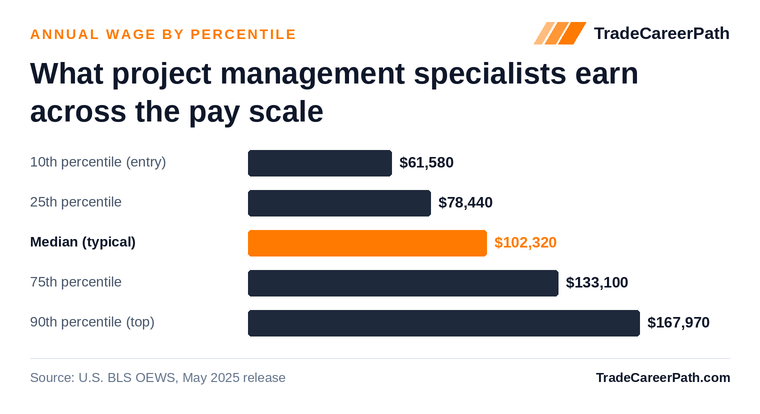
The money is the argument for making this move. The national median for project management specialists is $102,320 per year, and the spread rewards experience: the 25th percentile sits at $78,440, roughly where assistant PMs land, while the 75th percentile reaches $133,100 and the top 10% earn $167,970 or more. The 10th percentile is $61,580 (BLS OEWS, May 2025).
Where the Jobs and the Money Are
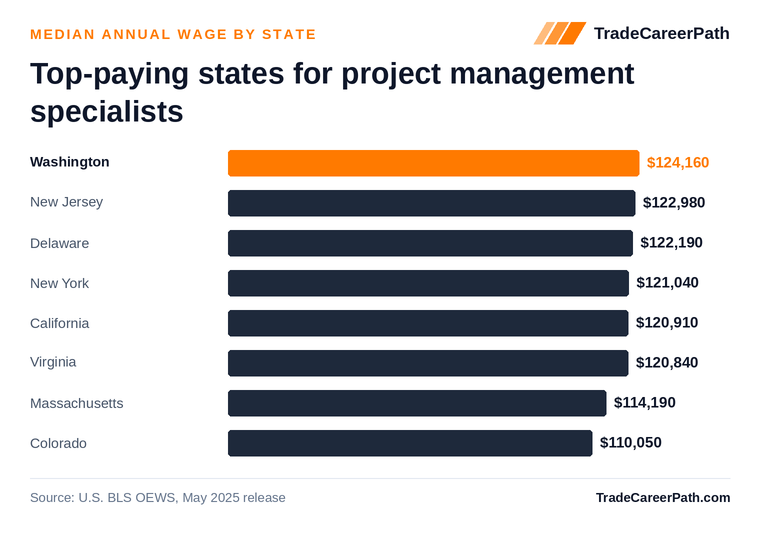
Because SOC 13-1082 covers project managers across industries, the geography follows big-project money. Washington tops the pay table at a $124,160 median, with New Jersey, Delaware, New York, and California close behind (BLS OEWS, May 2025).
| State | Median annual wage | Employment |
|---|---|---|
| Washington | $124,160 | 36,240 |
| New Jersey | $122,980 | 28,300 |
| Delaware | $122,190 | 1,770 |
| New York | $121,040 | 68,020 |
| California | $120,910 | 114,380 |
Sheer job volume tells a different story. Texas is the single biggest market at 138,960 project management specialists - and with a location quotient of 1.44, PMs are about 44% more common there than in the average state labor market, driven by energy, industrial, and datacenter construction. Washington’s concentration is even higher (1.49), pairing top-of-table pay with a deep market; California (114,380 jobs) and Florida (76,370) round out the volume leaders. High-concentration states mean more employers competing for you - room to negotiate pay, and room to change jobs without relocating.
How to Become a Construction Project Manager
1. Lead from the field
Foreman and superintendent experience is the classic PM feeder - start running crews. As a foreman you learn production rates and manpower loading; as a superintendent you learn sequencing, coordination, and how schedules actually break. When you interview for PM roles, that record is your resume - be able to talk about specific jobs, what they were worth, and what you did when they went wrong.
2. Earn the bachelor’s degree
Construction management, engineering technology, or business - and online programs are built for field schedules. Construction management is the most direct fit: estimating, scheduling, contracts, and construction law coursework maps one-to-one onto the job. Get a written transfer evaluation before you enroll anywhere - prior college, military training, and apprenticeship coursework can be worth meaningful credit, and some programs grant credit for documented field-leadership experience.
3. Learn the PM toolkit
Scheduling (P6), estimating, contracts, and cost control round out field instincts. Volunteer for office-side tasks on your current job - pricing change orders, updating the three-week look-ahead, running a sub meeting - so the transition shows up on your record before the title does.
4. Get certified
PMP or the construction-specific CCM formalizes the credential. The PMP requires documented hours leading projects - hours a foreman or super has in abundance - while the CCM is the alternative that owner’s-rep and CM-agency firms respect most. Neither is legally required; both move resumes past screening software and both are commonly reimbursed by employers.
5. Advance
Senior PM, program manager, or director of construction on major infrastructure programs. The fork comes after a few big jobs delivered well: stay project-side and run larger, more complex work, or move up to program and executive roles where you own a portfolio and a P&L. The datacenter and energy buildout has made experienced construction PMs one of the tightest hires in the industry, which is pulling this timeline forward for people with field backgrounds.
Career Ladder: Titles and Realistic Pay
The BLS wage percentiles map cleanly onto how PM careers progress. Use this as a sanity check on offers, not a guarantee:
| Stage | Typical titles | Years in | Realistic pay (BLS OEWS, May 2025) |
|---|---|---|---|
| Entry level | Project engineer, assistant PM | 0-3 | ~$61,580-$78,440 (10th-25th pct) |
| Mid-career | Project manager | 3-10 | ~$102,320 (median) |
| Senior | Senior PM, project executive | 10-15 | ~$133,100 (75th pct) |
| Principal / leadership | Program manager, director of construction | 15+ | $167,970+ (90th pct) |
Two notes for career changers. First, field experience compresses this ladder: a superintendent moving over rarely starts at the bottom of the entry band - many step in as PMs directly. Second, these are base-wage figures across all industries in SOC 13-1082; construction PMs at large general contractors typically add project bonuses, vehicle allowances, and per-diem on travel work, so total compensation on major programs often runs well above the numbers shown.
Do You Need a License?
No. There is no state license for the PM role itself - this is a certification-driven career. Two voluntary credentials carry the weight:
- PMP (Project Management Professional): the general project-management standard from PMI. Requires documented project-leadership hours plus an exam; widely used as a screening filter by large employers.
- CCM (Certified Construction Manager): the construction-specific credential from CMAA, most valued on the owner’s-rep and CM-agency side.
One distinction worth knowing: a contractor’s license is a business credential held by the firm (or its qualifying party) to contract for work in a state - it is not something the PM needs personally. A trade or contractor license from your field years is not a PM requirement, but it absolutely reads as credibility.
Why an Online Degree Works for This Career
Trades-to-PM is one of the most traveled ladders in construction: your field knowledge is what makes schedules real and subcontractors honest. An online construction management bachelor’s plus the PMP is the standard credential stack, and the current datacenter and energy buildout has made experienced-trade PMs one of the tightest hires in the industry. Employer tuition assistance is common at general contractors and CM firms - many supers finish the degree nights and weekends with most of the tuition covered, without giving up their field pay while they do it.
Job Outlook for 2026 and Beyond
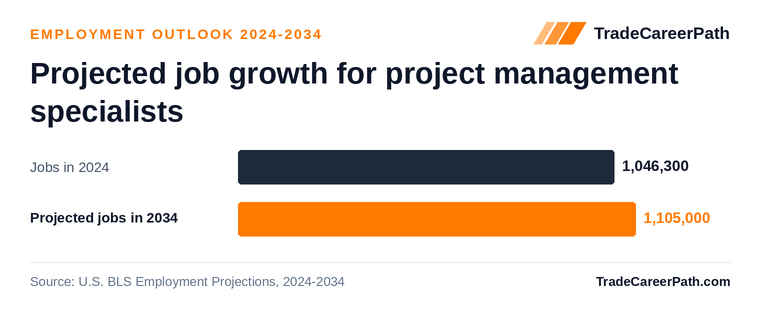
BLS projects employment of project management specialists to grow +6.7% from 2025 to 2035 - from 1,094,300 to 1,167,400 jobs - with about 76,500 openings per year once retirements and occupation changes are counted (BLS Employment Projections, 2025-35). The latest wage data (OEWS, May 2025) puts the median at $102,320, up from the 2024 figure of $100,750 - steady growth in a field where demand is running ahead of supply.
For a tradesperson weighing the move, the openings number is the one that matters: 76,500 seats a year is a continuous hiring pipeline, and on the construction side it is being pulled by structurally funded work - datacenters, grid upgrades, and infrastructure programs scheduled years out. Those are exactly the projects where owners want PMs who came up through the field, because aggressive schedules and technical scopes punish paper-only managers.
Cost and Time to Complete the Degree
For construction project managers, the credential is: Bachelor’s in construction management, engineering technology, or business. A bachelor’s degree is typically 120 credit hours: four years full-time, and commonly five to six years part-time while working. Transfer credit is the other lever: prior college, military training, apprenticeship coursework, and industry certifications can be worth meaningful credit at transfer-friendly schools, so get a written transfer evaluation before enrolling anywhere. Costs vary widely by school type; in-state public online programs are usually the value benchmark, and employer tuition assistance is common for working adults in this field. Unlike most degree-track careers, you can often start earning in the role before the degree is finished.
Pros and Cons of Training as a Construction Project Manager
Pros
- Median pay of $102,320 nationally, with the 75th percentile at $133,100 (BLS OEWS, May 2025)
- BLS projects +6.7% employment growth through 2035, with about 76,500 openings per year
- Field experience from the trades is a genuine hiring advantage
- Accredited online and hybrid degree paths exist for working adults
- No state license required - PMP/CCM certifications are attainable while working
Cons
- Requires a 4-year degree (typically 120 credit hours) for the strongest employers
- Entry-level pay starts near $61,580 at the 10th percentile
- You carry the budget and schedule risk - the stress moves from your back to your inbox
Frequently Asked Questions
Can a tradesperson work as a construction project manager?
Yes - it is the standard field-to-office ladder. BLS groups construction PMs under project management specialists (SOC 13-1082), whose median pay is shown above; construction-side PMs with trade backgrounds are in especially high demand on datacenter and energy projects.
How much do construction project managers make?
The national median annual wage for project management specialists is $102,320 (BLS OEWS, May 2025). The top 10% earn $167,970 or more, while entry-level pay starts around $61,580.
What is the job outlook for construction project managers?
BLS projects employment of project management specialists to change by +6.7% from 2025 to 2035 (BLS Employment Projections, 2025-35).
How long does construction project manager training take?
The bachelor's degree is typically 120 credit hours: four years full-time, commonly five to six years part-time while working. Tradespeople with foreman or superintendent experience often step into assistant PM roles before finishing the degree, and transfer credit for prior college, military training, or apprenticeship coursework can meaningfully shorten it.
Is being a construction project manager hard?
The coursework is manageable for anyone who has run work in the field - the harder shift is the job itself: living in schedules, contracts, and cost reports instead of tools, and being accountable for budget and schedule on someone else's money. Field experience makes the technical side easier; the paperwork discipline is what most career changers have to build.
Should I get a construction management degree or a business degree?
For a tradesperson, construction management is usually the better buy: the estimating, scheduling, and contracts coursework maps directly to the PM job, and employers recognize it. A business degree keeps more doors open outside construction but leaves you learning the PM toolkit on the job. Engineering technology is a solid middle path for the technically minded.
Can you train as a construction project manager without a degree?
Yes, more often than in most degree-track careers - superintendents are promoted into PM roles on field record alone. But the degree plus PMP is what large general contractors and owners increasingly screen for, and pay at the top of the range ($133,100 at the 75th percentile, $167,970 at the 90th) concentrates at those employers.
Do construction project managers need a license?
No state license is required for the PM role itself. The recognized credentials are voluntary certifications: the PMP from PMI and the construction-specific CCM from CMAA. Note that a contractor's license is a separate business credential held by the firm or its qualifier, not something the PM needs personally.
Construction Project Manager Salary and Requirements by State
Alabama · Alaska · Arizona · Arkansas · California · Colorado · Connecticut · Delaware · District of Columbia · Florida · Georgia · Hawaii · Idaho · Illinois · Indiana · Iowa · Kansas · Kentucky · Louisiana · Maine · Maryland · Massachusetts · Michigan · Minnesota · Mississippi · Missouri · Montana · Nebraska · Nevada · New Hampshire · New Jersey · New Mexico · New York · North Carolina · North Dakota · Ohio · Oklahoma · Oregon · Pennsylvania · Rhode Island · South Carolina · South Dakota · Tennessee · Texas · Utah · Vermont · Virginia · Washington · West Virginia · Wisconsin · Wyoming
Related Careers and Degree Paths
- Construction Manager - the sibling occupation (SOC 11-9021) that overlaps heavily with construction-side PM work
- Cost Estimator - the preconstruction side of the same office; a common lateral move
- Civil Engineer - the design-side degree path for heavy-civil and infrastructure work
- Facilities Manager - running buildings after they are built, another field-to-office ladder
- All trade careers that require a 4-year degree
Degree and Program Guides
- Online Project Management Degrees - degree plus PMP credential planning
Sources
- U.S. Bureau of Labor Statistics, Occupational Employment and Wage Statistics (OEWS), May 2025 - Project Management Specialists (SOC 13-1082)
- U.S. Bureau of Labor Statistics, Employment Projections, 2025-35
- U.S. Bureau of Labor Statistics, Occupational Outlook Handbook - education and licensing requirements
Construction Project Manager Salary by State
About this guide: Researched and written by the TradeCareerPath Editorial Team. Our editorial team researches and sources every trade school and career guide using federal labor and education data, including BLS OEWS and Employment Projections, DOL apprenticeship records, IPEDS, College Scorecard, and state licensing boards. We follow the editorial standards documented at /editorial-policy/.
Data sources
Figures on this page are sourced from the federal and state datasets below. Methodology: how we rank and source data.
| Data | Provider | Vintage |
|---|---|---|
| Occupational Employment and Wage Statistics (OEWS) | U.S. Bureau of Labor Statistics | May 2025 |
| Employment Projections | U.S. Bureau of Labor Statistics | 2025-2035 |
| Integrated Postsecondary Education Data System | National Center for Education Statistics (IPEDS) | 2024 |
| College Scorecard (school-level outcomes) | U.S. Department of Education | latest release |
| College Scorecard (field-of-study earnings) | U.S. Department of Education | latest release (updated 2026-06-12) |
| Occupational licensing requirements | CareerOneStop (U.S. Department of Labor) | latest release (updated 2026-02-22) |
| Registered apprenticeship programs | CareerOneStop / Apprenticeship.gov (U.S. Department of Labor) | latest release (updated 2025-10-25) |
| O*NET occupation profiles (skills, tasks, tools, job zones) | U.S. Department of Labor (O*NET / Employment & Training Admin.) | O*NET 31.0 (updated 2026-10-14) |