
How to Become a Construction Worker in 2026
Is Construction Worker Right for You?
The U.S. Department of Labor's O*NET profile for Construction Laborers (SOC 47-2061) describes the work this way: Perform tasks involving physical labor at construction sites. May operate hand and power tools of all types: air hammers, earth tampers, cement mixers, small mechanical hoists, surveying and measuring equipment, and a variety of other equipment and instruments. May clean and prepare sites, dig trenches, set braces to support the sides of excavations, erect scaffolding, and clean up rubble, debris, and other waste materials. May assist other craft workers.
What the work involves
- Tend pumps, compressors, or generators to provide power for tools, machinery, or equipment or to heat or move materials, such as asphalt.
- Lubricate, clean, or repair machinery, equipment, or tools.
- Signal equipment operators to facilitate alignment, movement, or adjustment of machinery, equipment, or materials.
- Read plans, instructions, or specifications to determine work activities.
- Measure, mark, or record openings or distances to layout areas where construction work will be performed.
Skills and knowledge that matter
Skills: Speaking, Operation and Control, Coordination, Active Listening, Operations Monitoring, Reading Comprehension.
Knowledge: Building and Construction, Public Safety and Security, Mechanical, Customer and Personal Service.
Tools and technology you may use
Tools: Adjustable widemouth pliers, Adjustable wrenches, Air compressors, Air drills, Air monitoring equipment, Asphalt kettles.
Technology: Computer aided design CAD software, Spreadsheet software, Office suite software, Autodesk Revit, Microsoft Excel, Microsoft Office software.
Typical preparation
O*NET Job Zone Two (Some Preparation Needed). These occupations usually require a high school diploma. Employees in these occupations need anywhere from a few months to one year of working with experienced employees. A recognized apprenticeship program may be associated with these occupations.
Interest fit
O*NET interest profile: Realistic, Conventional, Investigative. People who enjoy hands-on, practical work with tools, machines, plants, or materials often find this occupation a good fit.
Source: O*NET 29.1 (updated 2026-06-13)
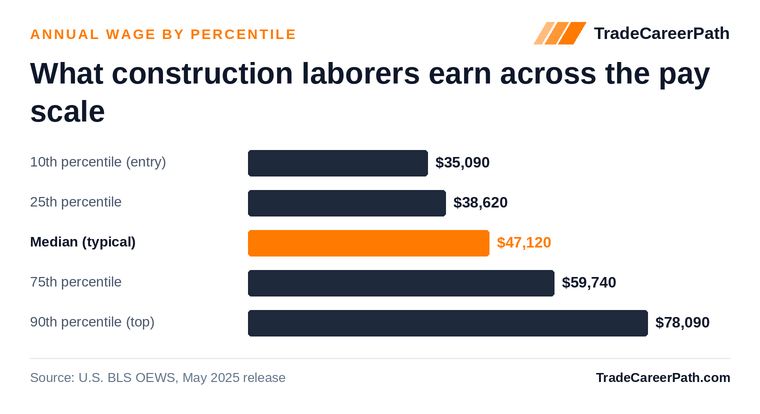
Quick answer: You can start working as a construction laborer within weeks once you have a high school diploma or GED and basic safety training. Many workers build the career through a registered apprenticeship with a union such as LIUNA, which pays you while you learn over a few years, or through a trade-school or community college program. Costs vary by program and school, and most apprenticeships pay you while you train. Entry-level jobs usually do not require a license, though job sites expect OSHA safety training. The median construction laborer wage is $47,120 per year ($22.66/hour), and employers post about 129,400 openings nationwide each year (BLS, May 2025).
Construction laborers build and support the structures around us, from homes and schools to roads, bridges, and commercial buildings. The work is hands-on, pays a solid wage, and does not require a four-year degree. This guide explains how to get started, what training covers, and how licensing and certifications can apply by state.
How to Become a Construction Worker
Most people get into construction faster than into many other careers. There is no single licensing exam to pass at the entry level. Instead, you build the career through basic education, hands-on training, safety certification, and real job-site experience.
1. Meet the basic requirements
Start with a high school diploma or GED, which most apprenticeships and employers require. Useful high school or adult-education coursework includes math, especially measurements and fractions you will use for layout and material estimates, plus shop, welding, or any class that puts tools in your hands. Many roles require a valid driver’s license, and some sites ask for a clean drug screen and the physical ability to lift, bend, and stand for long shifts. If you are a career changer, you usually do not need to repeat school. Skills from past jobs, such as reliability, teamwork, and following directions, carry over well to a job site. Showing up on time and being willing to learn matters as much as anything on a resume when you are starting out.
2. Get into an apprenticeship or trade program
This is where you build real skills, and you have a few solid paths. A registered apprenticeship, such as those sponsored by the Laborers’ International Union of North America (LIUNA), pays you while you learn over several years and combines paid on-the-job hours with classroom instruction in concrete, demolition, scaffolding, and site preparation. Trade-school programs offer shorter, focused training and often help with job placement. Community college programs can lead to certificates or associate degrees in construction technology or construction management, which help if you want to move into supervision later. Apprenticeships are popular because you earn a paycheck and graduate with little or no tuition debt. When comparing options, ask about the trades covered, how hands-on hours work, and what credentials you finish with.
3. Complete safety and skills certifications
Safety training is expected on nearly every job site. The standard credentials are the OSHA 10 and OSHA 30 Construction outreach cards, which cover hazard recognition, fall protection, and your rights and responsibilities on site. Many general contractors will not let you start without one. Beyond OSHA, NCCER offers construction-trades curricula and credentials that document skills in areas like core construction, carpentry, and concrete, and these portable credentials can help you move between employers and states. Depending on the work, you may also pick up certifications for equipment operation, scaffolding, flagging, or first aid and CPR. Each certificate you add makes you more useful on a crew and easier to hire.
4. Gain on-the-job experience
Training gets you ready, but employers want to see you can do the work. Apprenticeships build this in by placing you on real job sites alongside journey-level workers, where you learn how to read site plans, set forms, mix and pour concrete, and operate tools and machinery safely. If you start outside an apprenticeship, an entry-level laborer or helper position gets you onto a crew where you can learn the workflow and earn references. Treat the early months as paid learning: ask questions, watch experienced workers, and master the basics of site safety. Reliability and a strong work ethic get noticed fast, and they are what lead to more responsibility and higher pay.
5. Advance to a specialty, supervisor, or contractor role
Construction offers clear ways to grow. With experience you can specialize in a trade such as carpentry, masonry, concrete finishing, or heavy-equipment operation, each of which can raise your earning potential. Strong, dependable workers often move up to lead positions like foreman or site supervisor, managing crews and schedules. If you want to run your own jobs, many states require a contractor license to bid and operate independently, with requirements that vary by state and specialty. Check your state licensing board before bidding on projects. Continuing education, added NCCER credentials, and a track record of safe, quality work all support these moves.
What Do Construction Workers Do?
The term construction worker covers a wide range of roles, from general laborers to specialized tradespeople and licensed contractors. Laborers handle the physical groundwork that keeps a project moving and support the skilled trades on site.
Common duties include:
- Building residential and commercial structures
- Reading blueprints and site plans
- Operating machinery and power tools
- Pouring concrete, framing walls, or setting up scaffolding
- Loading, unloading, and moving materials
- Maintaining safety standards on job sites
As you gain experience, you can specialize in areas like carpentry, masonry, concrete finishing, roofing, or general contracting.
Skills That Make Great Construction Professionals
- Physical strength, stamina, and coordination
- Blueprint reading and basic math
- Teamwork and clear communication
- Attention to safety and detail
- Time and task management
- Reliability and a strong work ethic
If you like building things with your hands and seeing tangible results, construction can be a strong fit.
Construction Training Options
Whether you are starting out or upskilling, training options include:
- Union apprenticeships with organizations such as LIUNA. Earn while you learn with structured on-the-job hours and benefits.
- Trade-school programs. Short-term, hands-on training, often with career support.
- Community college programs. Certificates or associate degrees in construction technology or construction management.
Licensing and Certifications
Depending on your role and state, you may need:
- OSHA 10 or OSHA 30 Construction safety cards for job-site access
- NCCER credentials that document trade skills
- General contractor license (varies by state)
- Specialty contractor license (plumbing, electrical, HVAC, and others)
Tip: Always check with your state licensing board before starting independent work or bidding on projects.
Career Growth and Advancement
With experience, construction workers can move into roles such as:
- Skilled tradesperson in carpentry, masonry, or concrete finishing
- Equipment operator running heavy machinery
- Foreman or site supervisor who manages crews and schedules
- General or specialty contractor running independent jobs
Cost and Duration of Training
- Program cost: varies by program and school. Registered apprenticeships pay you while you learn and often carry little or no tuition.
- Time to start: many laborers begin within weeks; registered apprenticeships run a few years.
- Certifications: OSHA 10 or OSHA 30 Construction cards and optional NCCER credentials.
Compare programs directly, since tuition and length differ by state and format.
Pros and Cons of Construction Work
Pros
- Steady demand and projected job growth
- No college degree required
- Apprenticeships let you earn while you learn
- Clear paths to specialty, supervisor, or contractor roles
Cons
- Physically demanding work
- Outdoor and seasonal conditions
- Risk of injury if safety is ignored
Quick Facts: Construction Worker Salary, Education, and Outlook

Industry Organizations & Certifying Bodies
These are the recognized national organizations, unions, certifying bodies, and regulatory authorities that shape this trade. They issue the credentials, sponsor the apprenticeships, publish the codes, and represent workers and employers.
- Laborers' International Union of North America (LIUNA) Primary construction laborer union; sponsors registered apprenticeships.
- OSHA 10 / OSHA 30 Construction Safety Standard job-site safety training cards.
- NCCER Construction trades curricula and credentials.
Wage and Employment Charts
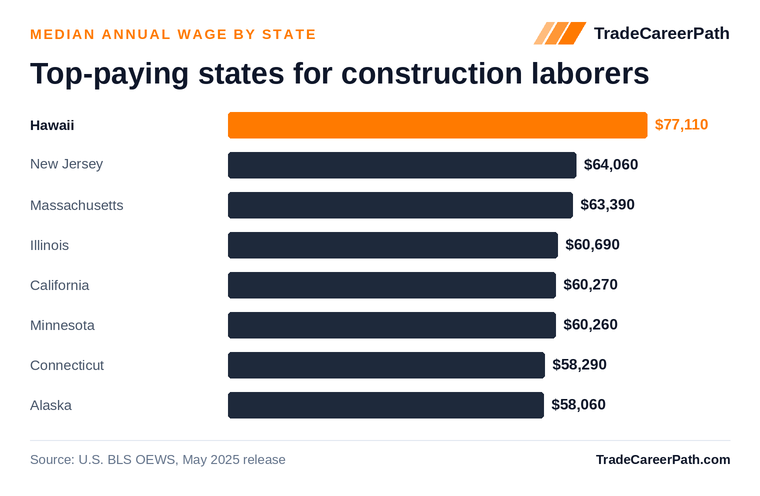
Construction Trades Worker Salary and Requirements by State
Select your state for local wage data, training options, and requirements:
Alabama · Alaska · Arizona · Arkansas · California · Colorado · Connecticut · Delaware · District of Columbia · Florida · Georgia · Hawaii · Idaho · Illinois · Indiana · Iowa · Kansas · Kentucky · Louisiana · Maine · Maryland · Massachusetts · Michigan · Minnesota · Mississippi · Missouri · Montana · Nebraska · Nevada · New Hampshire · New Jersey · New Mexico · New York · North Carolina · North Dakota · Ohio · Oklahoma · Oregon · Pennsylvania · Rhode Island · South Carolina · South Dakota · Tennessee · Texas · Utah · Vermont · Virginia · Washington · West Virginia · Wisconsin · Wyoming
Workplace Safety Snapshot
BLS Survey of Occupational Injuries and Illnesses data (2023-2024) report approximately 316.9 days-away, restricted, or transfer cases per 10,000 full-time-equivalent workers in construction laborers (about 3.17 per 100 FTE). Source: BLS Survey of Occupational Injuries and Illnesses, Table R98.
Frequently Asked Questions
How long does construction worker training take?
Many people start working as a construction laborer within weeks once they have a high school diploma or GED and basic safety training. A registered apprenticeship through a union such as LIUNA usually runs a few years, combining paid on-the-job hours with classroom instruction, and leads to higher pay and specialized skills.
Do you need a college degree to work as a construction worker?
No. A college degree is not required to work in construction. Most people enter through an apprenticeship, a trade-school or community college program, or direct on-the-job training. A high school diploma or GED is typically the only educational prerequisite.
How much does construction training cost?
Costs vary widely by program and school. Registered apprenticeships, such as those sponsored by LIUNA, pay you while you learn and often carry little or no tuition. Trade-school and community college programs charge tuition that differs by state, length, and format, so compare programs directly before enrolling.
Do you need a license or certification to work in construction?
Entry-level construction laborer jobs usually do not require a license. Most job sites do expect safety training such as an OSHA 10 or OSHA 30 Construction card, and NCCER credentials can help you stand out. Specialty and contractor roles may require a state-issued license, so check your state's requirements.
Is construction work hard?
The work is physically demanding and often takes place outdoors in heat, cold, or seasonal conditions. It rewards stamina, attention to safety, and reliability. Many workers value the hands-on nature of the job and the chance to see finished structures they helped build.
Is construction a growing career?
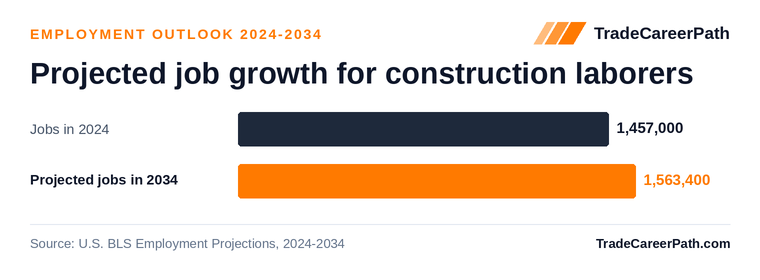
Yes. BLS projects 7.3% employment growth for construction laborers between 2024 and 2034. Employers are expected to post about 129,400 openings nationwide each year over that period as workers retire or move into other roles.
How many construction laborers work in the United States?
BLS reports approximately 1,096,780 construction laborers employed nationwide as of May 2025, with a median wage of $47,120 per year ($22.66 per hour).
How Construction Worker Pay Compares to Similar Trades
Side-by-side comparison of Construction Worker and the closest related careers, based on U.S. Bureau of Labor Statistics data (May 2025 OEWS + 2024-2034 Employment Projections).
| Career | Median Pay | 10-Year Growth | Annual Openings |
|---|---|---|---|
| Construction Worker this guide | $47,120 | +7.3% | 129,400 |
| Carpentry | $60,580 | +4.5% | 74,100 |
| Plumbing | $63,800 | +4.5% | 44,000 |
| Electrician | $63,190 | +9.5% | 81,000 |
| Welding | $53,750 | +2.2% | 45,600 |
Source: BLS Occupational Employment and Wage Statistics + BLS Employment Projections.
Advance Your Career with a Degree
Experienced Construction Worker professionals often step up into degree-track careers where field experience is a hiring advantage:
- Civil Engineer - median pay $100,840 (BLS OEWS, May 2025); requires a 4-year degree
- Land Surveyor - median pay $75,440 (BLS OEWS, May 2025); requires a 4-year degree
- Architect - median pay $99,280 (BLS OEWS, May 2025); requires a 4-year degree
- Health and Safety Engineer - median pay $115,160 (BLS OEWS, May 2025); requires a 4-year degree
- Welding Engineer - median pay $112,860 (BLS OEWS, May 2025); requires a 4-year degree
- Landscape Architect - median pay $79,870 (BLS OEWS, May 2025); requires a 4-year degree
- Cartographer & GIS Specialist - median pay $81,390 (BLS OEWS, May 2025); requires a 4-year degree
- Mining Engineer - median pay $106,220 (BLS OEWS, May 2025); requires a 4-year degree
- Construction Project Manager - median pay $102,320 (BLS OEWS, May 2025); requires a 4-year degree
See all trade careers that require a 4-year degree.
Sources
- U.S. Bureau of Labor Statistics, Occupational Employment and Wage Statistics (May 2025)
- U.S. Bureau of Labor Statistics, Employment Projections 2024-2034
- U.S. Bureau of Labor Statistics, Survey of Occupational Injuries and Illnesses (2023-2024, Table R98)
- U.S. Department of Labor, Wage and Hour Division, Davis-Bacon General Wage Determinations (2026)
Outcome figures such as graduation, completion, and job placement rates are reported by schools and by federal data sources, reflect prior student cohorts, and are not a prediction or promise of future results. Individual outcomes may vary.
Construction Worker Salary by State
About this guide: Researched and written by the TradeCareerPath Editorial Team. Our editorial team researches and sources every trade school and career guide using federal labor and education data, including BLS OEWS and Employment Projections, DOL apprenticeship records, IPEDS, College Scorecard, and state licensing boards. We follow the editorial standards documented at /editorial-policy/.
Data sources
Figures on this page are sourced from the federal and state datasets below. Methodology: how we rank and source data.
| Data | Provider | Vintage |
|---|---|---|
| Occupational Employment and Wage Statistics (OEWS) | U.S. Bureau of Labor Statistics | May 2025 |
| Employment Projections | U.S. Bureau of Labor Statistics | 2024-2034 |
| Integrated Postsecondary Education Data System | National Center for Education Statistics (IPEDS) | 2024 |
| College Scorecard (school-level outcomes) | U.S. Department of Education | latest release |
| College Scorecard (field-of-study earnings) | U.S. Department of Education | latest release (updated 2026-06-12) |
| Occupational licensing requirements | CareerOneStop (U.S. Department of Labor) | latest release (updated 2026-02-22) |
| Registered apprenticeship programs | CareerOneStop / Apprenticeship.gov (U.S. Department of Labor) | latest release (updated 2025-10-25) |
| O*NET occupation profiles (skills, tasks, tools, job zones) | U.S. Department of Labor (O*NET / Employment & Training Admin.) | O*NET 29.1 (updated 2026-06-13) |