
How to Become a Controls Technician: Training Steps
Is Controls Technician Right for You?
The U.S. Department of Labor's O*NET profile for Electrical and Electronic Engineering Technologists and Technicians (SOC 17-3023) describes the work this way: Apply electrical and electronic theory and related knowledge, usually under the direction of engineering staff, to design, build, repair, adjust, and modify electrical components, circuitry, controls, and machinery for subsequent evaluation and use by engineering staff in making engineering design decisions.
What the work involves
- Modify, maintain, or repair electronics equipment or systems to ensure proper functioning.
- Replace defective components or parts, using hand tools and precision instruments.
- Set up and operate specialized or standard test equipment to diagnose, test, or analyze the performance of electronic components, assemblies, or systems.
- Read blueprints, wiring diagrams, schematic drawings, or engineering instructions for assembling electronics units, applying knowledge of electronic theory and components.
- Identify and resolve equipment malfunctions, working with manufacturers or field representatives as necessary to procure replacement parts.
Skills and knowledge that matter
Skills: Reading Comprehension, Critical Thinking, Active Listening, Troubleshooting, Repairing, Complex Problem Solving.
Knowledge: Computers and Electronics, Engineering and Technology, English Language, Design.
Tools and technology you may use
Tools: Adjustable widemouth pliers, Adjustable wrenches, Alternating current AC generators, Ammeters, Analog current meters, Analog multimeters.
Technology: Document management software, Development environment software, Computer aided design CAD software, Adobe Acrobat, Autodesk AutoCAD, Autodesk Revit.
Typical preparation
O*NET Job Zone Three (Medium Preparation Needed). Most occupations in this zone require training in vocational schools, related on-the-job experience, or an associate's degree. Employees in these occupations usually need one or two years of training involving both on-the-job experience and informal training with experienced workers. A recognized apprenticeship program may be associated with these occupations.
Interest fit
O*NET interest profile: Realistic, Investigative, Conventional. People who enjoy hands-on, practical work with tools, machines, plants, or materials often find this occupation a good fit.
Source: O*NET 29.1 (updated 2026-06-13)
From assembly lines to climate systems, modern industry runs on automation.
Controls technicians are the professionals who keep those automated systems working safely and efficiently.
Controls technicians install, calibrate, and maintain electrical and electronic control systems used in factories, utilities, and commercial buildings.
They work with sensors, programmable logic controllers (PLCs), and instrumentation that keeps processes running smoothly.
If you enjoy solving problems and working with both electrical and computer systems, controls technician work combines hands-on electrical tasks with PLC-based diagnostics.
Quick answers
What does a controls technician do?
Controls technicians install, calibrate, and maintain electrical and electronic control systems used in factories, utilities, and commercial buildings. They troubleshoot PLCs, sensors, and instrumentation to keep processes running smoothly.
Where do controls technicians work?
Common work settings include manufacturing and automation facilities, utilities like power plants and water treatment systems, and commercial HVAC and building automation. Some roles are with engineering firms or equipment service contractors.
What systems and tools do they work with?
This role commonly involves sensors, programmable logic controllers (PLCs), instrumentation, and control panels. Day-to-day work includes reading wiring diagrams and PLC logic diagrams and calibrating sensors and actuators.
What training is typical?
Many start with a certificate program or associate degree in industrial automation, mechatronics, or electrical technology. Hands-on learning often continues through supervised entry-level work, moderate on-the-job training, or an apprenticeship.
Are certifications required?
Certifications are optional, but credentials from ISA, Siemens, or Rockwell Automation can demonstrate specialized skills in PLCs or process control systems.
How long does it take and what does it cost?
Training as proficient typically takes 1-3 years of training and experience. Program costs are listed as varies by school, format and location and certification fees are typically under $500.
At a glance
- Time to work as proficient: 1-3 years
- Common training paths: certificate, associate degree, apprenticeship
- Typical program cost: varies by school, format and location
- Systems you work on: sensors, PLCs, instrumentation, control panels
- Work settings: manufacturing, utilities, commercial building automation
Quick Facts: Controls Technician Training and Outlook
What Controls Technicians Do
Controls technicians manage and maintain automated equipment that regulates industrial machinery, HVAC systems, or energy systems.
They interpret wiring diagrams, troubleshoot PLCs, and ensure sensors and control loops function properly.
Typical Responsibilities
- Install and configure control panels and instrumentation
- Read electrical schematics and PLC logic diagrams
- Calibrate sensors and actuators
- Troubleshoot electrical and software faults
- Maintain system documentation and safety standards
Controls technicians blend electrical expertise with computer-based diagnostics to keep automation running reliably.
Key Skills and Traits for Success
- Electrical and electronic troubleshooting
- Familiarity with PLCs and industrial control systems
- Understanding of sensors, actuators, and process control loops
- Attention to detail and analytical thinking
- Ability to work independently and safely around high-voltage equipment
Work Settings for Controls Technicians
Controls technicians work in:
- Manufacturing and automation facilities
- Utilities, power plants, and water treatment systems
- Commercial HVAC and building automation
- Engineering firms and equipment service contractors
How to Become a Controls Technician (5 Steps)
It usually takes 1-3 years of training and experience to work as proficient as a controls technician.
1. Earn a High School Diploma or GED
Focus on math, electronics, and computer classes to prepare for technical training.
2. Complete a Technical or Associate Program
Trade schools and community colleges offer programs in industrial automation, mechatronics, or electrical technology.
3. Gain Hands-On Experience
Entry-level technicians often work under supervision while learning to wire panels, test systems, and perform calibration tasks.
4. Obtain Industry Certifications
Credentials from ISA, Siemens, or Rockwell Automation demonstrate specialized skills in PLCs or process control systems.
5. Continue Learning and Advance
With experience, technicians can move into engineering support, automation design, or control system integration roles.
Education and Training Paths
| Pathway | Typical Duration | Outcome |
|---|---|---|
| Certificate Program | 6-12 months | Foundational control and automation skills |
| Associate Degree | 2 years | In-depth electronics and control systems education |
| Apprenticeship | 2-3 years | Paid, structured training under industry professionals |
| Certification | Variable | Validation of PLC or automation expertise |
Career Growth and Advancement
Controls technicians can progress into:
- Automation Specialist - designs and programs industrial control systems
- Maintenance Supervisor - oversees technicians and preventive systems
- Control Systems Integrator - configures PLCs and networked systems for automation
- Field Service Engineer - installs and supports advanced industrial control systems
Cost and Duration of Training
- Program Cost: varies by school, format and location depending on training and equipment
- Duration: 1-3 years
- Certification Fees: typically under $500
Controls technicians work at the crossroads of electricity and automation. This trade offers long-term career potential in every sector that relies on automated systems.
Pros and Cons
✅ Pros
- Strong demand across industries adopting automation
- Technically challenging and engaging work
- Opportunities for specialization and advancement
- Transferable skills across manufacturing and utilities
⚠️ Cons
- Requires ongoing learning due to evolving technology
- Work may involve high-voltage systems or tight spaces
- Occasional overtime for system shutdowns or upgrades
Industry Organizations & Certifying Bodies
These are the recognized national organizations, unions, certifying bodies, and regulatory authorities that shape this trade. They issue the credentials, sponsor the apprenticeships, publish the codes, and represent workers and employers.
- International Society of Automation (ISA) Issues the Certified Control Systems Technician (CCST) credential.
- Association for Advancing Automation (A3) Industrial automation industry association.
Wage and Employment Charts
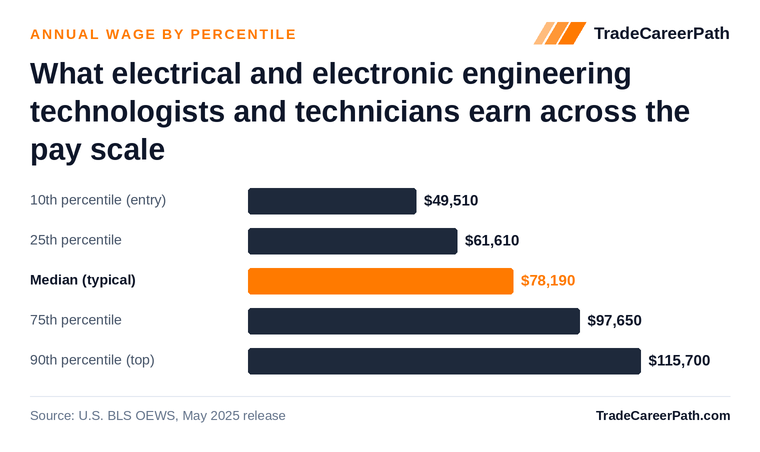
| Percentile | Annual wage |
|---|---|
| 10th | $49,510 |
| 25th | $61,610 |
| 50th (median) | $78,190 |
| 75th | $97,650 |
| 90th | $115,700 |
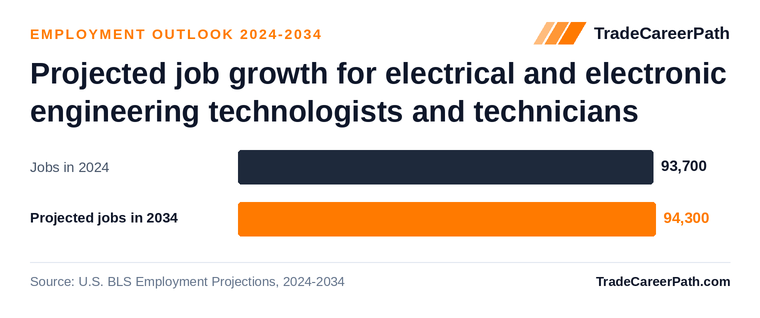
| Year | Employment |
|---|---|
| 2024 | 93,700 |
| 2034 projected | 94,300 |
| Percent change | +0.6% |
Controls Technician Salary and Requirements by State
Select your state for local wage data, training options, and requirements:
Alabama · Alaska · Arizona · Arkansas · California · Colorado · Connecticut · Delaware · District of Columbia · Florida · Georgia · Hawaii · Idaho · Illinois · Indiana · Iowa · Kansas · Kentucky · Louisiana · Maine · Maryland · Massachusetts · Michigan · Minnesota · Mississippi · Missouri · Montana · Nebraska · Nevada · New Hampshire · New Jersey · New Mexico · New York · North Carolina · North Dakota · Ohio · Oklahoma · Oregon · Pennsylvania · Rhode Island · South Carolina · South Dakota · Tennessee · Texas · Utah · Vermont · Virginia · Washington · West Virginia · Wisconsin · Wyoming
Workplace Safety Snapshot
BLS Survey of Occupational Injuries and Illnesses data (2023-2024) report approximately 84.5 days-away, restricted, or transfer cases per 10,000 full-time-equivalent workers in electrical and electronic engineering technologists and technicians (about 0.84 per 100 FTE). Source: BLS Survey of Occupational Injuries and Illnesses, Table R98.
Frequently Asked Questions
How long does controls technician training take?
It typically takes typically 6 months to 2 years of training. The most common entry path is through a certificate or associate degree program. A high school diploma or GED is generally required to get started.
How much do controls technicians make?
The median annual salary for controls technicians is $78,190 according to the Bureau of Labor Statistics (May 2025). Entry-level workers earn around $49,510, while those in the 90th percentile earn over $115,700. Pay varies by state, experience, and specialization.
What is the job outlook for controls technicians?
The Bureau of Labor Statistics projects -0.8% employment growth for this occupation from 2024 to 2034, which is roughly on pace with the overall economy. Approximately 4,700 job openings are expected each year due to growth, retirements, and workers leaving the field.
Do you need a college degree to work as a controls technician?
No. A college degree is not required to work as a controls technician. Most people enter the field through a certificate or associate degree program. A high school diploma or GED is typically the only educational prerequisite.
Which states pay controls technicians the most?
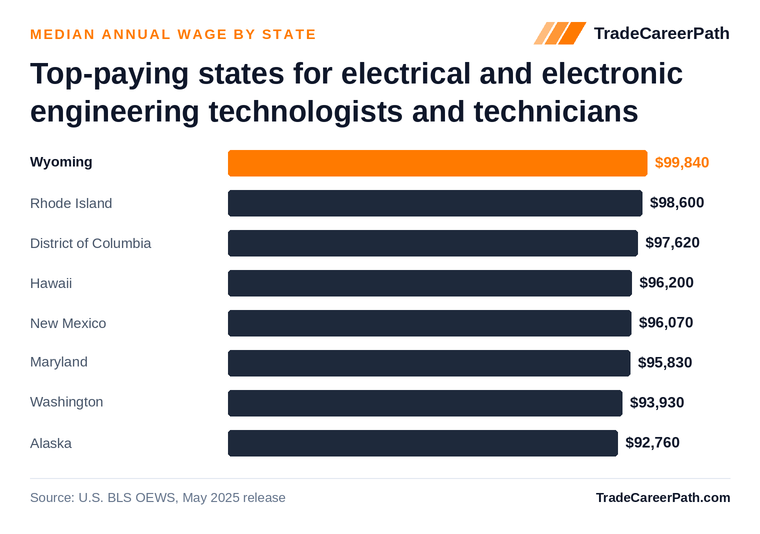
According to the U.S. Bureau of Labor Statistics (May 2025 OEWS), the highest-paying states for controls technicians are Wyoming, Rhode Island, and District of Columbia. Median annual wages: Wyoming ($99,840); Rhode Island ($98,600); District of Columbia ($97,620).
Which states employ the most controls technicians?
BLS reports the largest concentrations of controls technicians in California, Texas, and Florida. Employment levels: California (13,450 workers); Texas (8,960 workers); Florida (4,710 workers) (May 2025).
How much do experienced controls technicians earn?
The top 10% of controls technicians earn more than $115,700 per year, according to BLS Occupational Employment and Wage Statistics (May 2025). Experienced workers in this band typically hold senior credentials, supervisory roles, or specialty certifications.
What is entry-level pay for controls technicians?
BLS reports the bottom 10% of controls technicians earn under $49,510 per year. New workers often start near this level and see pay rise as they accumulate experience and credentials.
How many controls technicians work in the United States?
BLS reports approximately 95,130 controls technicians employed nationwide as of May 2025.
How many job openings are expected for controls technicians each year?
BLS projects approximately 8,400 openings per year for controls technicians from 2024 through 2034, including new positions, retirements, and workers transitioning out. The occupation is projected to grow 0.6% from 2024 to 2034, classified as about as fast as average growth.
How much do controls technicians make per hour?
The median hourly wage for controls technicians is $37.59, according to BLS (May 2025). Hourly pay ranges from about $23.80 (bottom 10%) to $55.62 (top 10%).
How Controls Technician Pay Compares to Similar Trades
Side-by-side comparison of Controls Technician and the closest related careers, based on U.S. Bureau of Labor Statistics data (May 2025 OEWS + 2024-2034 Employment Projections).
| Career | Median Pay | 10-Year Growth | Annual Openings |
|---|---|---|---|
| Controls Technician this guide | $78,190 | +0.6% | 8,400 |
| Electrician | $63,190 | +9.5% | 81,000 |
| HVAC Technician | $61,010 | +8.1% | 40,100 |
| Robotics Technician | $78,190 | +0.6% | 8,400 |
| Maintenance Technician | $49,590 | +3.8% | 159,800 |
Source: BLS Occupational Employment and Wage Statistics + BLS Employment Projections.
Sources
- U.S. Bureau of Labor Statistics, Occupational Employment and Wage Statistics (May 2025)
- U.S. Bureau of Labor Statistics, Employment Projections 2024-2034
- U.S. Bureau of Labor Statistics, Survey of Occupational Injuries and Illnesses (2023-2024, Table R98)
- U.S. Department of Labor, Wage and Hour Division, Davis-Bacon General Wage Determinations (2026)
Controls Technician Salary by State
About this guide: Researched and written by the TradeCareerPath Editorial Team. Our editorial team researches and sources every trade school and career guide using federal labor and education data, including BLS OEWS and Employment Projections, DOL apprenticeship records, IPEDS, College Scorecard, and state licensing boards. We follow the editorial standards documented at /editorial-policy/.
Data sources
Figures on this page are sourced from the federal and state datasets below. Methodology: how we rank and source data.
| Data | Provider | Vintage |
|---|---|---|
| Occupational Employment and Wage Statistics (OEWS) | U.S. Bureau of Labor Statistics | May 2025 |
| Employment Projections | U.S. Bureau of Labor Statistics | 2024-2034 |
| Integrated Postsecondary Education Data System | National Center for Education Statistics (IPEDS) | 2024 |
| College Scorecard (school-level outcomes) | U.S. Department of Education | latest release |
| College Scorecard (field-of-study earnings) | U.S. Department of Education | latest release (updated 2026-06-12) |
| Occupational licensing requirements | CareerOneStop (U.S. Department of Labor) | latest release (updated 2026-02-22) |
| Registered apprenticeship programs | CareerOneStop / Apprenticeship.gov (U.S. Department of Labor) | latest release (updated 2025-10-25) |
| O*NET occupation profiles (skills, tasks, tools, job zones) | U.S. Department of Labor (O*NET / Employment & Training Admin.) | O*NET 29.1 (updated 2026-06-13) |