
How to Become a Cosmetologist: 5 Steps
Is Cosmetologist Right for You?
The U.S. Department of Labor's O*NET profile for Hairdressers, Hairstylists, and Cosmetologists (SOC 39-5012) describes the work this way: Provide beauty services, such as cutting, coloring, and styling hair, and massaging and treating scalp. May shampoo hair, apply makeup, dress wigs, remove hair, and provide nail and skincare services.
What the work involves
- Keep work stations clean and sanitize tools, such as scissors and combs.
- Schedule client appointments.
- Bleach, dye, or tint hair, using applicator or brush.
- Cut, trim and shape hair or hairpieces, based on customers' instructions, hair type, and facial features, using clippers, scissors, trimmers and razors.
- Shampoo, rinse, condition, and dry hair and scalp or hairpieces with water, liquid soap, or other solutions.
Skills and knowledge that matter
Skills: Active Listening, Speaking, Service Orientation, Critical Thinking, Active Learning, Judgment and Decision Making.
Knowledge: Customer and Personal Service, Sales and Marketing, English Language, Administration and Management.
Tools and technology you may use
Technology: Operating system software, Calendar and scheduling software, Data base user interface and query software, Apple iOS, Facebook, Intuit QuickBooks.
Typical preparation
O*NET Job Zone Three (Medium Preparation Needed). Most occupations in this zone require training in vocational schools, related on-the-job experience, or an associate's degree. Employees in these occupations usually need one or two years of training involving both on-the-job experience and informal training with experienced workers. A recognized apprenticeship program may be associated with these occupations.
Interest fit
O*NET interest profile: Realistic, Conventional, Social. People who enjoy hands-on, practical work with tools, machines, plants, or materials often find this occupation a good fit.
Source: O*NET 31.0 (updated 2026-10-14)
Love hair, makeup, and helping people look their best?
Cosmetology might be your perfect career, where creativity meets confidence.
Cosmetologists are beauty professionals trained in hair styling, skincare, nail care, and makeup artistry. They work in salons, spas, and even on film sets, turning everyday clients into works of art.
With the right training and license, you can build a flexible, creative career in the beauty industry.
This page covers what cosmetologists do, where they work, and the steps to work as licensed.
Quick answers
- What does a cosmetologist do? Cosmetologists are trained in hair styling, skincare, nail care, and makeup artistry. They work in salons, spas, and even on film sets.
- What do cosmetology programs cover? Programs cover haircutting, coloring, and styling; skincare and facial treatments; nail care and design; and sanitation and client safety.
- What are the steps to work as a cosmetologist? Earn a high school diploma or GED, complete a state-approved cosmetology program, gain practical experience, pass the state licensing exam, and start your career.
- How many training hours do most states require? Most states require 1,000-1,600 training hours, depending on regulations.
- Do you need a license to work as a cosmetologist? Each state has its own cosmetology board and licensing process. Most require completing a state-approved program, passing written and practical exams, and paying a licensing fee.
- Where can cosmetologists work? Cosmetologists can work in salons and spas, film and television production, fashion and bridal industries, cruise ships and luxury resorts, or as self-employed entrepreneurs.
At a glance
- Services: hair, skincare, nails, makeup
- Typical path: state-approved program, supervised practice, state board exam
- Training hours: most states require 1,000-1,600 hours
- Work settings: salons/spas, film/TV, fashion/bridal, resorts, self-employed
What Cosmetologists Actually Do
A cosmetologist is more than just a stylist - they’re an artist, a consultant, and a trusted professional.
Typical Responsibilities
- Cutting, coloring, and styling hair
- Applying makeup and skincare treatments
- Performing manicures, pedicures, and nail art
- Advising clients on beauty products and maintenance
- Staying current with trends, techniques, and safety standards
Every client is a new canvas, and your skills bring their confidence to life.
How to Become a Cosmetologist (5 Steps)
Cosmetology training focuses on both hands-on practice and state licensing, so you can start working as soon as you’re certified.
Earn a High School Diploma or GED
Most beauty schools require a high school diploma or equivalent.Complete a State-Approved Cosmetology Program
Enroll in an accredited cosmetology or beauty school. Programs cover:- Haircutting, coloring, and styling
- Skincare and facial treatments
- Nail care and design
- Sanitation and client safety
Most states require 1,000-1,600 training hours, depending on regulations.
Gain Practical Experience
Beauty school students often work with real clients under supervision, developing real-world skills.Pass the State Licensing Exam
After completing training hours, you’ll need to pass your state board exam, which includes written and practical components.Start Your Cosmetology Career
Work in salons, spas, resorts, or even open your own business.
You can also specialize in niches like makeup artistry, skincare, or hair color correction.
Licensing & Certification
Each state has its own cosmetology board and licensing process. Most require:
- Completion of a state-approved cosmetology program
- Passing written and practical exams
- Paying a licensing fee
Continuing education is often required to renew your license and stay current with evolving beauty standards.
Skills That Make You Great at This
- Creativity and artistic sense
- Strong communication and customer service
- Manual dexterity and attention to detail
- Knowledge of trends and techniques
- Time management and business skills
Great cosmetologists combine artistry with professionalism, and make every client feel their best.
Where You’ll Work (and Grow)
Cosmetologists can work in:
- Salons and spas
- Film and television production
- Fashion and bridal industries
- Cruise ships and luxury resorts
- As self-employed entrepreneurs
Career Growth Paths
- Salon Manager or Owner
- Makeup Artist or Skincare Specialist
- Educator or Brand Representative
- Platform Artist or Beauty Influencer
Cosmetology Salary Snapshot
U.S.73,400 openings/yr
Pros & Cons
Pros:
- Creative, social, and flexible work environment
- Opportunities for self-employment
- Rapid career entry and consistent demand
Cons:
- Requires standing for long periods
- Income can fluctuate with client base
- Continuous learning to keep up with trends
Start Your Cosmetology Journey
If you’re passionate about beauty, creativity, and helping people feel amazing, cosmetology offers a rewarding and flexible path to success.
Industry Organizations & Certifying Bodies
These are the recognized national organizations, unions, certifying bodies, and regulatory authorities that shape this trade. They issue the credentials, sponsor the apprenticeships, publish the codes, and represent workers and employers.
- National-Interstate Council of State Boards of Cosmetology (NIC) Develops state cosmetology licensure exams used by most states.
- Professional Beauty Association (PBA) Largest beauty industry trade association.
- National Accrediting Commission of Career Arts & Sciences (NACCAS) Accredits the majority of U.S. cosmetology schools.
Wage and Employment Charts
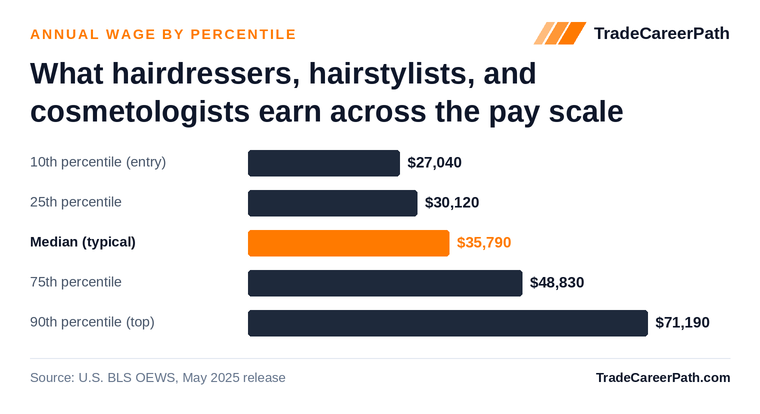
| Percentile | Annual wage |
|---|---|
| 10th | $27,040 |
| 25th | $30,120 |
| 50th (median) | $35,790 |
| 75th | $48,830 |
| 90th | $71,190 |
| Year | Employment |
|---|---|
| 2025 | 595,000 |
| 2035 projected | 640,900 |
| Percent change | +7.7% |
Cosmetologist Salary and Requirements by State
Select your state for local wage data, training options, and requirements:
Alabama · Alaska · Arizona · Arkansas · California · Colorado · Connecticut · Delaware · District of Columbia · Florida · Georgia · Hawaii · Idaho · Illinois · Indiana · Iowa · Kansas · Kentucky · Louisiana · Maine · Maryland · Massachusetts · Michigan · Minnesota · Mississippi · Missouri · Montana · Nebraska · Nevada · New Hampshire · New Jersey · New Mexico · New York · North Carolina · North Dakota · Ohio · Oklahoma · Oregon · Pennsylvania · Rhode Island · South Carolina · South Dakota · Tennessee · Texas · Utah · Vermont · Virginia · Washington · West Virginia · Wisconsin · Wyoming
Workplace Safety Snapshot
BLS Survey of Occupational Injuries and Illnesses data (2023-2024) report approximately 9.1 days-away, restricted, or transfer cases per 10,000 full-time-equivalent workers in hairdressers, hairstylists, and cosmetologists (about 0.09 per 100 FTE). Source: BLS Survey of Occupational Injuries and Illnesses, Table R98.
Frequently Asked Questions
How long does cosmetologist training take?
It typically takes typically 6 months to 2 years of training. The most common entry path is through a certificate or associate degree program. A high school diploma or GED is generally required to get started.
How much do cosmetologists make?
The median annual salary for cosmetologists is $35,790 according to the Bureau of Labor Statistics (May 2025). Entry-level workers earn around $27,040, while those in the 90th percentile earn over $71,190. Pay varies by state, experience, and specialization.
What is the job outlook for cosmetologists?
The Bureau of Labor Statistics projects 7.7% employment growth for this occupation from 2025 to 2035, which is about as fast as average. Approximately 73,400 job openings are expected each year due to growth, retirements, and workers leaving the field.
Do you need a college degree to work as a cosmetologist?
No. A college degree is not required to work as a cosmetologist. Most people enter the field through a certificate or associate degree program. A high school diploma or GED is typically the only educational prerequisite.
Which states pay cosmetologists the most?
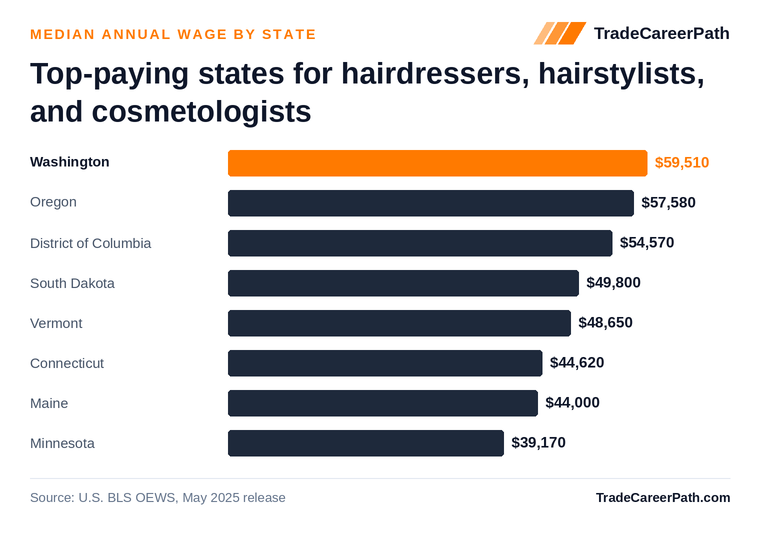
According to the U.S. Bureau of Labor Statistics (May 2025 OEWS), the highest-paying states for cosmetologists are Washington, Oregon, and District of Columbia. Median annual wages: Washington ($59,510); Oregon ($57,580); District of Columbia ($54,570).
Which states employ the most cosmetologists?
BLS reports the largest concentrations of cosmetologists in California, Florida, and Texas. Employment levels: California (27,080 workers); Florida (23,530 workers); Texas (22,440 workers) (May 2025).
How much do experienced cosmetologists earn?
The top 10% of cosmetologists earn more than $71,190 per year, according to BLS Occupational Employment and Wage Statistics (May 2025). Experienced workers in this band typically hold senior credentials, supervisory roles, or specialty certifications.
What is entry-level pay for cosmetologists?
BLS reports the bottom 10% of cosmetologists earn under $27,040 per year. New workers often start near this level and see pay rise as they accumulate experience and credentials.
How many cosmetologists work in the United States?
BLS reports approximately 305,710 cosmetologists employed nationwide as of May 2025.
How many job openings are expected for cosmetologists each year?
BLS projects approximately 73,400 openings per year for cosmetologists from 2025 through 2035, including new positions, retirements, and workers transitioning out. The occupation is projected to grow 7.7% from 2025 to 2035, classified as faster than average growth.
Is cosmetologist a growing career?
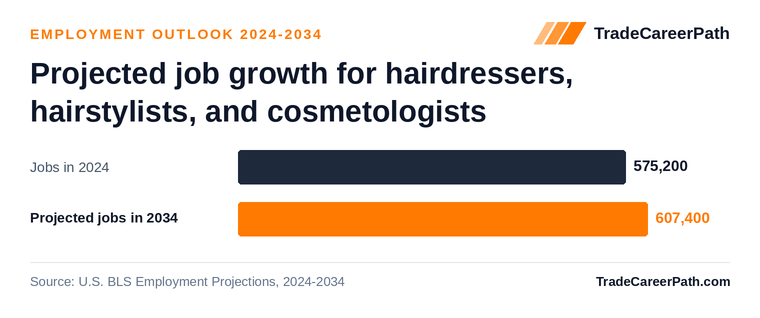
Yes. BLS projects 7.7% employment growth for cosmetologists between 2024 and 2034, classified as faster than average. Employment is projected to rise from approximately 595,000 jobs in 2024 to 640,900 in 2034.
How much do cosmetologists make per hour?
The median hourly wage for cosmetologists is $17.21, according to BLS (May 2025). Hourly pay ranges from about $13.00 (bottom 10%) to $34.23 (top 10%).
How Cosmetology Pay Compares to Similar Trades
Side-by-side comparison of Beauty & Cosmetology and the closest related careers, based on U.S. Bureau of Labor Statistics data (May 2025 OEWS + 2025-2035 Employment Projections).
| Career | Median Pay | 10-Year Growth | Annual Openings |
|---|---|---|---|
| Beauty & Cosmetology this guide | $35,790 | +7.7% | 73,400 |
| Esthetician | $45,330 | +8.8% | 14,200 |
| Beauty & Cosmetology | $35,790 | +7.7% | 73,400 |
| Massage Therapy | $58,450 | +15.3% | 20,400 |
Source: BLS Occupational Employment and Wage Statistics + BLS Employment Projections.
Sources
- U.S. Bureau of Labor Statistics, Occupational Employment and Wage Statistics (May 2025)
- U.S. Bureau of Labor Statistics, Employment Projections 2025-2035
- U.S. Bureau of Labor Statistics, Survey of Occupational Injuries and Illnesses (2023-2024, Table R98)
- U.S. Department of Labor, Wage and Hour Division, Davis-Bacon General Wage Determinations (2026)
Cosmetology Salary by State
About this guide: Researched and written by the TradeCareerPath Editorial Team. Our editorial team researches and sources every trade school and career guide using federal labor and education data, including BLS OEWS and Employment Projections, DOL apprenticeship records, IPEDS, College Scorecard, and state licensing boards. We follow the editorial standards documented at /editorial-policy/.
Data sources
Figures on this page are sourced from the federal and state datasets below. Methodology: how we rank and source data.
| Data | Provider | Vintage |
|---|---|---|
| Occupational Employment and Wage Statistics (OEWS) | U.S. Bureau of Labor Statistics | May 2025 |
| Employment Projections | U.S. Bureau of Labor Statistics | 2025-2035 |
| Integrated Postsecondary Education Data System | National Center for Education Statistics (IPEDS) | 2024 |
| College Scorecard (school-level outcomes) | U.S. Department of Education | latest release |
| College Scorecard (field-of-study earnings) | U.S. Department of Education | latest release (updated 2026-06-12) |
| Occupational licensing requirements | CareerOneStop (U.S. Department of Labor) | latest release (updated 2026-02-22) |
| Registered apprenticeship programs | CareerOneStop / Apprenticeship.gov (U.S. Department of Labor) | latest release (updated 2025-10-25) |
| O*NET occupation profiles (skills, tasks, tools, job zones) | U.S. Department of Labor (O*NET / Employment & Training Admin.) | O*NET 31.0 (updated 2026-10-14) |