
How to Become a Construction Cost Estimator in 2026
Is Construction Cost Estimator Right for You?
The U.S. Department of Labor's O*NET profile for Cost Estimators (SOC 13-1051) describes the work this way: Prepare cost estimates for product manufacturing, construction projects, or services to aid management in bidding on or determining price of product or service. May specialize according to particular service performed or type of product manufactured.
What the work involves
- Analyze blueprints and other documentation to prepare time, cost, materials, and labor estimates.
- Confer with engineers, architects, owners, contractors, and subcontractors on changes and adjustments to cost estimates.
- Collect historical cost data to estimate costs for current or future products.
- Assess cost effectiveness of products, projects or services, tracking actual costs relative to bids as the project develops.
- Consult with clients, vendors, personnel in other departments, or construction foremen to discuss and formulate estimates and resolve issues.
Skills and knowledge that matter
Skills: Reading Comprehension, Mathematics, Speaking, Active Listening, Critical Thinking, Judgment and Decision Making.
Knowledge: Mathematics, Economics and Accounting, Computers and Electronics, Engineering and Technology.
Tools and technology you may use
Technology: Document management software, Spreadsheet software, Data base user interface and query software, Adobe Acrobat, Autodesk AutoCAD, Autodesk Revit.
Typical preparation
O*NET Job Zone Four (Considerable Preparation Needed). Most of these occupations require a four-year bachelor's degree, but some do not. Employees in these occupations usually need several years of work-related experience, on-the-job training, and/or vocational training.
Interest fit
O*NET interest profile: Conventional, Enterprising, Investigative. People who enjoy structured, detail-oriented work with clear procedures and data often find this occupation a good fit.
Source: O*NET 31.0 (updated 2026-10-14)
Quick answer: Training as a construction cost estimator requires a 4-year degree - typically a Bachelor’s in construction management, building science, or business. The national median pay is $78,740 per year, and BLS projects -3.1% employment change from 2025 to 2035 (BLS OEWS, May 2025; BLS Employment Projections, 2025-35).
Construction Cost Estimator at a Glance
| Metric | Detail | Source |
|---|---|---|
| Median annual wage | $78,740 | BLS OEWS, May 2025 |
| Typical wage range | $48,530 (10th pct) - $130,820 (90th pct) | BLS OEWS, May 2025 |
| Employment | 224,220 nationwide | BLS OEWS, May 2025 |
| Projected growth (2025-35) | -3.1%, about 17,600 openings per year | BLS Employment Projections, 2025-35 |
| Typical education | Bachelor’s in construction management, building science, or business | BLS Occupational Outlook Handbook |
| License / certification | No license; ASPE/AACE certifications valued | None for most roles |
What Does a Construction Cost Estimator Do?
Cost estimators price construction work before anyone swings a hammer: quantity takeoffs from the drawings, labor and material pricing, subcontractor bid analysis, and the final number that wins or loses the job. When the bid is wrong, the company eats it - so the estimator’s judgment carries real weight. It is the office role where trade experience translates most directly: you cannot price work you have never built.
Day to day the work varies by seat. An estimator at a general contractor spends bid week assembling a full project: leveling sub quotes trade by trade, catching scope gaps between the electrical and mechanical bids, and pricing general conditions. An estimator at a specialty subcontractor goes deeper on one trade - counting fixtures, pricing duct runs, working feeder schedules - closer to the crews whose productivity rates make or break the number. In preconstruction groups at larger firms, estimators price projects at partial design, telling owners what a building will cost before the drawings are done. Everywhere the toolkit is the same: Bluebeam or On-Screen Takeoff for quantities, RSMeans and historical job-cost data for pricing, and a spreadsheet model the estimator trusts.
If you are coming off the tools - carpenter, electrician, plumber, HVAC, any installing trade - the shortest way to say it: the crew builds the work; the estimator decides what it should cost and whether the company should chase it. Your years in the field are the database: you know how long the work actually takes, what the drawings always miss, and which shortcuts on paper turn into overtime in reality. That judgment is exactly what firms are hiring for when they pull someone from the field to an estimating desk.
Skills That Make a Great Construction Cost Estimator
- Quantity takeoffs from plans and specs
- Construction means and methods
- Labor productivity judgment - the rates that make or break a bid
- Estimating software (Bluebeam, On-Screen Takeoff) and cost databases (RSMeans)
- Subcontractor bid analysis and scope leveling
- Spreadsheet and cost modeling
- Negotiation and vendor relationships
- Writing: clarifications, qualifications, and exclusions protect the number you bid
Construction Cost Estimator Salary
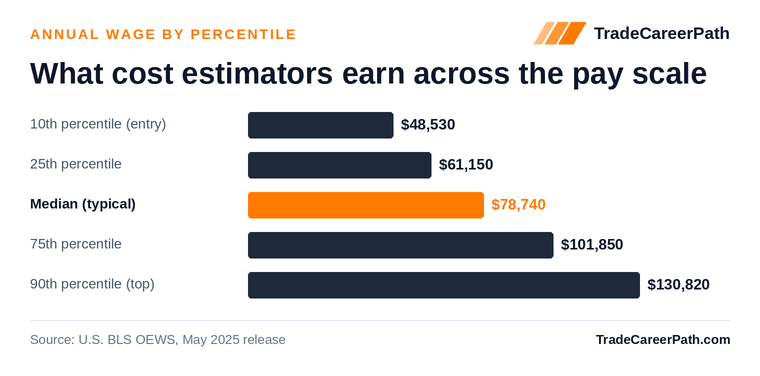
Estimating pays meaningfully better than most of the trades that feed it. The national median is $78,740 per year, and the spread rewards experience: the 10th percentile - roughly where junior estimators start - is $48,530, the 75th percentile is $101,850, and the top 10% earn $130,820 or more (BLS OEWS, May 2025). For a journeyman weighing the move, the honest comparison is the mid-career number, not the entry one - and it comes without the body wear, weather, and travel of field work.
Where the Jobs and the Money Are
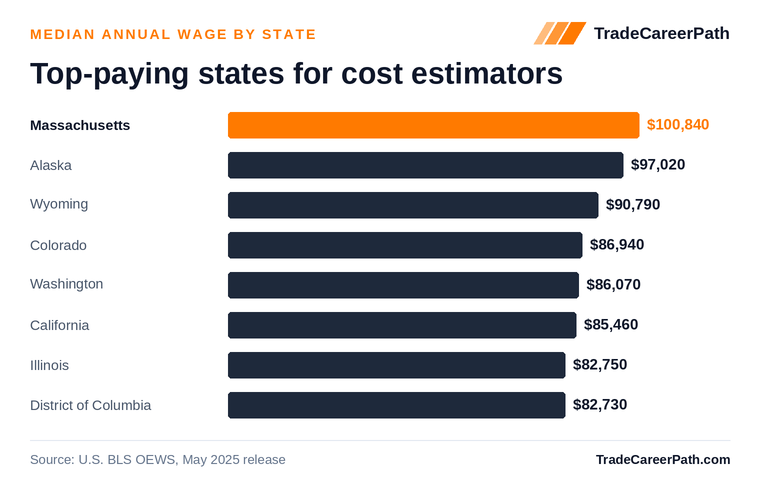
Estimating work exists wherever construction does - 224,220 cost estimators work nationwide, and the biggest job markets track the biggest construction markets: California (26,020 estimators), Texas (20,760), and Florida (13,720) (BLS OEWS, May 2025). The best pay clusters elsewhere:
| State | Median annual wage | Employment |
|---|---|---|
| Massachusetts | $100,840 | 4,520 |
| Alaska | $97,020 | 220 |
| Wyoming | $90,790 | 440 |
| Colorado | $86,940 | 6,100 |
| Washington | $86,070 | 7,470 |
Colorado and Washington are the standout combination: strong pay plus real concentration - estimators are nearly one and a half times as common there as in the average state labor market, which means deeper job markets and more room to change employers without moving. Massachusetts pays the most outright. Alaska and Wyoming pay well but are thin markets - a few hundred jobs statewide - so land with a job in hand rather than moving to look.
How to Become a Construction Cost Estimator
1. Build trade experience
Estimators who have installed the work price it better - this is your existing advantage. Every year on the tools taught you production rates, sequencing, and where jobs bleed money. Start paying attention to the numbers side of your current job: ask your PM what the labor budget was, track your crew’s actual units per day against it, and volunteer for material takeoffs. That habit is the bridge from the field to the desk.
2. Earn a bachelor’s degree
Construction management, building science, or business - and for tradespeople, construction management is usually the right pick, because plan reading, scheduling, contracts, and estimating coursework map directly onto the job. Online programs fit around field work, and apprenticeship coursework, prior college, and military training can be worth meaningful transfer credit. At specialty subs, strong field experience sometimes substitutes for the degree entirely - but the degree keeps the chief-estimator and preconstruction doors open later.
3. Learn the software
On-Screen Takeoff, Bluebeam, and cost databases like RSMeans are the working toolkit, and you can learn all three before anyone hires you. Bluebeam is cheap enough to self-teach at home, and Excel fluency - lookups and linked sheets, not just data entry - is the single most tested skill in estimating interviews. Walking in already able to run a takeoff moves you past most career changers.
4. Start as a junior estimator
General contractors and specialty subs hire from the field into estimating desks. Starting at a sub in your own trade is the easiest jump - you are pricing work you have personally installed. Starting at a GC teaches breadth faster: leveling bids across every trade, learning the full anatomy of a project. Either way, expect the first year to be takeoffs and bid-day support while a senior estimator checks your numbers.
5. Advance
Senior estimator, chief estimator, or preconstruction manager. The fork comes with a few wins on your record: stay technical as the chief estimator who prices the firm’s biggest pursuits, or move into preconstruction management, closer to owners and design teams. Estimating is also a proven springboard into construction management - the estimator who priced the job is a natural candidate to run it.
Career Ladder: Titles and Realistic Pay
The BLS wage percentiles map cleanly onto how estimating careers actually progress. Use this as a sanity check on offers, not a guarantee:
| Stage | Typical titles | Years in | Realistic pay (BLS OEWS, May 2025) |
|---|---|---|---|
| Entry level | Junior estimator, estimating assistant, takeoff tech | 0-3 | ~$48,530-$61,150 (10th-25th pct) |
| Mid-career | Estimator, project estimator | 3-8 | ~$78,740 (median) |
| Senior | Senior estimator, lead estimator | 8-15 | ~$101,850 (75th pct) |
| Chief / preconstruction | Chief estimator, preconstruction manager | 15+ | $130,820+ (90th pct) |
Two notes for career changers. First, trade experience compresses this ladder: a journeyman with ten years in the field is routinely hired above the bottom of the entry band, needing far less supervision on means, methods, and production rates than a fresh graduate. Second, the table shows base wage only - at many GCs and subs, estimators share in bid-win bonuses or profit pools, so senior and chief total compensation often runs above these figures.
Do You Need a License?
No. No state licenses cost estimators - there is no exam, no board, and no legal barrier between you and the job. What the industry uses instead is voluntary certification, and two bodies matter: the American Society of Professional Estimators (ASPE), whose Certified Professional Estimator credential signals tested competence to bid-heavy firms, and AACE International, whose cost-engineering certifications carry weight on industrial and heavy-civil work. Neither is required to get hired; both help at promotion time.
The practical gatekeepers are different: a track record of bids that made money, fluency in the software stack, and references from PMs who trusted your numbers. Take a certification if your employer will pay for it - but do not delay a job search waiting on one.
Why an Online Degree Works for This Career
Estimating is the most common office landing spot for experienced tradespeople leaving the tools. Note the honest trade-off: BLS projects a decline for the occupation overall as software automates simple takeoffs - but construction firms consistently report difficulty finding estimators who know how work actually goes together, which is precisely what a trade background provides. An online construction management bachelor’s is the standard credential.
Job Outlook for 2026 and Beyond
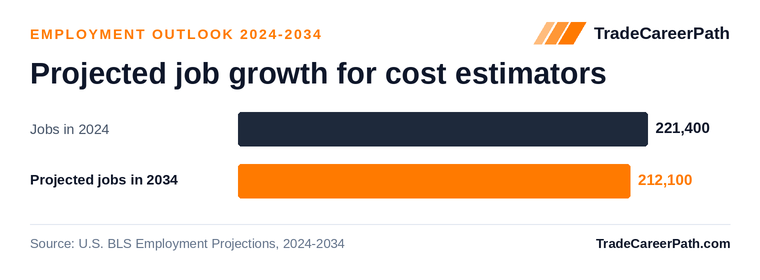
Go in with clear eyes: BLS projects cost estimator employment to change -3.1% from 2025 to 2035 - from 226,400 to 219,500 jobs (BLS Employment Projections, 2025-35). Software keeps absorbing the simple, repetitive end of the work, and that is where the decline concentrates.
The number that matters more for a career changer is openings: BLS still projects about 17,600 openings per year through 2035, driven by retirements and estimators moving up into management. That is a large replacement pipeline in a 224,220-person occupation, and construction is the segment where field judgment is hardest to automate - software can count fixtures, but it cannot judge whether a sub’s labor number survives a congested site. Wages back this up: the median rose from $77,070 in 2024 to $78,740 in the May 2025 data - shrinking occupations do not usually post rising pay.
Cost and Time to Complete the Degree
For cost estimators, the credential is: Bachelor’s in construction management, building science, or business. A bachelor’s degree is typically 120 credit hours: four years full-time, and commonly five to six years part-time while working. Transfer credit is the other lever: prior college, military training, apprenticeship coursework, and industry certifications can be worth meaningful credit at transfer-friendly schools, so get a written transfer evaluation before enrolling anywhere. Costs vary widely by school type; in-state public online programs are usually the value benchmark, and employer tuition assistance is common for working adults in this field. One advantage specific to this career: because subs hire on experience, many tradespeople land a junior estimating seat mid-degree and finish school already off the tools.
Pros and Cons of Training as a Construction Cost Estimator
Pros
- Median pay of $78,740 nationally, with the top 10% above $130,820 (BLS OEWS, May 2025)
- Field experience from the trades is a genuine hiring advantage
- No license or exam required to enter the occupation
- Accredited online and hybrid degree paths exist for working adults
Cons
- Requires a 4-year degree (typically 120 credit hours) for the best-paying seats
- Entry-level pay starts near $48,530 at the 10th percentile
- BLS projects a -3.1% employment change through 2035; plan around the ~17,600 annual replacement openings
- Bid-week deadline pressure is real - the stress trades weather for spreadsheets
Frequently Asked Questions
Is cost estimating a declining career?
BLS projects overall employment of cost estimators to decline through 2035 as software automates simple takeoffs. Construction estimating is the segment where experienced-trade judgment is hardest to automate, and firms continue to hire field-experienced estimators - but go in with clear eyes about the trend.
How much do cost estimators make?
The national median annual wage for cost estimators is $78,740 (BLS OEWS, May 2025). The top 10% earn $130,820 or more, while entry-level pay starts around $48,530.
What is the job outlook for cost estimators?
BLS projects employment of cost estimators to change by -3.1% from 2025 to 2035 (BLS Employment Projections, 2025-35).
How long does cost estimator training take?
The bachelor's is 120 credit hours: four years full-time, commonly five to six years part-time while working. Tradespeople with prior college, military training, or apprenticeship coursework can often transfer meaningful credit, and some move into junior estimating roles before the degree is finished.
Is cost estimating hard?
The math is arithmetic and spreadsheets, not calculus - the hard part is judgment. Pricing labor productivity, catching what the drawings leave out, and knowing when a subcontractor's number is too good to be true all come from field experience, which is exactly why tradespeople make strong estimators.
Should I get a construction management or business degree to work as an estimator?
For working tradespeople, construction management is usually the better buy: the coursework (plan reading, scheduling, estimating, contracts) maps directly to the job, and the same degree qualifies you for project management and superintendent roles later. A business degree works but leaves more to learn on the job.
Can you train as a cost estimator without a degree?
Yes, more often than in most office careers - specialty subcontractors regularly promote foremen into estimating on experience alone. But general contractors and larger firms increasingly screen for the bachelor's, and the chief estimator and preconstruction manager roles that pay toward the $130,820 top decile usually require it.
Do cost estimators need a license?
No state licenses a cost estimator. Voluntary certifications - ASPE's Certified Professional Estimator and AACE International's credentials - are respected and can help at bid-heavy firms, but hiring decisions turn on field experience, software skills, and bid track record.
Construction Cost Estimator Salary and Requirements by State
Alabama · Alaska · Arizona · Arkansas · California · Colorado · Connecticut · Delaware · District of Columbia · Florida · Georgia · Hawaii · Idaho · Illinois · Indiana · Iowa · Kansas · Kentucky · Louisiana · Maine · Maryland · Massachusetts · Michigan · Minnesota · Mississippi · Missouri · Montana · Nebraska · Nevada · New Hampshire · New Jersey · New Mexico · New York · North Carolina · North Dakota · Ohio · Oklahoma · Oregon · Pennsylvania · Rhode Island · South Carolina · South Dakota · Tennessee · Texas · Utah · Vermont · Virginia · Washington · West Virginia · Wisconsin · Wyoming
Related Careers and Degree Paths
- Construction Manager - the role estimators most often grow into; the same degree covers both
- Construction Project Manager - runs the jobs the estimating desk wins
- Home Building Inspector - another off-the-tools path built on knowing how work goes together
- Online Construction Management Degrees - how to pick a program that fits a work schedule
- All trade careers that require a 4-year degree
Degree and Program Guides
- Online Project Management Degrees - the degree behind estimating and PM roles
Sources
- U.S. Bureau of Labor Statistics, Occupational Employment and Wage Statistics (OEWS), May 2025 - Cost Estimators (SOC 13-1051)
- U.S. Bureau of Labor Statistics, Employment Projections, 2025-35
- U.S. Bureau of Labor Statistics, Occupational Outlook Handbook - education and licensing requirements
Cost Estimator Salary by State
About this guide: Researched and written by the TradeCareerPath Editorial Team. Our editorial team researches and sources every trade school and career guide using federal labor and education data, including BLS OEWS and Employment Projections, DOL apprenticeship records, IPEDS, College Scorecard, and state licensing boards. We follow the editorial standards documented at /editorial-policy/.
Data sources
Figures on this page are sourced from the federal and state datasets below. Methodology: how we rank and source data.
| Data | Provider | Vintage |
|---|---|---|
| Occupational Employment and Wage Statistics (OEWS) | U.S. Bureau of Labor Statistics | May 2025 |
| Employment Projections | U.S. Bureau of Labor Statistics | 2025-2035 |
| Integrated Postsecondary Education Data System | National Center for Education Statistics (IPEDS) | 2024 |
| College Scorecard (school-level outcomes) | U.S. Department of Education | latest release |
| College Scorecard (field-of-study earnings) | U.S. Department of Education | latest release (updated 2026-06-12) |
| Occupational licensing requirements | CareerOneStop (U.S. Department of Labor) | latest release (updated 2026-02-22) |
| Registered apprenticeship programs | CareerOneStop / Apprenticeship.gov (U.S. Department of Labor) | latest release (updated 2025-10-25) |
| O*NET occupation profiles (skills, tasks, tools, job zones) | U.S. Department of Labor (O*NET / Employment & Training Admin.) | O*NET 31.0 (updated 2026-10-14) |