
How to Become a Crane Operator: Training and Certification
Is Crane Operator Right for You?
The U.S. Department of Labor's O*NET profile for Crane and Tower Operators (SOC 53-7021) describes the work this way: Operate mechanical boom and cable or tower and cable equipment to lift and move materials, machines, or products in many directions.
What the work involves
- Determine load weights and check them against lifting capacities to prevent overload.
- Move levers, depress foot pedals, or turn dials to operate cranes, cherry pickers, electromagnets, or other moving equipment for lifting, moving, or placing loads.
- Inspect and adjust crane mechanisms or lifting accessories to prevent malfunctions or damage.
- Inspect cables or grappling devices for wear and install or replace cables, as needed.
- Direct helpers engaged in placing blocking or outrigging under cranes.
Skills and knowledge that matter
Skills: Operation and Control, Operations Monitoring, Critical Thinking, Monitoring, Active Listening, Time Management.
Knowledge: Mechanical, Mathematics, Transportation, English Language.
Tools and technology you may use
Tools: Adjustable wrenches, All-terrain cranes, Anemometers, Angle grinders, Anti-two block devices, Ball peen hammers.
Technology: Industrial control software, Inventory management software, Spreadsheet software, Microsoft Excel, Microsoft Office software, Microsoft Outlook.
Typical preparation
O*NET Job Zone Three (Medium Preparation Needed). Most occupations in this zone require training in vocational schools, related on-the-job experience, or an associate's degree. Employees in these occupations usually need one or two years of training involving both on-the-job experience and informal training with experienced workers. A recognized apprenticeship program may be associated with these occupations.
Interest fit
O*NET interest profile: Realistic, Conventional, Investigative. People who enjoy hands-on, practical work with tools, machines, plants, or materials often find this occupation a good fit.
Source: O*NET 29.1 (updated 2026-06-13)
Ever looked up at a construction site and wondered who controls those massive cranes towering above?
Crane operators are the precision experts who make that happen.
Crane operators handle heavy lifting and equipment placement on construction sites, ports, and manufacturing yards. They ensure loads move safely and efficiently.
If you enjoy hands-on mechanical work and have strong spatial awareness, this career offers solid long-term stability and skilled-trade respect.
Quick answers
What does a crane operator do?
Crane operators lift and move heavy materials using cranes. They focus on safe, precise load placement.
Where do crane operators work?
Common work environments include construction sites, ports and shipyards, warehouses and manufacturing plants, oil and gas facilities, and utility and power projects.
Do I need certification to work as a crane operator?
Most employers require a recognized certification such as NCCCO (National Commission for the Certification of Crane Operators) or NCCER Crane Certification. These validate your knowledge of load charts, signaling, and safe operation.
How long does crane operator training take?
Training can take about 3 months to 1 year, depending on the program and equipment type.
How much does crane operator training cost?
Program cost is typically varies by school, format and location and certification exam fees are about $100-$300 per test.
How often do certifications need renewal?
Renew certifications as required (typically every five years). Stay current with OSHA safety standards.
At a glance
- Work settings: construction, ports, manufacturing, oil and gas, utilities
- Entry requirement: high school diploma or GED
- Training duration: about 3 months to 1 year
- Common certifications: NCCCO or NCCER
- Costs: $3,000-$12,000 programs; $100-$300 per test
What Crane Operators Do
Crane operators lift and move heavy materials using various types of cranes. from mobile truck cranes to tower and overhead cranes. They must understand load limits, signaling systems, and site safety regulations.
Typical Responsibilities
- Operate stationary or mobile cranes to lift materials
- Inspect equipment and verify load weights
- Communicate via hand or radio signals
- Set up cranes and secure loads properly
- Maintain safety logs and equipment records
Crane operators keep construction and industrial projects running safely and efficiently.
Key Skills and Traits for Success
- Excellent hand-eye coordination
- Mechanical aptitude and attention to detail
- Understanding of physics and load dynamics
- Focus under pressure
- Strong safety awareness
- Team communication and reliability
Common Work Environments
Crane operators work in:
- Construction sites (commercial, industrial, infrastructure)
- Ports and shipyards
- Warehouses and manufacturing plants
- Oil and gas facilities
- Utility and power projects
How to Become a Crane Operator (5 Steps)
1. Earn a High School Diploma or GED
Take courses in math, shop, and physics to prepare for equipment operation and safety concepts.
2. Complete Crane Operator Training
Enroll in a trade school or vocational program that offers crane operation, rigging, and safety courses. Programs combine classroom instruction with simulator or field training.
3. Obtain Certification
Most employers require a recognized certification such as:
- NCCCO (National Commission for the Certification of Crane Operators)
- NCCER Crane Certification
These validate your knowledge of load charts, signaling, and safe operation.
4. Gain On-the-Job Experience
New operators start as riggers or signalpersons before handling cranes independently. Apprenticeships last several months to a year.
5. Maintain and Renew Licenses
Stay current with OSHA safety standards and renew certifications as required (typically every five years).
Education and Certification Options
| Pathway | Typical Duration | Outcome |
|---|---|---|
| Certificate Program | 3-6 months | Entry-level operation & prep for certification |
| Apprenticeship | 1-3 years | Paid on-the-job training |
| NCCCO Certification | Variable | Meets national standards for safe crane operation |
Career Growth and Advancement
With experience, crane operators may advance into:
- Master Operator - handles complex lifts or specialized equipment
- Site Supervisor - oversees safety and crane operations on large projects
- Instructor or Safety Trainer - teaches new operators
- Equipment Inspector - verifies compliance and maintenance
Cost and Duration of Training
- Program Cost: varies by school, format and location depending on equipment type and hours
- Duration: 3 months to 1 year
- Certification Exam Fees: about $100-$300 per test
Many training programs combine classroom and simulator time, helping you build confidence before operating real cranes.
Pros and Cons
✅ Pros
- Strong demand in construction and infrastructure
- High level of job stability
- Hands-on and technical work
- Clear certification pathways
⚠️ Cons
- Physically demanding outdoor work
- Requires precision and focus at heights
- Strict safety and certification standards
Take the First Step Toward a Crane Operator Career
If you like big machines, working outdoors, and seeing the results of your effort every day, crane operation offers a solid skilled-trade path with long-term opportunity.
Quick Facts: Crane Operator Salary, Education, and Outlook
Industry Organizations & Certifying Bodies
These are the recognized national organizations, unions, certifying bodies, and regulatory authorities that shape this trade. They issue the credentials, sponsor the apprenticeships, publish the codes, and represent workers and employers.
- National Commission for the Certification of Crane Operators (NCCCO) OSHA-accredited national crane operator certification.
- International Union of Operating Engineers (IUOE) Sponsors crane and heavy-equipment apprenticeships.
- Specialized Carriers & Rigging Association (SC&RA) Industry trade association for crane and rigging contractors.
Wage and Employment Charts
| Percentile | Annual wage |
|---|---|
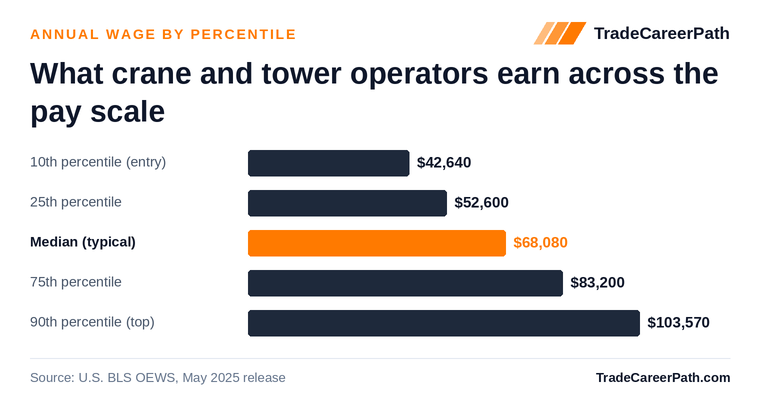
| 10th | $42,640 |
| 25th | $52,600 |
| 50th (median) | $68,080 |
| 75th | $83,200 |
| 90th | $103,570 |
| Year | Employment |
|---|---|
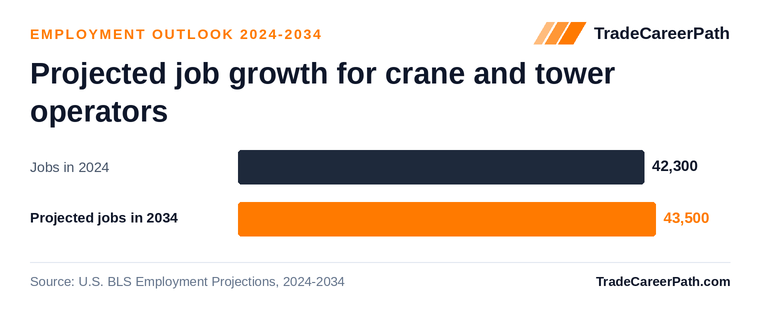
| 2024 | 42,300 |
| 2034 projected | 43,500 |
| Percent change | +3.0% |
Crane Operator Salary and Requirements by State
Select your state for local wage data, training options, and requirements:
Alabama · Alaska · Arizona · Arkansas · California · Colorado · Connecticut · Delaware · District of Columbia · Florida · Georgia · Hawaii · Idaho · Illinois · Indiana · Iowa · Kansas · Kentucky · Louisiana · Maine · Maryland · Massachusetts · Michigan · Minnesota · Mississippi · Missouri · Montana · Nebraska · Nevada · New Hampshire · New Jersey · New Mexico · New York · North Carolina · North Dakota · Ohio · Oklahoma · Oregon · Pennsylvania · Rhode Island · South Carolina · South Dakota · Tennessee · Texas · Utah · Vermont · Virginia · Washington · West Virginia · Wisconsin · Wyoming
Workplace Safety Snapshot
BLS Survey of Occupational Injuries and Illnesses data (2023-2024) report approximately 166.9 days-away, restricted, or transfer cases per 10,000 full-time-equivalent workers in crane and tower operators (about 1.67 per 100 FTE). Source: BLS Survey of Occupational Injuries and Illnesses, Table R98.
Frequently Asked Questions
How long does crane operator training take?
It typically takes 3 to 4 years through an apprenticeship or training program. The most common entry path is through crane operator training and NCCCO certification. A high school diploma or GED is generally required to get started.
How much do crane operators make?
The median annual salary for crane operators is $68,080 according to the Bureau of Labor Statistics (May 2025). Entry-level workers earn around $42,640, while those in the 90th percentile earn over $103,570. Pay varies by state, experience, and specialization.
What is the job outlook for crane operators?
The Bureau of Labor Statistics projects 3.0% employment growth for this occupation from 2024 to 2034, which is roughly on pace with the overall economy. Approximately 3,800 job openings are expected each year due to growth, retirements, and workers leaving the field.
Do you need a college degree to work as a crane operator?
No. A college degree is not required to work as a crane operator. Most people enter the field through crane operator training and NCCCO certification. A high school diploma or GED is typically the only educational prerequisite.
Which states pay crane operators the most?
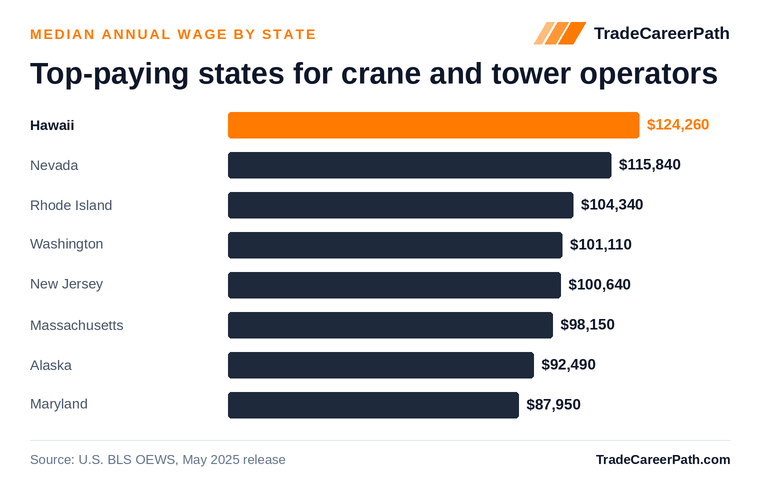
According to the U.S. Bureau of Labor Statistics (May 2025 OEWS), the highest-paying states for crane operators are Hawaii, Nevada, and Rhode Island. Median annual wages: Hawaii ($124,260); Nevada ($115,840); Rhode Island ($104,340).
Which states employ the most crane operators?
BLS reports the largest concentrations of crane operators in Texas, Florida, and Indiana. Employment levels: Texas (6,010 workers); Florida (2,570 workers); Indiana (2,300 workers) (May 2025).
How much do experienced crane operators earn?
The top 10% of crane operators earn more than $103,570 per year, according to BLS Occupational Employment and Wage Statistics (May 2025). Experienced workers in this band typically hold senior credentials, supervisory roles, or specialty certifications.
What is entry-level pay for crane operators?
BLS reports the bottom 10% of crane operators earn under $42,640 per year. New workers often start near this level and see pay rise as they accumulate experience and credentials.
How many crane operators work in the United States?
BLS reports approximately 42,890 crane operators employed nationwide as of May 2025.
How many job openings are expected for crane operators each year?
BLS projects approximately 3,800 openings per year for crane operators from 2024 through 2034, including new positions, retirements, and workers transitioning out. The occupation is projected to grow 3.0% from 2024 to 2034, classified as about as fast as average growth.
How much do crane operators make per hour?
The median hourly wage for crane operators is $32.73, according to BLS (May 2025). Hourly pay ranges from about $20.50 (bottom 10%) to $49.79 (top 10%).
Sources
- U.S. Bureau of Labor Statistics, Occupational Employment and Wage Statistics (May 2025)
- U.S. Bureau of Labor Statistics, Employment Projections 2024-2034
- U.S. Bureau of Labor Statistics, Survey of Occupational Injuries and Illnesses (2023-2024, Table R98)
- U.S. Department of Labor, Wage and Hour Division, Davis-Bacon General Wage Determinations (2026)
Crane Operator Salary by State
About this guide: Researched and written by the TradeCareerPath Editorial Team. Our editorial team researches and sources every trade school and career guide using federal labor and education data, including BLS OEWS and Employment Projections, DOL apprenticeship records, IPEDS, College Scorecard, and state licensing boards. We follow the editorial standards documented at /editorial-policy/.
Data sources
Figures on this page are sourced from the federal and state datasets below. Methodology: how we rank and source data.
| Data | Provider | Vintage |
|---|---|---|
| Occupational Employment and Wage Statistics (OEWS) | U.S. Bureau of Labor Statistics | May 2025 |
| Employment Projections | U.S. Bureau of Labor Statistics | 2024-2034 |
| Integrated Postsecondary Education Data System | National Center for Education Statistics (IPEDS) | 2024 |
| College Scorecard (school-level outcomes) | U.S. Department of Education | latest release |
| College Scorecard (field-of-study earnings) | U.S. Department of Education | latest release (updated 2026-06-12) |
| Occupational licensing requirements | CareerOneStop (U.S. Department of Labor) | latest release (updated 2026-02-22) |
| Registered apprenticeship programs | CareerOneStop / Apprenticeship.gov (U.S. Department of Labor) | latest release (updated 2025-10-25) |
| O*NET occupation profiles (skills, tasks, tools, job zones) | U.S. Department of Labor (O*NET / Employment & Training Admin.) | O*NET 29.1 (updated 2026-06-13) |