
How to Become a CTE Teacher (Shop Teacher) in 2026
Is CTE Teacher (Shop Teacher) Right for You?
The U.S. Department of Labor's O*NET profile for Career/Technical Education Teachers, Secondary School (SOC 25-2032) describes the work this way: Teach occupational, vocational, career, or technical subjects to students at the secondary school level.
What the work involves
- Instruct students individually and in groups, using various teaching methods, such as lectures, discussions, and demonstrations.
- Establish and enforce rules for behavior and procedures for maintaining order among students.
- Prepare materials and classroom for class activities.
- Observe and evaluate students' performance, behavior, social development, and physical health.
- Instruct students in the knowledge and skills required in a specific occupation or occupational field, using a systematic plan of lectures, discussions, audio-visual presentations, and laboratory, shop, and field studies.
Skills and knowledge that matter
Skills: Instructing, Reading Comprehension, Active Listening, Speaking, Learning Strategies, Writing.
Knowledge: Education and Training, English Language, Computers and Electronics, Customer and Personal Service.
Tools and technology you may use
Technology: Computer aided design CAD software, Computer based training software, Word processing software, Autodesk AutoCAD Civil 3D, Google Docs, Microsoft Excel.
Typical preparation
O*NET Job Zone Four (Considerable Preparation Needed). Most of these occupations require a four-year bachelor's degree, but some do not. Employees in these occupations usually need several years of work-related experience, on-the-job training, and/or vocational training.
Interest fit
O*NET interest profile: Social, Conventional, Artistic. People who enjoy working with, helping, and teaching other people often find this occupation a good fit.
Source: O*NET 31.0 (updated 2026-10-14)
Quick answer: Training as a career and technical education teacher requires a 4-year degree - typically a Bachelor’s in career & technical education or your trade field + teacher certification. The national median pay is $66,270 per year, and BLS projects -0.4% employment change from 2025 to 2035 (BLS OEWS, May 2025; BLS Employment Projections, 2025-35).
CTE Teacher (Shop Teacher) at a Glance
| Metric | Detail | Source |
|---|---|---|
| Median annual wage | $66,270 | BLS OEWS, May 2025 |
| Typical wage range | $50,040 (10th pct) - $101,340 (90th pct) | BLS OEWS, May 2025 |
| Employment | 111,420 nationwide | BLS OEWS, May 2025 |
| Projected growth (2025-35) | -0.4%, about 6,400 openings per year | BLS Employment Projections, 2025-35 |
| Typical education | Bachelor’s in career & technical education or your trade field + teacher certification | BLS Occupational Outlook Handbook |
| License / certification | State teaching certificate; many states offer alternative CTE routes crediting trade experience | State licensing boards |
What Does a CTE Teacher (Shop Teacher) Do?
Career and technical education teachers teach the trades - welding, auto, construction, HVAC, health sciences, manufacturing - in high schools and regional career centers. It is the one career where 20 years on the tools is the qualification: the point of CTE is putting students in front of someone who has actually done the work.
Day to day, the job depends on what you teach. A welding instructor runs a live shop - demonstrating bead work, inspecting student welds against certification standards. An automotive teacher works donated vehicles through diagnostic sequences. A construction-trades teacher might frame an actual house with a class over a school year; health-sciences teachers run clinical labs. Around the shop time sits the load every specialty shares: lesson plans against state standards, grading, safety documentation (non-negotiable when minors run equipment), employer advisory boards, and SkillsUSA coaching.
If you are coming from any trade on this site, the honest translation is this: the skill you spent a career building - reading a job, sequencing the work, catching mistakes before they get expensive - becomes the thing you teach, minus the production pressure and most of the physical toll. If you have trained apprentices, you already know the hardest part; the classroom version adds a salary schedule, benefits, a pension in most states, and summers that belong to you.
Skills That Make a Great CTE Teacher (Shop Teacher)
- Deep mastery of your trade - current, hands-on, and demonstrable
- Lesson planning and curriculum building against state CTE standards
- Classroom and shop management - especially with power equipment and minors
- Mentoring and coaching, one student at a time
- Safety instruction and documentation
- Patience with beginners making the mistakes you stopped making decades ago
- Employer relationships for placements, donations, and advisory input
CTE Teacher (Shop Teacher) Salary
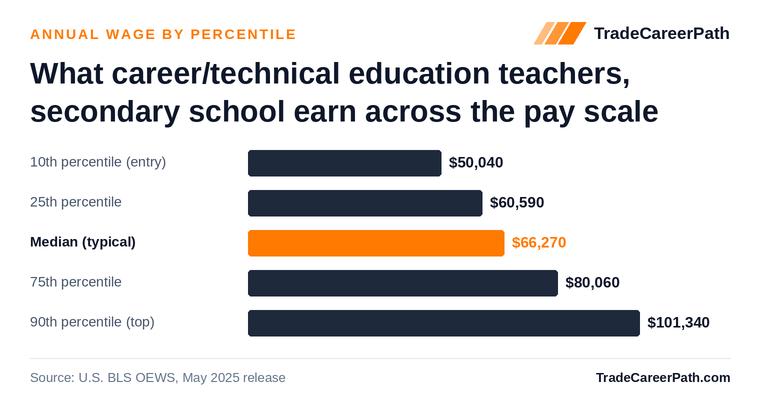
The national median for career/technical education teachers at the secondary level is $66,270 per year, with a mean of $72,680 (BLS OEWS, May 2025). The 10th percentile - roughly where a first-year provisional teacher lands - is $50,040, and the 90th percentile reaches $101,340. Two things make these numbers read differently than trade wages: they sit on a published salary schedule that climbs automatically with years and credits, and they cover a 10-month contract - many CTE teachers add summer income working their trade.
Where the Jobs and the Money Are
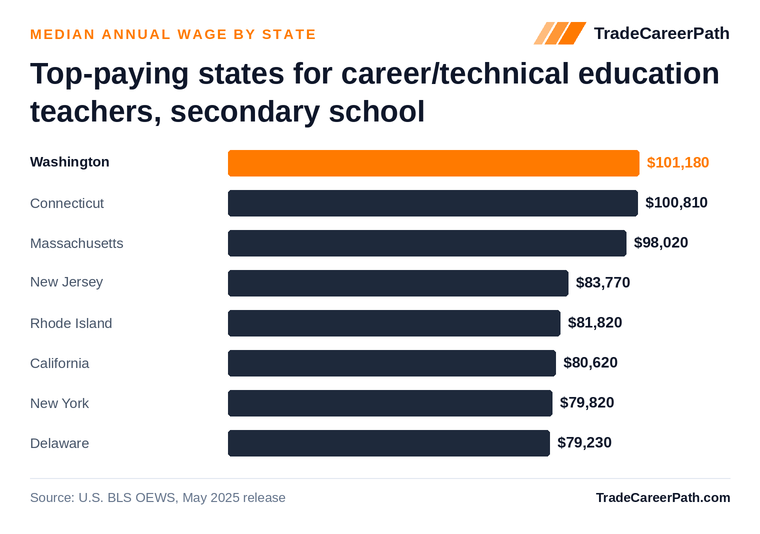
Pay tracks the same geography as teacher pay generally: the Northeast and West Coast lead, with three states at or near $100,000 medians (BLS OEWS, May 2025).
| State | Median annual wage | Employment |
|---|---|---|
| Washington | $101,180 | 3,460 |
| Connecticut | $100,810 | 1,910 |
| Massachusetts | $98,020 | 3,130 |
| New Jersey | $83,770 | 2,320 |
| Rhode Island | $81,820 | 90 |
The high-pay states are genuine CTE strongholds: CTE teachers are about 1.57 times as concentrated in Connecticut’s labor market as the national average, 1.36 times in Washington, and 1.2 times in Massachusetts. The volume story is different. Texas employs 32,250 CTE teachers at a $64,610 median - more than three times the national concentration and by far the deepest job market in the country - with New York (7,610 jobs, $79,820 median) and Florida (6,820, $62,140) next. In practice: Texas is the easiest place to get hired; Washington and New England are where the credential pays best.
How to Become a CTE Teacher (Shop Teacher)
1. Bank your trade experience
States typically require documented years in the trade you’ll teach - recent, verifiable, full-time experience plus any journeyman or industry certification you hold. If you have been working the trade for years, you likely already qualify; the work now is paperwork. Start collecting proof early - employer verification letters, license copies, apprenticeship records - because your state’s certification office will want the file, and having it ready shortens everything that follows.
2. Earn the bachelor’s (or start an alternative route)
BLS lists a bachelor’s as the typical entry-level education, and full licensure usually requires it - but the sequencing is the tradesperson’s advantage. Several states issue provisional CTE certificates on trade experience alone, letting you teach full-time and earn while finishing the degree. Online bachelor’s programs in career and technical education or workforce education are built for exactly this, with asynchronous coursework and credit awarded for documented trade experience.
3. Get your state teaching certificate
CTE certification usually combines three things: documented trade experience, one or more exams (often a pedagogy test plus a subject-area assessment in your trade), and pedagogy coursework covering lesson design, assessment, and classroom management. It is a different, faster track than the traditional education-degree route - states built it specifically to move experienced tradespeople into classrooms.
4. Start in a high school or technical center
District CTE programs and regional career and technical centers hire trade-experienced teachers directly, and openings often sit unfilled for months - a welding or electrical instructor is much harder to find than an English teacher. Career centers are often the better first stop: the whole building is shop-based and your colleagues are fellow tradespeople. Reach out to the CTE director directly rather than waiting on the district portal.
5. Advance
The ladder runs from classroom teacher to program lead, then into CTE director or administrator roles, apprenticeship and work-based-learning coordination, or state agency positions. Administrative moves usually require a master’s or administrator credential, which districts frequently help pay for. Some teachers advance sideways instead - building a flagship program and climbing the salary schedule without ever leaving the shop.
Career Ladder: Titles and Realistic Pay
The BLS percentiles map onto how school careers progress - with the caveat that districts pay on published schedules, so placement depends heavily on state, district, and how much trade experience your schedule credits:
| Stage | Typical titles | Years in | Realistic pay (BLS OEWS, May 2025) |
|---|---|---|---|
| Entry level | Provisional/first-year CTE instructor | 0-3 | ~$50,040-$60,590 (10th-25th pct) |
| Mid-career | Certified CTE teacher | 3-10 | ~$66,270 (median) |
| Senior | Lead teacher, department chair, program lead | 10-15 | ~$80,060 (75th pct) |
| Leadership | CTE director, career-center administrator, work-based learning coordinator | 15+ | $101,340+ (90th pct) |
Two notes for career changers. First, ask about salary-schedule placement before you sign: many districts credit trade years as teaching years for pay purposes, which can start you several steps up the schedule instead of at the bottom of the entry band. Second, the base-wage figures understate total value - pensions, summers off, and stipends for extra duties all sit outside the OEWS wage data.
Do You Need a Teaching License?
Yes - for public schools, a state teaching certificate is mandatory, and it is the real gate for this career. What makes CTE different from every other teaching field is how you get it: most states run alternative certification routes that credit documented trade experience toward the credential, in some cases in place of the degree requirement for an initial or provisional certificate. The typical package is verified trade years, passing scores on required exams, and pedagogy coursework completed before or during your first years teaching.
The specifics - years of experience required, which exams, whether a provisional certificate lets you start before the bachelor’s is done - vary by state, so treat this page as the general shape and your state board’s CTE page as the actual rule. Private trade schools may hire on industry credentials alone, but the salary schedules, pensions, and job security sit on the public side, behind the certificate.
Why an Online Degree Works for This Career
This is the one degree path open to every trade on this site. Most states offer CTE-specific certification routes that credit years of trade experience toward licensure, and online bachelor’s programs in career & technical education are built for tradespeople teaching part-time while they finish the credential.
Job Outlook for 2026 and Beyond
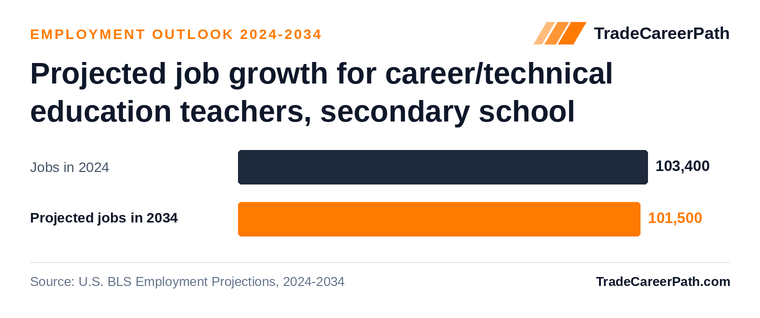
BLS projects employment of career/technical education teachers, secondary school to change -0.4% from 2025 to 2035 - from 110,500 to 110,100 jobs (BLS Employment Projections, 2025-35). Read that carefully before it scares you off: the same projection counts about 6,400 openings per year from retirements and occupational exits. Replacement demand - not growth - is what hires people here, and the retirement wave is exactly why states run alternative certification routes to recruit tradespeople.
Wages are moving the right direction: the occupation’s 2024 median of $63,910 rose to $66,270 in the May 2025 OEWS data. And the hiring picture beats the topline, because openings concentrate in the subjects hardest to staff - a certified welding, electrical, or HVAC instructor is scarce, which gives trade-experienced candidates an edge on placement and schedule credit.
Cost and Time to Complete the Degree
For CTE teachers, the credential is: Bachelor’s in career & technical education or your trade field + teacher certification. Several states issue provisional CTE certificates on trade experience alone, letting you teach and earn while finishing the bachelor’s; check your state board before assuming you need the degree first. A bachelor’s is typically 120 credit hours - four years full-time, five to six part-time - but transfer credit is the tradesperson’s lever: prior college, military training, apprenticeship coursework, and industry certifications can be worth meaningful credit at transfer-friendly schools. Costs vary widely by school type; in-state public online programs are usually the value benchmark, and some states offer tuition support for CTE teachers in shortage areas.
Pros and Cons of Training as a CTE Teacher (Shop Teacher)
Pros
- Median pay of $66,270 nationally (BLS OEWS, May 2025)
- Field experience from the trades is a genuine hiring advantage
- About 6,400 openings per year from replacement demand, concentrated in hard-to-staff trade subjects
- Accredited online and hybrid degree paths exist for working adults
Cons
- Requires a 4-year degree (typically 120 credit hours) for full licensure in most states
- Entry-level pay starts near $50,040 at the 10th percentile
- Licensing hurdle: State teaching certificate; many states offer alternative CTE routes crediting trade experience
- BLS projects a -0.4% employment change through 2035; plan around replacement demand
Frequently Asked Questions
Can I teach my trade without a degree?
Some states issue provisional CTE certificates on trade experience alone, but a bachelor's is required for full licensure and pay-scale placement in most - BLS lists it as the typical entry-level education, and BLS projects a small employment decline for the occupation overall.
How much do CTE teachers make?
The national median annual wage for career/technical education teachers, secondary school is $66,270 (BLS OEWS, May 2025). The top 10% earn $101,340 or more, while entry-level pay starts around $50,040.
What is the job outlook for CTE teachers?
BLS projects employment of career/technical education teachers, secondary school to change by -0.4% from 2025 to 2035 (BLS Employment Projections, 2025-35).
How long does CTE teacher training take?
If your state offers a trade-experience route, you can often start teaching on a provisional certificate within months and finish coursework while working. The full bachelor's path is typically 120 credit hours - four years full-time, commonly five to six part-time - and transfer credit for prior college, military training, or apprenticeship coursework can cut that down substantially.
Is teaching harder than working the trade?
It is a different kind of hard. The physical toll drops, but classroom management, lesson planning, grading, and documentation replace it. Most tradespeople who make the switch say the first year is the hardest - once your curriculum and shop routines are built, the job settles into a rhythm the trade rarely offered.
Should I get a CTE degree or a bachelor's in my trade field?
For most working tradespeople, a bachelor's in career and technical education or workforce education is the more direct buy - it is built around certification requirements and often awards credit for trade experience. A degree in your trade field works too, but usually requires adding pedagogy coursework for licensure. Check what your state board accepts before enrolling.
Do CTE teachers need a license?
Yes - public schools require a state teaching certificate. The good news for tradespeople is that most states run CTE-specific certification routes that credit documented years in your trade toward the credential, often alongside exams and pedagogy coursework rather than a traditional education degree.
Where do CTE teachers earn the most?
Washington ($101,180), Connecticut ($100,810), and Massachusetts ($98,020) post the highest state median wages for CTE teachers, all well above the $66,270 national median (BLS OEWS, May 2025). Texas employs by far the most - 32,250 - at a $64,610 median.
CTE Teacher (Shop Teacher) Salary and Requirements by State
Alabama · Alaska · Arizona · Arkansas · California · Colorado · Connecticut · Delaware · Florida · Georgia · Idaho · Illinois · Indiana · Iowa · Kansas · Kentucky · Louisiana · Maine · Maryland · Massachusetts · Michigan · Minnesota · Mississippi · Missouri · Montana · Nebraska · Nevada · New Hampshire · New Jersey · New Mexico · New York · North Carolina · North Dakota · Ohio · Oklahoma · Oregon · Pennsylvania · Rhode Island · South Carolina · South Dakota · Tennessee · Texas · Utah · Vermont · Virginia · Washington · West Virginia · Wisconsin · Wyoming
Related Careers and Degree Paths
- Construction Manager - the classic degree move for tradespeople who would rather run jobs than teach them
- Health and Safety Engineer - shop-floor safety experience turned into a degree-track specialty
- Facilities Manager - multi-trade knowledge applied to running buildings
- Substance Abuse Counselor - another helping-profession pivot with state-credential routes
- All trade careers that require a 4-year degree
Degree and Program Guides
- Online Teaching and CTE Degrees - how trade experience substitutes for the traditional education path
Sources
- U.S. Bureau of Labor Statistics, Occupational Employment and Wage Statistics (OEWS), May 2025 - Career/Technical Education Teachers, Secondary School (SOC 25-2032)
- U.S. Bureau of Labor Statistics, Employment Projections, 2025-35
- U.S. Bureau of Labor Statistics, Occupational Outlook Handbook - education and licensing requirements
Cte Teacher Salary by State
About this guide: Researched and written by the TradeCareerPath Editorial Team. Our editorial team researches and sources every trade school and career guide using federal labor and education data, including BLS OEWS and Employment Projections, DOL apprenticeship records, IPEDS, College Scorecard, and state licensing boards. We follow the editorial standards documented at /editorial-policy/.
Data sources
Figures on this page are sourced from the federal and state datasets below. Methodology: how we rank and source data.
| Data | Provider | Vintage |
|---|---|---|
| Occupational Employment and Wage Statistics (OEWS) | U.S. Bureau of Labor Statistics | May 2025 |
| Employment Projections | U.S. Bureau of Labor Statistics | 2025-2035 |
| Integrated Postsecondary Education Data System | National Center for Education Statistics (IPEDS) | 2024 |
| College Scorecard (school-level outcomes) | U.S. Department of Education | latest release |
| College Scorecard (field-of-study earnings) | U.S. Department of Education | latest release (updated 2026-06-12) |
| Occupational licensing requirements | CareerOneStop (U.S. Department of Labor) | latest release (updated 2026-02-22) |
| Registered apprenticeship programs | CareerOneStop / Apprenticeship.gov (U.S. Department of Labor) | latest release (updated 2025-10-25) |
| O*NET occupation profiles (skills, tasks, tools, job zones) | U.S. Department of Labor (O*NET / Employment & Training Admin.) | O*NET 31.0 (updated 2026-10-14) |