
How to Become a Culinary Chef in 2026
Is Culinary Chef Right for You?
The U.S. Department of Labor's O*NET profile for Chefs and Head Cooks (SOC 35-1011) describes the work this way: Direct and may participate in the preparation, seasoning, and cooking of salads, soups, fish, meats, vegetables, desserts, or other foods. May plan and price menu items, order supplies, and keep records and accounts.
What the work involves
- Monitor sanitation practices to ensure that employees follow standards and regulations.
- Check the quality of raw or cooked food products to ensure that standards are met.
- Determine production schedules and staff requirements necessary to ensure timely delivery of services.
- Check the quantity and quality of received products.
- Supervise or coordinate activities of cooks or workers engaged in food preparation.
Skills and knowledge that matter
Skills: Coordination, Time Management, Speaking, Monitoring, Critical Thinking, Active Listening.
Knowledge: Food Production, Customer and Personal Service, Production and Processing, Administration and Management.
Tools and technology you may use
Tools: Apple corers, Blast chillers, Blenders, Bone saws, Boning knives, Box graters.
Technology: Time accounting software, Analytical or scientific software, Data base user interface and query software, Facebook, Google Sheets, Microsoft Excel.
Typical preparation
O*NET Job Zone Three (Medium Preparation Needed). Most occupations in this zone require training in vocational schools, related on-the-job experience, or an associate's degree. Employees in these occupations usually need one or two years of training involving both on-the-job experience and informal training with experienced workers. A recognized apprenticeship program may be associated with these occupations.
Interest fit
O*NET interest profile: Enterprising, Realistic, Conventional. People who enjoy starting projects, leading others, and making decisions often find this occupation a good fit.
Source: O*NET 29.1 (updated 2026-06-13)
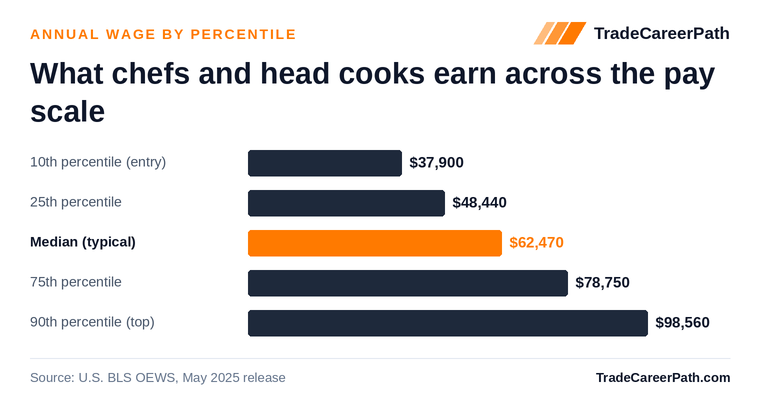
Quick answer: Training as a culinary chef usually takes 6 months to 2 years of training plus hands-on kitchen time. You complete a certificate or associate degree in culinary arts (costs vary by program and school), build experience as a prep or line cook, and can earn voluntary credentials such as a ServSafe food safety certificate or the American Culinary Federation Certified Culinarian (CC). No college degree is required, and cooking professionally generally does not require a license, though local food safety rules may. The median chef and head cook salary is $62,470 per year ($30.03/hour), and employers post about 24,400 openings nationwide each year (BLS, May 2025).
Culinary chefs plan menus, run kitchens, and lead cooks to put out consistent, high-quality food in restaurants, hotels, and catering operations. If you enjoy hands-on work, creativity, and leading a team under pressure, it is a career you can enter without a four-year degree.
Interested in the baking side of the kitchen? Check out our Pastry Chef Career Guide.
How to Become a Culinary Chef
Most chefs reach the role through a mix of training and kitchen experience over six months to two years and beyond. There is no single national license to cook professionally. Instead, you build the career through culinary education, hands-on practice, food safety certification, and steady advancement.
1. Earn a high school diploma or GED
A high school diploma or GED is the baseline for most culinary arts programs and for many entry-level kitchen jobs. Before you enroll, the most useful preparation is practical: basic math for scaling recipes and managing food costs, science for understanding how heat and ingredients behave, and any hands-on or shop class that builds comfort working with your hands and following procedures. Time management and the ability to stay calm under pressure matter as much as cooking talent, since kitchens move fast during service. If you are changing careers and already hold a diploma or a degree in another field, you can move straight to training or even start cooking in an entry-level role. Many strong chefs come from unrelated backgrounds and bring useful skills in organization, budgeting, and team leadership.
2. Complete a culinary arts program
Formal training gives chefs a competitive edge and a faster path to lead roles. You have several formats to choose from:
- Certificate programs focus on professional cooking, sanitation, and core techniques and are popular with people who want to enter the field quickly.
- Associate degree programs combine general education with culinary coursework and management training, and are a common route toward chef and supervisory roles.
- Community college programs often offer culinary arts or hospitality tracks at a lower cost.
When comparing schools, look for accreditation from the Accrediting Commission of the American Culinary Federation Education Foundation (ACFEFAC), which reviews culinary degree and certificate programs against recognized standards. Typical coursework covers knife skills, cooking methods, baking basics, food safety and sanitation, nutrition, menu planning, and kitchen and cost management. Some programs include an externship in a working kitchen. Compare tuition, program length, and equipment fees, and ask about financial aid before you enroll.
3. Gain hands-on kitchen experience
Coursework prepares you, but employers want proven kitchen experience. Start as a prep cook or line cook to build speed, knife skills, and station knowledge under experienced chefs. Many of the best chefs say they learned the most on the job, working different stations such as grill, saute, and pantry to understand how a full kitchen runs during service. Volunteer for catering events, stage (do a trial shift) at restaurants you admire, and take on more responsibility as you prove you can keep up. Track the dishes and techniques you master so you can speak to them in interviews. Real service experience, more than any single class, is what moves you from cook to chef.
4. Earn food safety and professional certification
Certification is voluntary in most cases, but it strengthens your resume and is sometimes required by local food safety rules. Start with a ServSafe food handler or manager certificate, which many employers and jurisdictions expect for anyone running a kitchen. For professional recognition, the American Culinary Federation (ACF) issues a ladder of credentials, from Certified Culinarian (CC) through Certified Chef de Cuisine (CCC) and up to Certified Master Chef (CMC). Each ACF credential generally combines education, work experience, and exams, so they reward both training and time in real kitchens. Check your local health department for food safety certificate rules before you take on a head-cook or management role.
5. Advance into chef and management roles
Restaurants, hotels, resorts, catering companies, and private households all hire culinary talent. With experience and any certifications you have earned, you can move from line cook to sous chef, then to executive chef or kitchen manager, taking on menu design, staffing, budgeting, and food cost control. Some chefs specialize in a cuisine or move into catering, personal cheffing, food consulting, or culinary instruction. Others open their own restaurant or catering business. Networking through industry events and culinary associations helps you hear about openings and learn from established chefs as you advance.
What Does a Culinary Chef Do?
Culinary chefs are responsible for the creation, preparation, and presentation of food in restaurants, hotels, catering operations, and private kitchens. They lead teams, design menus, and manage the flow of the kitchen so each dish goes out accurate and on time.
Typical responsibilities include:
- Designing menus and new dishes
- Supervising kitchen staff and line cooks
- Overseeing food safety and quality control
- Managing budgets, inventory, and suppliers
- Training new kitchen employees
- Ensuring consistency and customer satisfaction
Culinary chefs may specialize in specific cuisines, or advance to executive chef, kitchen manager, or culinary director roles.
Skills That Make a Great Chef
- Strong leadership and communication
- Creativity and attention to detail
- Excellent time management
- Knowledge of food safety and nutrition
- Stamina and stress management in busy kitchens
If you thrive under pressure and enjoy turning raw ingredients into finished plates, this field rewards that energy.
Culinary Training Options
Formal training gives chefs a competitive edge in a fast-moving industry. Options include:
- Culinary Schools - Focus on professional cooking, sanitation, and global cuisine
- Community Colleges - Offer culinary arts or hospitality programs, often at lower cost
- Apprenticeships - Learn while you earn under professional chefs
- Online Culinary Courses - Study techniques, plating, and kitchen management remotely, usually paired with hands-on labs
Costs vary by program and school, so compare tuition, length, and equipment fees before enrolling.
Certifications for Culinary Chefs
While not mandatory to cook, professional certifications demonstrate expertise and can open doors to advancement.
Common credentials include:
- ServSafe Food Handler / Manager food safety certification
- ACF Certified Culinarian (CC)
- ACF Certified Chef de Cuisine (CCC)
Many restaurants and hotels prefer chefs who hold food safety certification and have solid kitchen experience.
Culinary Chef Career Paths
With experience, you can specialize or advance into higher positions like:
- Sous Chef / Executive Chef
- Catering or Banquet Chef
- Private Chef or Consultant
- Restaurant Owner / Manager
- Culinary Instructor
Pros and Cons of the Culinary Profession
Pros
- Creative and hands-on work
- International career potential
- No traditional college degree required
- Opportunities to lead teams or own a business
Cons
- Long hours, nights, and weekends
- Physically demanding
- Constant pressure to maintain consistency and quality
Quick Facts: Chef Salary, Education, and Outlook
Start Your Culinary Journey
Training as a chef takes passion, patience, and precision. It can lead to kitchen and management jobs for people who love to cook and lead a team.

Industry Organizations & Certifying Bodies
These are the recognized national organizations, unions, certifying bodies, and regulatory authorities that shape this trade. They issue the credentials, sponsor the apprenticeships, publish the codes, and represent workers and employers.
- American Culinary Federation (ACF) Issues the Certified Culinarian (CC) through Certified Master Chef (CMC) credentials.
- Accrediting Commission of the American Culinary Federation Education Foundation (ACFEFAC) Accredits culinary degree and certificate programs.
Wage and Employment Charts
Culinary Professional Salary and Requirements by State
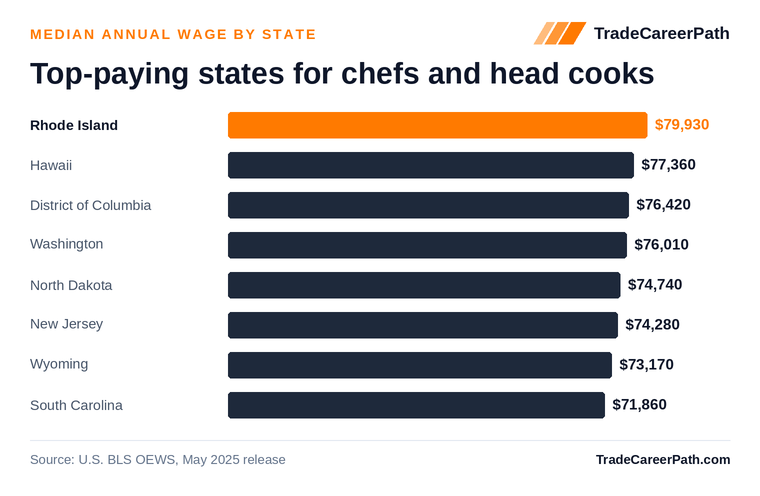
Select your state for local wage data, training options, and requirements:
Alabama · Alaska · Arizona · Arkansas · California · Colorado · Connecticut · Delaware · District of Columbia · Florida · Georgia · Hawaii · Idaho · Illinois · Indiana · Iowa · Kansas · Kentucky · Louisiana · Maine · Maryland · Massachusetts · Michigan · Minnesota · Mississippi · Missouri · Montana · Nebraska · Nevada · New Hampshire · New Jersey · New Mexico · New York · North Carolina · North Dakota · Ohio · Oklahoma · Oregon · Pennsylvania · Rhode Island · South Carolina · South Dakota · Tennessee · Texas · Utah · Vermont · Virginia · Washington · West Virginia · Wisconsin · Wyoming
Workplace Safety Snapshot
BLS Survey of Occupational Injuries and Illnesses data (2023-2024) report approximately 213.1 days-away, restricted, or transfer cases per 10,000 full-time-equivalent workers in chefs and head cooks (about 2.13 per 100 FTE). Source: BLS Survey of Occupational Injuries and Illnesses, Table R98.
Frequently Asked Questions
How long does chef training take?
It typically takes 6 months to 2 years of training. The most common entry path is a certificate or associate degree in culinary arts. A high school diploma or GED is generally required to get started, and many chefs build additional skills through years of kitchen experience.
Do you need a college degree to work as a chef?
No. A college degree is not required to work as a chef. Most people enter the field through a certificate or associate degree program, and many learn on the job starting as prep or line cooks. A high school diploma or GED is typically the only educational prerequisite.
How much does culinary training cost?
Culinary program costs vary widely by school and format, from short community college certificates to longer degree programs at dedicated culinary schools. Compare tuition, length, and equipment fees, and ask each school about financial aid before you enroll.
Is certification required to work as a chef?
Certification is voluntary in most cases, not legally required to cook professionally. Many employers value credentials such as the American Culinary Federation (ACF) Certified Culinarian (CC) or Certified Chef de Cuisine (CCC), along with a ServSafe food safety certification. Local food safety rules may require a food handler or manager certificate.
Is it hard to train as a chef?
Entry is accessible because no degree or license is required, and many cooks start in entry-level kitchen roles. The work itself is demanding, with long hours, nights and weekends, fast-paced service, and physical stamina required to keep up in a busy kitchen.
Can you study culinary arts online?
You can study some culinary topics online, including techniques, food science, and kitchen management. Because cooking is hands-on, most programs combine online coursework with in-person kitchen labs or a supervised externship so you build real knife and station skills.
What is the difference between a chef and a cook?
A cook prepares food following recipes and instructions, often at a single station. A chef leads the kitchen, designs menus, manages staff and food costs, and is responsible for quality and consistency. Many chefs start as cooks and move up with experience and training.
How Culinary Chef Pay Compares to Similar Trades
Side-by-side comparison of Culinary Arts and the closest related careers, based on U.S. Bureau of Labor Statistics data (May 2025 OEWS + 2024-2034 Employment Projections).
| Career | Median Pay | 10-Year Growth | Annual Openings |
|---|---|---|---|
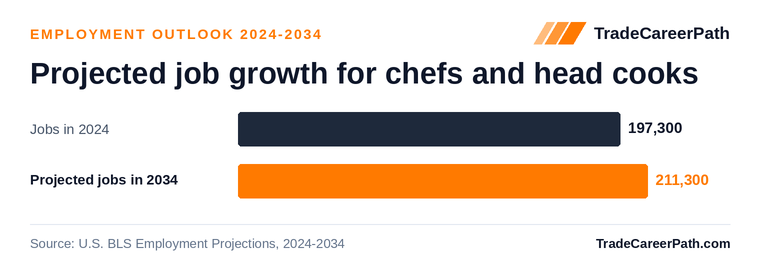
| Culinary Arts this guide | $62,470 | +7.1% | 24,400 |
| Pastry Arts | $37,160 | +5.6% | 39,900 |
Source: BLS Occupational Employment and Wage Statistics + BLS Employment Projections.
Advance Your Career with a Degree
Experienced Culinary Chef professionals often step up into degree-track careers where field experience is a hiring advantage:
- Food Scientist - median pay $88,720 (BLS OEWS, May 2025); requires a 4-year degree
See all trade careers that require a 4-year degree.
Sources
- U.S. Bureau of Labor Statistics, Occupational Employment and Wage Statistics (May 2025)
- U.S. Bureau of Labor Statistics, Employment Projections 2024-2034
- U.S. Bureau of Labor Statistics, Survey of Occupational Injuries and Illnesses (2023-2024, Table R98)
- U.S. Department of Labor, Wage and Hour Division, Davis-Bacon General Wage Determinations (2026)
Culinary Chef Salary by State
About this guide: Researched and written by the TradeCareerPath Editorial Team. Our editorial team researches and sources every trade school and career guide using federal labor and education data, including BLS OEWS and Employment Projections, DOL apprenticeship records, IPEDS, College Scorecard, and state licensing boards. We follow the editorial standards documented at /editorial-policy/.
Data sources
Figures on this page are sourced from the federal and state datasets below. Methodology: how we rank and source data.
| Data | Provider | Vintage |
|---|---|---|
| Occupational Employment and Wage Statistics (OEWS) | U.S. Bureau of Labor Statistics | May 2025 |
| Employment Projections | U.S. Bureau of Labor Statistics | 2024-2034 |
| Integrated Postsecondary Education Data System | National Center for Education Statistics (IPEDS) | 2024 |
| College Scorecard (school-level outcomes) | U.S. Department of Education | latest release |
| College Scorecard (field-of-study earnings) | U.S. Department of Education | latest release (updated 2026-06-12) |
| Occupational licensing requirements | CareerOneStop (U.S. Department of Labor) | latest release (updated 2026-02-22) |
| Registered apprenticeship programs | CareerOneStop / Apprenticeship.gov (U.S. Department of Labor) | latest release (updated 2025-10-25) |
| O*NET occupation profiles (skills, tasks, tools, job zones) | U.S. Department of Labor (O*NET / Employment & Training Admin.) | O*NET 29.1 (updated 2026-06-13) |