
How to Become a Dental Assistant in 2026
Is Dental Assistant Right for You?
The U.S. Department of Labor's O*NET profile for Dental Assistants (SOC 31-9091) describes the work this way: Perform limited clinical duties under the direction of a dentist. Clinical duties may include equipment preparation and sterilization, preparing patients for treatment, assisting the dentist during treatment, and providing patients with instructions for oral healthcare procedures. May perform administrative duties such as scheduling appointments, maintaining medical records, billing, and coding information for insurance purposes.
What the work involves
- Prepare patient, sterilize or disinfect instruments, set up instrument trays, prepare materials, or assist dentist during dental procedures.
- Record treatment information in patient records.
- Assist dentist in management of medical or dental emergencies.
- Order and monitor dental supplies and equipment inventory.
- Expose dental diagnostic x-rays.
Skills and knowledge that matter
Skills: Active Listening, Speaking, Reading Comprehension, Active Learning, Monitoring, Social Perceptiveness.
Knowledge: Customer and Personal Service, Medicine and Dentistry, English Language, Administration and Management.
Tools and technology you may use
Technology: Electronic mail software, Medical software, Spreadsheet software, Henry Schein Dentrix, Microsoft Excel, Microsoft Office software.
Typical preparation
O*NET Job Zone Three (Medium Preparation Needed). Most occupations in this zone require training in vocational schools, related on-the-job experience, or an associate's degree. Employees in these occupations usually need one or two years of training involving both on-the-job experience and informal training with experienced workers. A recognized apprenticeship program may be associated with these occupations.
Interest fit
O*NET interest profile: Conventional, Realistic, Social. People who enjoy structured, detail-oriented work with clear procedures and data often find this occupation a good fit.
Source: O*NET 31.0 (updated 2026-10-14)
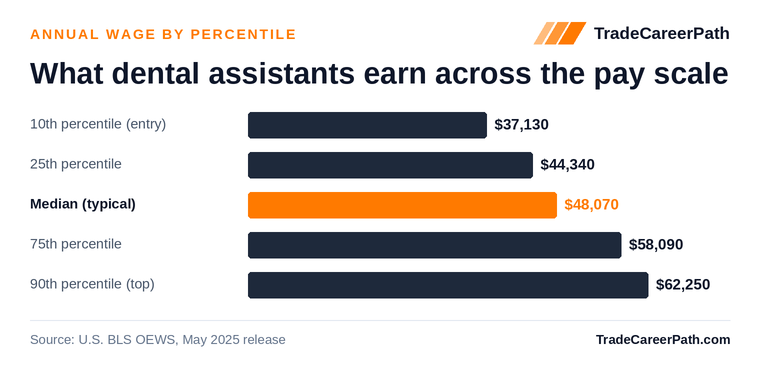
Quick answer: Training as a dental assistant usually takes 6 months to 2 years. You complete a certificate or associate degree program, build hands-on chairside experience through an externship or paid on-the-job training, and, depending on your state, earn a credential such as the DANB Certified Dental Assistant (CDA) or a radiography permit. Many states require certification or registration for clinical tasks, while others allow on-the-job training. The median dental assistant salary is $48,070 per year ($23.11/hour), and employers post about 53,000 openings nationwide each year (BLS, May 2025).
Dental assistants support dentists and hygienists with both clinical and front-office work, from preparing patients and sterilizing instruments to taking X-rays and managing records. It is one of the faster ways into healthcare, since many training programs take less than a year. This guide covers training, certification, and common state requirements.
How to Become a Dental Assistant
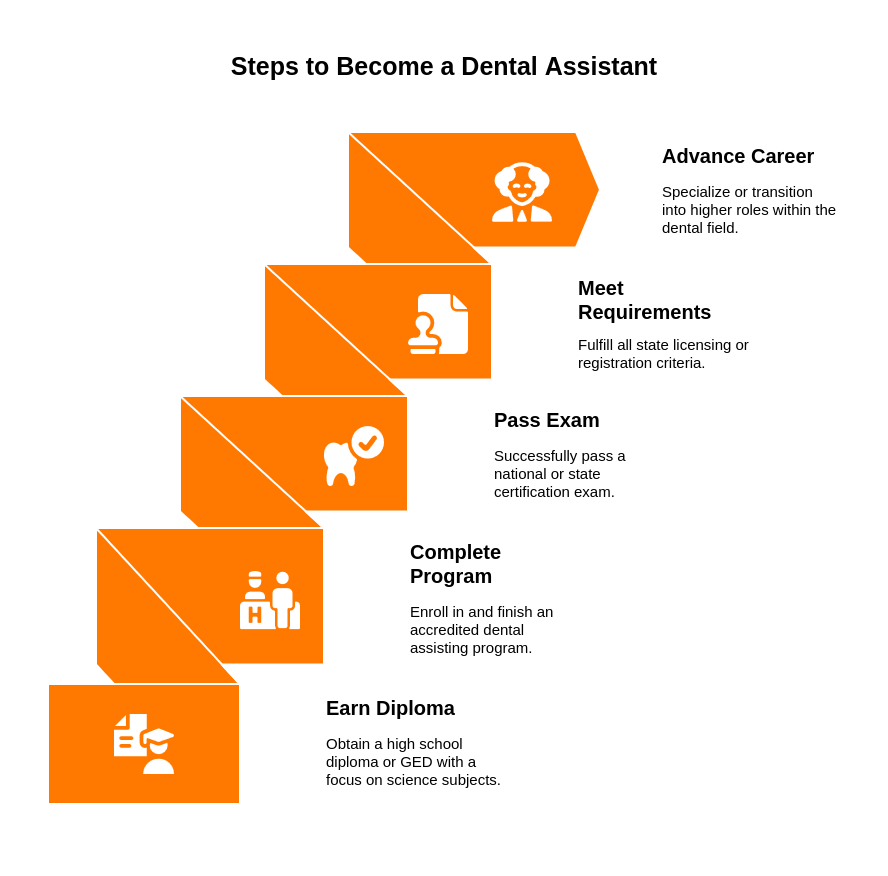
Most people enter the field in about six months to two years, depending on the training path they choose. State rules vary, so part of the process is confirming what your state requires before you start performing clinical tasks.
1. Earn a high school diploma or GED
A high school diploma or GED is the baseline requirement for dental assisting programs and almost every entry-level job in a dental office. Before you enroll, it helps to build a foundation in the subjects the work depends on. Biology and chemistry give you the science behind anatomy, materials, and infection control, while health science courses introduce medical terminology you will use every day. Comfort with computers matters too, since modern practices run on scheduling software, digital X-rays, and electronic patient records. If you are changing careers and already hold a diploma or a degree, you can move straight to training. Many strong dental assistants come from customer-service or other healthcare backgrounds and bring useful skills in communication, organization, and working calmly with anxious patients.
2. Complete a dental assisting program
This is the core credential, and you have a few formats to choose from. Certificate or diploma programs typically take under a year and are the most popular route, while associate degree programs take about two years and add general-education credits. When comparing schools, look for accreditation from the Commission on Dental Accreditation (CODA), which signals the program meets recognized standards and is often preferred by employers and required for some certification paths. Coursework usually covers dental anatomy and terminology, radiography, infection control and sterilization, chairside assisting, dental materials, and patient communication. A good program also includes a clinical or externship component so you practice real procedures under supervision. Classroom material may be available online, but the hands-on clinical training must be completed in person, so confirm how a program delivers that part before you enroll.
3. Gain hands-on clinical experience
Coursework gets you started, but employers want to see that you can work chairside. An externship, which many CODA-accredited programs build into the curriculum, lets you assist with cleanings and procedures, mix materials, take X-rays, and manage instruments under supervision. If you are entering through on-the-job training instead of a formal program, an entry-level role in a dental office gets you inside the workflow and earning while you learn. Many practices hire new assistants directly and pay for certification exam fees after a probation period. Use this time to get comfortable with the pace of a clinic, the sterilization routine, and the way a strong assistant anticipates what the dentist needs next, which is the skill that makes you valuable.
4. Earn certification or meet state requirements
Requirements differ a lot from state to state, so check your state dental board first. Many states require certification, registration, or a radiography permit before you can perform specific clinical tasks such as taking X-rays or coronal polishing, while others allow on-the-job training. The most widely recognized national credential is the Certified Dental Assistant (CDA) from the Dental Assisting National Board (DANB), which also offers component exams in radiation health and safety and infection control. Earning the CDA can strengthen your resume and is accepted toward licensure in many states. Confirm the exact exams, permits, and renewal rules your state expects, since these determine which duties you can legally take on.
5. Advance your career
Dental offices, group practices, specialty clinics, and public-health programs all hire dental assistants. Once you have experience, you can grow in several directions. Earning expanded-functions credentials (EFDA) where your state allows them lets you take on more clinical duties and higher pay. Others move into office management or treatment coordination, or use their experience as a stepping stone toward dental hygiene or other healthcare programs. Staying active with a professional group such as the American Dental Assistants Association (ADAA) gives you continuing education and networking that help you find better roles over time.
What Dental Assistants Do
Dental assistants perform both clinical and administrative duties that support dentists, hygienists, and patients. Their work keeps a practice running smoothly, lets the dentist focus on treatment, and helps patients feel comfortable during care.
Typical Responsibilities
- Prepare patients for treatment and explain procedures
- Assist dentists during cleanings and procedures
- Sterilize instruments and maintain equipment
- Take and process X-rays
- Manage patient records and appointments
- Educate patients on oral hygiene
Many assistants also handle specialized functions such as coronal polishing or impression taking, depending on state regulations.
Key Skills and Traits for Success
- Steady hand and attention to detail
- Clear communication and empathy with patients
- Ability to multitask under pressure
- Comfort with dental tools and technology
- Strong sense of cleanliness and organization
Work Settings for Dental Assistants
Dental assistants can work in many environments including:
- General and family dental practices
- Specialty offices such as orthodontics, oral surgery, or periodontics
- Group and corporate dental practices
- Public-health clinics and community health centers
- Hospital and university dental departments
Education and Certification Paths
| Pathway | Typical Duration | Outcome |
|---|---|---|
| Certificate or Diploma | Under a year | Most common entry credential |
| Associate Degree | About 2 years | Adds general-education credits |
| On-the-Job Training | Varies by employer | Allowed in some states for certain tasks |
| DANB Certified Dental Assistant (CDA) | Exam-based | National credential accepted toward licensure in many states |
Program costs vary by school and format, so compare tuition, length, and whether the clinical portion is included before you enroll.
Career Growth and Advancement
With experience, dental assistants may move into roles such as:
- Expanded Functions Dental Assistant (EFDA) where state rules allow expanded clinical duties
- Office Manager or Treatment Coordinator overseeing scheduling and operations
- Lead or Senior Dental Assistant mentoring newer staff
- Dental Hygienist for those who continue their education
Cost and Duration of Training
- Time to complete: under a year for a certificate, about two years for an associate degree
- Program cost: varies by program and school, so request tuition details and confirm what is included
- Certification: many offices cover DANB exam fees after a probation period
Many programs deliver classroom material online, but the clinical training must be completed in person.
Pros and Cons
Pros
- Quick entry, often under a year of training
- Patient-facing, hands-on work in healthcare
- Clear paths to advancement and higher pay
- No four-year degree required
Cons
- Long hours on your feet
- Exposure to clinical and infection-control environments
- Certification and permit renewals on a regular cycle
Quick Facts: Dental Assistant Salary, Education, and Outlook
Take the First Step Toward a Dental Assisting Career
If you enjoy working with people, have a steady hand, and want a stable, hands-on role in healthcare, dental assisting offers a fast path into the field. Whether you start fresh or pivot from another job, you can take the first step today.
Industry Organizations & Certifying Bodies
These are the recognized national organizations, unions, certifying bodies, and regulatory authorities that shape this trade. They issue the credentials, sponsor the apprenticeships, publish the codes, and represent workers and employers.
- Dental Assisting National Board (DANB) Issues the Certified Dental Assistant (CDA) credential.
- American Dental Assistants Association (ADAA) Professional association for dental assistants.
- Commission on Dental Accreditation (CODA) Accredits dental-assisting education programs.
Wage and Employment Charts
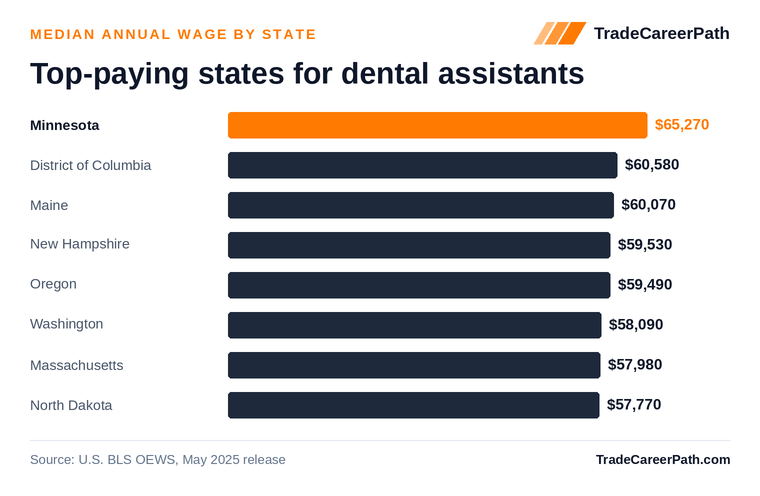
Dental Assistant Salary and Requirements by State
Select your state for local wage data, training options, and requirements:
Alabama · Alaska · Arizona · Arkansas · California · Colorado · Connecticut · Delaware · District of Columbia · Florida · Georgia · Hawaii · Idaho · Illinois · Indiana · Iowa · Kansas · Kentucky · Louisiana · Maine · Maryland · Massachusetts · Michigan · Minnesota · Mississippi · Missouri · Montana · Nebraska · Nevada · New Hampshire · New Jersey · New Mexico · New York · North Carolina · North Dakota · Ohio · Oklahoma · Oregon · Pennsylvania · Rhode Island · South Carolina · South Dakota · Tennessee · Texas · Utah · Vermont · Virginia · Washington · West Virginia · Wisconsin · Wyoming
Workplace Safety Snapshot
BLS Survey of Occupational Injuries and Illnesses data (2023-2024) report approximately 33.1 days-away, restricted, or transfer cases per 10,000 full-time-equivalent workers in dental assistants (about 0.33 per 100 FTE). Source: BLS Survey of Occupational Injuries and Illnesses, Table R98.
Frequently Asked Questions
How long does dental assistant training take?
It typically takes 6 months to 2 years of training. The most common entry path is a certificate program (under a year) or an associate degree (about 2 years). A high school diploma or GED is generally required to get started.
Do you need a college degree to work as a dental assistant?
No. A college degree is not required to work as a dental assistant. Most people enter the field through a certificate or associate degree program, and some learn through on-the-job training. A high school diploma or GED is typically the only educational prerequisite.
Is certification required to be a dental assistant?
Requirements vary by state. Many states require certification, a radiography permit, or registration for certain clinical tasks, while others allow on-the-job training. The Certified Dental Assistant (CDA) from the Dental Assisting National Board (DANB) is the most widely recognized national credential.
How many dental assistants work in the United States?
BLS reports approximately 387,790 dental assistants employed nationwide as of May 2025.
Is dental assistant a growing career?
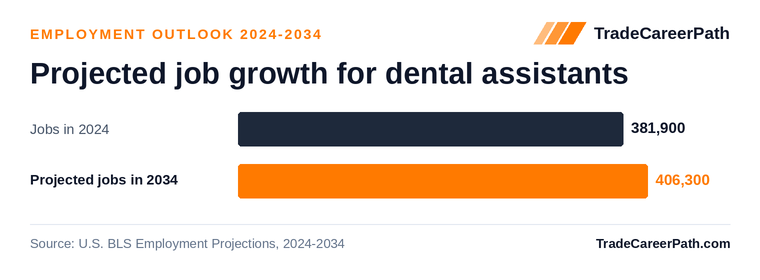
Yes. BLS projects 7.4% employment growth for dental assistants between 2024 and 2034, with employers expected to post about 53,000 openings nationwide each year over that period.
How much does a dental assistant make?
The median dental assistant wage is $48,070 per year, or about $23.11 per hour (BLS, May 2025). The lowest 10 percent earned around $37,130 and the highest 10 percent earned around $62,250.
Can you train as a dental assistant online?
Some programs offer classroom coursework online, but dental assisting requires hands-on clinical training that must be completed in person or through a supervised externship. Look for a program with accreditation from the Commission on Dental Accreditation (CODA) and confirm how the clinical portion is delivered before enrolling.
How Dental Assistant Pay Compares to Similar Trades
Side-by-side comparison of Dental Assistant and the closest related careers, based on U.S. Bureau of Labor Statistics data (May 2025 OEWS + 2025-2035 Employment Projections).
| Career | Median Pay | 10-Year Growth | Annual Openings |
|---|---|---|---|
| Dental Assistant this guide | $48,070 | +7.4% | 53,000 |
| Medical Assistant | $45,690 | +12.9% | 109,700 |
| Optician Certification Programs | $47,260 | +4.2% | 5,600 |
| Phlebotomy Technician | $45,230 | +6.8% | 18,000 |
| Surgical Technologist | $64,650 | +5.0% | 7,100 |
Source: BLS Occupational Employment and Wage Statistics + BLS Employment Projections.
Degree and Program Guides
- Online Dental Hygiene Programs - the licensed step up from chairside assisting
Sources
- U.S. Bureau of Labor Statistics, Occupational Employment and Wage Statistics (May 2025)
- U.S. Bureau of Labor Statistics, Employment Projections 2025-2035
- U.S. Bureau of Labor Statistics, Survey of Occupational Injuries and Illnesses (2023-2024, Table R98)
- U.S. Department of Labor, Wage and Hour Division, Davis-Bacon General Wage Determinations (2026)
Dental Assistant Salary by State
About this guide: Researched and written by the TradeCareerPath Editorial Team. Our editorial team researches and sources every trade school and career guide using federal labor and education data, including BLS OEWS and Employment Projections, DOL apprenticeship records, IPEDS, College Scorecard, and state licensing boards. We follow the editorial standards documented at /editorial-policy/.
Data sources
Figures on this page are sourced from the federal and state datasets below. Methodology: how we rank and source data.
| Data | Provider | Vintage |
|---|---|---|
| Occupational Employment and Wage Statistics (OEWS) | U.S. Bureau of Labor Statistics | May 2025 |
| Employment Projections | U.S. Bureau of Labor Statistics | 2025-2035 |
| Integrated Postsecondary Education Data System | National Center for Education Statistics (IPEDS) | 2024 |
| College Scorecard (school-level outcomes) | U.S. Department of Education | latest release |
| College Scorecard (field-of-study earnings) | U.S. Department of Education | latest release (updated 2026-06-12) |
| Occupational licensing requirements | CareerOneStop (U.S. Department of Labor) | latest release (updated 2026-02-22) |
| Registered apprenticeship programs | CareerOneStop / Apprenticeship.gov (U.S. Department of Labor) | latest release (updated 2025-10-25) |
| O*NET occupation profiles (skills, tasks, tools, job zones) | U.S. Department of Labor (O*NET / Employment & Training Admin.) | O*NET 31.0 (updated 2026-10-14) |