
How to Become a Digital Court Reporter in 2026
Is Digital Court Reporter Right for You?
The U.S. Department of Labor's O*NET profile for Court Reporters and Simultaneous Captioners (SOC 27-3092) describes the work this way: Use verbatim methods and equipment to capture, store, retrieve, and transcribe pretrial and trial proceedings or other information. Includes stenocaptioners who operate computerized stenographic captioning equipment to provide captions of live or prerecorded broadcasts for hearing-impaired viewers.
What the work involves
- Provide transcripts of proceedings upon request of judges, lawyers, or the public.
- Record symbols on computer storage media and use computer aided transcription to translate and display them as text.
- Record verbatim proceedings of courts, legislative assemblies, committee meetings, and other proceedings, using computerized recording equipment, electronic stenograph machines, or stenomasks.
- Record depositions and other proceedings for attorneys.
- Ask speakers to clarify inaudible statements.
Skills and knowledge that matter
Skills: Active Listening, Writing, Reading Comprehension, Speaking, Monitoring, Critical Thinking.
Knowledge: English Language, Computers and Electronics, Administrative, Law and Government.
Tools and technology you may use
Technology: Data base user interface and query software, Enterprise resource planning ERP software, Word processing software, Microsoft Excel, Microsoft Office software, Microsoft Outlook.
Typical preparation
O*NET Job Zone Three (Medium Preparation Needed). Most occupations in this zone require training in vocational schools, related on-the-job experience, or an associate's degree. Employees in these occupations usually need one or two years of training involving both on-the-job experience and informal training with experienced workers. A recognized apprenticeship program may be associated with these occupations.
Interest fit
O*NET interest profile: Conventional, Artistic, Social. People who enjoy structured, detail-oriented work with clear procedures and data often find this occupation a good fit.
Source: O*NET 31.0 (updated 2026-10-14)
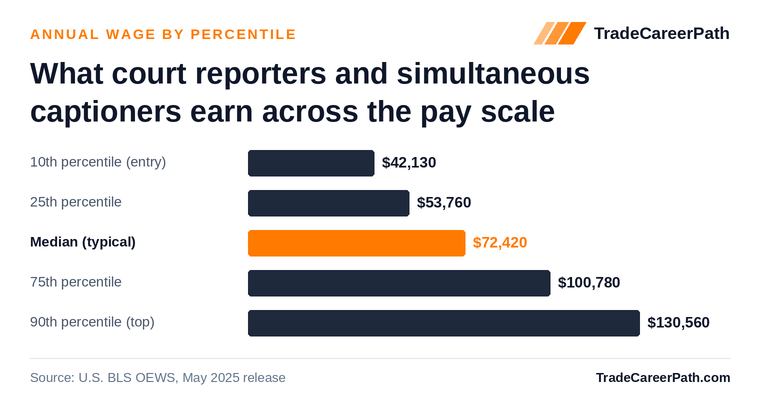
Quick answer: Training as a digital court reporter usually takes 6 months to 2 years through a certificate or associate degree program. You learn audio recording and transcription, get hands-on experience, and can earn an AAERT certification (CER or CET). Certification is often preferred rather than required, and there is no single national license. The median wage for court reporters and simultaneous captioners is $72,420 per year ($34.82/hour), with about 1,800 openings nationwide each year (BLS, May 2025).
Digital court reporters use audio recording systems and transcription software to capture and annotate legal proceedings. Unlike traditional stenographers, they focus on managing the digital recording setup, logging speakers, and making sure the official record meets legal standards.
How to Become a Digital Court Reporter
Most people enter the field in about six months to two years, depending on the program they choose. There is no single national license to pass. Instead, you build the career through training, hands-on experience, and an optional certification that many courts and agencies prefer.
1. Earn a high school diploma or GED
A high school diploma or GED is the baseline requirement for digital court reporting programs and for most entry-level legal jobs. Before you enroll, it helps to build the skills the work leans on. Strong listening, careful reading, and a solid vocabulary all matter because you will be capturing spoken testimony accurately and labeling who said what. English and government or civics classes give you a head start on legal language and courtroom structure. Comfort with computers is just as important, since the job runs on digital recording systems, audio software, and transcript editing tools. If you are changing careers and already hold a diploma or another degree, you can move straight to training. Many digital reporters come from administrative, customer service, or technical backgrounds and bring useful skills in organization, accuracy, and working under time pressure.
2. Complete a digital court reporting program
This is the core training, and you can usually choose between a certificate program or an associate degree. Certificate programs are shorter and popular with adults who already have a degree or work experience and want to move into legal work quickly. Associate degree programs take longer and combine general-education credits with reporting-specific coursework. Either way, expect to study legal terminology and courtroom procedure, audio and video recording technology, transcript formatting and editing, confidentiality, and professional ethics. You will spend real time operating recording equipment and cleaning up automated transcripts so the final record reads clearly and accurately. Many programs are available online, which lets working students learn at a flexible pace. Whatever format you choose, confirm the program’s accreditation and ask whether it includes a hands-on internship or externship before you enroll.
3. Gain hands-on experience
Coursework prepares you, but employers want to see that you can run a recording session from start to finish. Look for an internship or externship, which many programs build into the curriculum, so you can practice setting up equipment, monitoring audio quality, logging speakers in real time, and reviewing transcripts under supervision. If a formal placement is not available, entry-level roles with a court, a deposition service, or a transcription agency get you inside the workflow and earn you references. As you go, get comfortable troubleshooting audio problems on the spot, because a clear recording is the whole job. Save examples of clean, well-formatted transcripts you have produced, since hiring managers care more about accuracy and reliability than about which school you attended.
4. Earn AAERT certification
Certification is often preferred rather than legally required, but it can strengthen your resume and help you qualify for better positions. The most recognized credentials in digital reporting come from the American Association of Electronic Reporters and Transcribers (AAERT): the Certified Electronic Reporter (CER) for those running the recording in proceedings, and the Certified Electronic Transcriber (CET) for those producing the written transcript. Each credential tests the technical and procedural skills the role demands. Beyond AAERT, the National Court Reporters Association (NCRA) is a major professional body for the wider court reporting field and a useful source of training and networking. Requirements vary by court and state, so check local rules, since some courts add their own test, background check, or continuing-education expectations.
5. Apply for digital court reporting roles
Courthouses, deposition services, law firms, government agencies, and remote transcription companies all hire digital reporters. Tailor your resume to the setting you are targeting, highlight your training and any AAERT credential, and include examples of clean transcripts when you can. Networking through professional associations is one of the fastest ways to hear about openings, and freelance deposition work is a common way to build hours early on. Once you are established, experience and certification can move you into roles such as supervising reporter, trainer, certified transcriber or editor, or legal transcription manager, including fully remote positions as courts continue adopting digital and remote proceedings.
What Digital Court Reporters Actually Do
Digital court reporters produce verbatim records of legal proceedings using modern audio and video recording systems. They set up and monitor the equipment, keep track of who is speaking, and make sure the recording is clear and complete from gavel to gavel. After the proceeding, they help turn that audio into an accurate, properly formatted transcript that attorneys, judges, and the public can rely on.
Daily Responsibilities
- Set up and monitor recording equipment in courtrooms or deposition rooms
- Annotate proceedings and log speakers in real time
- Ensure clear, complete audio capture
- Manage transcript requests and review automated transcripts for accuracy
- Submit official recordings and documentation for legal use
The job combines technology, precision, and professionalism, and it offers a front-row seat to the legal system.
Skills That Make You Great at This
- Excellent listening and attention to detail
- Strong typing and computer proficiency
- Familiarity with legal terminology
- Discretion and professionalism
- Ability to focus in fast-paced environments
The best digital reporters are part technician, part editor, and part legal professional.
Where You’ll Work (and Grow)
Digital court reporters work in:
- Courthouses (state, federal, municipal)
- Deposition services and law firms
- Government agencies and hearings
- Freelance and remote transcription services
Career Growth Paths
- Certified Transcriber / Editor
- Supervising Reporter or Trainer
- Legal Transcription Manager
- Remote Digital Court Reporter
Certification and Licensing
Courts and agencies often prefer certification through AAERT (American Association of Electronic Reporters and Transcribers), which issues the Certified Electronic Reporter (CER) and Certified Electronic Transcriber (CET) credentials. Some courts add their own requirements, such as:
- Passing a state-administered test
- Submitting background checks
- Continuing education for renewal
Even when it is not required, certification helps you stand out and qualify for higher-paying positions.
Cost and Duration of Training
- Time to complete: about six months to two years, depending on whether you choose a certificate or an associate degree
- Program cost: varies by program and school, with certificate programs generally costing less than degree programs
- Format: many programs are available online for flexible, part-time study
Contact the schools you are considering for current tuition and start dates, and ask about financial aid.
Pros and Cons
Pros
- Demand supported by courts adopting digital and remote proceedings
- Work-from-home opportunities for transcription
- Relatively short training timeline
- Engaging legal environment with no law degree required
Cons
- Requires strong focus and accuracy under pressure
- Long sitting periods
- Exposure to sensitive or emotional content
Start Your Digital Court Reporting Career
If you are detail-oriented, tech-savvy, and drawn to the justice system, digital court reporting is a modern way to start a respected legal career without a law degree.
Industry Organizations & Certifying Bodies
These are the recognized national organizations, unions, certifying bodies, and regulatory authorities that shape this trade. They issue the credentials, sponsor the apprenticeships, publish the codes, and represent workers and employers.
- American Association of Electronic Reporters and Transcribers (AAERT) Issues the Certified Electronic Reporter (CER) and Certified Electronic Transcriber (CET) credentials.
- National Court Reporters Association (NCRA) Major court reporter professional association.
Wage and Employment Charts
Digital Court Reporter Salary and Requirements by State
Select your state for local wage data, training options, and requirements:
Alabama · Alaska · Arizona · Arkansas · California · Colorado · Connecticut · Delaware · District of Columbia · Florida · Georgia · Hawaii · Idaho · Illinois · Indiana · Iowa · Kansas · Kentucky · Louisiana · Maine · Maryland · Massachusetts · Michigan · Minnesota · Mississippi · Missouri · Montana · Nebraska · Nevada · New Hampshire · New Jersey · New Mexico · New York · North Carolina · North Dakota · Ohio · Oklahoma · Oregon · Pennsylvania · Rhode Island · South Carolina · South Dakota · Tennessee · Texas · Utah · Vermont · Virginia · Washington · West Virginia · Wisconsin · Wyoming
Frequently Asked Questions
How long does digital court reporter training take?
It typically takes 6 months to 2 years of training. Most people enter through a certificate or associate degree program in digital court reporting. A high school diploma or GED is generally required to get started.
Do you need a college degree to work as a digital court reporter?
No. A college degree is not required. Most people enter the field through a certificate or associate degree program, and a high school diploma or GED is typically the only educational prerequisite.
How much does digital court reporting training cost?
Costs vary by program and school, with certificate programs generally costing less than associate degree programs. Contact the schools you are considering for current tuition, and ask about online options and financial aid.
Is certification or a license required to be a digital court reporter?
Requirements vary by court and state. Certification is often preferred rather than legally required. The American Association of Electronic Reporters and Transcribers (AAERT) offers the Certified Electronic Reporter (CER) and Certified Electronic Transcriber (CET) credentials, and some courts add their own tests or background checks.
How much do court reporters earn?
The median wage for court reporters and simultaneous captioners is $72,420 per year ($34.82/hour), according to BLS (May 2025). The lowest 10 percent earned about $42,130 and the highest 10 percent earned about $130,560.
How many court reporters work in the United States?
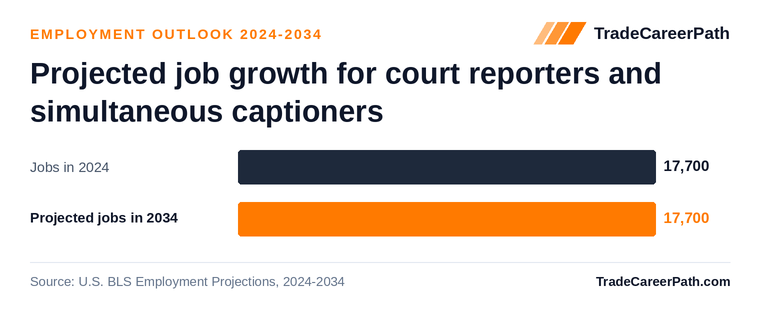
BLS reports approximately 12,870 court reporters and simultaneous captioners employed nationwide as of May 2025. The field is projected to see about 1,800 job openings each year from 2025 to 2035.
Can you train as a digital court reporter online?
Yes. Many schools offer digital court reporting coursework online, which lets working students study at a flexible pace. Confirm a program's accreditation before enrolling, and check whether it includes a hands-on internship or externship.
How Digital Court Reporter Pay Compares to Similar Trades
Side-by-side comparison of Digital Court Reporter and the closest related careers, based on U.S. Bureau of Labor Statistics data (May 2025 OEWS + 2025-2035 Employment Projections).
| Career | Median Pay | 10-Year Growth | Annual Openings |
|---|---|---|---|
| Digital Court Reporter this guide | $72,420 | -0.1% | 1,800 |
| Paralegal | $62,890 | -0.3% | 40,800 |
Source: BLS Occupational Employment and Wage Statistics + BLS Employment Projections.
Sources
- U.S. Bureau of Labor Statistics, Occupational Employment and Wage Statistics (May 2025)
- U.S. Bureau of Labor Statistics, Employment Projections 2025-2035
- U.S. Bureau of Labor Statistics, Survey of Occupational Injuries and Illnesses (2023-2024, Table R98)
- U.S. Department of Labor, Wage and Hour Division, Davis-Bacon General Wage Determinations (2026)
Digital Court Reporter Salary by State
About this guide: Researched and written by the TradeCareerPath Editorial Team. Our editorial team researches and sources every trade school and career guide using federal labor and education data, including BLS OEWS and Employment Projections, DOL apprenticeship records, IPEDS, College Scorecard, and state licensing boards. We follow the editorial standards documented at /editorial-policy/.
Data sources
Figures on this page are sourced from the federal and state datasets below. Methodology: how we rank and source data.
| Data | Provider | Vintage |
|---|---|---|
| Occupational Employment and Wage Statistics (OEWS) | U.S. Bureau of Labor Statistics | May 2025 |
| Employment Projections | U.S. Bureau of Labor Statistics | 2025-2035 |
| Integrated Postsecondary Education Data System | National Center for Education Statistics (IPEDS) | 2024 |
| College Scorecard (school-level outcomes) | U.S. Department of Education | latest release |
| College Scorecard (field-of-study earnings) | U.S. Department of Education | latest release (updated 2026-06-12) |
| Occupational licensing requirements | CareerOneStop (U.S. Department of Labor) | latest release (updated 2026-02-22) |
| Registered apprenticeship programs | CareerOneStop / Apprenticeship.gov (U.S. Department of Labor) | latest release (updated 2025-10-25) |
| O*NET occupation profiles (skills, tasks, tools, job zones) | U.S. Department of Labor (O*NET / Employment & Training Admin.) | O*NET 31.0 (updated 2026-10-14) |