
How to Become a Dog Trainer in 2026
Is Dog Trainer Right for You?
The U.S. Department of Labor's O*NET profile for Animal Trainers (SOC 39-2011) describes the work this way: Train animals for riding, harness, security, performance, or obedience, or for assisting persons with disabilities. Accustom animals to human voice and contact, and condition animals to respond to commands. Train animals according to prescribed standards for show or competition. May train animals to carry pack loads or work as part of pack team.
What the work involves
- Cue or signal animals during performances.
- Talk to or interact with animals to familiarize them to human voices or contact.
- Conduct training programs to develop or maintain desired animal behaviors for competition, entertainment, obedience, security, riding, or related purposes.
- Feed or exercise animals or provide other general care, such as cleaning or maintaining holding or performance areas.
- Observe animals' physical conditions to detect illness or unhealthy conditions requiring medical care.
Skills and knowledge that matter
Skills: Instructing, Speaking, Learning Strategies, Critical Thinking, Active Learning, Active Listening.
Knowledge: Customer and Personal Service, Education and Training, Psychology, Administration and Management.
Tools and technology you may use
Technology: Project management software, Transaction server software, Data base user interface and query software, Atlassian JIRA, Epic Systems, Facebook.
Typical preparation
O*NET Job Zone 1-2 (Very Little to Some Preparation Needed). Usually requires a high school diploma or GED, though some occupations may not. Ranges from a few days to one year of on-the-job training.
Interest fit
O*NET interest profile: Realistic, Social, Conventional. People who enjoy hands-on, practical work with tools, machines, plants, or materials often find this occupation a good fit.
Source: O*NET 31.0 (updated 2026-10-14)
Quick answer: Training as a dog trainer usually takes about 6 months to 2 years, depending on the program you pick. You complete a dog training program, build real experience handling dogs at kennels, shelters, or under a mentor, and can earn an optional certification such as the CPDT-KA. No college degree is required, and there is generally no state license to train dogs. The median pay for animal trainers is $39,990 per year ($19.22/hour), and there are about 6,500 openings nationwide each year (BLS, May 2025).
Dog trainers teach dogs obedience, socialization, and good everyday behavior, and they coach owners to keep up the work at home. Some specialize in service, therapy, or protection dogs. If you like animals, enjoy teaching, and have patience, this is a flexible path with a low barrier to entry.
How to Become a Dog Trainer
Most people enter the field in about six months to two years, depending on the program they choose. There is no single national license or exam to pass. You build the career through training, real practice with dogs, and an optional certification.
1. Earn a high school diploma or GED
A high school diploma or GED is the baseline most training programs and employers expect, and it is usually the only formal education requirement. Before you start, it helps to build a foundation the work depends on. Classes in biology or psychology give you a head start on understanding how animals learn, and any course that strengthens communication is useful because so much of the job is coaching people. Comfort with basic record keeping and scheduling matters too, since you will track each dog’s progress and manage client appointments. If you are switching careers and already finished school, you can move straight to the next step. Many strong trainers come from unrelated backgrounds and bring transferable skills in teaching, customer service, or working with the public. The most important early habit is simple: spend time around dogs, watch how they respond to people, and start paying attention to body language and temperament.
2. Complete a dog training program
A dedicated training program is the fastest way to build a real skill set. Programs teach canine behavior, learning theory, obedience methods, and positive reinforcement techniques, and many include supervised practice with live dogs. You will learn how to mark and reward behavior, shape commands like sit, stay, and recall, and address common problems such as barking, jumping, leash pulling, and reactivity. Formats vary widely. Some programs run in person at a training facility, others are online with practical assignments, and some follow an apprentice model where you learn alongside a working trainer. When comparing schools, ask what hands-on practice is included, who teaches the course, and what methods they emphasize, since modern training leans heavily on reward based, force free approaches. Costs vary by program and school, so request pricing and start dates from a few options before you commit. Confirm any accreditation or affiliations the program advertises.
3. Gain hands-on experience
Coursework prepares you, but real skill comes from handling many different dogs. Look for paid or volunteer work at kennels, animal shelters, boarding and daycare facilities, or veterinary offices, where you will meet a wide range of breeds, ages, and temperaments. Assisting an established trainer is one of the best routes, because you can watch full sessions, see how a pro reads a dog and coaches an owner, and gradually take on parts of the lesson yourself. As you build hours, practice the soft skills that separate good trainers from great ones: explaining a technique so an owner can repeat it, staying calm with an anxious or excited dog, and adjusting your plan when something is not working. Keep notes on the cases you handle. A track record of dogs you have helped, including before and after behavior, becomes powerful proof when you start looking for clients or a job.
4. Consider professional certification
Certification is optional and generally not required by law, but it signals professionalism and can help you win clients and employment. The most widely recognized credential is the CPDT-KA (Certified Professional Dog Trainer, Knowledge Assessed) from the Certification Council for Professional Dog Trainers (CCPDT), which tests learning theory, instruction skills, and animal husbandry and usually requires documented training hours before you sit the exam. Other recognized options include the American Kennel Club (AKC) Canine Good Citizen Evaluator designation and credentials from the International Association of Animal Behavior Consultants (IAABC) for behavior focused work. Each has its own eligibility and continuing education rules, so review the requirements directly with the organization before you apply. A credential is not a substitute for skill, but paired with real experience it helps you stand out in a field where anyone can call themselves a trainer.
5. Start training and build your business
Once you have training and hands-on hours, you can begin offering services. Many new trainers start by working under a mentor or at an established facility, then add their own group classes and private sessions. Decide early whether you want to work for a company, such as a pet store training program, boarding facility, or daycare, or run your own business. If you go independent, word of mouth and client referrals drive most of your growth, so consistent results and clear communication matter as much as marketing. A specialty can raise your income and demand over time. Some trainers focus on puppy and basic obedience, others on behavior modification for aggression or anxiety, and others on service, therapy, or protection dogs. As you grow, repeat clients, partnerships with vets and shelters, and a strong local reputation work as your most reliable source of work.
What Does a Professional Dog Trainer Do?
Dog trainers teach dogs obedience, socialization, and specific behaviors for everyday living or specialized tasks. They work with pet owners, shelters, boarding facilities, or organizations that train service and working animals. A large part of the job is coaching people, since owners have to reinforce the training at home for it to stick.
Common responsibilities include:
- Teaching commands like sit, stay, and come
- Correcting behavior problems such as barking, biting, or jumping
- Helping owners understand and continue training techniques
- Training therapy, service, or protection dogs
- Running group classes and private sessions
Skills That Make Great Dog Trainers
- Patience and empathy
- Clear communication with owners
- A solid understanding of animal behavior and learning
- Confident, consistent use of positive reinforcement
- Physical stamina and comfort handling dogs of all sizes
Success as a trainer depends as much on teaching people as on teaching dogs.
Popular Dog Trainer Certifications
| Certification | Organization | Focus |
|---|---|---|
| CPDT-KA | Certification Council for Professional Dog Trainers | Learning theory, instruction skills, and animal husbandry |
| AKC CGC Evaluator | American Kennel Club | Evaluates dogs and handlers for good citizenship and basic obedience |
| IAABC Certified Trainer | International Association of Animal Behavior Consultants | Behavior focused training and problem solving |
Certification is not required, but it shows professionalism and can help attract more clients or job opportunities.
Cost and Duration of Training
- Program cost: varies by program, format, and school; request pricing and start dates from a few options before you enroll
- Time to complete: about six months to two years, depending on the path you choose
- Certification: optional, with its own fees and eligibility rules set by each organization
Many programs are available online or in a flexible format, which helps students who work or have other commitments.
Pros and Cons of a Dog Training Career
Pros
- Rewarding work improving animal behavior and owner relationships
- Flexible, often self-directed schedule
- Low barrier to entry with no degree required
- Strong potential for self-employment
Cons
- Physically demanding and sometimes unpredictable work
- Income can vary, especially when self-employed
- Requires patience and ongoing learning
Quick Facts: Dog Trainer Salary, Education, and Outlook
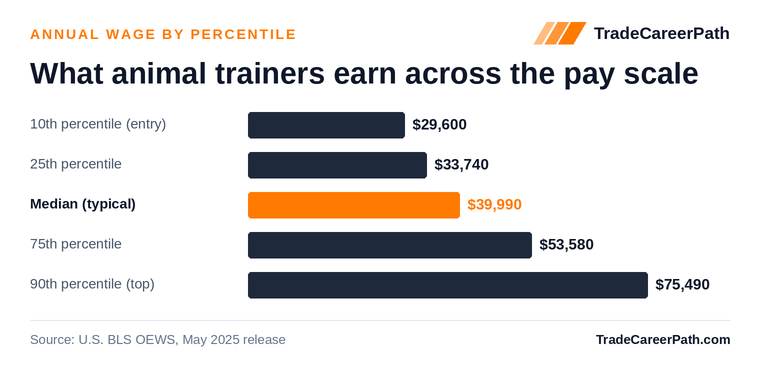


Wage and Employment Charts
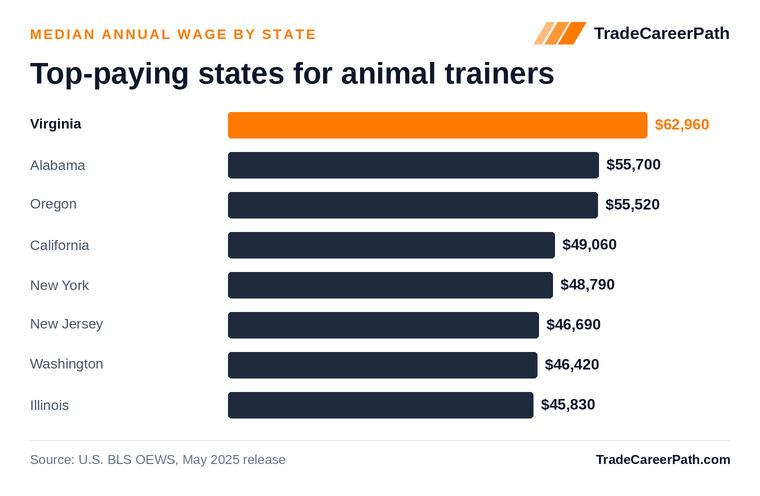
Dog Trainer Salary and Requirements by State
Select your state for local wage data, training options, and requirements:
Alabama · Alaska · Arizona · Arkansas · California · Colorado · Connecticut · Delaware · District of Columbia · Florida · Georgia · Hawaii · Idaho · Illinois · Indiana · Iowa · Kansas · Kentucky · Louisiana · Maine · Maryland · Massachusetts · Michigan · Minnesota · Mississippi · Missouri · Montana · Nebraska · Nevada · New Hampshire · New Jersey · New Mexico · New York · North Carolina · North Dakota · Ohio · Oklahoma · Oregon · Pennsylvania · Rhode Island · South Carolina · South Dakota · Tennessee · Texas · Utah · Vermont · Virginia · Washington · West Virginia · Wisconsin · Wyoming
Workplace Safety Snapshot
BLS Survey of Occupational Injuries and Illnesses data (2023-2024) report approximately 246.5 days-away, restricted, or transfer cases per 10,000 full-time-equivalent workers in animal trainers (about 2.46 per 100 FTE). Source: BLS Survey of Occupational Injuries and Illnesses, Table R98.
Frequently Asked Questions
How long does dog trainer training take?
It typically takes about 6 months to 2 years to get started, depending on the program you choose. Many trainers complete a certificate program and then keep building skills through hands-on experience. A high school diploma or GED is generally enough to begin.
Do you need a college degree to work as a dog trainer?
No. A college degree is not required to work as a dog trainer. Most people enter the field through a certificate or short training program combined with real practice handling dogs. A high school diploma or GED is typically the only educational prerequisite.
How much does dog trainer training cost?
Costs vary by program, format, and school, so it pays to compare a few options and request pricing directly. In-person, online, and apprentice style programs are all available, and many schools list tuition and start dates when you ask for information.
Is dog trainer certification required?
Certification is generally voluntary rather than legally required. Earning a recognized credential, such as the CPDT-KA from the Certification Council for Professional Dog Trainers, can build client trust and help you stand out. Always check any rules in your state or local area before you advertise services.
Is it hard to train as a dog trainer?
Entry is relatively accessible because there is no required degree or single national exam. The work itself takes patience and physical stamina, since you handle different dogs, read body language, and coach owners. Building a client base or a reputation takes time and consistent results.
Where can you get hands-on dog training experience?
You can build experience by working or volunteering at kennels, animal shelters, boarding facilities, or veterinary offices. Assisting an established trainer is another strong route, since it lets you observe real sessions and practice handling many temperaments.
How many dog trainers work in the United States?
The U.S. Bureau of Labor Statistics reports approximately 18,770 animal trainers employed nationwide as of May 2025, with about 6,500 openings projected each year over the 2025 to 2035 period.
Sources
- U.S. Bureau of Labor Statistics, Occupational Employment and Wage Statistics (May 2025)
- U.S. Bureau of Labor Statistics, Employment Projections 2025-2035
- U.S. Bureau of Labor Statistics, Survey of Occupational Injuries and Illnesses (2023-2024, Table R98)
- U.S. Department of Labor, Wage and Hour Division, Davis-Bacon General Wage Determinations (2026)
Dog Obedience Salary by State
About this guide: Researched and written by the TradeCareerPath Editorial Team. Our editorial team researches and sources every trade school and career guide using federal labor and education data, including BLS OEWS and Employment Projections, DOL apprenticeship records, IPEDS, College Scorecard, and state licensing boards. We follow the editorial standards documented at /editorial-policy/.
Data sources
Figures on this page are sourced from the federal and state datasets below. Methodology: how we rank and source data.
| Data | Provider | Vintage |
|---|---|---|
| Occupational Employment and Wage Statistics (OEWS) | U.S. Bureau of Labor Statistics | May 2025 |
| Employment Projections | U.S. Bureau of Labor Statistics | 2025-2035 |
| Integrated Postsecondary Education Data System | National Center for Education Statistics (IPEDS) | 2024 |
| College Scorecard (school-level outcomes) | U.S. Department of Education | latest release |
| College Scorecard (field-of-study earnings) | U.S. Department of Education | latest release (updated 2026-06-12) |
| Occupational licensing requirements | CareerOneStop (U.S. Department of Labor) | latest release (updated 2026-02-22) |
| Registered apprenticeship programs | CareerOneStop / Apprenticeship.gov (U.S. Department of Labor) | latest release (updated 2025-10-25) |
| O*NET occupation profiles (skills, tasks, tools, job zones) | U.S. Department of Labor (O*NET / Employment & Training Admin.) | O*NET 31.0 (updated 2026-10-14) |