
How to Become a Drywall Installer
Is Drywall Installer Right for You?
The U.S. Department of Labor's O*NET profile for Drywall and Ceiling Tile Installers (SOC 47-2081) describes the work this way: Apply plasterboard or other wallboard to ceilings or interior walls of buildings. Apply or mount acoustical tiles or blocks, strips, or sheets of shock-absorbing materials to ceilings and walls of buildings to reduce or reflect sound. Materials may be of decorative quality. Includes lathers who fasten wooden, metal, or rockboard lath to walls, ceilings, or partitions of buildings to provide support base for plaster, fireproofing, or acoustical material.
What the work involves
- Read blueprints or other specifications to determine methods of installation, work procedures, or material or tool requirements.
- Measure and mark surfaces to lay out work, according to blueprints or drawings, using tape measures, straightedges or squares, and marking devices.
- Fit and fasten wallboard or drywall into position on wood or metal frameworks, using glue, nails, or screws.
- Measure and cut openings in panels or tiles for electrical outlets, windows, vents, plumbing, or other fixtures, using keyhole saws or other cutting tools.
- Assemble or install metal framing or decorative trim for windows, doorways, or vents.
Skills and knowledge that matter
Skills: Critical Thinking, Time Management, Speaking, Monitoring, Judgment and Decision Making, Coordination.
Knowledge: Building and Construction, Mathematics, Mechanical, Public Safety and Security.
Tools and technology you may use
Tools: Adhesive guns, Air compressors, Automatic taping tools, Box beam levels, Bullnose trowels, Caulking guns.
Technology: Data base user interface and query software, Project management software, Accounting software, Microsoft Office software, Microsoft Windows, Microsoft Word.
Typical preparation
O*NET Job Zone Two (Some Preparation Needed). These occupations usually require a high school diploma. Employees in these occupations need anywhere from a few months to one year of working with experienced employees. A recognized apprenticeship program may be associated with these occupations.
Interest fit
O*NET interest profile: Realistic, Conventional, Artistic. People who enjoy hands-on, practical work with tools, machines, plants, or materials often find this occupation a good fit.
Source: O*NET 29.1 (updated 2026-06-13)
Ever noticed smooth, finished walls in a new building and wondered who made them look flawless?
Drywall installers are the skilled tradespeople behind that work.
Drywall installers, also known as hangers or finishers, measure, cut, and attach drywall panels to create walls and ceilings.
They finish seams and apply coatings that prepare surfaces for painting or texture application.
If you enjoy hands-on, detail-oriented construction work, training as a drywall installer offers a steady and practical trade career in building and remodeling.
At a glance
- Work includes hanging drywall and finishing seams for walls and ceilings
- Also known as drywall hangers or finishers
- Training is often on the job or through an apprenticeship (often 1-3 years)
- Typical timeline ranges from 6 months to 3 years depending on the path
- Program costs listed on this page range from varies by school, format and location (certification fees are typically under $200)
Quick answers
What does a drywall installer do?
Drywall installers measure, cut, and attach drywall panels to create walls and ceilings. They tape and finish seams to prepare surfaces for painting or texture.
Are drywall installers also called hangers or finishers?
Yes. Drywall installers are also known as hangers or finishers.
How long does drywall installer training take?
Training can take about 1-2 years through on-the-job learning or an apprenticeship. Apprenticeships often last 1-3 years.
What skills help you succeed as a drywall installer?
This work rewards accurate measuring, attention to detail, and physical stamina for lifting and overhead work. Manual dexterity and comfort using finishing tools are also important.
Where do drywall installers work?
Drywall installers work on residential and commercial construction sites, as well as remodeling and renovation projects. Many work for drywall and finishing contractors.
How much does training cost?
This page lists program costs from varies by school, format and location depending on the program or apprenticeship fees. Certification fees are typically under $200.
What Drywall Installers Do
Drywall installers attach wallboard to walls, ceilings, and interior partitions in homes and commercial buildings.
They cut panels, fit around openings, and prepare surfaces for painting and finishing.
Typical Responsibilities
- Measure and cut drywall panels to size
- Secure panels to studs using screws or nails
- Fit drywall around doors, windows, and outlets
- Tape and finish joints to create smooth surfaces
- Repair damaged drywall or re-texture surfaces
Drywall installers combine craftsmanship and precision to give buildings their interior form and finish.
Key Skills and Traits for Success
- Manual dexterity and steady hands
- Ability to measure accurately and work from blueprints
- Physical stamina for lifting and positioning panels
- Knowledge of finishing tools and materials
- Attention to detail and quality workmanship
Work Settings for Drywall Installers
Drywall installers work in:
- Residential and commercial construction sites
- Home remodeling and renovation projects
- Drywall and finishing contractors
- Interior design and architectural build-out firms
How to Become a Drywall Installer (5 Steps)
It typically takes 1-2 years to train as a drywall installer through on-the-job learning or an apprenticeship.
1. Earn a High School Diploma or GED
Basic math and blueprint reading skills are helpful for layout and measurements.
2. Learn the Basics of Construction
Start by learning how to handle materials, measure accurately, and use basic tools safely.
3. Join an Apprenticeship or On-the-Job Training Program
Most drywall installers learn through practical experience under experienced tradespeople. Apprenticeships often last 1-3 years.
4. Develop Finishing and Safety Skills
Learn advanced techniques such as taping, sanding, corner finishing, and applying textures. OSHA safety training is also recommended.
5. Gain Experience and Advance
As you build skill, you can advance to crew leader or estimator roles or specialize in decorative or acoustic ceiling systems.
Education and Training Paths
| Pathway | Typical Duration | Outcome |
|---|---|---|
| On-the-Job Training | 6-12 months | Entry-level drywall installation skills |
| Apprenticeship | 1-3 years | Journeyman-level proficiency |
| Certificate Program | 6-12 months | Formal instruction in drywall installation and finishing |
| Safety Certification | 1-3 months | Workplace safety and OSHA compliance |
Career Growth and Advancement
Drywall installers can progress into:
- Crew Leader or Supervisor: oversees installation projects
- Estimator or Project Coordinator: plans materials and job timelines
- Drywall Finisher or Texture Specialist: focuses on finishing and aesthetic detail
- Independent Contractor: operates a small drywall or renovation business
Cost and Duration of Training
- Program Cost: varies by school, format and location depending on program or apprenticeship fees
- Duration: 6 months to 3 years
- Certification Fees: typically under $200
Drywall installation is a practical and in-demand trade offering long-term opportunities in residential and commercial construction.
Pros and Cons
✅ Pros
- High demand across construction and renovation projects
- Hands-on work with visible results
- Opportunities to work independently or with crews
- Low barriers to entry for new workers
⚠️ Cons
- Physically demanding, involving lifting and overhead work
- Exposure to dust and noise on job sites
- Seasonal or project-based work in some regions
Quick Facts: Drywall Installer Training and Outlook
Industry Organizations & Certifying Bodies
These are the recognized national organizations, unions, certifying bodies, and regulatory authorities that shape this trade. They issue the credentials, sponsor the apprenticeships, publish the codes, and represent workers and employers.
- Association of the Wall and Ceiling Industry (AWCI) Drywall and wall/ceiling contractor trade association.
- International Union of Painters and Allied Trades (IUPAT) Represents drywall finishers and tapers; sponsors apprenticeships.
Wage and Employment Charts
| Percentile | Annual wage |
|---|---|
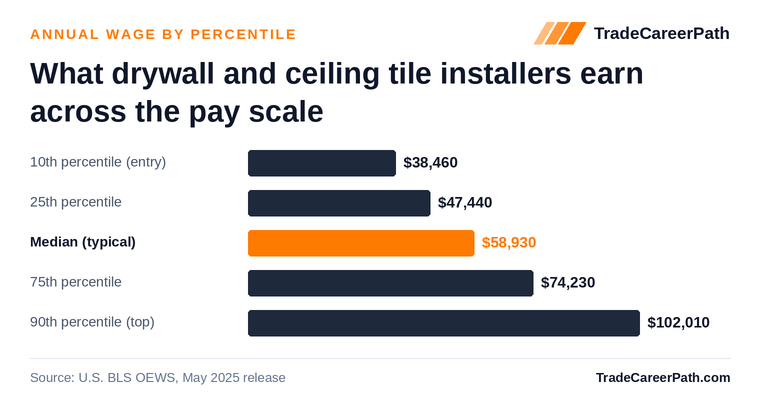
| 10th | $38,460 |
| 25th | $47,440 |
| 50th (median) | $58,930 |
| 75th | $74,230 |
| 90th | $102,010 |
| Year | Employment |
|---|---|
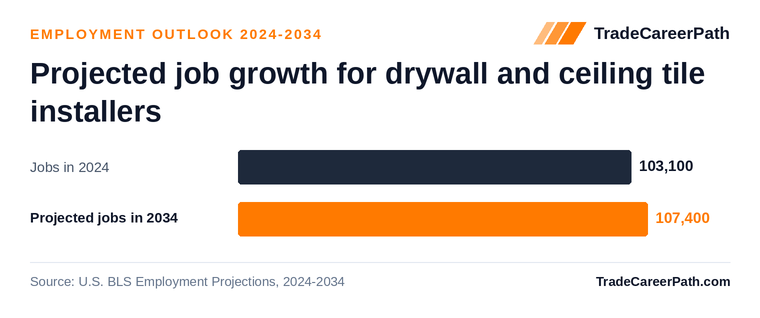
| 2024 | 103,100 |
| 2034 projected | 107,400 |
| Percent change | +4.2% |
Drywall Installer Salary and Requirements by State
Select your state for local wage data, training options, and requirements:
Alabama · Alaska · Arizona · Arkansas · California · Colorado · Connecticut · Delaware · District of Columbia · Florida · Georgia · Hawaii · Idaho · Illinois · Indiana · Iowa · Kansas · Kentucky · Louisiana · Maine · Maryland · Massachusetts · Michigan · Minnesota · Mississippi · Missouri · Montana · Nebraska · Nevada · New Hampshire · New Jersey · New Mexico · New York · North Carolina · North Dakota · Ohio · Oklahoma · Oregon · Pennsylvania · Rhode Island · South Carolina · South Dakota · Tennessee · Texas · Utah · Vermont · Virginia · Washington · West Virginia · Wisconsin · Wyoming
Workplace Safety Snapshot
BLS Survey of Occupational Injuries and Illnesses data (2023-2024) report approximately 268.6 days-away, restricted, or transfer cases per 10,000 full-time-equivalent workers in drywall and ceiling tile installers (about 2.69 per 100 FTE). Source: BLS Survey of Occupational Injuries and Illnesses, Table R98.
Frequently Asked Questions
How long does drywall installer training take?
It typically takes typically 6 months to 2 years of training. The most common entry path is through a certificate or associate degree program. A high school diploma or GED is generally required to get started.
How much do drywall installers make?
The median annual salary for drywall installers is $58,930 according to the Bureau of Labor Statistics (May 2025). Entry-level workers earn around $38,460, while those in the 90th percentile earn over $102,010. Pay varies by state, experience, and specialization.
What is the job outlook for drywall installers?
The Bureau of Labor Statistics projects 4.2% employment growth for this occupation from 2024 to 2034, which is about as fast as average. Approximately 7,700 job openings are expected each year due to growth, retirements, and workers leaving the field.
Do you need a college degree to work as a drywall installer?
No. A college degree is not required to work as a drywall installer. Most people enter the field through a certificate or associate degree program. A high school diploma or GED is typically the only educational prerequisite.
Which states pay drywall installers the most?
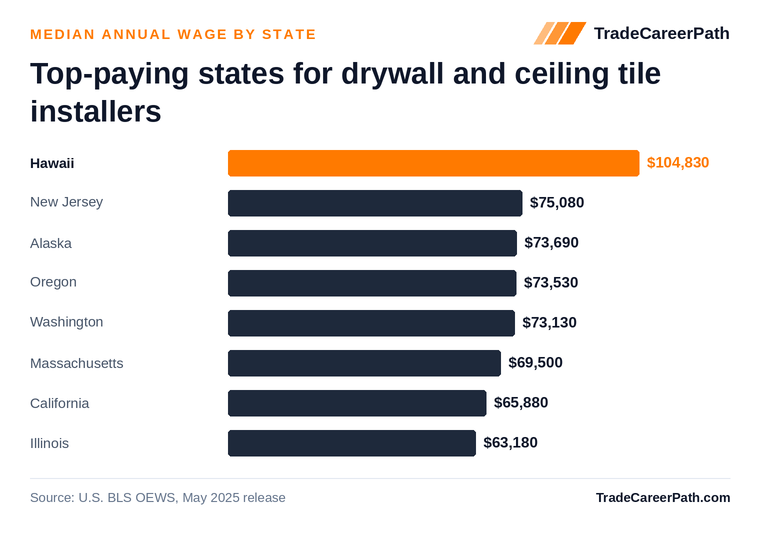
According to the U.S. Bureau of Labor Statistics (May 2025 OEWS), the highest-paying states for drywall installers are Hawaii, New Jersey, and Alaska. Median annual wages: Hawaii ($104,830); New Jersey ($75,080); Alaska ($73,690).
Which states employ the most drywall installers?
BLS reports the largest concentrations of drywall installers in California, Florida, and Texas. Employment levels: California (27,280 workers); Florida (6,000 workers); Texas (5,760 workers) (May 2025).
How much do experienced drywall installers earn?
The top 10% of drywall installers earn more than $102,010 per year, according to BLS Occupational Employment and Wage Statistics (May 2025). Experienced workers in this band typically hold senior credentials, supervisory roles, or specialty certifications.
What is entry-level pay for drywall installers?
BLS reports the bottom 10% of drywall installers earn under $38,460 per year. New workers often start near this level and see pay rise as they accumulate experience and credentials.
How many drywall installers work in the United States?
BLS reports approximately 83,080 drywall installers employed nationwide as of May 2025.
How many job openings are expected for drywall installers each year?
BLS projects approximately 7,700 openings per year for drywall installers from 2024 through 2034, including new positions, retirements, and workers transitioning out. The occupation is projected to grow 4.2% from 2024 to 2034, classified as about as fast as average growth.
How much do drywall installers make per hour?
The median hourly wage for drywall installers is $28.33, according to BLS (May 2025). Hourly pay ranges from about $18.49 (bottom 10%) to $49.04 (top 10%).
How Drywall Installer Pay Compares to Similar Trades
Side-by-side comparison of Drywall Installer and the closest related careers, based on U.S. Bureau of Labor Statistics data (May 2025 OEWS + 2024-2034 Employment Projections).
| Career | Median Pay | 10-Year Growth | Annual Openings |
|---|---|---|---|
| Drywall Installer this guide | $58,930 | +4.2% | 7,700 |
| Carpentry | $60,580 | +4.5% | 74,100 |
| Construction Worker | $47,120 | +7.3% | 129,400 |
| Floor Installing Listings | $55,690 | +10.1% | 4,200 |
| Construction & Insulation Listings | $49,120 | +3.8% | 3,400 |
Source: BLS Occupational Employment and Wage Statistics + BLS Employment Projections.
Sources
- U.S. Bureau of Labor Statistics, Occupational Employment and Wage Statistics (May 2025)
- U.S. Bureau of Labor Statistics, Employment Projections 2024-2034
- U.S. Bureau of Labor Statistics, Survey of Occupational Injuries and Illnesses (2023-2024, Table R98)
- U.S. Department of Labor, Wage and Hour Division, Davis-Bacon General Wage Determinations (2026)
Drywall Installer Salary by State
About this guide: Researched and written by the TradeCareerPath Editorial Team. Our editorial team researches and sources every trade school and career guide using federal labor and education data, including BLS OEWS and Employment Projections, DOL apprenticeship records, IPEDS, College Scorecard, and state licensing boards. We follow the editorial standards documented at /editorial-policy/.
Data sources
Figures on this page are sourced from the federal and state datasets below. Methodology: how we rank and source data.
| Data | Provider | Vintage |
|---|---|---|
| Occupational Employment and Wage Statistics (OEWS) | U.S. Bureau of Labor Statistics | May 2025 |
| Employment Projections | U.S. Bureau of Labor Statistics | 2024-2034 |
| Integrated Postsecondary Education Data System | National Center for Education Statistics (IPEDS) | 2024 |
| College Scorecard (school-level outcomes) | U.S. Department of Education | latest release |
| College Scorecard (field-of-study earnings) | U.S. Department of Education | latest release (updated 2026-06-12) |
| Occupational licensing requirements | CareerOneStop (U.S. Department of Labor) | latest release (updated 2026-02-22) |
| Registered apprenticeship programs | CareerOneStop / Apprenticeship.gov (U.S. Department of Labor) | latest release (updated 2025-10-25) |
| O*NET occupation profiles (skills, tasks, tools, job zones) | U.S. Department of Labor (O*NET / Employment & Training Admin.) | O*NET 29.1 (updated 2026-06-13) |