
How to Become an Electrical Engineer in 2026
Is Electrical Engineer Right for You?
The U.S. Department of Labor's O*NET profile for Electrical Engineers (SOC 17-2071) describes the work this way: Research, design, develop, test, or supervise the manufacturing and installation of electrical equipment, components, or systems for commercial, industrial, military, or scientific use.
What the work involves
- Design, implement, maintain, or improve electrical instruments, equipment, facilities, components, products, or systems for commercial, industrial, or domestic purposes.
- Oversee project production efforts to assure projects are completed on time and within budget.
- Direct or coordinate manufacturing, construction, installation, maintenance, support, documentation, or testing activities to ensure compliance with specifications, codes, or customer requirements.
- Perform detailed calculations to compute and establish manufacturing, construction, or installation standards or specifications.
- Operate computer-assisted engineering or design software or equipment to perform engineering tasks.
Skills and knowledge that matter
Skills: Writing, Reading Comprehension, Critical Thinking, Active Listening, Speaking, Active Learning.
Knowledge: Engineering and Technology, Computers and Electronics, Design, English Language.
Tools and technology you may use
Technology: Development environment software, File versioning software, Analytical or scientific software, Apache Subversion SVN, Autodesk AutoCAD, Autodesk AutoCAD Civil 3D.
Typical preparation
O*NET Job Zone Four (Considerable Preparation Needed). Most of these occupations require a four-year bachelor's degree, but some do not. Employees in these occupations usually need several years of work-related experience, on-the-job training, and/or vocational training.
Interest fit
O*NET interest profile: Realistic, Investigative, Conventional. People who enjoy hands-on, practical work with tools, machines, plants, or materials often find this occupation a good fit.
Source: O*NET 31.0 (updated 2026-10-14)
Quick answer: Training as an electrical engineer requires a 4-year degree - typically an ABET-accredited bachelor’s in electrical engineering. The national median pay is $120,630 per year, and BLS projects +9.9% employment change from 2025 to 2035 (BLS OEWS, May 2025; BLS Employment Projections, 2025-35).
Electrical Engineer at a Glance
| Metric | Detail | Source |
|---|---|---|
| Median annual wage | $120,630 | BLS OEWS, May 2025 |
| Typical wage range | $76,550 (10th pct) - $184,300 (90th pct) | BLS OEWS, May 2025 |
| Employment | 198,750 nationwide | BLS OEWS, May 2025 |
| Projected growth (2025-35) | +9.9%, about 11,400 openings per year | BLS Employment Projections, 2025-35 |
| Typical education | ABET-accredited bachelor’s in electrical engineering | BLS Occupational Outlook Handbook |
| License / certification | PE license required for power/utility sign-off roles | State licensing boards |
What Does an Electrical Engineer Do?
Electrical engineers design power systems, electronics, control systems, and communications equipment - from utility-scale distribution to circuit boards - and they own the engineering decisions behind the systems that electricians, lineworkers, and renewable-energy techs install and maintain.
Day to day, the work depends heavily on sub-specialty. A power engineer runs load-flow and short-circuit studies, sizes transformers and conductors, designs protective relaying schemes, and stamps one-line diagrams that a utility or an AHJ will hold them accountable for. A controls engineer writes and commissions PLC logic, designs motor-control centers, and spends startup weeks on the plant floor chasing I/O faults with the maintenance crew. An electronics or embedded engineer lives closer to the bench: schematic capture, board layout, firmware, then long test sessions with a scope and a logic analyzer proving the design meets spec. Across all of them, the constant is documented, reviewed decision-making - calculations, drawings, and test reports that other people will build from and inspectors will check against the NEC, IEEE standards, and utility interconnection rules.
If you are coming off the tools as an electrician or a solar/wind tech, the shortest way to say it: you currently install and troubleshoot to the print; the engineer decides what the print says and proves it is safe and code-compliant. The fault-current calc behind the breaker you land, the relay settings behind the recloser you maintain, the inverter interconnection study behind the array you commissioned - those work as your calls. Field people who make this jump report one consistent advantage: they design things that can actually be built and pulled through conduit, and construction crews notice.
Skills That Make a Great Electrical Engineer
- Circuit and power-system analysis
- NEC code fluency
- PLC and controls programming
- Test instrumentation and troubleshooting
- Protective relaying and grounding design
- Load-flow, short-circuit, and arc-flash study tools (SKM, ETAP) plus MATLAB or Python for analysis
- CAD for one-lines and panel layouts (AutoCAD Electrical, Revit on building work)
- Writing: design basis documents, study reports, and commissioning records carry the job
Electrical Engineer Salary
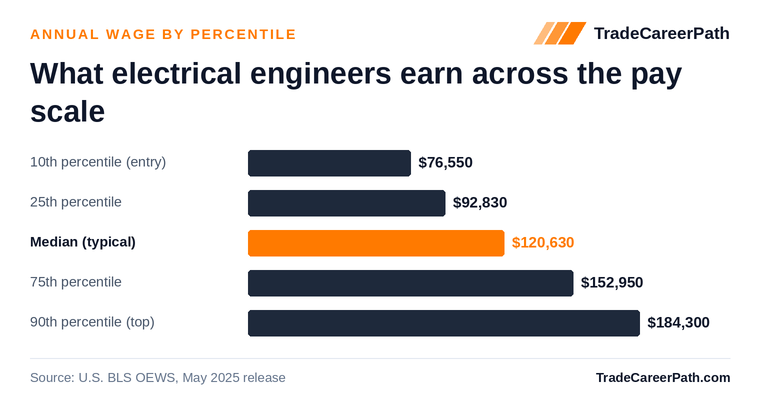
Electrical engineering pays well above nearly every trade that feeds into it. The national median is $120,630 per year, and the 10th percentile - roughly where new graduates start - is $76,550, already in the range of a good journeyman year without the overtime. The 25th percentile sits at $92,830, the 75th at $152,950, and the 90th percentile reaches $184,300 (BLS OEWS, May 2025). The mean of $125,100 sitting above the median tells you the top of this field pulls hard.
Where the Jobs and the Money Are
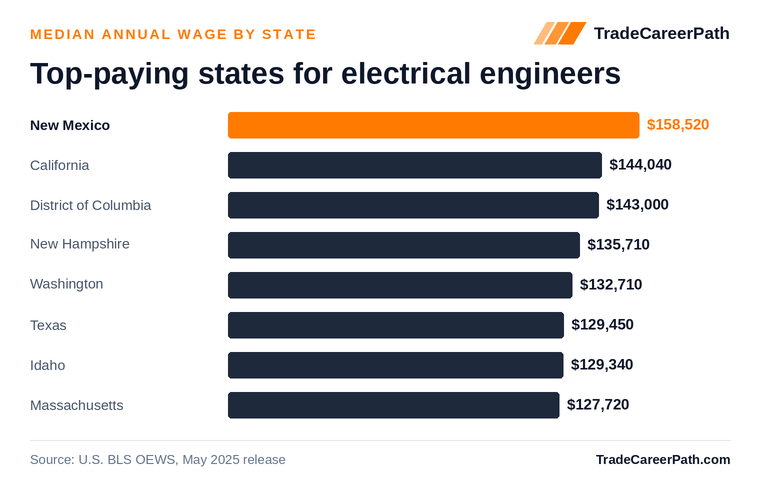
Electrical engineering is a big, geographically spread occupation - 198,750 jobs nationwide - but pay and concentration cluster in specific markets. National-lab and defense work drives New Mexico to the top of the pay table, tech and utility work drives California and Washington, and the Sun Belt build-out of data centers, semiconductor fabs, and grid capacity keeps Texas hiring at scale (BLS OEWS, May 2025).
| State | Median annual wage | Employment |
|---|---|---|
| New Mexico | $158,520 | 2,560 |
| California | $144,040 | 24,230 |
| District of Columbia | $143,000 | 330 |
| New Hampshire | $135,710 | 1,600 |
| Washington | $132,710 | 7,610 |
Concentration matters as much as the headline wage. In New Mexico, electrical engineers are about 2.3 times as common as in the average state labor market; Michigan (10,840 jobs, driven by automotive electrification) runs about 1.9 times, and New Hampshire about 1.8 - deep markets where you can change employers without moving. By raw headcount, California (24,230), Texas (20,870 jobs at a $129,450 median), and Michigan (median $106,070) are the three biggest employers.
How to Become an Electrical Engineer
1. Earn an ABET-accredited bachelor’s
Electrical engineering or electrical engineering technology. Accreditation is the one non-negotiable: employers screen for it, and the FE/PE licensure path assumes it. For working electricians, note the EE-versus-EET distinction before enrolling - some state boards restrict or lengthen PE licensure for engineering technology graduates, so if power or utility work is the goal, the straight EE degree is the safer buy. Several ABET-accredited programs run online or in evening formats built for working adults.
2. Pass the FE exam
The Fundamentals of Engineering exam - taken as a senior or right after graduation - earns the EIT (Engineer in Training) designation and starts the clock toward PE licensure. Take it while the coursework is fresh; engineers who put it off for years consistently regret it. Skipping it is defensible in electronics - but it closes the utility and consulting doors.
3. Start in power, electronics, or controls
Utilities, manufacturers, and engineering firms all hire at the bachelor’s level. For former electricians, the natural entry points are power distribution engineering, substation design, and controls/commissioning - roles where employers explicitly value someone who has bent conduit, terminated gear, and read the NEC for a living. Say the field experience out loud in applications: a journeyman card plus a degree reads as an engineer who understands how installations actually go together and fail.
4. Gain experience toward the PE
Four years of qualifying experience under licensed engineers, then the PE exam - typically the Power discipline for this crowd. In utility, consulting, and building-design work, the PE is what lets you stamp drawings and studies, and it is effectively the gate to project-lead and principal roles in those sectors. Track your experience and supervising PEs from day one.
5. Specialize
Power systems, renewable energy, embedded systems, or controls/automation. The market is rewarding depth right now: grid interconnection and protection engineers, battery-storage and inverter specialists, and controls engineers who can commission complex plants are all scarce. Specialty plus PE plus field background is the combination that moves you toward the top of the wage table.
Career Ladder: Titles and Realistic Pay
The BLS wage percentiles map cleanly onto how electrical engineering careers actually progress. Use this as a sanity check on offers, not a guarantee:
| Stage | Typical titles | Years in | Realistic pay (BLS OEWS, May 2025) |
|---|---|---|---|
| Entry level | Engineer I, EIT, field/commissioning engineer | 0-3 | ~$76,550-$92,830 (10th-25th pct) |
| Mid-career | Engineer II/III, project engineer, controls engineer | 3-10 | ~$120,630 (median) |
| Senior | Senior engineer, PE, lead protection/power engineer | 10-15 | ~$152,950 (75th pct) |
| Principal / leadership | Principal engineer, engineering manager, chief electrical engineer | 15+ | $184,300+ (90th pct) |
Two notes for career changers. First, trade experience compresses this ladder: former journeyman electricians and renewable techs are routinely hired above the bottom of the entry band because they need less supervision around energized equipment and real installations, and commissioning roles often pay field premiums on top. Second, the base-wage data understates senior pay in several sectors - utility storm and on-call premiums, consulting bonuses, and stock at tech and semiconductor employers push total compensation well past the figures shown here.
Do You Need a PE License?
It depends entirely on which side of the field you work. Electrical engineers at product manufacturers - electronics, embedded systems, semiconductors, automotive - mostly work under the “industrial exemption”: the company holds design responsibility, so most never license, and the FE/PE track is optional there. In power, utility, and consulting work, the answer flips: drawings and studies submitted to utilities and building authorities need a PE stamp, so the license is effectively required for advancement.
The path: ABET degree, pass the FE exam (sit for it as a senior), four years of qualifying experience under licensed engineers, then the PE exam - usually the Power discipline - per your state board’s rules. If you are unsure which side you will land on, take the FE anyway - it is cheap insurance, and it closes nothing.
Why an Online Degree Works for This Career
Electricians and solar/wind technicians already speak the language of this degree. An ABET-accredited electrical engineering bachelor’s moves you from installing systems to designing them, and utility and renewable-energy employers actively recruit engineers with field backgrounds. Online and evening ABET programs let you keep the journeyman income and seniority while you study, and employer tuition assistance is common at utilities, contractors, and manufacturers - many field techs finish the degree with most of the tuition covered.
Job Outlook for 2026 and Beyond
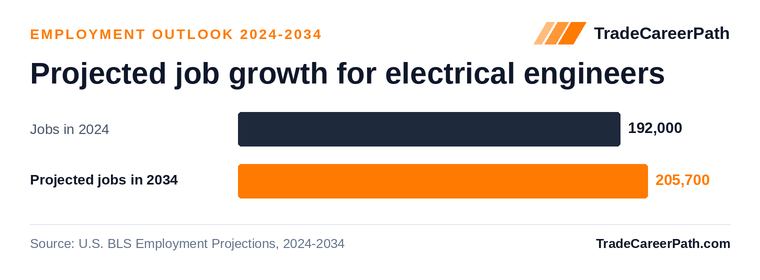
BLS projects electrical engineering employment to grow +9.9% from 2025 to 2035 - from 199,700 to 219,500 jobs - with about 11,400 openings per year once retirements and occupation changes are counted (BLS Employment Projections, 2025-35). Pay is moving too: the 2024 median of $111,910 rose to $120,630 in the latest wage data (BLS OEWS, May 2025) - a meaningful jump in a single data cycle, driven by demand outrunning supply.
The demand drivers are structural: grid modernization and interconnection queues, data-center and semiconductor construction, vehicle and building electrification, and a wave of retirements among utility power engineers. For career changers, the openings figure is the number that matters - 11,400 seats a year in a 198,750-person occupation means steady hiring, and the power side in particular has fewer qualified candidates than open requisitions.
Cost and Time to Complete the Degree
For electrical engineers, the credential is: ABET-accredited bachelor’s in electrical engineering. A bachelor’s degree is typically 120 credit hours: four years full-time, and commonly five to six years part-time while working. Transfer credit is the other lever: prior college, military training, apprenticeship coursework, and industry certifications can be worth meaningful credit at transfer-friendly schools, so get a written transfer evaluation before enrolling anywhere. Costs vary widely by school type; in-state public online programs are usually the value benchmark, and employer tuition assistance is common for working adults in this field.
Pros and Cons of Training as an Electrical Engineer
Pros
- Median pay of $120,630 nationally (BLS OEWS, May 2025)
- BLS projects +9.9% employment growth through 2035
- Field experience from the trades is a genuine hiring advantage
- Accredited online and hybrid degree paths exist for working adults
Cons
- Requires a 4-year degree (typically 120 credit hours)
- Entry-level pay starts near $76,550 at the 10th percentile
- Licensing hurdle: PE license required for power/utility sign-off roles
Frequently Asked Questions
Can an electrician work as an electrical engineer?
Yes - it is one of the strongest trade-to-degree jumps. Code knowledge and field experience compound with the engineering credential; the requirement is the ABET-accredited bachelor's plus the FE/PE exam track for licensed roles.
How much do electrical engineers make?
The national median annual wage for electrical engineers is $120,630 (BLS OEWS, May 2025). The top 10% earn $184,300 or more, while entry-level pay starts around $76,550.
What is the job outlook for electrical engineers?
BLS projects employment of electrical engineers to change by +9.9% from 2025 to 2035 (BLS Employment Projections, 2025-35).
How long does electrical engineer training take?
The ABET-accredited bachelor's is 120 credit hours: four years full-time, commonly five to six years part-time while working. Journeyman electricians with prior college or apprenticeship coursework can often transfer meaningful credit at transfer-friendly schools.
Is electrical engineering hard?
The degree is math-heavy - calculus, differential equations, electromagnetics, and signals courses are unavoidable. Working electricians usually find circuits, machines, and power-systems courses far easier than fresh high-school graduates do, because the theory maps onto equipment they have already installed and troubleshot.
Should I get an electrical engineering or electrical engineering technology degree?
For design roles and the cleanest PE path, the electrical engineering (EE) bachelor's is the safer buy - some states restrict or lengthen licensure for engineering technology (EET) graduates. EET degrees are more hands-on and can suit controls and test roles, but check your state board's rules before enrolling.
Can you train as an electrical engineer without a degree?
Not with the engineer title in most cases - employers require the ABET-accredited bachelor's, and PE licensure assumes it. Without the degree, the ceiling is engineering technician, controls technician, or field-service roles. Trade experience shortens the degree; it does not replace it.
Do electrical engineers need a PE license?
It depends on the sector. Engineers at product manufacturers mostly work under the industrial exemption and never license. In power, utility, and consulting work - where drawings get stamped and submitted to authorities - the PE is effectively required to advance. The path is FE exam, four years of qualifying experience, then the PE exam.
Electrical Engineer Salary and Requirements by State
Alabama · Alaska · Arizona · Arkansas · California · Colorado · Connecticut · Delaware · District of Columbia · Florida · Hawaii · Idaho · Illinois · Indiana · Iowa · Kansas · Kentucky · Louisiana · Maine · Maryland · Massachusetts · Michigan · Minnesota · Mississippi · Missouri · Montana · Nebraska · Nevada · New Hampshire · New Jersey · New Mexico · New York · North Carolina · North Dakota · Ohio · Oklahoma · Oregon · Pennsylvania · South Carolina · South Dakota · Tennessee · Texas · Utah · Vermont · Virginia · Washington · West Virginia · Wisconsin · Wyoming
Related Careers and Degree Paths
- Electrician to Engineer - the full bridge guide for making this exact jump from the tools
- Electronics Engineer - the sibling occupation focused on devices and circuits rather than power
- Computer Hardware Engineer - the digital-hardware branch of the same degree
- Mechanical Engineer - the other high-volume engineering path for tradespeople
- Online Engineering Degrees for Tradespeople - how to pick an ABET program that fits a work schedule
Degree and Program Guides
- Online Electrical Engineering Degrees - what an ABET-accredited BSEE looks like for a working electrician
Sources
- U.S. Bureau of Labor Statistics, Occupational Employment and Wage Statistics (OEWS), May 2025 - Electrical Engineers (SOC 17-2071)
- U.S. Bureau of Labor Statistics, Employment Projections, 2025-35
- U.S. Bureau of Labor Statistics, Occupational Outlook Handbook - education and licensing requirements
Electrical Engineer Salary by State
About this guide: Researched and written by the TradeCareerPath Editorial Team. Our editorial team researches and sources every trade school and career guide using federal labor and education data, including BLS OEWS and Employment Projections, DOL apprenticeship records, IPEDS, College Scorecard, and state licensing boards. We follow the editorial standards documented at /editorial-policy/.
Data sources
Figures on this page are sourced from the federal and state datasets below. Methodology: how we rank and source data.
| Data | Provider | Vintage |
|---|---|---|
| Occupational Employment and Wage Statistics (OEWS) | U.S. Bureau of Labor Statistics | May 2025 |
| Employment Projections | U.S. Bureau of Labor Statistics | 2025-2035 |
| Integrated Postsecondary Education Data System | National Center for Education Statistics (IPEDS) | 2024 |
| College Scorecard (school-level outcomes) | U.S. Department of Education | latest release |
| College Scorecard (field-of-study earnings) | U.S. Department of Education | latest release (updated 2026-06-12) |
| Occupational licensing requirements | CareerOneStop (U.S. Department of Labor) | latest release (updated 2026-02-22) |
| Registered apprenticeship programs | CareerOneStop / Apprenticeship.gov (U.S. Department of Labor) | latest release (updated 2025-10-25) |
| O*NET occupation profiles (skills, tasks, tools, job zones) | U.S. Department of Labor (O*NET / Employment & Training Admin.) | O*NET 31.0 (updated 2026-10-14) |