
Can an Electrician Work as an Engineer? Yes: Here's the Path (2026)
Quick answer: Yes. An electrician becomes an electrical engineer by earning the accredited bachelor’s degree, usually part-time over five to six years while working, less with transfer credit. The national median moves from $63,190 (electrician) to $120,630 (electrical engineer), per BLS OEWS, May 2025, and your field experience is an asset the whole way.
The Numbers
| Role | National median pay | Source |
|---|---|---|
| Electrician | $63,190 | BLS OEWS, May 2025 |
| Electrical Engineer | $120,630 | BLS OEWS, May 2025 |
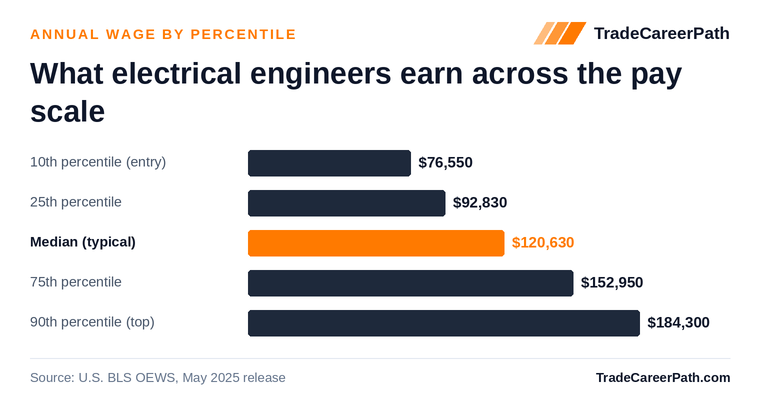
That is a difference of roughly $57,440 per year at the median - and the engineering side has room above it: the 75th percentile for electrical engineers is $152,950 and the 90th is $184,300 (BLS OEWS, May 2025). There are 198,750 electrical engineers employed nationwide, so this is a large, liquid job market, not a niche.
Full career details, percentiles, and state-by-state pay: Electrical Engineer career guide.
What Your Experience Is Worth
Code fluency, load calculations, troubleshooting instincts, and thousands of hours with real electrical systems. Utilities and design firms explicitly value engineers who have bent conduit.
Here is why that matters in practice: a large share of electrical engineering work product - one-line diagrams, panel schedules, conduit and cable schedules, protection coordination - gets built and installed by electricians. Engineers who have never been in the field routinely produce drawings that are technically correct and practically miserable to build. You will not be that engineer, and hiring managers know it. On power and construction-side engineering teams especially, a journeyman card plus a BSEE reads as a rare and valuable combination, not a late start.
What Transfers
Apprenticeship classroom hours, NEC coursework, and any community-college credits can transfer; military training (Navy/Air Force electrical ratings) often carries ACE credit recommendations.
Ask every program for a written transfer-credit evaluation before enrolling; it is free, and the difference between schools can be a full year of your life.
The Path, Step by Step
- Close the math gap first. Most working tradespeople start with algebra-to-calculus refreshers at a community college; cheap, online, and it de-risks the whole plan.
- Pick an accredited program built for working adults. ABET accreditation if you may ever want the PE license; evening, online, or hybrid formats.
- Submit everything for transfer credit. Apprenticeship records, certifications, military training, and old college credits.
- Keep working your trade. Your income funds the degree, and your daily work keeps compounding into exactly the experience employers want attached to the diploma.
- Move sideways before you graduate. Design-adjacent roles (drafting, field engineering, QA) often open to students partway through and convert to engineering titles at graduation.
What the Work Is Like on the Other Side
The honest version, because “designs electrical systems” tells you nothing.
Day to day, an electrical engineer’s work is mostly analysis, drawings, and decisions - the layer of the job that happens before the material ever ships. A power engineer at a design firm runs load and fault-current calculations, sizes feeders and transformers, coordinates protective devices, and produces the stamped drawing sets electricians build from. A plant or utility engineer troubleshoots relaying and power-quality problems, plans outages, and specifies replacement gear. A product-side engineer designs circuits and control systems, then lives in the lab validating them. Across all of it, you spend far more time in front of a screen - CAD, calculation software, spreadsheets, email - than in front of energized equipment.
Two changes hit former electricians hardest. First, the feedback loop gets longer: in the trade, you know by end of day whether the circuit works; in engineering, a design decision may not get built for a year. Second, everything is documented and reviewed - your calculations get checked, your drawings get red-lined, and your name is on the record. The trade-off is real: climate-controlled work, no more crawl spaces at fifty-five, a schedule that mostly respects weekends, and a compounding pay curve instead of a body that wears out.
What stays the same is the part you are probably best at: figuring out why an electrical system is not doing what it should. That instinct, backed by field hours, is precisely what separates good engineers from average ones.
Electrical Engineer Salary: The Full Range
The bridge is worth walking because the destination pays across its whole range, not just at the top. The 10th percentile for electrical engineers - roughly where new graduates start - is $76,550, which is already well above the electrician median of $63,190. The median is $120,630, the mean $125,100, and the 90th percentile reaches $184,300 (BLS OEWS, May 2025).
Career Ladder: Titles and Realistic Pay
The BLS percentiles map cleanly onto how electrical engineering careers actually progress. Use this to sanity-check offers:
| Stage | Typical titles | Years in | Realistic pay (BLS OEWS, May 2025) |
|---|---|---|---|
| Entry level | Engineer I, field engineer, EIT | 0-3 | ~$76,550-$92,830 (10th-25th pct) |
| Mid-career | Engineer II/III, project engineer | 3-10 | ~$120,630 (median) |
| Senior | Senior engineer, PE, technical lead | 10-15 | ~$152,950 (75th pct) |
| Principal / leadership | Principal engineer, engineering manager | 15+ | $184,300+ (90th pct) |
One note for career changers: a journeyman electrician with a fresh BSEE is not a typical entry-level hire. On construction, utility, and industrial teams, prior field experience routinely earns a starting offer above the bottom of the entry band and compresses the early years of this ladder, because you need far less supervision around real equipment.
Where Electrical Engineers Earn the Most
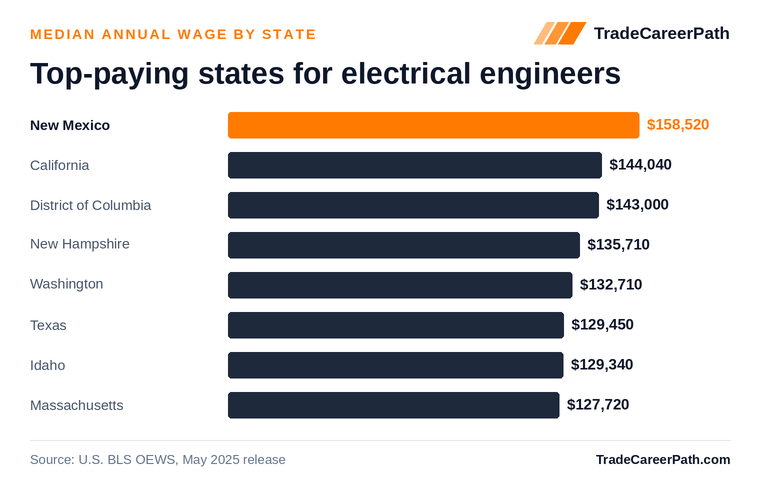
Electrical engineering pay varies widely by state - the spread between the top-paying state and the national median is nearly $38,000 a year.
| State | Median annual wage | Employment |
|---|---|---|
| New Mexico | $158,520 | 2,560 |
| California | $144,040 | 24,230 |
| District of Columbia | $143,000 | 330 |
| New Hampshire | $135,710 | 1,600 |
| Washington | $132,710 | 7,610 |
New Mexico tops the list on the strength of national-lab and defense work - electrical engineers are more than twice as concentrated there as in the average state labor market. For sheer volume of jobs, California (24,230), Texas (20,870 jobs at a $129,450 median), and Michigan (10,840) are the deepest markets - and deep markets matter for a career changer, because they mean you can switch employers without relocating.
Job Outlook for 2026 and Beyond
BLS projects electrical engineering employment to grow +7.2% from 2024 to 2034 - from 192,000 to 205,700 jobs - with about 11,700 openings per year once retirements and occupation changes are counted (BLS Employment Projections, 2024-34).
The drivers are the same forces you already see from the field: grid modernization and utility replacement cycles, electrification of vehicles and buildings, data-center construction, and renewables interconnection. Every one of those creates design and engineering work upstream of the installation work electricians are already doing. For a career changer, the openings number is the one that matters - 11,700 seats a year means steady hiring, and the wage data backs the trend: the occupation’s median moved from $111,910 in the 2024 projections base to $120,630 in the May 2025 OEWS data.

Do You Need a PE License?
It depends on which side of the field you land on - and as a former electrician, you are more likely than most to land on the side where it matters.
Most electrical engineers at manufacturers and product companies work under the “industrial exemption”: the company holds design responsibility, so the individual engineer never licenses. But in power, utility, and building-systems work - the corner of the field where electricians most naturally fit - construction drawings must be stamped by a licensed Professional Engineer, and the PE is effectively the ticket to senior roles and consulting.
The path: graduate from an ABET-accredited program, pass the Fundamentals of Engineering (FE) exam - you can sit for it as a senior - then accumulate roughly four years of qualifying experience under licensed engineers, then pass the PE exam (Power is the common discipline for this crowd), per your state board’s rules. This is exactly why ABET accreditation is the non-negotiable filter when you pick a program: some state boards make licensure slow or impossible from non-accredited degrees. Your trade experience does not count toward the post-degree experience requirement in most states, but it will make the Power PE exam material feel familiar in a way no textbook can.
If This Path Is Not Quite Right
Related jumps from the same starting point:
- Electronics Engineer - circuit and component-level design; same degree, different specialization
- Computer Network Architect - for electricians who gravitated to low-voltage and data work
- CTE Teacher (Shop Teacher) - teach the trade instead of leaving it
- Online Engineering Degrees for Tradespeople - how to pick an ABET program that fits a work schedule
Or browse all trade careers that require a 4-year degree.
Frequently Asked Questions
Can an electrician really work as an electrical engineer?
Yes. The requirement is the accredited bachelor's degree; nothing about starting in the trade blocks the path, and employers consistently treat field experience as an advantage rather than a detour.
How long does it take while working full-time?
Typically five to six years part-time for the bachelor's, less with transfer credit. Apprenticeship classroom hours, NEC coursework, and any community-college credits can transfer.
What is the pay difference?
The national median is $63,190 for electricians versus $120,630 for the degree role (BLS OEWS, May 2025), a difference of about $57,440 per year at the median.
Is the electrical engineering degree hard for an electrician?
The math is the hard part - calculus, differential equations, and electromagnetics are unavoidable. The circuits, power, and machines courses are where working electricians hold a real edge, because you have already seen the hardware the equations describe. Most tradespeople who start with a math refresher finish.
Should I get an electrical engineering degree or an electrical engineering technology (EET) degree?
If you may ever want the PE license or the full engineer title, choose the ABET-accredited electrical engineering (BSEE) degree. EET programs are shorter and more hands-on, but some employers and some state licensing boards treat them as a lesser credential. For a working electrician investing five-plus years, the BSEE is usually the safer buy.
Can an electrician work as an engineer without a degree?
Not with the engineer title in most companies - employers screen for the accredited bachelor's. Without it, the realistic ceiling is engineering technician, designer, or field-engineering roles. Those can be excellent stepping stones while you finish the degree, but they rarely convert to the engineer title and its pay band without it.
Do electrical engineers need a PE license?
Often no - most electrical engineers at manufacturers work under the industrial exemption and never license. The PE matters in power, utility, and consulting work, where drawings must be stamped. The path is the FE exam (you can take it as a senior), about four years of qualifying experience, then the PE exam.
What is the job outlook for electrical engineers?
BLS projects electrical engineering employment to grow +7.2% from 2024 to 2034, from 192,000 to 205,700 jobs, with about 11,700 openings per year (BLS Employment Projections, 2024-34).
Electrical Engineer Salary and Requirements by State
Alabama · Alaska · Arizona · Arkansas · California · Colorado · Connecticut · Delaware · District of Columbia · Florida · Hawaii · Idaho · Illinois · Indiana · Iowa · Kansas · Kentucky · Louisiana · Maine · Maryland · Massachusetts · Michigan · Minnesota · Mississippi · Missouri · Montana · Nebraska · Nevada · New Hampshire · New Jersey · New Mexico · New York · North Carolina · North Dakota · Ohio · Oklahoma · Oregon · Pennsylvania · South Carolina · South Dakota · Tennessee · Texas · Utah · Vermont · Virginia · Washington · West Virginia · Wisconsin · Wyoming
Degree and Program Guides
- Online Electrical Engineering Degrees - accredited program options for this path
Sources
- U.S. Bureau of Labor Statistics, Occupational Employment and Wage Statistics (OEWS), May 2025 - Electrical Engineers (SOC 17-2071) and Electricians
- U.S. Bureau of Labor Statistics, Employment Projections, 2024-34
- U.S. Bureau of Labor Statistics, Occupational Outlook Handbook - education and licensing requirements
Electrician to Engineer Salary by State
About this guide: Researched and written by the TradeCareerPath Editorial Team. Our editorial team researches and sources every trade school and career guide using federal labor and education data, including BLS OEWS and Employment Projections, DOL apprenticeship records, IPEDS, College Scorecard, and state licensing boards. We follow the editorial standards documented at /editorial-policy/.
Data sources
Figures on this page are sourced from the federal and state datasets below. Methodology: how we rank and source data.
| Data | Provider | Vintage |
|---|---|---|
| Occupational Employment and Wage Statistics (OEWS) | U.S. Bureau of Labor Statistics | May 2025 |
| Employment Projections | U.S. Bureau of Labor Statistics | 2024-2034 |
| Integrated Postsecondary Education Data System | National Center for Education Statistics (IPEDS) | 2024 |
| College Scorecard (school-level outcomes) | U.S. Department of Education | latest release |
| College Scorecard (field-of-study earnings) | U.S. Department of Education | latest release (updated 2026-06-12) |
| Occupational licensing requirements | CareerOneStop (U.S. Department of Labor) | latest release (updated 2026-02-22) |
| Registered apprenticeship programs | CareerOneStop / Apprenticeship.gov (U.S. Department of Labor) | latest release (updated 2025-10-25) |
| O*NET occupation profiles (skills, tasks, tools, job zones) | U.S. Department of Labor (O*NET / Employment & Training Admin.) | O*NET 29.1 (updated 2026-06-13) |