
How to Become an Electrician in 2026
Is Electrician Right for You?
The U.S. Department of Labor's O*NET profile for Electricians (SOC 47-2111) describes the work this way: Install, maintain, and repair electrical wiring, equipment, and fixtures. Ensure that work is in accordance with relevant codes. May install or service street lights, intercom systems, or electrical control systems.
What the work involves
- Prepare sketches or follow blueprints to determine the location of wiring or equipment and to ensure conformance to building and safety codes.
- Place conduit, pipes, or tubing, inside designated partitions, walls, or other concealed areas, and pull insulated wires or cables through the conduit to complete circuits between boxes.
- Work from ladders, scaffolds, or roofs to install, maintain, or repair electrical wiring, equipment, or fixtures.
- Use a variety of tools or equipment, such as power construction equipment, measuring devices, power tools, and testing equipment, such as oscilloscopes, ammeters, or test lamps.
- Assemble, install, test, or maintain electrical or electronic wiring, equipment, appliances, apparatus, or fixtures, using hand tools or power tools.
Skills and knowledge that matter
Skills: Troubleshooting, Repairing, Active Listening, Speaking, Critical Thinking, Active Learning.
Knowledge: Building and Construction, Administration and Management, Mechanical, Mathematics.
Tools and technology you may use
Technology: Document management software, Computer aided design CAD software, Industrial control software, Adobe Acrobat, Autodesk AutoCAD, Microsoft Excel.
Typical preparation
O*NET Job Zone Three (Medium Preparation Needed). Most occupations in this zone require training in vocational schools, related on-the-job experience, or an associate's degree. Employees in these occupations usually need one or two years of training involving both on-the-job experience and informal training with experienced workers. A recognized apprenticeship program may be associated with these occupations.
Interest fit
O*NET interest profile: Realistic, Conventional, Investigative. People who enjoy hands-on, practical work with tools, machines, plants, or materials often find this occupation a good fit.
Source: O*NET 31.0 (updated 2026-10-14)
Quick answer: Training as a licensed electrician usually takes 4 to 5 years. You start with a high school diploma or GED, enter a registered apprenticeship through the IBEW, IEC, or ABC (or attend trade school first), complete 4,000 to 8,000 supervised hours, and pass a state journeyman licensing exam that covers the National Electrical Code. Most states require a license to work. The median electrician salary is $63,190 per year ($30.38/hour), and employers post about 72,700 openings nationwide each year (BLS, May 2025).
Electricians install, maintain, and repair the wiring and electrical systems in homes, businesses, factories, and infrastructure. It is one of the most accessible skilled trades to enter without a degree, and demand stays steady as buildings, electric vehicles, and renewable energy keep growing. This guide walks through every step, from training and apprenticeship to licensing and pay.
How to Become an Electrician
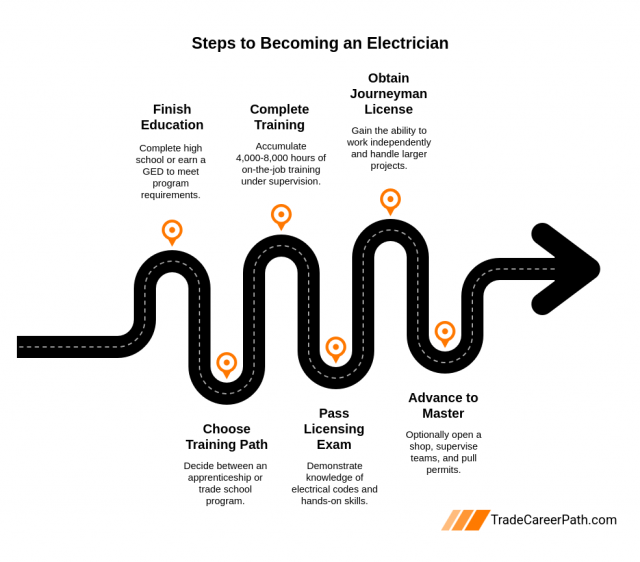
Most people reach a journeyman license in about four to five years. The path is well defined: meet the basic requirements, train through an apprenticeship or trade school, log supervised work hours, pass a licensing exam, and then advance over time.
1. Earn a high school diploma or GED
A high school diploma or GED is the minimum requirement for nearly every apprenticeship and trade school. Before you apply, focus on the skills the trade depends on. Algebra and basic trigonometry come up constantly when you size conductors, calculate loads, and bend conduit, so do not skip the math. Physics helps you understand voltage, current, and resistance, and any shop, electronics, or technical-drawing class gives you a head start on reading blueprints and using tools. Many apprenticeship programs also expect applicants to pass an aptitude test that covers reading comprehension and math, and some require a valid driver’s license because you travel between job sites. If you are switching careers and already have a diploma, you can move straight to choosing a training path. Plenty of strong electricians came from unrelated jobs and brought useful habits in problem solving, reliability, and working safely with their hands.
2. Choose an apprenticeship or trade school
This is where your real training begins, and you have two main routes. A registered apprenticeship is the most common path. You earn a paycheck from day one while working under licensed electricians and attending related classroom instruction, usually in the evenings or on weekends. The International Brotherhood of Electrical Workers (IBEW) sponsors apprenticeships through the Electrical Training Alliance alongside the National Electrical Contractors Association (NECA). On the non-union side, Independent Electrical Contractors (IEC) and Associated Builders and Contractors (ABC) run registered apprenticeships in many states. The other route is trade school, where you complete electrical theory, code instruction, and hands-on lab work in a classroom setting, often in 6 months to 2 years. Trade school can build confidence and may give you advanced standing toward apprenticeship hours, but in most states you still need apprenticeship time before you can be licensed.
3. Complete your supervised work hours
Licensing is built on documented experience. Most states require roughly 4,000 to 8,000 hours of supervised on-the-job training, which works out to about four to five years of full-time work, plus related classroom instruction each year. During this time you rotate through residential, commercial, and sometimes industrial work, learning to pull wire, install panels and fixtures, terminate connections, troubleshoot circuits, and read electrical drawings. A central part of every program is the National Electrical Code (NEC), published by the National Fire Protection Association (NFPA), which governs safe installation and is updated regularly. Keep careful records of your hours and the type of work you perform, because your state licensing board will require proof when you apply to test. Treat this stage as paid education: the more variety you get now, the more capable and marketable you will be later.
4. Pass the journeyman licensing exam
Once you meet your state’s hour and classroom requirements, you apply to sit for the journeyman electrician exam. The exam tests your knowledge of the NEC, safe wiring practices, electrical theory, and local amendments to the code, and many jurisdictions allow you to bring a tabbed code book to reference. Passing earns you a journeyman license, which generally lets you perform most electrical work without direct supervision and take on bigger, more independent jobs. Licensing is handled at the state and sometimes city level, so requirements, fees, and renewal periods vary by location. Many states require continuing education to renew, since the NEC changes on a regular cycle. Some states offer reciprocity that lets you transfer a license across state lines, while others do not, so confirm the rules wherever you plan to work.
5. Advance to master electrician
After several years as a journeyman, you can pursue a master electrician license. This requires additional documented experience and a more advanced exam that goes deeper into code, design, and load calculations. A master license typically lets you pull permits, supervise journeymen and apprentices, and run your own electrical contracting business, which is the route many electricians take to higher pay and ownership. You can also specialize. Solar photovoltaic installation, electric-vehicle charging infrastructure, industrial controls and automation, and low-voltage data and fiber work are all growing niches that reward specific expertise. Joining a trade organization and keeping up with code changes helps you stay current and connected to job opportunities as you move up.
What Do Electricians Do?
Electricians install and maintain the systems that deliver power and control throughout a building or facility. The day-to-day work ranges far beyond wiring outlets. Depending on their specialty, electricians:
- Wire homes, commercial buildings, and new construction
- Set up and maintain industrial control and automation systems
- Install solar panels and electric-vehicle chargers
- Run low-voltage data cables and fiber optics
- Design and maintain backup power for hospitals, data centers, and airports
- Troubleshoot faults and bring older systems up to current code
Most electricians focus on residential, commercial, or industrial work, and many move between them over a career. No two job sites are quite the same, which keeps the work varied.
Skills That Make Great Electricians
- A detail-oriented mindset, because safety and code compliance matter
- Problem-solving under pressure
- Physical endurance and steady hands
- Solid math and mechanical reasoning
- Comfort reading blueprints and technical drawings
- Willingness to keep up with NEC code changes
Training Options
You have three main paths into the trade:
- Union Apprenticeships (IBEW / NECA) for structured wage increases, benefits, and the Electrical Training Alliance curriculum
- Non-Union Apprenticeships (IEC, ABC) for flexible, employer-sponsored registered programs
- Trade School for faster classroom-based programs, often 6 months to 2 years, that may include career assistance
Registered apprenticeships are paid, so you earn while you learn instead of taking on tuition debt. Trade school charges tuition that varies by program and school, but it can build classroom confidence first and sometimes shorten time to licensure through advanced standing. Many electricians blend the two: start with trade school, then enter an apprenticeship to finish their required hours.
Licensing Requirements
Most states require:
- At least 18 years old with a high school diploma or GED
- 4 to 5 years of documented work experience (typically 4,000 to 8,000 supervised hours)
- A passing score on a state journeyman licensing exam (usually includes the NEC)
- License renewal every 1 to 2 years, often with continuing education
Rules are set at the state and sometimes city level. Some states offer reciprocity so you can transfer your license; others do not. Always confirm the requirements where you plan to work.
State-by-State Licensing & Pay Directory
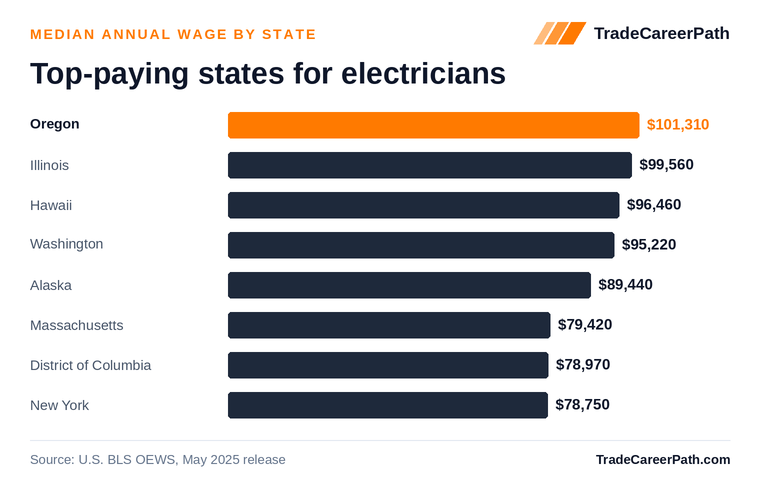
Every state has its own licensing authority, requirements, and wage scale. The table below lists every state guide with current BLS median pay (May 2025) - open any state's guide for licensing steps, fees, and reciprocity.
| State | Median Annual | State Employment | Guide |
|---|---|---|---|
| Alabama | $55,690 | 10,900 | Open guide → |
| Alaska | $89,440 | 1,870 | Open guide → |
| Arizona | $61,060 | 21,140 | Open guide → |
| Arkansas | $49,070 | 7,500 | Open guide → |
| California | $76,160 | 73,310 | Open guide → |
| Colorado | $62,230 | 17,010 | Open guide → |
| Connecticut | $77,540 | 7,710 | Open guide → |
| Delaware | $63,700 | 2,260 | Open guide → |
| District of Columbia | $78,970 | 2,440 | Open guide → |
| Florida | $57,250 | 49,700 | Open guide → |
| Georgia | $58,320 | 21,650 | Open guide → |
| Hawaii | $96,460 | 3,070 | Open guide → |
| Idaho | $63,000 | 5,690 | Open guide → |
| Illinois | $99,560 | 23,120 | Open guide → |
| Indiana | $68,490 | 19,020 | Open guide → |
| Iowa | $60,860 | 10,310 | Open guide → |
| Kansas | $65,860 | 6,350 | Open guide → |
| Kentucky | $59,720 | 11,030 | Open guide → |
| Louisiana | $61,540 | 10,550 | Open guide → |
| Maine | $75,380 | 3,780 | Open guide → |
| Maryland | $73,490 | 13,690 | Open guide → |
| Massachusetts | $79,420 | 17,810 | Open guide → |
| Michigan | $76,270 | 23,530 | Open guide → |
| Minnesota | $78,160 | 14,350 | Open guide → |
| Mississippi | $60,860 | 6,610 | Open guide → |
| Missouri | $65,410 | 12,780 | Open guide → |
| Montana | $76,760 | 2,750 | Open guide → |
| Nebraska | $60,820 | 6,440 | Open guide → |
| Nevada | $73,570 | 8,350 | Open guide → |
| New Hampshire | $62,840 | 3,330 | Open guide → |
| New Jersey | $77,250 | 13,520 | Open guide → |
| New Mexico | $58,390 | 5,020 | Open guide → |
| New York | $78,750 | 40,130 | Open guide → |
| North Carolina | $56,800 | 21,640 | Open guide → |
| North Dakota | $65,710 | 3,570 | Open guide → |
| Ohio | $64,700 | 28,950 | Open guide → |
| Oklahoma | $61,010 | 8,500 | Open guide → |
| Oregon | $101,310 | 10,590 | Open guide → |
| Pennsylvania | $67,600 | 22,730 | Open guide → |
| Rhode Island | $74,090 | 2,420 | Open guide → |
| South Carolina | $58,740 | 8,010 | Open guide → |
| South Dakota | $61,390 | 2,980 | Open guide → |
| Tennessee | $61,090 | 17,070 | Open guide → |
| Texas | $58,570 | 76,770 | Open guide → |
| Utah | $62,000 | 11,450 | Open guide → |
| Vermont | $63,430 | 1,270 | Open guide → |
| Virginia | $62,900 | 23,630 | Open guide → |
| Washington | $95,220 | 19,380 | Open guide → |
| West Virginia | $64,810 | 4,290 | Open guide → |
| Wisconsin | $76,540 | 14,310 | Open guide → |
| Wyoming | $76,120 | 2,960 | Open guide → |
Wages: BLS OEWS, May 2025. Licensing details and apprenticeship rules vary by state - open each guide for current fees, exam structure, and reciprocity.
Education and Licensing Paths
| Pathway | Typical Duration | Outcome |
|---|---|---|
| Registered Apprenticeship | 4 to 5 years | Paid path to journeyman license |
| Trade School | 6 months to 2 years | Classroom and lab preparation, often before apprenticeship |
| Journeyman License | After required hours and exam | Work independently on most jobs |
| Master Electrician | Additional experience and exam | Pull permits, supervise, own a business |
Career Growth and Advancement
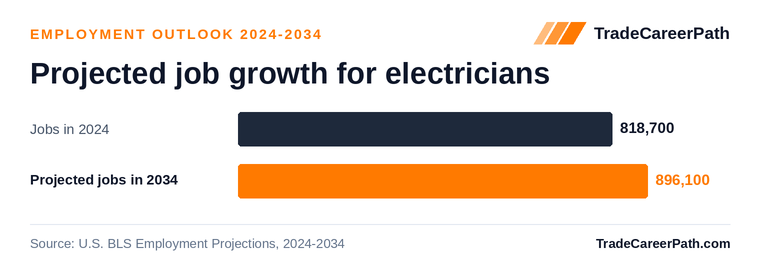
With experience, electricians can move into roles such as:
- Journeyman Electrician who works independently on most jobs
- Master Electrician who pulls permits and supervises crews
- Electrical Contractor or Business Owner who runs their own shop
- Specialist in solar, EV charging, industrial controls, or low-voltage systems
- Foreman, Estimator, or Project Manager on larger construction teams
Cost and Duration of Training
- Apprenticeship: typically paid, so you earn a wage while you train rather than paying tuition
- Trade school: tuition varies by program and school; request current pricing directly
- Time to license: about 4 to 5 years to reach journeyman, with master licensure later
Registered apprenticeships through the IBEW, IEC, and ABC let you avoid tuition debt while building licensing hours, which is a major reason the trade is so accessible.
Pros and Cons of the Electrical Trade
Pros
- Strong pay without a college degree (BLS median $63,190)
- Steady demand across residential, commercial, and industrial work
- Room to specialize in solar, EV charging, and automation
- A clear ladder from apprentice to journeyman to business owner
Cons
- Physically demanding work
- Ongoing licensing and continuing education
- Working with live power carries real safety responsibility
Quick Facts: Electrician Salary, Education, and Outlook
Citeable national medians, percentiles, openings, and injury rates: electrician salary statistics 2026.
Wage and Employment Charts
Wage Progression by Experience
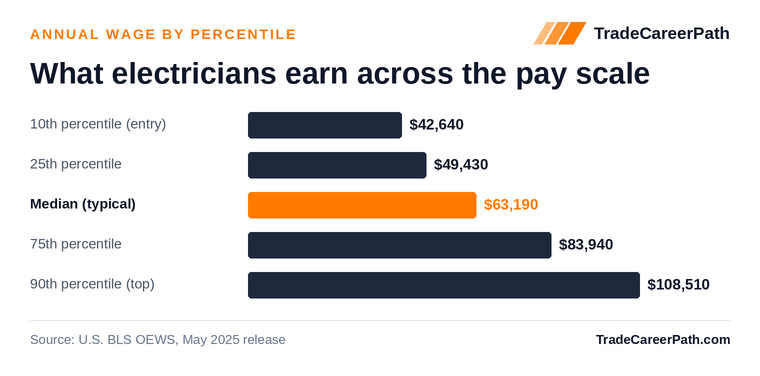
BLS reports the wage distribution for this occupation as percentile bands. Workers typically move through these bands as they accumulate experience, credentials, and specialty skills - actual pace varies by region, employer, and union status.
- 10th percentile 1st-year apprentice $42,640 / yr$20.50/hr
- 25th percentile Apprentice (years 2-3) $49,430 / yr$23.76/hr
- median Journeyman $63,190 / yr$30.38/hr
- 75th percentile Experienced journeyman $83,940 / yr$40.36/hr
- 90th percentile Master electrician / specialist $108,510 / yr$52.17/hr
Source: BLS Occupational Employment and Wage Statistics (OEWS), May 2025. Stage labels are illustrative of typical career progression in this trade and do not represent guaranteed earnings at specific years of experience.
Top States by Median Wage
Highest-Paying U.S. Metros
Federal Prevailing Wages (Davis-Bacon)
The U.S. Department of Labor sets Davis-Bacon prevailing wages that contractors must pay on federally funded construction projects. These are minimum hourly rates, not averages - actual market pay can be higher. Across 43 states with active 2026 determinations, the average total compensation (base + fringe) for electricians is $55.95/hour. Rhode Island pays the highest rate ($100.21/hr total), while South Carolina reports the lowest active determination ($15.00/hr total).
| State | Base Hourly | Fringe Hourly | Total Hourly | Annualized* |
|---|---|---|---|---|
| Rhode Island | $56.11 | $44.10 | $100.21 | $208,437 |
| Nevada | $65.84 | $33.38 | $99.22 | $206,378 |
| Washington | $60.00 | $27.78 | $87.78 | $182,582 |
| Pennsylvania | $49.11 | $36.79 | $85.90 | $178,672 |
| Massachusetts | $48.16 | $36.20 | $84.36 | $175,469 |
| Delaware | $47.50 | $35.93 | $83.43 | $173,534 |
| Michigan | $56.05 | $27.25 | $83.30 | $173,264 |
| District of Columbia | $59.50 | $23.06 | $82.56 | $171,725 |
| Missouri | $54.01 | $27.85 | $81.86 | $170,269 |
| Wisconsin | $50.86 | $28.26 | $79.12 | $164,570 |
| Oregon | $52.12 | $24.37 | $76.49 | $159,099 |
| Indiana | $46.00 | $29.23 | $75.23 | $156,478 |
| Minnesota | $48.37 | $26.13 | $74.50 | $154,960 |
| New Jersey | $41.00 | $32.12 | $73.12 | $152,090 |
| Idaho | $49.55 | $19.09 | $68.64 | $142,771 |
| Maryland | $47.00 | $20.84 | $67.84 | $141,107 |
| Virginia | $37.95 | $25.95 | $63.90 | $132,912 |
| Kentucky | $40.96 | $22.44 | $63.40 | $131,872 |
| West Virginia | $42.20 | $20.39 | $62.59 | $130,187 |
| New Hampshire | $36.12 | $22.92 | $59.04 | $122,803 |
| Illinois | $35.00 | $20.67 | $55.67 | $115,794 |
| New York | $44.30 | $5.50 | $49.80 | $103,584 |
| California | $40.50 | $8.18 | $48.68 | $101,254 |
| Ohio | $42.55 | $5.25 | $47.80 | $99,424 |
| Florida | $33.50 | $13.85 | $47.35 | $98,488 |
| Arizona | $36.50 | $10.00 | $46.50 | $96,720 |
| Colorado | $31.75 | $13.25 | $45.00 | $93,600 |
| Arkansas | $28.94 | $14.95 | $43.89 | $91,291 |
| Tennessee | $27.25 | $15.72 | $42.97 | $89,378 |
| Mississippi | $28.80 | $14.14 | $42.94 | $89,315 |
| Kansas | $27.58 | $10.98 | $38.56 | $80,205 |
| Louisiana | $31.98 | $4.34 | $36.32 | $75,546 |
| New Mexico | $28.25 | $6.62 | $34.87 | $72,530 |
| Maine | $25.27 | $9.30 | $34.57 | $71,906 |
| Iowa | $26.18 | $8.33 | $34.51 | $71,781 |
| Vermont | $21.53 | $9.36 | $30.89 | $64,251 |
| Utah | $23.36 | $6.06 | $29.42 | $61,194 |
| North Carolina | $22.15 | $5.93 | $28.08 | $58,406 |
| Oklahoma | $21.51 | $6.27 | $27.78 | $57,782 |
| Nebraska | $20.66 | $5.74 | $26.40 | $54,912 |
| Alabama | $19.05 | $4.30 | $23.35 | $48,568 |
| Texas | $18.06 | $4.87 | $22.93 | $47,694 |
| South Carolina | $15.00 | $0.00 | $15.00 | $31,200 |
* Annualized total = total hourly × 2,080 hours (40-hour week, 52 weeks). Actual annual pay varies with overtime, project length, and benefits utilization.
Source: U.S. Department of Labor, Wage and Hour Division - Davis-Bacon General Wage Determinations, 2026. Rates reflect the lowest base rate within each statewide determination for electrician classifications.
Electrician Salary and Requirements by State
Select your state for local wage data, training options, and requirements:
Alabama · Alaska · Arizona · Arkansas · California · Colorado · Connecticut · Delaware · District of Columbia · Florida · Georgia · Hawaii · Idaho · Illinois · Indiana · Iowa · Kansas · Kentucky · Louisiana · Maine · Maryland · Massachusetts · Michigan · Minnesota · Mississippi · Missouri · Montana · Nebraska · Nevada · New Hampshire · New Jersey · New Mexico · New York · North Carolina · North Dakota · Ohio · Oklahoma · Oregon · Pennsylvania · Rhode Island · South Carolina · South Dakota · Tennessee · Texas · Utah · Vermont · Virginia · Washington · West Virginia · Wisconsin · Wyoming
Industry Organizations & Certifying Bodies
These are the recognized national organizations, unions, certifying bodies, and regulatory authorities that shape this trade. They issue the credentials, sponsor the apprenticeships, publish the codes, and represent workers and employers.
- International Brotherhood of Electrical Workers (IBEW) Largest electrician union; sponsors registered apprenticeships through the Electrical Training Alliance.
- Independent Electrical Contractors (IEC) National non-union trade association sponsoring registered apprenticeships.
- Associated Builders and Contractors (ABC) Merit-shop trade association sponsoring electrical apprenticeships in many states.
- National Electrical Contractors Association (NECA) Employer association partnering with IBEW on the Electrical Training Alliance.
- National Fire Protection Association (NFPA) Publishes the National Electrical Code (NEC) used in licensing exams.
- International Code Council (ICC) Develops electrical and building codes adopted by many jurisdictions.
Workplace Safety Snapshot
BLS Survey of Occupational Injuries and Illnesses data (2023-2024) report approximately 146.9 days-away, restricted, or transfer cases per 10,000 full-time-equivalent workers in electricians (about 1.47 per 100 FTE). Source: BLS Survey of Occupational Injuries and Illnesses, Table R98.
Frequently Asked Questions
How long does electrician training take?
It typically takes 4 to 5 years to work as a fully licensed electrician through an apprenticeship, which usually requires 4,000 to 8,000 hours of supervised on-the-job work plus classroom instruction. A trade school program can be faster to complete, but you generally still need apprenticeship hours before you qualify for a journeyman license.
Do you need a college degree to work as an electrician?
No. A college degree is not required to work as an electrician. Most people enter the field through a registered apprenticeship or a trade school program followed by on-the-job training. A high school diploma or GED is typically the only educational prerequisite to get started.
Do you need a license to work as an electrician?
In most states, yes. Electricians usually progress from apprentice to journeyman to master, and the journeyman and master levels require passing a state or local licensing exam that tests the National Electrical Code (NEC) published by the National Fire Protection Association (NFPA). Exact rules, exams, and renewal periods vary by state and sometimes by city.
How much does electrician training cost?
Costs vary widely by program and school. Registered apprenticeships through the IBEW, IEC, or ABC are typically paid positions, so you earn a wage while you learn rather than taking on tuition. Trade school programs charge tuition that differs by school and format, so request current pricing directly from any program you are considering.
Is training as an electrician hard?
The path is demanding but accessible without a degree. Apprenticeship combines paid work with night or weekend classes over several years, and the job requires comfort with math, careful attention to safety, and the physical stamina to work on ladders, in tight spaces, and in varied conditions. The trade-off is steady demand and a clear ladder from apprentice to journeyman to master.
Can you train to be an electrician online?
Some classroom and electrical theory coursework is available online, and a few trade schools offer hybrid formats. However, you cannot work as a licensed electrician through online study alone. Every licensing path requires documented hands-on hours under a licensed electrician, which must be completed in person.
What is the difference between a journeyman and a master electrician?
A journeyman electrician has completed an apprenticeship and passed a licensing exam, and can perform most electrical work, often unsupervised. A master electrician has additional experience and has passed a higher-level exam, which in many states allows them to pull permits, supervise journeymen and apprentices, and run their own contracting business.
How Electrician Pay Compares to Similar Trades
Side-by-side comparison of Electrician and the closest related careers, based on U.S. Bureau of Labor Statistics data (May 2025 OEWS + 2025-2035 Employment Projections).
| Career | Median Pay | 10-Year Growth | Annual Openings |
|---|---|---|---|
| Electrician this guide | $63,190 | +9.2% | 72,700 |
| Lineworker | $95,320 | +10.3% | 10,900 |
| HVAC Technician | $61,010 | +10.9% | 40,600 |
| Solar Installation Professional | $53,140 | +36.5% | 4,200 |
| Tower Technician Training | $63,890 | -3.3% | 11,300 |
Source: BLS Occupational Employment and Wage Statistics + BLS Employment Projections.
Advance Your Career with a Degree
Experienced Electrician professionals often step up into degree-track careers where field experience is a hiring advantage:
- Electrician to engineer: the full path - what transfers and how long it takes
- Electrical Engineer - median pay $120,630 (BLS OEWS, May 2025); requires a 4-year degree
- Health and Safety Engineer - median pay $115,160 (BLS OEWS, May 2025); requires a 4-year degree
- Computer Hardware Engineer - median pay $161,740 (BLS OEWS, May 2025); requires a 4-year degree
- Construction Cost Estimator - median pay $78,740 (BLS OEWS, May 2025); requires a 4-year degree
- CTE Teacher (Shop Teacher) - median pay $66,270 (BLS OEWS, May 2025); requires a 4-year degree
- Facilities Manager - median pay $106,660 (BLS OEWS, May 2025); requires a 4-year degree
- Electronics Engineer - median pay $130,220 (BLS OEWS, May 2025); requires a 4-year degree
- Nuclear Engineer - median pay $133,970 (BLS OEWS, May 2025); requires a 4-year degree
- Computer Network Architect - median pay $134,050 (BLS OEWS, May 2025); requires a 4-year degree
- Construction Project Manager - median pay $102,320 (BLS OEWS, May 2025); requires a 4-year degree
See all trade careers that require a 4-year degree.
Degree and Program Guides
- Online Electrical Engineering Degrees - the degree route out of the field
Sources
- U.S. Bureau of Labor Statistics, Occupational Employment and Wage Statistics (May 2025)
- U.S. Bureau of Labor Statistics, Employment Projections 2025-2035
- U.S. Bureau of Labor Statistics, Survey of Occupational Injuries and Illnesses (2023-2024, Table R98)
- U.S. Department of Labor, Wage and Hour Division, Davis-Bacon General Wage Determinations (2026)
Electrician Salary by State
About this guide: Researched and written by the TradeCareerPath Editorial Team. Our editorial team researches and sources every trade school and career guide using federal labor and education data, including BLS OEWS and Employment Projections, DOL apprenticeship records, IPEDS, College Scorecard, and state licensing boards. We follow the editorial standards documented at /editorial-policy/.
Data sources
Figures on this page are sourced from the federal and state datasets below. Methodology: how we rank and source data.
| Data | Provider | Vintage |
|---|---|---|
| Occupational Employment and Wage Statistics (OEWS) | U.S. Bureau of Labor Statistics | May 2025 |
| Employment Projections | U.S. Bureau of Labor Statistics | 2025-2035 |
| Integrated Postsecondary Education Data System | National Center for Education Statistics (IPEDS) | 2024 |
| College Scorecard (school-level outcomes) | U.S. Department of Education | latest release |
| College Scorecard (field-of-study earnings) | U.S. Department of Education | latest release (updated 2026-06-12) |
| Occupational licensing requirements | CareerOneStop (U.S. Department of Labor) | latest release (updated 2026-02-22) |
| Registered apprenticeship programs | CareerOneStop / Apprenticeship.gov (U.S. Department of Labor) | latest release (updated 2025-10-25) |
| O*NET occupation profiles (skills, tasks, tools, job zones) | U.S. Department of Labor (O*NET / Employment & Training Admin.) | O*NET 31.0 (updated 2026-10-14) |