
How to Become an Electronics Engineer in 2026
Is Electronics Engineer Right for You?
The U.S. Department of Labor's O*NET profile for Electronics Engineers, Except Computer (SOC 17-2072) describes the work this way: Research, design, develop, or test electronic components and systems for commercial, industrial, military, or scientific use employing knowledge of electronic theory and materials properties. Design electronic circuits and components for use in fields such as telecommunications, aerospace guidance and propulsion control, acoustics, or instruments and controls.
What the work involves
- Design electronic components, software, products, or systems for commercial, industrial, medical, military, or scientific applications.
- Operate computer-assisted engineering or design software or equipment to perform electronics engineering tasks.
- Evaluate project work to ensure effectiveness, technical adequacy, or compatibility in the resolution of complex electronics engineering problems.
- Direct or coordinate activities concerned with manufacture, construction, installation, maintenance, operation, or modification of electronic equipment, products, or systems.
- Confer with engineers, customers, vendors, or others to discuss existing or potential electronics engineering projects or products.
Skills and knowledge that matter
Skills: Reading Comprehension, Critical Thinking, Complex Problem Solving, Speaking, Active Listening, Judgment and Decision Making.
Knowledge: Engineering and Technology, Computers and Electronics, Design, Mathematics.
Tools and technology you may use
Technology: Enterprise resource planning ERP software, Analytical or scientific software, File versioning software, Apache Subversion SVN, Autodesk AutoCAD, C.
Typical preparation
O*NET Job Zone Four (Considerable Preparation Needed). Most of these occupations require a four-year bachelor's degree, but some do not. Employees in these occupations usually need several years of work-related experience, on-the-job training, and/or vocational training.
Interest fit
O*NET interest profile: Realistic, Investigative, Conventional. People who enjoy hands-on, practical work with tools, machines, plants, or materials often find this occupation a good fit.
Source: O*NET 31.0 (updated 2026-10-14)
Quick answer: Training as an electronics engineer requires a 4-year degree - typically an ABET-accredited bachelor’s in electronics or electrical engineering. The national median pay is $130,220 per year, and BLS projects +3.7% employment change from 2025 to 2035 (BLS OEWS, May 2025; BLS Employment Projections, 2025-35).
Electronics Engineer at a Glance
| Metric | Detail | Source |
|---|---|---|
| Median annual wage | $130,220 | BLS OEWS, May 2025 |
| Typical wage range | $81,840 (10th pct) - $206,960 (90th pct) | BLS OEWS, May 2025 |
| Employment | 96,900 nationwide | BLS OEWS, May 2025 |
| Projected growth (2025-35) | +3.7%, about 4,900 openings per year | BLS Employment Projections, 2025-35 |
| Typical education | ABET-accredited bachelor’s in electronics or electrical engineering | BLS Occupational Outlook Handbook |
| License / certification | PE license for some roles; not required for most industry positions | State licensing boards |
What Does an Electronics Engineer Do?
Electronics engineers (distinct from electrical engineers, who focus on power generation and distribution) design the circuits, communications gear, navigation systems, and control electronics that technicians build, install, and repair. They own the design layer: the schematic, the board, the firmware architecture, and the test specification that everything downstream depends on.
Day to day, the work depends on the specialty. An RF engineer designs and tunes transmitter and receiver chains, then spends afternoons on a spectrum analyzer chasing spurious emissions before a compliance test. A hardware engineer takes a product from block diagram to schematic to PCB layout, sits with the first prototypes on a bench full of scopes and logic analyzers, and dispositions every failure the validation team logs. An instrumentation or controls engineer specifies sensors and signal-conditioning for industrial or avionics systems, where the paperwork - requirements, test procedures, review sign-offs - matters as much as the circuit, because a design error ships to thousands of units or flies on an aircraft. Across all of it, the routine is design-build-test loops punctuated by design reviews and documentation.
If you are coming from the bench - electronics tech, avionics tech, or tower and telecom work - the shortest way to say it: the technician finds the failed component and swaps it; the engineer decides why the circuit let it fail and changes the design so it stops happening. The troubleshooting instinct you already have is exactly what separates good design engineers from ones who only trust the simulation, and hiring managers in test and validation groups know it.
Skills That Make a Great Electronics Engineer
- Analog and digital circuit design
- RF and communications fundamentals
- Embedded systems and firmware (C, microcontrollers, FPGAs)
- Test instrumentation (scopes, spectrum and logic analyzers)
- Schematic capture, simulation, and PCB layout (SPICE, Altium/KiCad)
- Signal integrity, EMC/EMI, and compliance testing
- Writing: test plans, design documents, and failure analyses carry the job
Electronics Engineer Salary
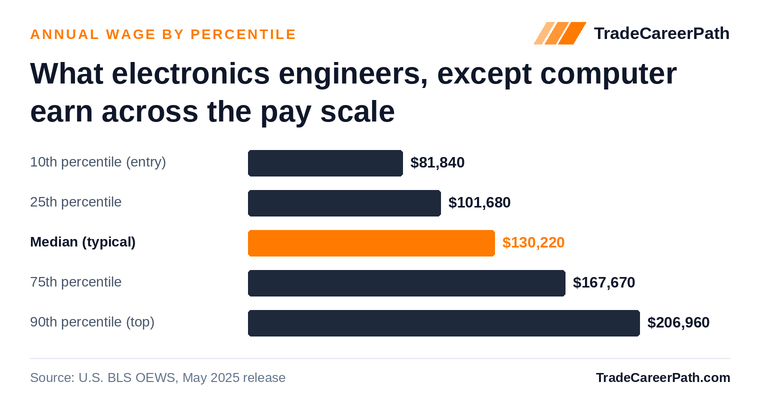
Electronics engineering is one of the best-paid destinations a bench background can lead to. The national median is $130,220 per year, and even the 10th percentile - roughly where new graduates start - is $81,840, which is above the median for most skilled trades. The 75th percentile sits at $167,670, and the top 10% earn $206,960 or more (BLS OEWS, May 2025). The mean of $137,280 running above the median tells you the upper end of the field pulls hard.
Where the Jobs and the Money Are
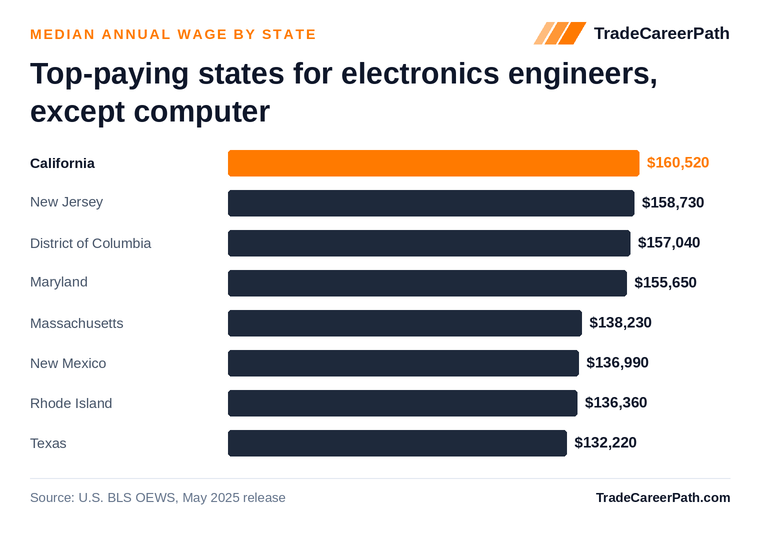
Electronics engineering clusters around defense, telecom, and instrumentation hubs. California is the largest single market by a wide margin - 20,830 engineers, more than one in five nationwide - and also the best-paying state. Texas (9,520 jobs at a $132,220 median) and Colorado (6,080 jobs) round out the biggest employment markets (BLS OEWS, May 2025).
| State | Median annual wage | Employment |
|---|---|---|
| California | $160,520 | 20,830 |
| New Jersey | $158,730 | 1,820 |
| District of Columbia | $157,040 | 400 |
| Maryland | $155,650 | 3,390 |
| Massachusetts | $138,230 | 5,910 |
Concentration matters as much as headline pay. In Colorado, electronics engineers are more than three times as common as in the average state labor market (location quotient 3.39) - aerospace and defense electronics along the Front Range drive that. Massachusetts (2.61) and Maryland (1.97) are similar stories: defense labs, radar, and instrumentation firms make these deep markets where you can change employers without relocating. New Jersey pays near the top but the market is thinner, so those roles skew senior.
How to Become an Electronics Engineer
1. Earn an ABET-accredited bachelor’s
Electronics engineering, or electrical engineering with an electronics focus. Accreditation is the one non-negotiable: employers screen for it, graduate schools require it, and the FE/PE licensure path assumes it. For working technicians, the electrical-engineering route usually offers far more accredited online and evening options, and employers hire EE graduates into electronics roles as a matter of course. ABET-accredited electronics engineering technology (EET) programs are the other common working-technician route - just confirm how your target employers treat EET versus EE before committing.
2. Convert bench skill to design skill
Circuit simulation, PCB layout, and embedded firmware round out hands-on experience. You already know how circuits fail; the degree teaches you why, and the tools - SPICE, schematic capture, a layout package, C on a microcontroller - are what turn troubleshooting knowledge into design output. Build a small portfolio as you study: a board you designed, laid out, and brought up says more in an interview than any course list. Get a written transfer evaluation first; military electronics training and an AAS in electronics technology are often worth meaningful credit.
3. Start in test or design
Defense, telecom, and instrumentation firms hire technicians-turned-engineers into validation roles first. Test engineering is the classic bridge job: you are judging real hardware with instruments you already know, while learning the design side from the engineers whose boards you are breaking. Sustaining and liaison engineering - dispositioning production failures and field returns - is the other natural entry point for someone with repair experience.
4. Specialize
RF/communications, avionics, instrumentation, or control systems. The specialty you pick sets your market: RF and avionics track toward defense and aerospace hubs (and often a security clearance), instrumentation and controls toward industrial and energy employers spread across more states. Pick the one closest to the hardware you have already worked on - that is where your trade background compounds fastest.
5. Advance
Senior engineer or engineering management; PE for public-sector sign-off. The fork comes around the ten-year mark: deepen into a technical-authority role - senior or principal engineer owning an architecture - or take the management track. In defense electronics, clearance level and program experience drive advancement as much as title does. The career ladder below maps the pay bands.
Career Ladder: Titles and Realistic Pay
The BLS wage percentiles map cleanly onto how electronics careers actually progress. Use this as a sanity check on offers, not a guarantee:
| Stage | Typical titles | Years in | Realistic pay (BLS OEWS, May 2025) |
|---|---|---|---|
| Entry level | Engineer I, test engineer, validation engineer | 0-3 | ~$81,840-$101,680 (10th-25th pct) |
| Mid-career | Engineer II/III, board or subsystem owner | 3-10 | ~$130,220 (median) |
| Senior | Senior/staff engineer, RF or hardware lead | 10-15 | ~$167,670 (75th pct) |
| Principal / leadership | Principal engineer, engineering manager | 15+ | $206,960+ (90th pct) |
Two notes for career changers. First, prior bench experience compresses this ladder: former electronics and avionics technicians are routinely hired above the bottom of the entry band because they need less supervision around real hardware and instruments. Second, the 90th-percentile figure understates senior compensation at defense primes and semiconductor firms, where bonuses, clearance premiums, and stock ride on top of the base-wage data shown here.
Do You Need a PE License?
Mostly no. Electronics engineers at manufacturers work under the “industrial exemption” - the company, not the individual engineer, holds design responsibility, so most never license. Two credentials tend to matter more in this field:
- Security clearance: on defense electronics programs, clearability is often the gate that matters most, and cleared engineers have a wider, better-paying market.
- Industry certifications: vendor and domain certs (RF, IPC design standards, functional-safety) help qualitatively but none is a legal requirement the way a license is.
If you want the PE anyway - it helps in consulting, public-infrastructure electronics, and expert-witness work - the path is: ABET degree, pass the Fundamentals of Engineering (FE) exam (you can sit for it as a senior), four years of qualifying experience, then the PE exam in electrical and computer engineering, per your state board’s rules.
Why an Online Degree Works for This Career
Electronics techs, avionics techs, and tower climbers already read the schematics; the ABET bachelor’s converts repair skill into design authority. Online electronics engineering technology programs are a common working-technician route, and accredited online EE programs have multiplied in the last decade. Employer tuition assistance is common at defense contractors, telecoms, and instrumentation firms - many technicians complete the degree with most of the tuition covered, without giving up their job or their seniority.
Job Outlook for 2026 and Beyond
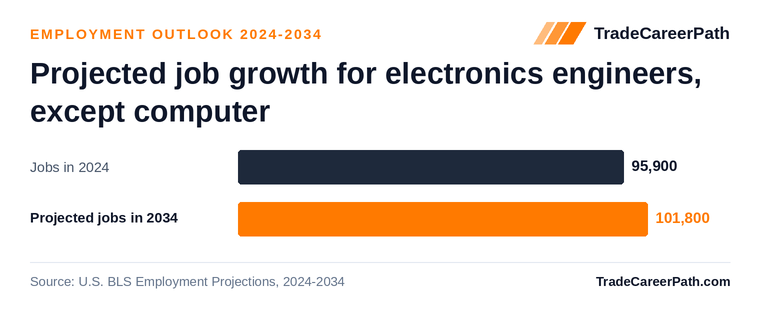
BLS projects electronics engineering employment to grow +3.7% from 2025 to 2035 - from 98,200 to 101,800 jobs - with about 4,900 openings per year once retirements and occupation changes are counted (BLS Employment Projections, 2025-35). Pay is moving the right direction too: the latest median of $130,220 (OEWS, May 2025) is up from the 2024 figure of $127,590.
The demand drivers are structural: defense electronics programs are funded years ahead, telecom infrastructure keeps cycling through generations, and every industrial product is absorbing more embedded electronics. For career changers, the more useful number is the openings figure - 4,900 seats a year in a 96,900-person occupation means steady hiring, and in the defense-heavy segments, citizenship and clearance requirements keep the candidate pool tighter than in most engineering fields.
Cost and Time to Complete the Degree
For electronics engineers, the credential is: ABET-accredited bachelor’s in electronics or electrical engineering. A bachelor’s degree is typically 120 credit hours: four years full-time, and commonly five to six years part-time while working. Transfer credit is the other lever: prior college, military training, apprenticeship coursework, and industry certifications can be worth meaningful credit at transfer-friendly schools, so get a written transfer evaluation before enrolling anywhere. Costs vary widely by school type; in-state public online programs are usually the value benchmark, and employer tuition assistance is common for working adults in this field.
Pros and Cons of Training as an Electronics Engineer
Pros
- Median pay of $130,220 nationally (BLS OEWS, May 2025)
- BLS projects +3.7% employment growth through 2035, about 4,900 openings per year
- Field experience from the trades is a genuine hiring advantage
- Accredited online and hybrid degree paths exist for working adults
Cons
- Requires a 4-year degree (typically 120 credit hours)
- Entry-level pay starts near $81,840 at the 10th percentile
- Licensing hurdle: PE license for some roles; not required for most industry positions
Frequently Asked Questions
What's the difference between electrical and electronics engineering?
BLS tracks them separately: electrical engineers (SOC 17-2071) center on power generation and distribution; electronics engineers (17-2072) on circuits, communications, and control systems. Both are bachelor's-entry and both pay six-figure medians.
How much do electronics engineers make?
The national median annual wage for electronics engineers, except computer is $130,220 (BLS OEWS, May 2025). The top 10% earn $206,960 or more, while entry-level pay starts around $81,840.
What is the job outlook for electronics engineers?
BLS projects employment of electronics engineers, except computer to change by +3.7% from 2025 to 2035 (BLS Employment Projections, 2025-35).
How long does electronics engineer training take?
The ABET-accredited bachelor's is 120 credit hours: four years full-time, commonly five to six years part-time while working. Transfer credit from prior college, military electronics training, or an AAS in electronics technology can meaningfully shorten it at transfer-friendly schools.
Is electronics engineering hard?
The degree is math-heavy - calculus, differential equations, signals and systems, and electromagnetics are unavoidable. Working technicians usually find the circuits and lab courses easier than fresh high-school graduates do, because they have already probed real hardware with a scope; the abstract math is the part that takes discipline.
Should I get an electronics or electrical engineering degree?
For working technicians, an ABET-accredited electrical engineering degree with an electronics concentration is often the smarter buy: far more accredited online options, and employers hire electrical engineering graduates into electronics roles (SOC 17-2072) as a matter of course. A pure electronics engineering or electronics engineering technology degree also works if it carries ABET accreditation.
Can you train as an electronics engineer without a degree?
Not with the engineer title - employers require the ABET-accredited bachelor's. Without it, the ceiling is electronics technician, test technician, or field-service roles. Bench experience and military electronics training shorten the degree through transfer credit, but they do not replace it.
Do electronics engineers need a PE license?
Usually no - most work at manufacturers under the industrial exemption, so the company holds design responsibility. The PE matters for consulting, public-infrastructure, and expert-witness work; the path is FE exam, four years of experience, then the PE. In defense electronics, a security clearance often opens more doors than the PE.
Electronics Engineer Salary and Requirements by State
Alabama · Alaska · Arizona · Arkansas · California · Colorado · Connecticut · District of Columbia · Florida · Georgia · Hawaii · Idaho · Illinois · Indiana · Iowa · Kansas · Kentucky · Louisiana · Maine · Maryland · Massachusetts · Michigan · Minnesota · Mississippi · Missouri · Montana · Nebraska · Nevada · New Hampshire · New Jersey · New Mexico · New York · North Carolina · North Dakota · Ohio · Oklahoma · Oregon · Pennsylvania · Rhode Island · South Carolina · South Dakota · Tennessee · Texas · Utah · Vermont · Virginia · Washington · West Virginia · Wisconsin · Wyoming
Related Careers and Degree Paths
- Electrical Engineer - the power-systems side of the same degree family
- Computer Hardware Engineer - the adjacent SOC for processor and computer-system design
- Aerospace Engineer - where avionics and RF specialists often land
- Electrician to Engineer - the bridge path for electrical trades
- Online Engineering Degrees for Tradespeople - how to pick an ABET program that fits a work schedule
Degree and Program Guides
- Online Electrical Engineering Degrees - the degree route into electronics and controls work
Sources
- U.S. Bureau of Labor Statistics, Occupational Employment and Wage Statistics (OEWS), May 2025 - Electronics Engineers, Except Computer (SOC 17-2072)
- U.S. Bureau of Labor Statistics, Employment Projections, 2025-35
- U.S. Bureau of Labor Statistics, Occupational Outlook Handbook - education and licensing requirements
Electronics Engineer Salary by State
About this guide: Researched and written by the TradeCareerPath Editorial Team. Our editorial team researches and sources every trade school and career guide using federal labor and education data, including BLS OEWS and Employment Projections, DOL apprenticeship records, IPEDS, College Scorecard, and state licensing boards. We follow the editorial standards documented at /editorial-policy/.
Data sources
Figures on this page are sourced from the federal and state datasets below. Methodology: how we rank and source data.
| Data | Provider | Vintage |
|---|---|---|
| Occupational Employment and Wage Statistics (OEWS) | U.S. Bureau of Labor Statistics | May 2025 |
| Employment Projections | U.S. Bureau of Labor Statistics | 2025-2035 |
| Integrated Postsecondary Education Data System | National Center for Education Statistics (IPEDS) | 2024 |
| College Scorecard (school-level outcomes) | U.S. Department of Education | latest release |
| College Scorecard (field-of-study earnings) | U.S. Department of Education | latest release (updated 2026-06-12) |
| Occupational licensing requirements | CareerOneStop (U.S. Department of Labor) | latest release (updated 2026-02-22) |
| Registered apprenticeship programs | CareerOneStop / Apprenticeship.gov (U.S. Department of Labor) | latest release (updated 2025-10-25) |
| O*NET occupation profiles (skills, tasks, tools, job zones) | U.S. Department of Labor (O*NET / Employment & Training Admin.) | O*NET 31.0 (updated 2026-10-14) |