
How to Become an Energy Auditor
Is Energy Auditor Right for You?
The U.S. Department of Labor's O*NET profile for Construction and Building Inspectors (SOC 47-4011) describes the work this way: Inspect structures using engineering skills to determine structural soundness and compliance with specifications, building codes, and other regulations. Inspections may be general in nature or may be limited to a specific area, such as electrical systems or plumbing.
What the work involves
- Approve building plans that meet required specifications.
- Review and interpret plans, blueprints, site layouts, specifications, or construction methods to ensure compliance to legal requirements and safety regulations.
- Issue permits for construction, relocation, demolition, or occupancy.
- Inspect bridges, dams, highways, buildings, wiring, plumbing, electrical circuits, sewers, heating systems, or foundations during and after construction for structural quality, general safety, or conformance to specifications and codes.
- Monitor installation of plumbing, wiring, equipment, or appliances to ensure that installation is performed properly and is in compliance with applicable regulations.
Skills and knowledge that matter
Skills: Reading Comprehension, Critical Thinking, Speaking, Active Listening, Judgment and Decision Making, Complex Problem Solving.
Knowledge: Building and Construction, Public Safety and Security, English Language, Customer and Personal Service.
Tools and technology you may use
Tools: 10-key calculators, Adjustable widemouth pliers, Adjustable wrenches, Air sampling devices, Air sampling pumps, Air velocity and temperature meters.
Technology: Computer aided design CAD software, Compliance software, Calendar and scheduling software, Autodesk AutoCAD, Intuit QuickBooks, Microsoft Excel.
Typical preparation
O*NET Job Zone Three (Medium Preparation Needed). Most occupations in this zone require training in vocational schools, related on-the-job experience, or an associate's degree. Employees in these occupations usually need one or two years of training involving both on-the-job experience and informal training with experienced workers. A recognized apprenticeship program may be associated with these occupations.
Interest fit
O*NET interest profile: Realistic, Conventional, Investigative. People who enjoy hands-on, practical work with tools, machines, plants, or materials often find this occupation a good fit.
Source: O*NET 29.1 (updated 2026-06-13)
Energy auditors help identify ways homes and businesses can save money and reduce environmental impact.
They inspect buildings, analyze energy use, and recommend improvements for heating, cooling, and lighting systems.
Energy auditors blend construction knowledge, building science, and technology to measure energy efficiency.
They often work with utility companies, contractors, or sustainability consultants to improve performance and lower costs.
If you’re detail-oriented and enjoy solving technical problems related to buildings and energy use, training as an energy auditor offers a smart and sustainable trade career.
Quick answers
What does an energy auditor do?
Energy auditors inspect buildings, analyze energy use, and recommend improvements for heating, cooling, and lighting systems. They look for air leaks, insulation gaps, and inefficiencies in HVAC systems and appliances.
What problems do they look for during an audit?
They use diagnostic testing to detect air leaks, insulation gaps, and inefficiencies in HVAC systems and appliances. They may also review utility bills to analyze consumption patterns.
What tools and software are common?
Energy auditors use tools like blower doors and infrared cameras to test energy performance. Many also use energy modeling software to interpret data and support recommendations.
Where do energy auditors work?
Energy auditors often work for energy efficiency consulting firms, home performance contractors, or utility and government weatherization programs. They may also work with environmental and engineering firms.
What training is typical to get started?
Many energy auditors start with technical training or building science experience. Common paths include certificate programs (6-12 months), associate degrees (2 years), and apprenticeship or field training (6-18 months).
How long does training take and what does it cost?
Training and fieldwork can take 1-2 years. Program costs are often varies by school, format and location and certification fees are typically under $700.
At a glance
- Typical work: inspect buildings, analyze energy use, recommend upgrades
- Common tools: blower doors, infrared cameras, energy modeling software
- Common employers: consulting firms, contractors, utilities, weatherization programs
- Training paths: certificate, associate degree, apprenticeship or field training
- Typical time and cost: 1-2 years, $3,000-$10,000, certification fees under $700
What Energy Auditors Do
Energy auditors evaluate how efficiently a building uses energy and identify cost-saving opportunities.
They use diagnostic tools to detect air leaks, insulation gaps, and inefficiencies in HVAC systems and appliances.
Typical Responsibilities
- Conduct on-site inspections and collect building data
- Use blower doors and infrared cameras to test energy performance
- Review utility bills and analyze consumption patterns
- Recommend upgrades for lighting, insulation, and HVAC systems
- Prepare reports summarizing findings and recommendations
Energy auditors combine science, technology, and sustainability to make buildings more efficient and comfortable.
Key Skills and Traits for Success
- Knowledge of building systems and HVAC principles
- Analytical and problem-solving ability
- Familiarity with diagnostic tools and energy modeling software
- Attention to detail and safety awareness
- Communication skills for explaining recommendations to clients
Work Settings for Energy Auditors
Energy auditors work for:
- Energy efficiency consulting firms
- Home performance contractors
- Utility and government weatherization programs
- Environmental and engineering firms
How to Become an Energy Auditor (5 Steps)
Most energy auditors enter the field with technical training or building science experience, followed by certification in energy auditing or home performance.
1. Earn a High School Diploma or GED
Take courses in math, physics, and environmental science to prepare for technical training.
2. Complete a Technical or Associate Program
Enroll in an energy auditing, construction technology, or HVAC systems program to learn building fundamentals.
3. Gain Field Experience
Work with contractors or inspection teams to learn on-site testing and diagnostic methods.
4. Earn Industry Certification
Certifications such as BPI Building Analyst or RESNET HERS Rater demonstrate expertise in energy performance assessment.
5. Advance into Specialized or Supervisory Roles
With experience, energy auditors can manage large-scale assessments or transition into sustainability consulting and energy management.
Education and Training Paths
Common pathways
| Pathway | Typical Duration | Outcome |
|---|---|---|
| Certificate Program | 6-12 months | Foundational energy auditing and building science skills |
| Associate Degree | 2 years | Broader training in environmental and construction systems |
| Apprenticeship or Field Training | 6-18 months | Hands-on energy assessment experience |
| Certification | Variable | Industry-recognized credentials like BPI or HERS Rater |
Career Growth and Advancement
Energy auditors can advance into:
- Energy Consultant or Analyst - designs and implements efficiency strategies
- Building Performance Specialist - manages large-scale energy upgrades
- Sustainability Coordinator - integrates energy efficiency into business operations
- Independent Energy Auditor - runs audits for residential and commercial clients
Cost and Duration of Training
- Program Cost: varies by school, format and location depending on tools and certification fees
- Duration: 1-2 years including training and fieldwork
- Certification Fees: typically under $700
Energy auditors find energy waste in buildings and recommend changes that improve comfort and cut utility use.
Pros and Cons
✅ Pros
- Growing demand for energy efficiency professionals
- Combines technical, environmental, and construction skills
- Opportunities for independent consulting work
- Contributes to sustainability and reduced energy costs
⚠️ Cons
- Requires fieldwork in varied building conditions
- Initial certification and equipment costs
- Must stay updated on evolving efficiency standards
Quick Facts: Energy Auditor Training and Outlook
Industry Organizations & Certifying Bodies
These are the recognized national organizations, unions, certifying bodies, and regulatory authorities that shape this trade. They issue the credentials, sponsor the apprenticeships, publish the codes, and represent workers and employers.
- Building Performance Institute (BPI) Issues the Building Analyst and Energy Auditor certifications.
- Residential Energy Services Network (RESNET) Issues the HERS Rater certification used in new-home energy ratings.
- Association of Energy Engineers (AEE) Issues the Certified Energy Manager (CEM) and CEA credentials.
Wage and Employment Charts
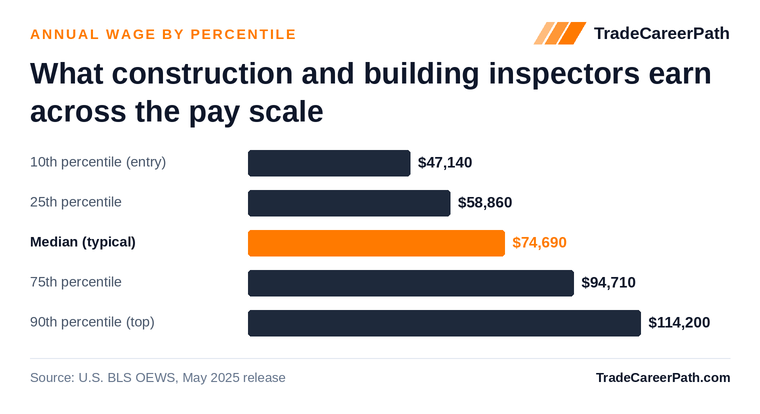
| Percentile | Annual wage |
|---|---|
| 10th | $47,140 |
| 25th | $58,860 |
| 50th (median) | $74,690 |
| 75th | $94,710 |
| 90th | $114,200 |
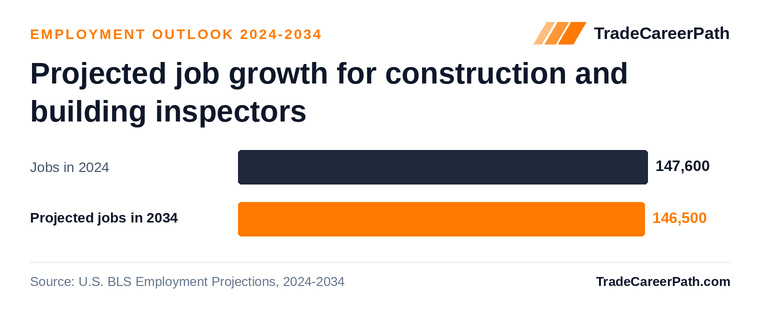
| Year | Employment |
|---|---|
| 2024 | 147,600 |
| 2034 projected | 146,500 |
| Percent change | -0.8% |
Energy Auditor Salary and Requirements by State
Select your state for local wage data, training options, and requirements:
Alabama · Alaska · Arizona · Arkansas · California · Colorado · Connecticut · Delaware · District of Columbia · Florida · Georgia · Hawaii · Idaho · Illinois · Indiana · Iowa · Kansas · Kentucky · Louisiana · Maine · Maryland · Massachusetts · Michigan · Minnesota · Mississippi · Missouri · Montana · Nebraska · Nevada · New Hampshire · New Jersey · New Mexico · New York · North Carolina · North Dakota · Ohio · Oklahoma · Oregon · Pennsylvania · Rhode Island · South Carolina · South Dakota · Tennessee · Texas · Utah · Vermont · Virginia · Washington · West Virginia · Wisconsin · Wyoming
Workplace Safety Snapshot
BLS Survey of Occupational Injuries and Illnesses data (2023-2024) report approximately 63.1 days-away, restricted, or transfer cases per 10,000 full-time-equivalent workers in construction and building inspectors (about 0.63 per 100 FTE). Source: BLS Survey of Occupational Injuries and Illnesses, Table R98.
Frequently Asked Questions
How long does energy auditor training take?
It typically takes typically 6 months to 2 years of training. The most common entry path is through a certificate or associate degree program. A high school diploma or GED is generally required to get started.
How much do energy auditors make?
The median annual salary for energy auditors is $74,690 according to the Bureau of Labor Statistics (May 2025). Entry-level workers earn around $47,140, while those in the 90th percentile earn over $114,200. Pay varies by state, experience, and specialization.
What is the job outlook for energy auditors?
The Bureau of Labor Statistics projects -0.8% employment growth for this occupation from 2024 to 2034, which is roughly on pace with the overall economy. Approximately 14,800 job openings are expected each year due to growth, retirements, and workers leaving the field.
Do you need a college degree to work as an energy auditor?
No. A college degree is not required to work as an energy auditor. Most people enter the field through a certificate or associate degree program. A high school diploma or GED is typically the only educational prerequisite.
Which states pay energy auditors the most?
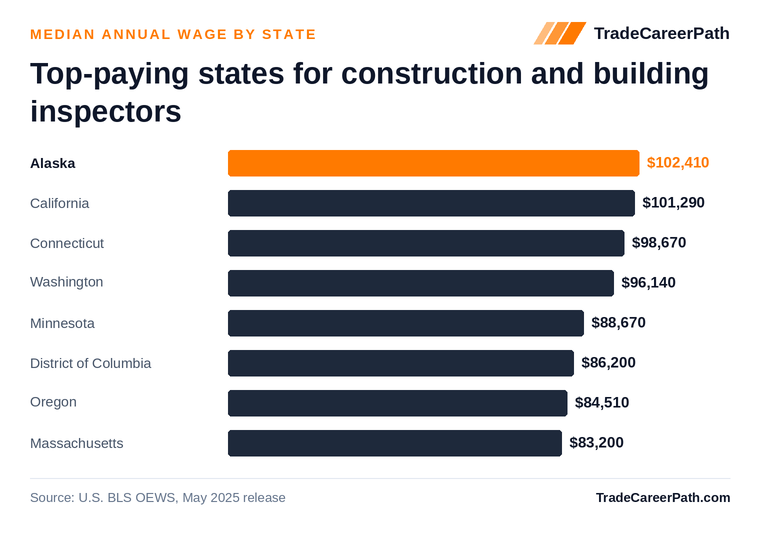
According to the U.S. Bureau of Labor Statistics (May 2025 OEWS), the highest-paying states for energy auditors are Alaska, California, and Connecticut. Median annual wages: Alaska ($102,410); California ($101,290); Connecticut ($98,670).
Which states employ the most energy auditors?
BLS reports the largest concentrations of energy auditors in Texas, Florida, and California. Employment levels: Texas (18,230 workers); Florida (13,860 workers); California (13,420 workers) (May 2025).
How much do experienced energy auditors earn?
The top 10% of energy auditors earn more than $114,200 per year, according to BLS Occupational Employment and Wage Statistics (May 2025). Experienced workers in this band typically hold senior credentials, supervisory roles, or specialty certifications.
What is entry-level pay for energy auditors?
BLS reports the bottom 10% of energy auditors earn under $47,140 per year. New workers often start near this level and see pay rise as they accumulate experience and credentials.
How many energy auditors work in the United States?
BLS reports approximately 146,720 energy auditors employed nationwide as of May 2025.
How many job openings are expected for energy auditors each year?
BLS projects approximately 14,800 openings per year for energy auditors from 2024 through 2034, including new positions, retirements, and workers transitioning out. The occupation is projected to grow -0.8% from 2024 to 2034, classified as in decline growth.
How much do energy auditors make per hour?
The median hourly wage for energy auditors is $35.91, according to BLS (May 2025). Hourly pay ranges from about $22.66 (bottom 10%) to $54.91 (top 10%).
How Energy Auditor Pay Compares to Similar Trades
Side-by-side comparison of Energy Auditor and the closest related careers, based on U.S. Bureau of Labor Statistics data (May 2025 OEWS + 2024-2034 Employment Projections).
| Career | Median Pay | 10-Year Growth | Annual Openings |
|---|---|---|---|
| Energy Auditor this guide | $74,690 | -0.8% | 14,800 |
| HVAC Technician | $61,010 | +8.1% | 40,100 |
| Home Inspector | $74,690 | -0.8% | 14,800 |
| Electrician | $63,190 | +9.5% | 81,000 |
| Solar Installation Professional | $53,140 | +42.1% | 4,100 |
Source: BLS Occupational Employment and Wage Statistics + BLS Employment Projections.
Sources
- U.S. Bureau of Labor Statistics, Occupational Employment and Wage Statistics (May 2025)
- U.S. Bureau of Labor Statistics, Employment Projections 2024-2034
- U.S. Bureau of Labor Statistics, Survey of Occupational Injuries and Illnesses (2023-2024, Table R98)
- U.S. Department of Labor, Wage and Hour Division, Davis-Bacon General Wage Determinations (2026)
Energy Auditor Salary by State
About this guide: Researched and written by the TradeCareerPath Editorial Team. Our editorial team researches and sources every trade school and career guide using federal labor and education data, including BLS OEWS and Employment Projections, DOL apprenticeship records, IPEDS, College Scorecard, and state licensing boards. We follow the editorial standards documented at /editorial-policy/.
Data sources
Figures on this page are sourced from the federal and state datasets below. Methodology: how we rank and source data.
| Data | Provider | Vintage |
|---|---|---|
| Occupational Employment and Wage Statistics (OEWS) | U.S. Bureau of Labor Statistics | May 2025 |
| Employment Projections | U.S. Bureau of Labor Statistics | 2024-2034 |
| Integrated Postsecondary Education Data System | National Center for Education Statistics (IPEDS) | 2024 |
| College Scorecard (school-level outcomes) | U.S. Department of Education | latest release |
| College Scorecard (field-of-study earnings) | U.S. Department of Education | latest release (updated 2026-06-12) |
| Occupational licensing requirements | CareerOneStop (U.S. Department of Labor) | latest release (updated 2026-02-22) |
| Registered apprenticeship programs | CareerOneStop / Apprenticeship.gov (U.S. Department of Labor) | latest release (updated 2025-10-25) |
| O*NET occupation profiles (skills, tasks, tools, job zones) | U.S. Department of Labor (O*NET / Employment & Training Admin.) | O*NET 29.1 (updated 2026-06-13) |