
How to Become an Engineering Manager in 2026
Is Engineering Manager Right for You?
The U.S. Department of Labor's O*NET profile for Architectural and Engineering Managers (SOC 11-9041) describes the work this way: Plan, direct, or coordinate activities in such fields as architecture and engineering or research and development in these fields.
What the work involves
- Manage the coordination and overall integration of technical activities in architecture or engineering projects.
- Direct, review, or approve project design changes.
- Consult or negotiate with clients to prepare project specifications.
- Prepare budgets, bids, or contracts.
- Present and explain proposals, reports, or findings to clients.
Skills and knowledge that matter
Skills: Reading Comprehension, Active Listening, Writing, Speaking, Complex Problem Solving, Mathematics.
Knowledge: Design, Engineering and Technology, Mathematics, Administration and Management.
Tools and technology you may use
Technology: Document management software, Enterprise resource planning ERP software, Data base management system software, Amazon DynamoDB, Amazon Elastic Compute Cloud EC2, Amazon Redshift.
Typical preparation
O*NET Job Zone Five (Extensive Preparation Needed). Most of these occupations require graduate school. For example, they may require a master's degree, and some require a Ph.D., M.D., or J.D. (law degree). Employees may need some on-the-job training, but most of these occupations assume that the person will already have the required skills, knowledge, work-related experience, and/or training.
Interest fit
O*NET interest profile: Enterprising, Investigative, Conventional. People who enjoy starting projects, leading others, and making decisions often find this occupation a good fit.
Source: O*NET 31.0 (updated 2026-10-14)
Quick answer: Training as an engineering manager requires a 4-year degree - typically an ABET-accredited engineering bachelor’s + experience; often an MBA or MEM. The national median pay is $171,270 per year, and BLS projects +5.5% employment change from 2025 to 2035 (BLS OEWS, May 2025; BLS Employment Projections, 2025-35).
Engineering Manager at a Glance
| Metric | Detail | Source |
|---|---|---|
| Median annual wage | $171,270 | BLS OEWS, May 2025 |
| Typical wage range | $120,810 (10th pct) - $262,760 (90th pct) | BLS OEWS, May 2025 |
| Employment | 220,260 nationwide | BLS OEWS, May 2025 |
| Projected growth (2025-35) | +5.5%, about 14,900 openings per year | BLS Employment Projections, 2025-35 |
| Typical education | ABET-accredited engineering bachelor’s + experience; often an MBA or MEM | BLS Occupational Outlook Handbook |
| License / certification | PE license commonly required for firms sealing work | State licensing boards |
What Does an Engineering Manager Do?
Engineering managers direct the engineers: setting technical direction, hiring and developing the team, owning budgets and schedules, and answering for delivery at utilities, EPC firms, manufacturers, and consulting practices. It is the capstone of every engineering ladder on this site - the point where your name stops appearing on the drawings and starts appearing on the org chart above them.
The day-to-day varies by setting. At an EPC or A&E firm, the manager runs a discipline group - assigning engineers to projects, reviewing designs before they go out, negotiating scope with project managers, and facing the client when a deliverable slips. At a manufacturer, the job is product delivery: staffing programs, arbitrating between design, test, and production, and defending headcount and capital requests. At a utility, it is asset stewardship - standards, capital project pipelines, and regulatory work that has to survive audits. Everywhere, the recurring work is three decisions: who does what, whether the work is good enough to release, and what to tell the people above you when reality diverges from the plan.
If you came up through the trades and are now working as an engineer - this page assumes exactly that trajectory, trade to engineer, engineer to manager - you already hold the scarcest qualification. You have watched designs fail in the field, and you have probably run a crew, which is most of what management is. The engineers who struggle here are the ones who have never been accountable for other people’s output on a deadline; a former foreman has been doing that for years. The missing pieces are budgeting, corporate machinery, and usually a management credential.
Skills That Make a Great Engineering Manager
- Sound technical judgment - enough depth to know when a design review is being snowed
- Budgeting, forecasting, and resource loading
- Hiring, mentoring, performance reviews, and the occasional hard termination
- Schedule and risk management across concurrent projects
- Cross-functional communication with executives and clients
- Contract and scope literacy on EPC and consulting work
- Writing: staffing plans, capital justifications, and design-review dispositions carry the job
Engineering Manager Salary
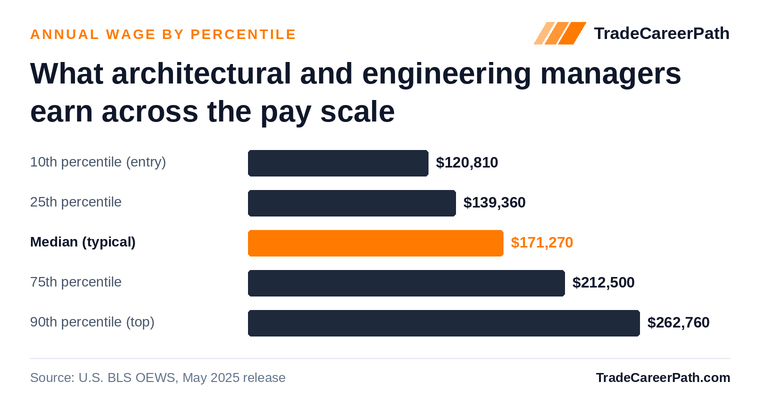
This is the best-paid destination on the entire trade-to-degree map. The national median is $171,270 per year, and even the 10th percentile - roughly where a first-time manager at a smaller firm lands - is $120,810. The 75th percentile is $212,500, the 90th reaches $262,760, and the mean of $181,540 sits well above the median because the top of this occupation stretches into director-level pay (BLS OEWS, May 2025).
Where the Jobs and the Money Are
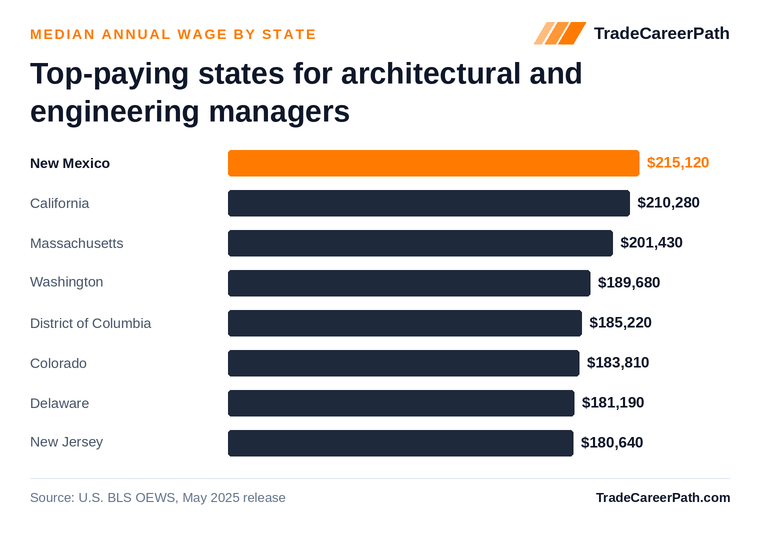
The pay leaders mix federal-lab country with coastal tech-and-defense markets, while the raw job counts follow the engineers: California employs 29,630 engineering managers, Texas 19,030, and Michigan 14,820 (BLS OEWS, May 2025).
| State | Median annual wage | Employment |
|---|---|---|
| New Mexico | $215,120 | 2,270 |
| California | $210,280 | 29,630 |
| Massachusetts | $201,430 | 7,690 |
| Washington | $189,680 | 6,060 |
| District of Columbia | $185,220 | 1,290 |
Concentration matters as much as the medians. Michigan is the standout hub - engineering managers are more than twice as common there as in the average state labor market (location quotient 2.38) on the strength of automotive engineering, with New Mexico’s national-lab economy close behind at 1.84. Massachusetts (1.49) and Washington (1.21) also run well above baseline - deeper markets, more room to change employers without relocating. Texas sits near the national average (0.95) but makes up for it in volume, and its $171,370 median still clears the national figure.
How to Become an Engineering Manager
1. Work as an engineer first
Any of the engineering paths on this site - the ABET-accredited bachelor’s plus several years of practice. There is no shortcut around this step: engineering managers are promoted from engineers. If you are still in the trades, pick the discipline closest to your trade - electrician to engineer, HVAC to mechanical engineer, carpenter to civil engineer - because the management role you eventually take will draw on exactly that field knowledge.
2. Take technical lead roles
Leading designs and mentoring juniors is the proving ground. Volunteer to run the design package, own the client interface, or supervise the EIT doing the calculations you used to do. Employers promote the engineer who is already informally managing - so make it visible: run the schedule, chair the design reviews, write the staffing estimate. Five to ten years of practice with two or three years of visible lead work is the typical runway.
3. Add the management layer
An online MEM or MBA, or an internal leadership development program. The Master of Engineering Management is purpose-built for this jump - finance, project delivery, and organizational skills taught to engineers by engineering schools, mostly online. The MBA is the broader credential if you might leave engineering for general management. Neither is universally mandatory, but at large employers the credential often separates two equally strong lead engineers when a manager slot opens - and tuition assistance commonly covers most of it.
4. Hold the PE where required
Firms sealing engineering work generally require licensed managers. If your path runs through consulting, A&E, or civil infrastructure, take the FE exam early, log the four years of qualifying experience, and clear the PE before you need it - the license takes years to obtain and minutes to be asked for. At manufacturers the PE is optional under the industrial exemption, but it never hurts the resume.
5. Advance
Department head, director of engineering, VP of engineering. The first management role is rarely the last: managers who deliver get handed larger portfolios, and the ladder runs through multi-discipline leadership into the executive tier. The 75th and 90th percentile figures - $212,500 and $262,760 - are largely these senior roles.
Career Ladder: Titles and Realistic Pay
The BLS wage percentiles map onto how these careers actually progress. Use this as a sanity check on offers, not a guarantee:
| Stage | Typical titles | Years in | Realistic pay (BLS OEWS, May 2025) |
|---|---|---|---|
| First management role | Engineering supervisor, group lead, project engineering manager | 0-3 as a manager | ~$120,810-$139,360 (10th-25th pct) |
| Established manager | Engineering manager, discipline manager, department manager | 3-8 | ~$171,270 (median) |
| Senior leadership | Senior engineering manager, director of engineering | 8-15 | ~$212,500 (75th pct) |
| Executive | Director, VP of engineering, chief engineer | 15+ | $262,760+ (90th pct) |
Two notes for career changers. First, a trade background compresses this ladder: crew leadership, field scheduling, and subcontractor management are direct rehearsals for this job, and employers promoting engineers into management look hardest for exactly that evidence. Second, the 90th-percentile figure understates the top of this market - director and VP compensation typically includes bonus and equity components the base-wage data does not capture.
Do You Need a PE License?
It depends on which side of the industry you manage in. At manufacturers, product companies, and most industrial employers, engineering managers work under the industrial exemption - the company holds design responsibility, and neither the engineers nor their manager needs a license. At consulting firms, A&E practices, utilities, and anywhere work is sealed for the public record, the calculus flips: the firm generally expects its engineering managers to hold the PE, because clients and state boards expect responsible charge to sit with a licensed engineer.
The path, if you need it, is the standard one: ABET-accredited degree, pass the Fundamentals of Engineering (FE) exam - you can sit for it as a senior - four years of qualifying experience under licensed engineers, then the PE exam in your discipline, per your state board’s rules. The practical advice for future managers is to start early: the license is cheap to get while you still do calculations daily and expensive to chase after ten years in meetings. Beyond the PE, credentials like the PMP carry weight on the project-delivery side, though no state licenses “engineering management” itself.
Why an Online Degree Works for This Career
This is the second jump: trade to engineer, then engineer to engineering manager. Online master of engineering management (MEM) and MBA programs exist for exactly that step, and the grid, datacenter, and infrastructure buildout has EPC firms promoting into this role faster than usual.
Job Outlook for 2026 and Beyond
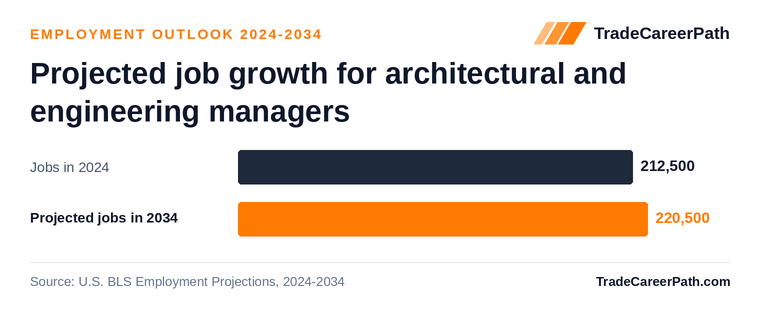
BLS projects employment of architectural and engineering managers to grow +5.5% from 2025 to 2035 - from 220,900 to 233,100 jobs - with about 14,900 openings per year once retirements and occupation changes are counted (BLS Employment Projections, 2025-35). Pay is moving too: the median rose from $167,740 in the 2024 data to $171,270 in the May 2025 OEWS figures.
Read the openings number, not the growth percentage. A 5.5% rate sounds modest, but 14,500 seats a year in a 220,260-person occupation means constant turnover - this is a role people retire out of, and every retirement opens a chair. The demand drivers are the ones pushing the engineering occupations underneath it: grid modernization, datacenter construction, plant buildouts, and a funded infrastructure pipeline. Firms that cannot hire experienced managers grow their own - which is precisely the opening for an engineer with field credibility and a fresh MEM.
Cost and Time to Complete the Degree
For architectural and engineering managers, the credential is: ABET-accredited engineering bachelor’s + experience; often an MBA or MEM. A bachelor’s degree is typically 120 credit hours: four years full-time, and commonly five to six years part-time while working. The management master’s on top usually runs about two years part-time online and is the piece most often paid for by an employer, since companies would rather fund a proven lead engineer’s MEM than recruit a manager cold. Transfer credit is the other lever: prior college, military training, apprenticeship coursework, and industry certifications can be worth meaningful credit at transfer-friendly schools, so get a written transfer evaluation before enrolling anywhere. In-state public online programs are usually the value benchmark, and employer tuition assistance is common for working adults in this field.
Pros and Cons of Training as an Engineering Manager
Pros
- Median pay of $171,270 nationally - $212,500 at the 75th percentile, $262,760 at the 90th (BLS OEWS, May 2025)
- BLS projects +5.5% employment growth through 2035, about 14,900 openings per year
- Trade experience is a genuine advantage - crew leadership is management experience
- Accredited online MEM and MBA paths exist for working adults, and employers commonly fund them
Cons
- Longest runway on this site: a 4-year degree plus 5-10 years of engineering practice before the first management role
- Entry-level pay starts near $120,810 at the 10th percentile
- Licensing hurdle: PE license commonly required for firms sealing work
- You trade design work for meetings, budgets, and personnel problems - not everyone wants that trade
Frequently Asked Questions
How do engineers work as engineering managers?
Typically 5-10 years of practice, technical lead experience, and often a management credential (MEM/MBA). BLS medians for architectural and engineering managers are among the highest of any occupation on this site.
How much do architectural and engineering managers make?
The national median annual wage for architectural and engineering managers is $171,270 (BLS OEWS, May 2025). The top 10% earn $262,760 or more, while entry-level pay starts around $120,810.
What is the job outlook for architectural and engineering managers?
BLS projects employment of architectural and engineering managers to change by +5.5% from 2025 to 2035 (BLS Employment Projections, 2025-35).
How long does engineering manager training take?
Plan on roughly a decade end to end: a 4-year engineering bachelor's (five to six years part-time while working), then 5-10 years of engineering practice with technical lead responsibility before the first management role. An online MEM or MBA adds about two years part-time and is usually done while working.
Is being an engineering manager hard?
The hard part is not the math - it is owning schedules, budgets, and people while remaining technically credible. Managers absorb the pressure between executives who want dates and engineers who want time. People from the trades who have run crews often find this transition more natural than career-long individual contributors do.
Should I get an MEM or an MBA to work as an engineering manager?
The MEM (Master of Engineering Management) is built for engineers staying in engineering leadership - project delivery, systems, technical strategy. The MBA is broader and travels better if you may leave engineering for general management. For a first engineering-manager role at an EPC firm, utility, or manufacturer, either works; many employers reimburse both.
Can you train as an engineering manager without a degree?
Effectively no. This role sits on top of an engineering career, and the engineers being managed hold accredited bachelor's degrees - employers expect the manager to hold at least the same. Trade experience shortens nothing here directly, but it makes you a stronger manager once you have the engineering credential.
Do engineering managers need a PE license?
It depends on the employer. At manufacturers and product companies, most managers work under the industrial exemption and never license. At consulting and A&E firms whose work is sealed for the public record, the manager of record is generally expected to hold the PE - the FE exam, four years of qualifying experience, then the PE exam, per state board rules.
Engineering Manager Salary and Requirements by State
Alabama · Alaska · Arizona · Arkansas · California · Colorado · Connecticut · Delaware · District of Columbia · Florida · Georgia · Hawaii · Idaho · Illinois · Indiana · Iowa · Kansas · Kentucky · Louisiana · Maine · Maryland · Massachusetts · Michigan · Minnesota · Mississippi · Missouri · Montana · Nebraska · Nevada · New Hampshire · New Jersey · New Mexico · New York · North Carolina · North Dakota · Ohio · Oklahoma · Oregon · Pennsylvania · Rhode Island · South Carolina · South Dakota · Tennessee · Texas · Utah · Vermont · Virginia · Washington · West Virginia · Wisconsin · Wyoming
Related Careers and Degree Paths
- Mechanical Engineer - the most common engineering discipline feeding this role
- Civil Engineer - the PE-track path where licensed managers are the norm
- Construction Manager - the parallel leadership role on the build side of the same projects
- Industrial Production Manager - the plant-floor counterpart at manufacturers
- Online Engineering Degrees for Tradespeople - how to pick an ABET program that fits a work schedule
Degree and Program Guides
- Which Engineering Degree Fits Your Trade - picking the discipline with the deepest job market
Sources
- U.S. Bureau of Labor Statistics, Occupational Employment and Wage Statistics (OEWS), May 2025 - Architectural and Engineering Managers (SOC 11-9041)
- U.S. Bureau of Labor Statistics, Employment Projections, 2025-35
- U.S. Bureau of Labor Statistics, Occupational Outlook Handbook - education and licensing requirements
Engineering Manager Salary by State
About this guide: Researched and written by the TradeCareerPath Editorial Team. Our editorial team researches and sources every trade school and career guide using federal labor and education data, including BLS OEWS and Employment Projections, DOL apprenticeship records, IPEDS, College Scorecard, and state licensing boards. We follow the editorial standards documented at /editorial-policy/.
Data sources
Figures on this page are sourced from the federal and state datasets below. Methodology: how we rank and source data.
| Data | Provider | Vintage |
|---|---|---|
| Occupational Employment and Wage Statistics (OEWS) | U.S. Bureau of Labor Statistics | May 2025 |
| Employment Projections | U.S. Bureau of Labor Statistics | 2025-2035 |
| Integrated Postsecondary Education Data System | National Center for Education Statistics (IPEDS) | 2024 |
| College Scorecard (school-level outcomes) | U.S. Department of Education | latest release |
| College Scorecard (field-of-study earnings) | U.S. Department of Education | latest release (updated 2026-06-12) |
| Occupational licensing requirements | CareerOneStop (U.S. Department of Labor) | latest release (updated 2026-02-22) |
| Registered apprenticeship programs | CareerOneStop / Apprenticeship.gov (U.S. Department of Labor) | latest release (updated 2025-10-25) |
| O*NET occupation profiles (skills, tasks, tools, job zones) | U.S. Department of Labor (O*NET / Employment & Training Admin.) | O*NET 31.0 (updated 2026-10-14) |