
How to Become an Environmental Engineer in 2026
Is Environmental Engineer Right for You?
The U.S. Department of Labor's O*NET profile for Environmental Engineers (SOC 17-2081) describes the work this way: Research, design, plan, or perform engineering duties in the prevention, control, and remediation of environmental hazards using various engineering disciplines. Work may include waste treatment, site remediation, or pollution control technology.
What the work involves
- Design, or supervise the design of, systems, processes, or equipment for control, management, or remediation of water, air, or soil quality.
- Assess the existing or potential environmental impact of land use projects on air, water, or land.
- Collaborate with environmental scientists, planners, hazardous waste technicians, engineers, experts in law or business, or other specialists to address environmental problems.
- Advise corporations or government agencies of procedures to follow in cleaning up contaminated sites to protect people and the environment.
- Develop proposed project objectives and targets and report to management on progress in attaining them.
Skills and knowledge that matter
Skills: Reading Comprehension, Active Listening, Writing, Speaking, Critical Thinking, Monitoring.
Knowledge: Engineering and Technology, Design, Chemistry, Mathematics.
Tools and technology you may use
Technology: Analytical or scientific software, Computer aided design CAD software, Office suite software, Autodesk AutoCAD, Autodesk AutoCAD Civil 3D, Bentley MicroStation.
Typical preparation
O*NET Job Zone Four (Considerable Preparation Needed). Most of these occupations require a four-year bachelor's degree, but some do not. Employees in these occupations usually need several years of work-related experience, on-the-job training, and/or vocational training.
Interest fit
O*NET interest profile: Investigative, Realistic, Conventional. People who enjoy working with ideas, searching for facts, and figuring out problems often find this occupation a good fit.
Source: O*NET 31.0 (updated 2026-10-14)
Quick answer: Training as an environmental engineer requires a 4-year degree - typically an ABET-accredited bachelor’s in environmental or civil engineering. The national median pay is $107,110 per year, and BLS projects +6.3% employment change from 2025 to 2035 (BLS OEWS, May 2025; BLS Employment Projections, 2025-35).
Environmental Engineer at a Glance
| Metric | Detail | Source |
|---|---|---|
| Median annual wage | $107,110 | BLS OEWS, May 2025 |
| Typical wage range | $69,990 (10th pct) - $162,220 (90th pct) | BLS OEWS, May 2025 |
| Employment | 38,340 nationwide | BLS OEWS, May 2025 |
| Projected growth (2025-35) | +6.3%, about 2,300 openings per year | BLS Employment Projections, 2025-35 |
| Typical education | ABET-accredited bachelor’s in environmental or civil engineering | BLS Occupational Outlook Handbook |
| License / certification | PE license for consulting and public-works sign-off | State licensing boards |
What Does an Environmental Engineer Do?
Environmental engineers design water and wastewater treatment systems, remediation plans, and pollution controls - the engineered systems behind clean water, safe soil, and air-quality compliance on industrial and municipal projects.
Day to day, the work splits by specialty. A water/wastewater engineer sizes pumps, clarifiers, and disinfection systems, runs hydraulic models, and reviews operating data when a plant misses its permit limits. A remediation engineer characterizes a contaminated site from boring logs and lab results, designs the cleanup - soil excavation, groundwater pump-and-treat, vapor extraction - and monitors it for years afterward. A stormwater engineer models runoff and designs detention, conveyance, and green infrastructure. A compliance or air-quality engineer works the permitting side: discharge permits, emissions calculations, and the reports that keep a facility legal. Almost all of it is documented and regulator-facing - the Clean Water Act, Safe Drinking Water Act, and state permit programs shape the daily routine as much as the hydraulics do, and a stamped design carries legal weight.
If you are coming from plumbing, water/wastewater operations, or HVAC, the shortest way to say it: the operator keeps the treatment plant running inside its permit; the engineer decides what the plant must be - the process train, the chemistry, the capacity - and proves on paper that it will work. The pumps you have rebuilt, the chemical feeds you have tuned, the backflow and piping codes you have worked under: those work as the systems you design, and hiring managers at consulting firms and utilities know exactly how rare that operating instinct is among fresh graduates.
Skills That Make a Great Environmental Engineer
- Water and wastewater treatment design
- Hydrology and stormwater modeling
- Hydraulics and pump/piping system design
- Permitting and regulatory navigation (NPDES, drinking-water rules, air permits)
- Sampling plans and lab-data interpretation
- GIS and site mapping
- CAD plus modeling tools (AutoCAD Civil 3D, EPANET, SWMM) and spreadsheet-level analysis
- Writing: permit applications, design reports, and remediation work plans carry the job
Environmental Engineer Salary
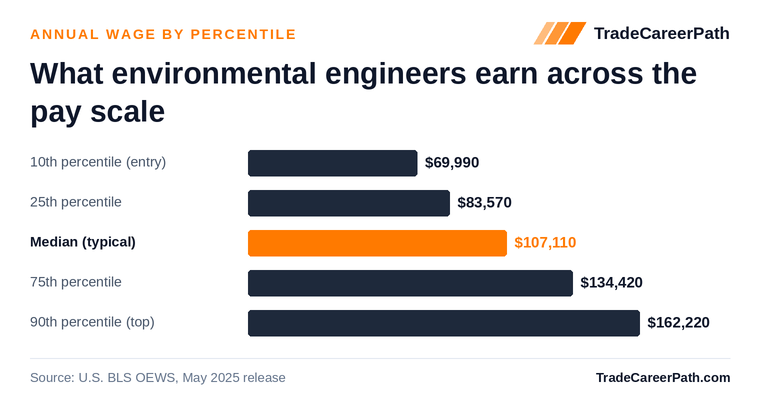
Environmental engineering pays a solid professional wage for a field you can enter from the water trades. The national median is $107,110 per year, the 10th percentile - where new graduates start - is $69,990, and the 90th reaches $162,220 (BLS OEWS, May 2025). The middle is wide - $83,570 at the 25th percentile, $134,420 at the 75th - and the gap between them is mostly the PE license.
Where the Jobs and the Money Are
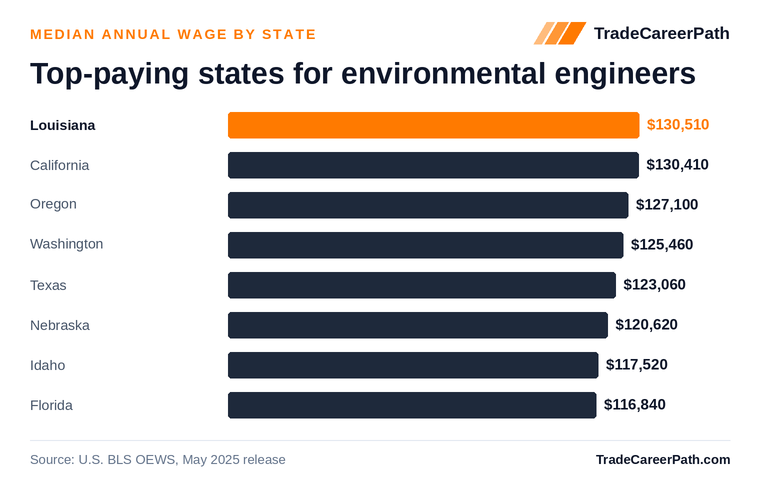
The best-paying states cluster along the West Coast and the Gulf: petrochemical remediation work in Louisiana, and water-scarcity and regulatory-driven work in California, Oregon, and Washington. California is also the largest job market, with 4,550 environmental engineers, followed by New York at 3,170 (BLS OEWS, May 2025).
| State | Median annual wage | Employment |
|---|---|---|
| Louisiana | $130,510 | 340 |
| California | $130,410 | 4,550 |
| Oregon | $127,100 | 650 |
| Washington | $125,460 | 1,920 |
| Texas | $123,060 | 1,940 |
Washington stands out on both counts: environmental engineers are more than twice as concentrated there as in the average state labor market, which means a deeper job market and more room to change employers without relocating. Oregon and New York also run well above average concentration, while high-paying Louisiana and Texas are thinner markets driven by industrial and energy-sector work. Unlike aerospace, though, this occupation is not hub-bound - every state runs water systems, landfills, and permit programs, so there is work close to wherever you already live.
How to Become an Environmental Engineer
1. Earn an ABET-accredited bachelor’s
Environmental engineering, or civil engineering with an environmental focus. Accreditation is the one non-negotiable: state licensing boards require it for the PE track, and consulting firms screen for it. For working tradespeople, the civil-engineering route usually offers more accredited online and evening options, and it keeps general civil work - roads, structures, land development - on the table if you later want it. Utilities and firms hire civil graduates into environmental roles as a matter of course.
2. Pass the FE exam
The Fundamentals of Engineering exam - you can sit for it as a senior - earns the EIT (Engineer in Training) credential and starts the clock toward the PE. Take it early: firms and agencies treat the EIT as the marker that you are on the licensure track, and in an occupation where the PE gates advancement, arriving at interviews with the FE passed puts you ahead of most applicants.
3. Start in water, remediation, or compliance
Consulting firms, utilities, and state and federal agencies all hire at the bachelor’s level. For former plumbers and operators, the natural entry points are water/wastewater design groups and field-heavy remediation work - jobs where reading a plant, a pump curve, or a site matters more than pure modeling. Say your trade background out loud in applications: an operator’s certification or a plumbing license reads as proof you know how this equipment actually behaves and fails.
4. Gain experience toward the PE
Most states require four years of experience supervised by a licensed PE before you can sit for the Principles and Practice exam. Choose your first employer with that in mind - a firm or utility with licensed engineers who will sign your experience record. The PE signs public-works designs, and at most consulting firms it is the explicit prerequisite for project-manager titles.
5. Specialize
Drinking water, stormwater, site remediation, or air quality. Specialization is where pay and seniority come from: a PE who is the regional authority on drinking-water treatment or landfill design is hard to replace. Pick the specialty nearest your trade background - water and wastewater for plumbers and operators, air and industrial compliance for HVAC and mechanical trades.
Career Ladder: Titles and Realistic Pay
The BLS wage percentiles map cleanly onto how environmental careers actually progress. Use this as a sanity check on offers, not a guarantee:
| Stage | Typical titles | Years in | Realistic pay (BLS OEWS, May 2025) |
|---|---|---|---|
| Entry level | Staff engineer, EIT, field engineer | 0-4 | ~$69,990-$83,570 (10th-25th pct) |
| Mid-career | Project engineer, PE | 4-10 | ~$107,110 (median) |
| Senior | Senior engineer, project manager | 10-15 | ~$134,420 (75th pct) |
| Principal / leadership | Principal engineer, practice leader, city/utility engineer | 15+ | $162,220+ (90th pct) |
Two notes for career changers. First, prior trade experience compresses this ladder: former operators and plumbers are routinely hired above the bottom of the entry band because they need less supervision around real treatment systems, and clients trust an engineer who has run the equipment. Second, the jump from the entry band to the median is mostly the PE license - the four-year experience clock is the rate limiter, so start it the day you graduate.
Do You Need a PE License?
For most of this field, effectively yes. Water, wastewater, and stormwater designs for cities and utilities are public works - a licensed Professional Engineer must sign and seal them, and consulting firms structure their promotion ladders around the license. An unlicensed environmental engineer can do the analysis and drafting, but cannot take design responsibility, which caps both title and pay.
The path is standardized: ABET-accredited degree, FE exam (sit as a senior), four years of qualifying experience under licensed PEs, then the PE exam - typically in environmental or civil engineering, per your state board’s rules. The main exception is in-house industrial work: compliance and environmental-management roles at private manufacturers often fall under the industrial exemption and can be held without a license. Even there, the PE strengthens your standing with regulators - it is the one credential in this field that reliably moves pay.
Why an Online Degree Works for This Career
Plumbers, water/wastewater operators, and HVAC technicians work on these systems every day; the ABET-accredited bachelor’s moves you from operating and installing them to designing them, with strong public-sector demand. ABET-accredited online and hybrid programs - often civil engineering with an environmental focus - serve working adults, and municipal utilities and consulting firms commonly offer tuition assistance. Many operators complete the degree while keeping their shift, their certification, and their seniority, then step into an engineering title at the same utility.
Job Outlook for 2026 and Beyond
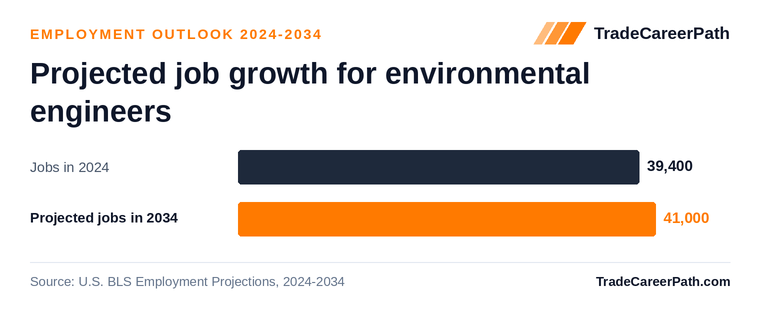
BLS projects environmental engineering employment to grow +6.3% from 2025 to 2035 - from 39,100 to 41,600 jobs - with about 2,300 openings per year once retirements and occupation changes are counted (BLS Employment Projections, 2025-35). The latest wage data (OEWS, May 2025) puts the median at $107,110, up from the 2024 figure of $104,170 - pay in this field is still climbing, not plateauing.
The demand drivers are structural: aging drinking-water and wastewater infrastructure, PFAS and other emerging-contaminant rules, stormwater mandates, and remediation backlogs that run on decade-long timelines. For career changers, the more useful number is the openings figure - 2,300 seats a year in a 38,340-person occupation means steady replacement hiring, and the PE requirement keeps the pool of fully qualified candidates tight.
Cost and Time to Complete the Degree
For environmental engineers, the credential is: ABET-accredited bachelor’s in environmental or civil engineering. A bachelor’s degree is typically 120 credit hours: four years full-time, and commonly five to six years part-time while working. Transfer credit is the other lever: prior college, military training, apprenticeship coursework, and industry certifications can be worth meaningful credit at transfer-friendly schools, so get a written transfer evaluation before enrolling anywhere. Costs vary widely by school type; in-state public online programs are usually the value benchmark, and employer tuition assistance is common for working adults in this field.
Pros and Cons of Training as an Environmental Engineer
Pros
- Median pay of $107,110 nationally (BLS OEWS, May 2025)
- BLS projects +6.3% employment growth through 2035, about 2,300 openings a year
- Field experience from the trades is a genuine hiring advantage
- Accredited online and hybrid degree paths exist for working adults
Cons
- Requires a 4-year degree (typically 120 credit hours)
- Entry-level pay starts near $69,990 at the 10th percentile
- Licensing hurdle: PE license for consulting and public-works sign-off, four years after graduation
Frequently Asked Questions
Can a plumber or water operator work as an environmental engineer?
Yes - operations experience with real treatment systems is a genuine advantage. The requirement is the ABET-accredited bachelor's plus the FE/PE track for licensed roles.
How much do environmental engineers make?
The national median annual wage for environmental engineers is $107,110 (BLS OEWS, May 2025). The top 10% earn $162,220 or more, while entry-level pay starts around $69,990.
What is the job outlook for environmental engineers?
BLS projects employment of environmental engineers to change by +6.3% from 2025 to 2035 (BLS Employment Projections, 2025-35).
How long does environmental engineer training take?
The ABET-accredited bachelor's is 120 credit hours: four years full-time, commonly five to six years part-time while working. Transfer credit from prior college, military training, or water/wastewater certification coursework can meaningfully shorten it at transfer-friendly schools. The PE license adds four years of supervised experience after graduation.
Is environmental engineering hard?
The degree includes calculus, chemistry, fluid mechanics, and hydraulics - the math is real but generally less punishing than aerospace or electrical engineering. Tradespeople who have run pumps, piping, or treatment systems usually find the water and hydraulics coursework far more intuitive than fresh high-school graduates do.
Should I get an environmental or civil engineering degree?
For working tradespeople, civil engineering with an environmental focus is often the smarter buy: more ABET-accredited online options, and the degree also qualifies you for general civil work. Consulting firms and utilities hire civil graduates into environmental roles constantly; the reverse move is harder.
Can you train as an environmental engineer without a degree?
Not with the engineer title - employers and state licensing boards require the ABET-accredited bachelor's. Without it, the ceiling is environmental technician, treatment-plant operator, or compliance-specialist roles. Operator certifications and field experience shorten the degree at transfer-friendly schools, but do not replace it.
Do environmental engineers need a PE license?
For consulting and public-works design, effectively yes - the PE is what lets you sign and seal treatment and stormwater designs, and it gates promotion at most firms. The path is the ABET degree, the FE exam, four years of supervised experience, then the PE exam. In-house compliance roles at private companies can be held without it.
Environmental Engineer Salary and Requirements by State
Alabama · Alaska · Arizona · Arkansas · California · Colorado · Connecticut · Delaware · Florida · Georgia · Hawaii · Idaho · Illinois · Indiana · Iowa · Kansas · Kentucky · Louisiana · Maine · Maryland · Massachusetts · Michigan · Minnesota · Mississippi · Missouri · Montana · Nebraska · Nevada · New Hampshire · New Jersey · New Mexico · New York · North Carolina · North Dakota · Ohio · Oklahoma · Oregon · Pennsylvania · Rhode Island · South Carolina · South Dakota · Tennessee · Texas · Utah · Vermont · Virginia · Washington · West Virginia · Wisconsin · Wyoming
Related Careers and Degree Paths
- Civil Engineer - the broader degree and license track that also qualifies you for environmental roles
- Environmental Technician - the sampling and monitoring role you can hold while finishing the degree
- Environmental Scientist - the science side of the same projects, without the PE design track
- Health and Safety Engineer - the workplace-compliance sibling of this occupation
- Online Engineering Degrees for Tradespeople - how to pick an ABET program that fits a work schedule
Degree and Program Guides
- Online Environmental Engineering Degrees - accredited routes for water and remediation workers
Sources
- U.S. Bureau of Labor Statistics, Occupational Employment and Wage Statistics (OEWS), May 2025 - Environmental Engineers (SOC 17-2081)
- U.S. Bureau of Labor Statistics, Employment Projections, 2025-35
- U.S. Bureau of Labor Statistics, Occupational Outlook Handbook - education and licensing requirements
Environmental Engineer Salary by State
About this guide: Researched and written by the TradeCareerPath Editorial Team. Our editorial team researches and sources every trade school and career guide using federal labor and education data, including BLS OEWS and Employment Projections, DOL apprenticeship records, IPEDS, College Scorecard, and state licensing boards. We follow the editorial standards documented at /editorial-policy/.
Data sources
Figures on this page are sourced from the federal and state datasets below. Methodology: how we rank and source data.
| Data | Provider | Vintage |
|---|---|---|
| Occupational Employment and Wage Statistics (OEWS) | U.S. Bureau of Labor Statistics | May 2025 |
| Employment Projections | U.S. Bureau of Labor Statistics | 2025-2035 |
| Integrated Postsecondary Education Data System | National Center for Education Statistics (IPEDS) | 2024 |
| College Scorecard (school-level outcomes) | U.S. Department of Education | latest release |
| College Scorecard (field-of-study earnings) | U.S. Department of Education | latest release (updated 2026-06-12) |
| Occupational licensing requirements | CareerOneStop (U.S. Department of Labor) | latest release (updated 2026-02-22) |
| Registered apprenticeship programs | CareerOneStop / Apprenticeship.gov (U.S. Department of Labor) | latest release (updated 2025-10-25) |
| O*NET occupation profiles (skills, tasks, tools, job zones) | U.S. Department of Labor (O*NET / Employment & Training Admin.) | O*NET 31.0 (updated 2026-10-14) |