
How to Become an Environmental Scientist in 2026
Is Environmental Scientist Right for You?
The U.S. Department of Labor's O*NET profile for Environmental Scientists and Specialists, Including Health (SOC 19-2041) describes the work this way: Conduct research or perform investigation for the purpose of identifying, abating, or eliminating sources of pollutants or hazards that affect either the environment or public health. Using knowledge of various scientific disciplines, may collect, synthesize, study, report, and recommend action based on data derived from measurements or observations of air, food, soil, water, and other sources.
What the work involves
- Communicate scientific or technical information to the public, organizations, or internal audiences through oral briefings, written documents, workshops, conferences, training sessions, or public hearings.
- Monitor effects of pollution or land degradation and recommend means of prevention or control.
- Collect, synthesize, analyze, manage, and report environmental data, such as pollution emission measurements, atmospheric monitoring measurements, meteorological or mineralogical information, or soil or water samples.
- Review and implement environmental technical standards, guidelines, policies, and formal regulations that meet all appropriate requirements.
- Provide scientific or technical guidance, support, coordination, or oversight to governmental agencies, environmental programs, industry, or the public.
Skills and knowledge that matter
Skills: Reading Comprehension, Active Listening, Writing, Speaking, Science, Complex Problem Solving.
Knowledge: English Language, Biology, Customer and Personal Service, Law and Government.
Tools and technology you may use
Technology: Analytical or scientific software, Document management software, Graphics or photo imaging software, Adobe Acrobat, Adobe Illustrator, Autodesk AutoCAD.
Typical preparation
O*NET Job Zone Four (Considerable Preparation Needed). Most of these occupations require a four-year bachelor's degree, but some do not. Employees in these occupations usually need several years of work-related experience, on-the-job training, and/or vocational training.
Interest fit
O*NET interest profile: Investigative, Realistic, Conventional. People who enjoy working with ideas, searching for facts, and figuring out problems often find this occupation a good fit.
Source: O*NET 31.0 (updated 2026-10-14)
Quick answer: Training as an environmental scientist requires a 4-year degree - typically a Bachelor’s in environmental science, chemistry, or geology. The national median pay is $82,220 per year, and BLS projects +6.1% employment change from 2025 to 2035 (BLS OEWS, May 2025; BLS Employment Projections, 2025-35).
Environmental Scientist at a Glance
| Metric | Detail | Source |
|---|---|---|
| Median annual wage | $82,220 | BLS OEWS, May 2025 |
| Typical wage range | $52,520 (10th pct) - $140,010 (90th pct) | BLS OEWS, May 2025 |
| Employment | 89,250 nationwide | BLS OEWS, May 2025 |
| Projected growth (2025-35) | +6.1%, about 7,300 openings per year | BLS Employment Projections, 2025-35 |
| Typical education | Bachelor’s in environmental science, chemistry, or geology | BLS Occupational Outlook Handbook |
| License / certification | No license for most roles; certifications (e.g., HAZWOPER, asbestos/lead assessor) role-specific | None for most roles |
What Does an Environmental Scientist Do?
Environmental scientists design and run the investigations that keep property deals, construction projects, and industrial operations legal: site assessments, sampling programs, remediation monitoring, and the compliance reports that go to EPA and state regulators. They decide where the samples come from, what the lab results mean, and what the client has to do about them.
The day-to-day depends on the sub-specialty. A due-diligence scientist at a consulting firm walks properties and writes Phase I Environmental Site Assessments, then scopes the Phase II drilling and sampling when the history looks dirty. A remediation scientist manages groundwater monitoring wells and soil-vapor systems on contaminated sites, tracking plume data quarter after quarter until closure. A compliance specialist keeps a factory’s air, stormwater, and hazardous-waste permits current - inspections, discharge monitoring reports, spill plans. Health-side specialists sample for asbestos, lead, and mold in buildings. Almost all of it splits between fieldwork and report-writing, and the report is the actual product: a Phase II conclusion that misses contamination is a liability event, so documentation and defensible methods dominate the work.
If you are coming from the environmental technician side, the shortest way to say it: the technician collects the samples; the scientist decides where they come from, interprets the lab data, and signs the report. You have already stood on these sites and run this equipment - the degree moves you from executing the sampling plan to writing it, and from hourly field rates to salaried project work at the same firms.
Skills That Make a Great Environmental Scientist
- Sampling protocols and chain of custody
- Laboratory and field methods (soil, groundwater, air, sediment)
- Phase I/II environmental site assessment (ASTM standards)
- Regulatory reporting (EPA and state programs)
- Hydrogeology and contaminant-fate basics
- GIS mapping and data analysis
- Writing: assessment reports, work plans, and compliance filings carry the job
- Client and regulator communication - much of consulting is explaining findings to non-scientists
Environmental Scientist Salary
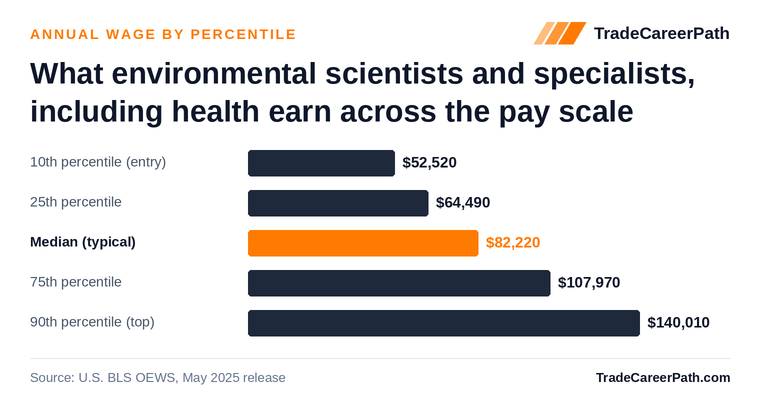
The national median for environmental scientists and specialists is $82,220 per year, with the 10th percentile at $52,520 - roughly where new staff scientists start - and the 90th percentile at $140,010, which is senior project-manager and program-lead territory (BLS OEWS, May 2025). The mean of $91,680 sitting well above the median shows the top of the field pulls hard: principals and niche specialists earn far more than the middle. For a working technician, the practical comparison is simpler - the 25th percentile for scientists is $64,490, already above what most field-tech roles top out at.
Where the Jobs and the Money Are
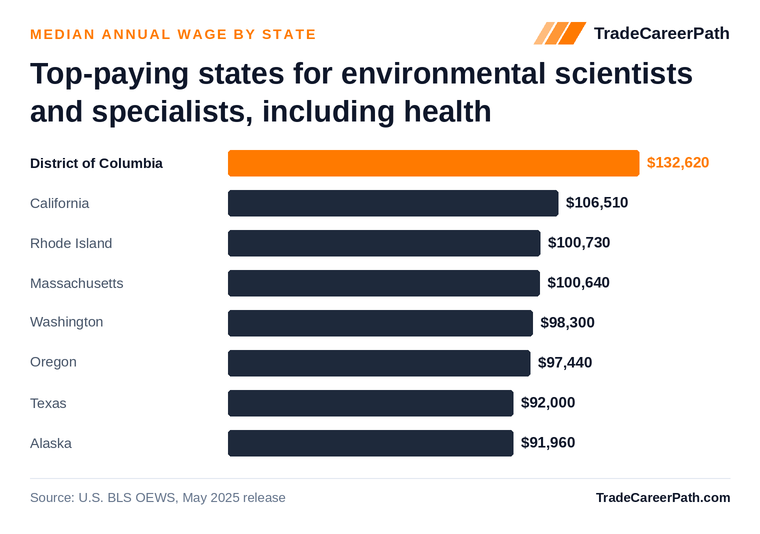
89,250 people do this job across all 50 states, wherever there are properties to assess and permits to keep current - but pay and density cluster hard around regulatory and government hubs.
| State | Median annual wage | Employment |
|---|---|---|
| District of Columbia | $132,620 | 1,270 |
| California | $106,510 | 12,490 |
| Rhode Island | $100,730 | 330 |
| Massachusetts | $100,640 | 2,930 |
| Washington | $98,300 | 4,470 |
The District of Columbia is the extreme case - federal agencies and policy shops make environmental scientists more than three times as common there as in the average labor market, at a $132,620 median. Washington State is the other standout hub: more than twice the national concentration, driven by state regulation and cleanup work, at a $98,300 median. California is the volume play - 12,490 jobs, the largest cluster in the country, at $106,510. Florida (5,950 jobs) and Texas (5,630 jobs, $92,000 median) round out the biggest markets - Texas pay is strong on oil-and-gas compliance work even though the occupation is less concentrated there.
How to Become an Environmental Scientist
1. Start or continue as a technician
Sampling and field-tech experience counts heavily at consulting firms - it is the closest thing this career has to an apprenticeship. Technicians who can oversee a drill rig, log soil, and keep clean chain-of-custody paperwork are exactly who firms want back as staff scientists. If you are not in the field yet, a technician job while you study beats finishing the degree cold.
2. Earn the bachelor’s degree
Environmental science, chemistry, or geology - all three are hired interchangeably into staff-scientist roles. Online programs are widely available and fit rotating field schedules; lab requirements are typically handled through short residencies. Get a written transfer evaluation before enrolling anywhere: prior college, military training, and some certification coursework can be worth meaningful credit at transfer-friendly schools.
3. Move to staff scientist
Phase I/II site assessments and remediation projects are the core work at the consulting firms that do most of the hiring: property walkovers and records review for Phase Is, field oversight on Phase II drilling, quarterly groundwater monitoring, and a steady diet of report-writing. State environmental agencies and industrial in-house compliance roles are the other entry doors, and both value field-tech backgrounds.
4. Add role certifications
The 40-hour OSHA HAZWOPER is near-universal for contaminated-site work and often the first thing a new hire completes. From there, credentials follow your specialty: state asbestos and lead assessor licenses for building work, stormwater and erosion-control certifications for construction compliance, wastewater credentials for treatment-side roles. Each one is a billable capability, and firms promote people who can be billed for more things.
5. Advance
Project manager is the first big jump - you own budgets, clients, and junior staff instead of tasks. From there the fork is program or office leadership, or deep technical specialization (risk assessment, vapor intrusion, hydrogeology). Both routes are covered in the career ladder below.
Career Ladder: Titles and Realistic Pay
The BLS wage percentiles map cleanly onto how environmental consulting careers actually progress. Use this as a sanity check on offers, not a guarantee:
| Stage | Typical titles | Years in | Realistic pay (BLS OEWS, May 2025) |
|---|---|---|---|
| Entry level | Staff scientist, field scientist, environmental specialist I | 0-3 | ~$52,520-$64,490 (10th-25th pct) |
| Mid-career | Project scientist, compliance specialist, site-assessment lead | 3-10 | ~$82,220 (median) |
| Senior | Project manager, senior scientist | 10-15 | ~$107,970 (75th pct) |
| Principal / leadership | Principal, program manager, office lead | 15+ | $140,010+ (90th pct) |
Two notes for career changers. First, technician experience compresses this ladder: firms routinely start former field techs above the bottom of the entry band because they need no field training and can be billed to projects on day one. Second, consulting pay tracks billability - senior people who bring clients or hold scarce specialties (risk assessment, litigation support) often out-earn the 90th-percentile wage data, which excludes bonuses and profit-sharing common at the principal level.
Do You Need a License?
For most environmental scientist roles, no state license is required - the bachelor’s degree plus role certifications is the credential stack. What matters instead:
- OSHA HAZWOPER (40-hour): effectively mandatory for hazardous-waste-site work, with annual 8-hour refreshers.
- State assessor licenses: asbestos inspector, lead risk assessor, and similar building-hazard credentials are state-issued and required for that specific work.
- Professional Geologist (PG): if you take the geology degree route, a number of states license geologists, and a PG stamp is valuable on hydrogeology and remediation reports where it applies.
- Voluntary certifications: credentials like Certified Hazardous Materials Manager (CHMM) signal seniority and help in compliance-heavy roles, but no employer treats them as a legal gate.
The honest summary: this career’s barrier is the degree, not a license exam. Role credentials are usually a short course plus a state application - not a multi-year licensure path.
Why an Online Degree Works for This Career
Environmental technicians already collect samples and run field equipment; the bachelor’s is the gate between technician pay and scientist/project-manager pay at the same consulting firms. Online environmental science programs are widely available, and this degree is unusually online-friendly - the field skills are learned on the job, which you already have, so the coursework fills in the chemistry, hydrogeology, and regulatory theory behind what you do. Many firms offer tuition assistance, and finishing while employed means skipping the entry-level job hunt: your current firm usually converts you.
Job Outlook for 2026 and Beyond
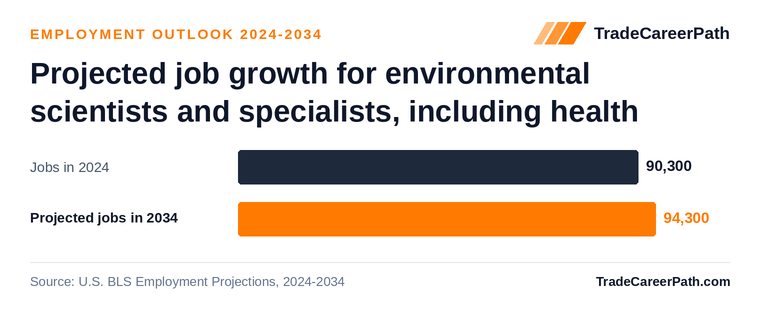
BLS projects employment of environmental scientists and specialists to grow +6.1% from 2025 to 2035 - from 93,400 to 99,200 jobs - with about 7,300 openings per year once retirements and occupation changes are counted (BLS Employment Projections, 2025-35). Wages are moving too: the latest data (OEWS, May 2025) puts the median at $82,220, up from the 2024 figure of $80,060.
The demand drivers are durable because they are legal, not cyclical: property transactions require Phase I assessments, industrial permits require ongoing compliance, and contaminated sites take decades to monitor and close. For career changers, the openings figure is the number that matters - 7,300 seats a year against 89,250 total jobs means steady hiring and real turnover, and consulting firms chronically struggle to find staff scientists who can already handle themselves in the field.
Cost and Time to Complete the Degree
For environmental scientists, the credential is: Bachelor’s in environmental science, chemistry, or geology. A bachelor’s degree is typically 120 credit hours: four years full-time, and commonly five to six years part-time while working. Transfer credit is the other lever: prior college, military training, apprenticeship coursework, and industry certifications can be worth meaningful credit at transfer-friendly schools, so get a written transfer evaluation before enrolling anywhere. Costs vary widely by school type; in-state public online programs are usually the value benchmark, and employer tuition assistance is common for working adults in this field.
Pros and Cons of Training as an Environmental Scientist
Pros
- Median pay of $82,220 nationally (BLS OEWS, May 2025)
- BLS projects +6.1% employment growth through 2035, with about 7,300 openings per year
- Field experience from the trades is a genuine hiring advantage
- Accredited online and hybrid degree paths exist for working adults
- No multi-year licensure hurdle - the degree plus short certifications is the full credential stack for most roles
Cons
- Requires a 4-year degree (typically 120 credit hours)
- Entry-level pay starts near $52,520 at the 10th percentile
- Consulting work is deadline- and billability-driven, with heavy report-writing
Frequently Asked Questions
Is the degree worth it for an environmental technician?
It is the single gate between technician and scientist titles at the same employers - BLS medians differ by tens of thousands of dollars, and consulting firms routinely promote techs who finish the bachelor's.
How much do environmental scientists make?
The national median annual wage for environmental scientists and specialists, including health is $82,220 (BLS OEWS, May 2025). The top 10% earn $140,010 or more, while entry-level pay starts around $52,520.
What is the job outlook for environmental scientists?
BLS projects employment of environmental scientists and specialists, including health to change by +6.1% from 2025 to 2035 (BLS Employment Projections, 2025-35).
How long does environmental scientist training take?
The bachelor's is 120 credit hours: four years full-time, commonly five to six years part-time while working as a technician. Transfer credit from prior college, military training, or certifications can meaningfully shorten it at transfer-friendly schools.
Is environmental science hard?
It is lab-science coursework - chemistry, biology, geology, and statistics - but lighter on advanced math than engineering degrees. Working field technicians usually find the sampling, hydrogeology, and site-assessment material easy because they have already done the fieldwork the courses describe.
Should I major in environmental science, chemistry, or geology?
All three are hired into the same staff-scientist roles. Environmental science is the most direct; geology helps for hydrogeology and remediation work (and can lead to a Professional Geologist license in some states); chemistry fits lab-heavy and compliance tracks. Pick the one with the strongest online program you can actually finish.
Can you train as an environmental scientist without a degree?
Not with the scientist title - consulting firms and agencies require the bachelor's. Without it, the ceiling is senior environmental technician or field supervisor. Technician experience shortens the ramp after graduation, but it does not replace the degree.
Do environmental scientists need a license?
Most roles require no state license. What matters are role-specific credentials: the 40-hour OSHA HAZWOPER for hazardous-site work, state asbestos or lead assessor licenses, and stormwater or wastewater certifications. Geology-track scientists may pursue a Professional Geologist license where states offer it.
Environmental Scientist Salary and Requirements by State
Alabama · Alaska · Arizona · Arkansas · California · Colorado · Connecticut · Delaware · District of Columbia · Florida · Georgia · Hawaii · Idaho · Illinois · Indiana · Iowa · Kansas · Kentucky · Louisiana · Maine · Maryland · Massachusetts · Michigan · Minnesota · Mississippi · Missouri · Montana · Nebraska · Nevada · New Hampshire · New Jersey · New Mexico · New York · North Carolina · North Dakota · Ohio · Oklahoma · Oregon · Pennsylvania · Rhode Island · South Carolina · South Dakota · Tennessee · Texas · Utah · Vermont · Virginia · Washington · West Virginia · Wisconsin · Wyoming
Related Careers and Degree Paths
- Environmental Technician - the feeder role, and the job to hold while finishing the degree
- Environmental Engineer - the engineering side of remediation and treatment-system design
- Geoscientist - the geology-degree route into subsurface and hydrogeology work
- Health and Safety Engineer - the adjacent workplace-safety and compliance track
- All trade careers that require a 4-year degree
Degree and Program Guides
- Online Environmental Engineering Degrees - the engineering alternative to the science degree
Sources
- U.S. Bureau of Labor Statistics, Occupational Employment and Wage Statistics (OEWS), May 2025 - Environmental Scientists and Specialists, Including Health (SOC 19-2041)
- U.S. Bureau of Labor Statistics, Employment Projections, 2025-35
- U.S. Bureau of Labor Statistics, Occupational Outlook Handbook - education and licensing requirements
Environmental Scientist Salary by State
About this guide: Researched and written by the TradeCareerPath Editorial Team. Our editorial team researches and sources every trade school and career guide using federal labor and education data, including BLS OEWS and Employment Projections, DOL apprenticeship records, IPEDS, College Scorecard, and state licensing boards. We follow the editorial standards documented at /editorial-policy/.
Data sources
Figures on this page are sourced from the federal and state datasets below. Methodology: how we rank and source data.
| Data | Provider | Vintage |
|---|---|---|
| Occupational Employment and Wage Statistics (OEWS) | U.S. Bureau of Labor Statistics | May 2025 |
| Employment Projections | U.S. Bureau of Labor Statistics | 2025-2035 |
| Integrated Postsecondary Education Data System | National Center for Education Statistics (IPEDS) | 2024 |
| College Scorecard (school-level outcomes) | U.S. Department of Education | latest release |
| College Scorecard (field-of-study earnings) | U.S. Department of Education | latest release (updated 2026-06-12) |
| Occupational licensing requirements | CareerOneStop (U.S. Department of Labor) | latest release (updated 2026-02-22) |
| Registered apprenticeship programs | CareerOneStop / Apprenticeship.gov (U.S. Department of Labor) | latest release (updated 2025-10-25) |
| O*NET occupation profiles (skills, tasks, tools, job zones) | U.S. Department of Labor (O*NET / Employment & Training Admin.) | O*NET 31.0 (updated 2026-10-14) |