
How to Become an Esthetician in 2026
Is Esthetician Right for You?
The U.S. Department of Labor's O*NET profile for Skincare Specialists (SOC 39-5094) describes the work this way: Provide skincare treatments to face and body to enhance an individual's appearance. Includes electrologists and laser hair removal specialists.
What the work involves
- Sterilize equipment and clean work areas.
- Cleanse clients' skin with water, creams, or lotions.
- Demonstrate how to clean and care for skin properly and recommend skin-care regimens.
- Determine which products or colors will improve clients' skin quality and appearance.
- Keep records of client needs and preferences and the services provided.
Skills and knowledge that matter
Skills: Speaking, Service Orientation, Active Listening, Monitoring, Reading Comprehension, Critical Thinking.
Knowledge: Customer and Personal Service, Sales and Marketing, Administration and Management, Education and Training.
Tools and technology you may use
Technology: Spreadsheet software, Office suite software, Presentation software, Microsoft Excel, Microsoft Office software, Microsoft PowerPoint.
Typical preparation
O*NET Job Zone Three (Medium Preparation Needed). Most occupations in this zone require training in vocational schools, related on-the-job experience, or an associate's degree. Employees in these occupations usually need one or two years of training involving both on-the-job experience and informal training with experienced workers. A recognized apprenticeship program may be associated with these occupations.
Interest fit
O*NET interest profile: Realistic, Social, Conventional. People who enjoy hands-on, practical work with tools, machines, plants, or materials often find this occupation a good fit.
Source: O*NET 31.0 (updated 2026-10-14)
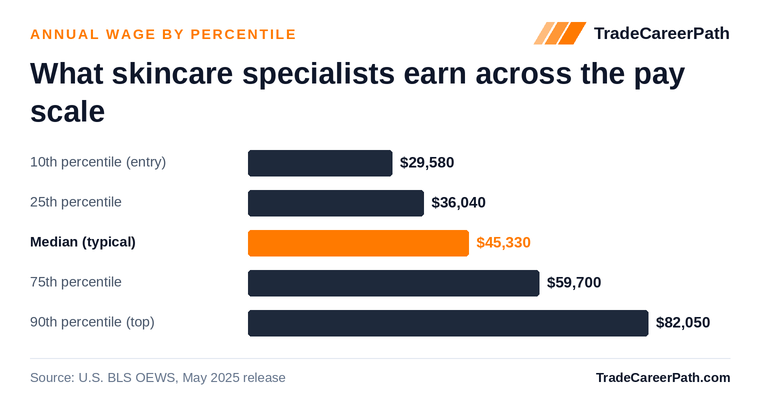
Quick answer: Training as a licensed esthetician usually takes about 6 months to a year of full-time training, up to 2 years part-time. You complete a state-licensed esthetics program (most states require 600 to 1,500 training hours), pass a written and practical state exam, and apply for your state license, which every state requires before you can work on clients. The median esthetician salary is $45,330 per year ($21.79/hour), and employers post about 14,200 openings nationwide each year (BLS, May 2025).
Estheticians are licensed skincare professionals who perform facials, waxing, exfoliation, and other treatments that keep skin healthy. They work in spas, salons, dermatology offices, and medical aesthetics clinics, and many later open their own studios. This guide walks you through the training, licensing, and career options step by step.
How to Become an Esthetician
Training as an esthetician is a licensed path, and the steps are similar in every state even though the details vary. You finish a state-approved training program, log your required hours, pass an exam, and get licensed before you ever work on a paying client. Most people complete the process in under a year of full-time study.
1. Earn a high school diploma or GED
A high school diploma or GED is the minimum requirement to enroll in a state-licensed esthetics program. Before you start, it helps to be comfortable with science, since esthetics coursework draws on skin anatomy, basic chemistry, and how ingredients react with different skin types. High school biology and chemistry are good preparation, and so is any class that builds careful, detail-focused habits. Customer service or retail experience is also a plus, because much of the job involves talking with clients, recommending products, and building a loyal book of business. If you are changing careers and already hold a diploma or degree, you can move straight to choosing a program. Many estheticians come from other fields and bring transferable strengths in communication, sales, and time management that serve them well in a spa or salon.
2. Complete a state-licensed esthetics program
This is the core of your training. You must attend a program approved by your state board so your hours count toward licensure. Required training hours vary by state and usually fall between 600 and 1,500 hours of combined classroom theory and hands-on practice. The curriculum typically covers skin anatomy and physiology, skin analysis, facial techniques, exfoliation, masks, waxing and other hair removal, makeup application, product chemistry, and sanitation and infection control. Hands-on hours are essential because the practical state exam tests your technique on real procedures. Some schools offer the theory portion online, but the practical hours must be done in person on mannequins or live models. Programs are offered at dedicated esthetics schools, cosmetology schools, and many community colleges. Before you enroll, confirm directly with the school that the program is state-approved and ask how it prepares students for the licensing exam.
3. Pass your state licensing exam
After you complete your required hours, you sit for your state’s esthetician licensing exam. Most states use a two-part exam with a written portion covering theory, safety, and state rules, and a practical portion where you demonstrate procedures such as a facial, hair removal, and proper sanitation. Many state boards use exams developed by the National-Interstate Council of State Boards of Cosmetology (NIC), which writes standardized esthetics exams used across the country. Your school should prepare you for the format and provide review materials, and practicing your timing on the practical procedures ahead of the test pays off. Check your specific state board for the exam provider, fees, and any application paperwork you need to submit before you can sit for the test.
4. Apply for your state esthetician license
Once you pass the exam, you apply to your state board for your esthetician license. The application usually requires proof of your completed training hours, your passing exam scores, identification, and a fee that varies by state. Some states also require a background check. After your license is issued, you can legally provide skincare services to clients in spas, salons, dermatology offices, and medical aesthetics settings. Keep track of your renewal date, because licenses must be renewed periodically and many states require continuing education hours to keep yours active. Working without a current license can carry penalties, so confirm your state’s renewal cycle as soon as you are licensed.
5. Advance your career
With your license and some experience, you can grow your career and income in several directions. Many estheticians add advanced skills such as chemical peels, microdermabrasion, microneedling, or lash and brow services, often through manufacturer or specialty training, which lets you offer higher-priced treatments. Others move into medical esthetics by working alongside dermatologists or plastic surgeons. Joining a professional group such as Associated Skin Care Professionals (ASCP), the largest association for estheticians, gives you access to liability insurance, continuing education, and a professional network. As you build a steady client base, you can rent a booth, work as an educator, or open your own studio or spa. Strong client relationships and a reputation for results are what drive long-term earning potential in this field.
What Does an Esthetician Do?
Estheticians are skincare professionals who provide treatments that keep skin healthy and clear. Depending on their training and license, they work in day spas, salons, dermatology offices, or medical aesthetics clinics, and they tailor each service to a client’s skin type and goals.
Common duties include:
- Performing facials and exfoliation treatments
- Analyzing skin types and recommending skincare regimens
- Waxing, threading, and other hair removal
- Applying makeup and cosmetic treatments
- Assisting with medical skincare under a provider’s supervision
Good estheticians combine technique with science, helping clients see real results and book repeat appointments.
Skills That Make Great Estheticians
- Strong communication and client care
- An eye for detail and balance
- Knowledge of skin types and product ingredients
- Manual dexterity and a steady, precise hand
- Sales skills for recommending products and services
Where Estheticians Work
- Day and resort spas
- Dermatology and medical offices
- Beauty salons and wellness centers
- Cruise ships and hotels
- Self-owned studios or mobile skincare services
Many estheticians start in spas and later open their own businesses or move into medical aesthetics.
Education and Licensing Paths
| Pathway | Typical Duration | Outcome |
|---|---|---|
| State-licensed certificate program | About 6 months to 1 year | Most common route to licensure |
| Associate degree | About 2 years | Broader credential with general-education credits |
| Advanced or specialty training | Varies | Skills like chemical peels or medical esthetics |
State training-hour requirements usually fall between 600 and 1,500 hours. Confirm your state’s exact requirement before you enroll.
Career Growth and Advancement
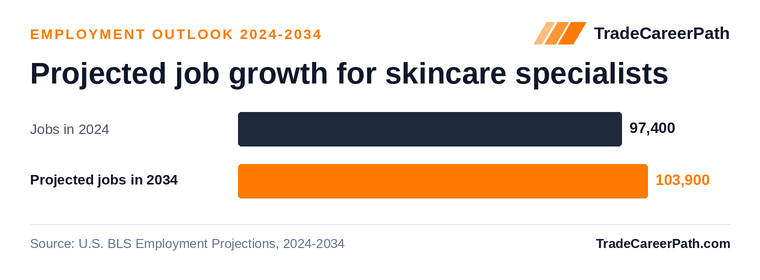
With experience, estheticians may move into roles such as:
- Medical esthetician working with dermatologists or plastic surgeons
- Spa manager or lead esthetician who oversees staff and operations
- Esthetics educator who trains new students
- Studio or spa owner who builds and runs an independent business
Cost and Duration of Training
- Program cost: varies by program and school. Check tuition, supplies, and licensing fees directly with each school.
- Time to complete: about 6 months to 1 year full-time, up to 2 years part-time
- Training hours: usually 600 to 1,500, set by your state
Some programs offer the theory portion online, but hands-on hours and the practical exam must be completed in person.
Pros and Cons
Pros
- Fast training, often under a year
- High job satisfaction helping clients look and feel great
- Wide range of specializations
- Opportunity to start your own spa or studio
Cons
- Physically demanding, with standing and repetitive motion
- Income can depend on clientele and location
- Continuing education required to keep your license active
Start Your Esthetics Career
Whether you want to work in luxury spas, medical skincare, or your own studio, training as a licensed esthetician opens a creative, flexible, and hands-on career in skincare.
Find esthetician schools near you and start your skincare journey today.
Quick Facts: Esthetician Salary, Education, and Outlook
Industry Organizations & Certifying Bodies
These are the recognized national organizations, unions, certifying bodies, and regulatory authorities that shape this trade. They issue the credentials, sponsor the apprenticeships, publish the codes, and represent workers and employers.
- Associated Skin Care Professionals (ASCP) Largest professional association for estheticians.
- National-Interstate Council of State Boards of Cosmetology (NIC) Develops state esthetician licensure exams used by most states.
Wage and Employment Charts
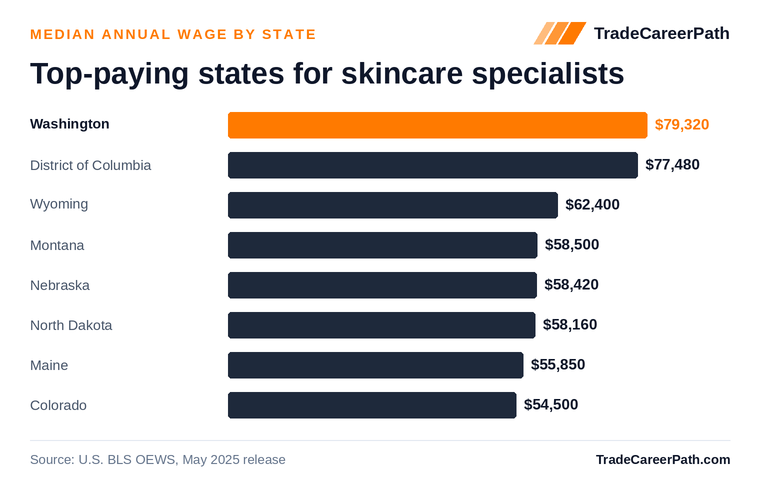
Esthetician Salary and Requirements by State
Select your state for local wage data, training options, and requirements:
Alabama · Alaska · Arizona · Arkansas · California · Colorado · Connecticut · Delaware · District of Columbia · Florida · Georgia · Hawaii · Idaho · Illinois · Indiana · Iowa · Kansas · Kentucky · Louisiana · Maine · Maryland · Massachusetts · Michigan · Minnesota · Mississippi · Missouri · Montana · Nebraska · Nevada · New Hampshire · New Jersey · New Mexico · New York · North Carolina · North Dakota · Ohio · Oklahoma · Oregon · Pennsylvania · Rhode Island · South Carolina · South Dakota · Tennessee · Texas · Utah · Vermont · Virginia · Washington · West Virginia · Wisconsin · Wyoming
Workplace Safety Snapshot
BLS Survey of Occupational Injuries and Illnesses data (2023-2024) report approximately 13.8 days-away, restricted, or transfer cases per 10,000 full-time-equivalent workers in skincare specialists (about 0.14 per 100 FTE). Source: BLS Survey of Occupational Injuries and Illnesses, Table R98.
Frequently Asked Questions
How long does esthetician training take?
Most people finish in about 6 months to a year of full-time training, though it can take up to 2 years part-time. The exact timeline depends on your state's required training hours, which usually fall between 600 and 1,500 hours. A high school diploma or GED is generally required to get started.
Do you need a college degree to work as an esthetician?
No. A college degree is not required. Most people enter the field through a state-licensed esthetics certificate program or an associate degree. A high school diploma or GED is typically the only educational prerequisite before you enroll.
Is an esthetician license required?
Yes. Every state requires estheticians to be licensed before working on clients. You earn the license by completing the required training hours and passing a state exam. Many state boards use exams developed by the National-Interstate Council of State Boards of Cosmetology (NIC).
How much does esthetician training cost?
Costs vary widely by program and school, so check tuition, supplies, and exam or licensing fees directly with the schools you are considering. State-licensed certificate programs are generally less expensive than associate degree programs.
Is it hard to train as an esthetician?
Entry is fairly accessible because no college degree is required and most people finish training in under a year. The training and the work are hands-on, however, covering skin science, sanitation, and treatment techniques, and you must pass a written and practical state exam to get licensed.
What is the difference between an esthetician and a cosmetologist?
An esthetician focuses on skincare, such as facials, exfoliation, waxing, and skin analysis. A cosmetologist is trained more broadly in hair, nails, and skin. Esthetics programs are usually shorter and more specialized, and the two have separate state licenses.
Can you train as an esthetician online?
Some programs offer the classroom theory portion online, but the hands-on hours and the practical state exam must be completed in person. Confirm that any program you choose is approved by your state board so your hours count toward licensure.
How Esthetician Pay Compares to Similar Trades
Side-by-side comparison of Esthetician and the closest related careers, based on U.S. Bureau of Labor Statistics data (May 2025 OEWS + 2025-2035 Employment Projections).
| Career | Median Pay | 10-Year Growth | Annual Openings |
|---|---|---|---|
| Esthetician this guide | $45,330 | +8.8% | 14,200 |
| Beauty & Cosmetology | $35,790 | +7.7% | 73,400 |
| Beauty & Cosmetology | $35,790 | +7.7% | 73,400 |
| Massage Therapy | $58,450 | +15.3% | 20,400 |
Source: BLS Occupational Employment and Wage Statistics + BLS Employment Projections.
Advance Your Career with a Degree
Experienced Esthetician professionals often step up into degree-track careers where field experience is a hiring advantage:
- Chemist - median pay $91,240 (BLS OEWS, May 2025); requires a 4-year degree
See all trade careers that require a 4-year degree.
Sources
- U.S. Bureau of Labor Statistics, Occupational Employment and Wage Statistics (May 2025)
- U.S. Bureau of Labor Statistics, Employment Projections 2025-2035
- U.S. Bureau of Labor Statistics, Survey of Occupational Injuries and Illnesses (2023-2024, Table R98)
- U.S. Department of Labor, Wage and Hour Division, Davis-Bacon General Wage Determinations (2026)
Esthetician Salary by State
About this guide: Researched and written by the TradeCareerPath Editorial Team. Our editorial team researches and sources every trade school and career guide using federal labor and education data, including BLS OEWS and Employment Projections, DOL apprenticeship records, IPEDS, College Scorecard, and state licensing boards. We follow the editorial standards documented at /editorial-policy/.
Data sources
Figures on this page are sourced from the federal and state datasets below. Methodology: how we rank and source data.
| Data | Provider | Vintage |
|---|---|---|
| Occupational Employment and Wage Statistics (OEWS) | U.S. Bureau of Labor Statistics | May 2025 |
| Employment Projections | U.S. Bureau of Labor Statistics | 2025-2035 |
| Integrated Postsecondary Education Data System | National Center for Education Statistics (IPEDS) | 2024 |
| College Scorecard (school-level outcomes) | U.S. Department of Education | latest release |
| College Scorecard (field-of-study earnings) | U.S. Department of Education | latest release (updated 2026-06-12) |
| Occupational licensing requirements | CareerOneStop (U.S. Department of Labor) | latest release (updated 2026-02-22) |
| Registered apprenticeship programs | CareerOneStop / Apprenticeship.gov (U.S. Department of Labor) | latest release (updated 2025-10-25) |
| O*NET occupation profiles (skills, tasks, tools, job zones) | U.S. Department of Labor (O*NET / Employment & Training Admin.) | O*NET 31.0 (updated 2026-10-14) |